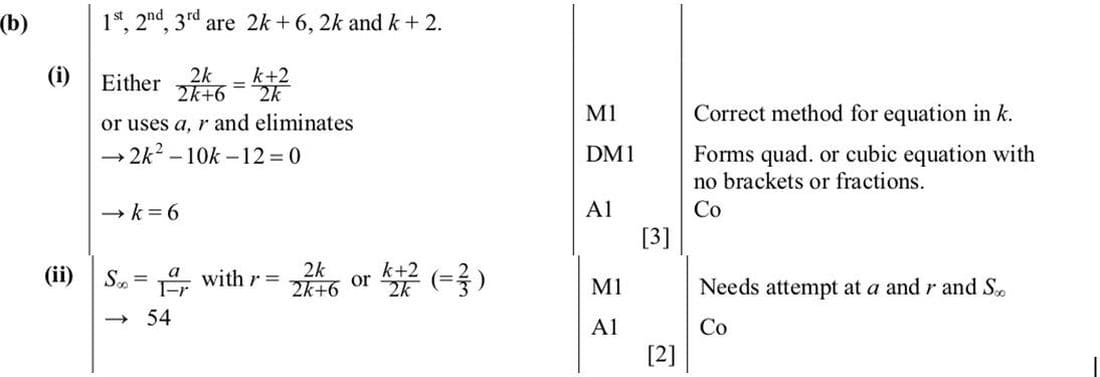
(i) For a geometric progression, the ratio between consecutive terms is constant. Therefore, \(\frac{2k}{2k+6} = \frac{k+2}{2k}\).
Cross-multiplying gives:
\((2k)(2k) = (2k+6)(k+2)\)
\(4k^2 = 2k^2 + 4k + 12k + 12\)
\(4k^2 = 2k^2 + 16k + 12\)
\(2k^2 - 16k - 12 = 0\)
Solving the quadratic equation \(2k^2 - 10k - 12 = 0\) using the quadratic formula:
\(k = \frac{-b \pm \sqrt{b^2 - 4ac}}{2a}\)
where \(a = 2\), \(b = -10\), \(c = -12\).
\(k = \frac{10 \pm \sqrt{(-10)^2 - 4 \times 2 \times (-12)}}{4}\)
\(k = \frac{10 \pm \sqrt{100 + 96}}{4}\)
\(k = \frac{10 \pm \sqrt{196}}{4}\)
\(k = \frac{10 \pm 14}{4}\)
\(k = 6\) (since \(k\) is positive)
(ii) The sum to infinity of a geometric progression is given by \(S_\infty = \frac{a}{1-r}\), where \(a\) is the first term and \(r\) is the common ratio.
With \(k = 6\), the first term \(a = 2k + 6 = 18\) and the common ratio \(r = \frac{2k}{2k+6} = \frac{12}{18} = \frac{2}{3}\).
Thus, \(S_\infty = \frac{18}{1 - \frac{2}{3}} = \frac{18}{\frac{1}{3}} = 54\).