The common ratio of a geometric progression is \(r\). The first term of the progression is \((r^2 - 3r + 2)\) and the sum to infinity is \(S\).
- Show that \(S = 2 - r\). [2]
- Find the set of possible values that \(S\) can take. [2]
Solution
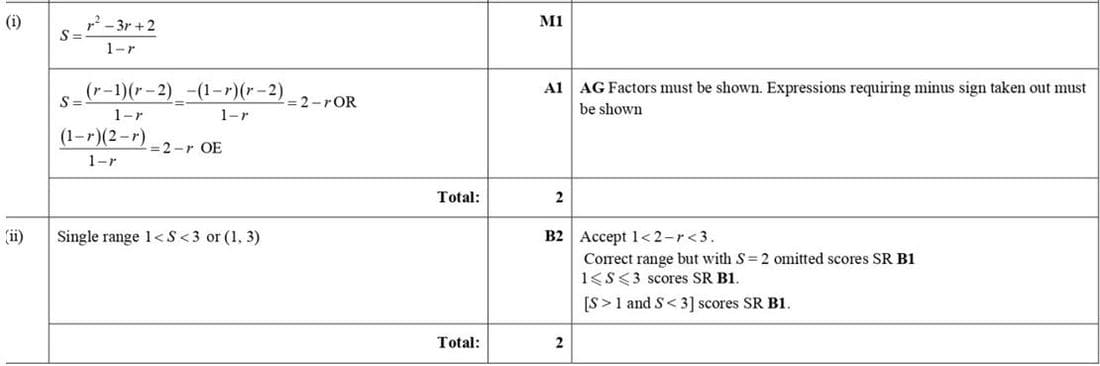
(i) The sum to infinity of a geometric progression is given by \(S = \frac{a}{1 - r}\), where \(a\) is the first term. Here, \(a = r^2 - 3r + 2\).
Thus, \(S = \frac{r^2 - 3r + 2}{1 - r}\).
Factor the numerator: \(r^2 - 3r + 2 = (r-1)(r-2)\).
So, \(S = \frac{(r-1)(r-2)}{1-r} = \frac{-(1-r)(r-2)}{1-r} = 2 - r\).
(ii) For the sum to infinity to exist, \(|r| < 1\). Therefore, \(1 < 2 - r < 3\).
This simplifies to \(1 < S < 3\) or \((1, 3)\).
Log in to record attempts.