Past Exam Questions
← Back9709 P12 - Jun 2011 - Q10
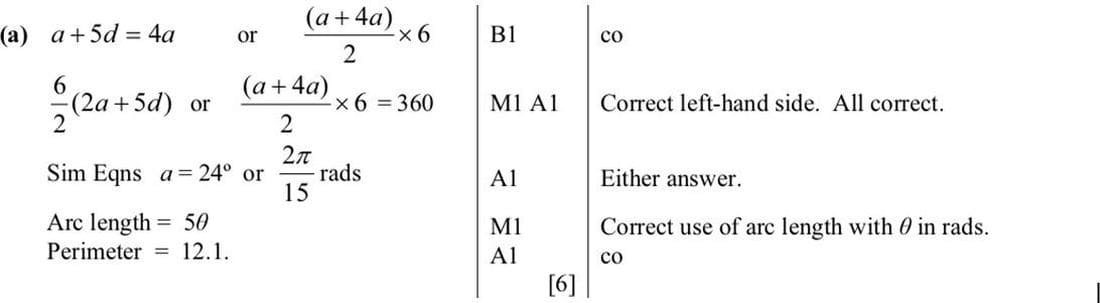
A circle is divided into 6 sectors in such a way that the angles of the sectors are in arithmetic progression. The angle of the largest sector is 4 times the angle of the smallest sector. Given that the radius of the circle is 5 cm, find the perimeter of the smallest sector.
9709 P13 - Nov 2010 - Q9
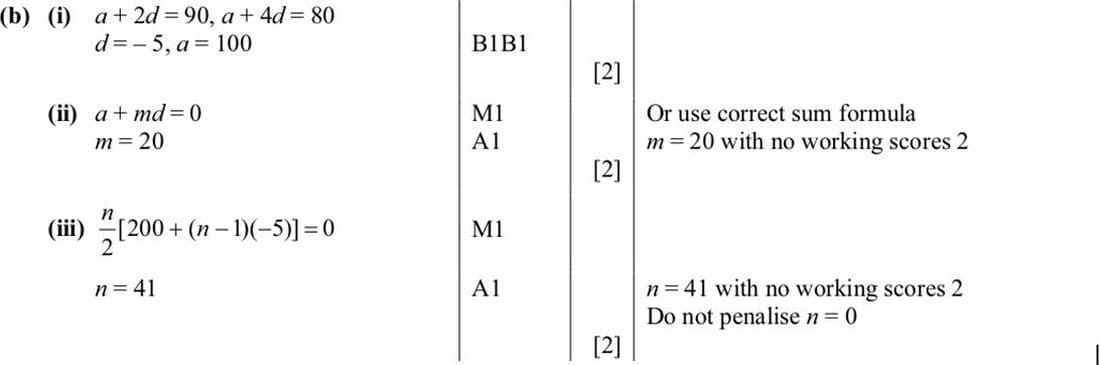
An arithmetic progression has third term 90 and fifth term 80.
(i) Find the first term and the common difference.
(ii) Find the value of \(m\) given that the sum of the first \(m\) terms is equal to the sum of the first \((m + 1)\) terms.
(iii) Find the value of \(n\) given that the sum of the first \(n\) terms is zero.
9709 P12 - Nov 2010 - Q5
The first and second terms of an arithmetic progression are 161 and 154 respectively. The sum of the first m terms is zero. Find the value of m.

9709 P11 - Nov 2010 - Q6
The fifth term of an arithmetic progression is 18 and the sum of the first 5 terms is 75. Find the first term and the common difference.

9709 P12 - Jun 2010 - Q7
Find the sum of all the multiples of 5 between 100 and 300 inclusive.

9709 P12 - Jun 2022 - Q4
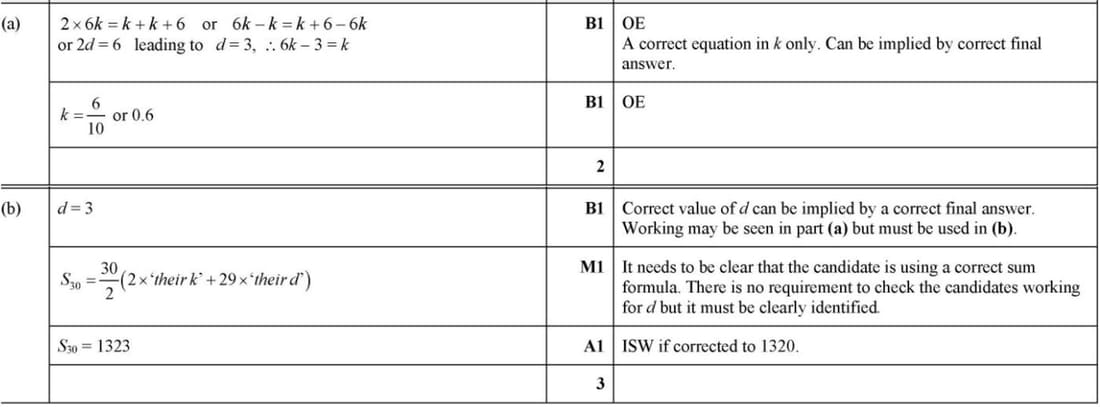
The first, second and third terms of an arithmetic progression are \(k\), \(6k\) and \(k + 6\) respectively.
(a) Find the value of the constant \(k\).
(b) Find the sum of the first 30 terms of the progression.
9709 P11 - Jun 2010 - Q3
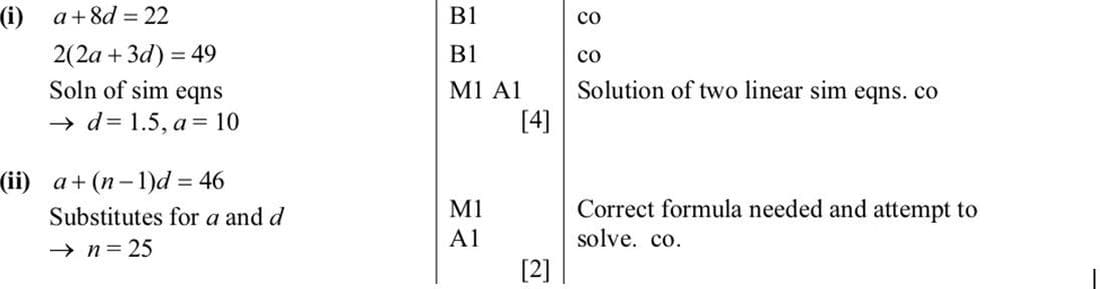
The ninth term of an arithmetic progression is 22 and the sum of the first 4 terms is 49.
(i) Find the first term of the progression and the common difference.
The nth term of the progression is 46.
(ii) Find the value of n.
9709 P1 - Jun 2009 - Q7
The first two terms in an arithmetic progression are 5 and 9. The last term in the progression is the only term which is greater than 200. Find the sum of all the terms in the progression.

9709 P1 - Nov 2008 - Q3
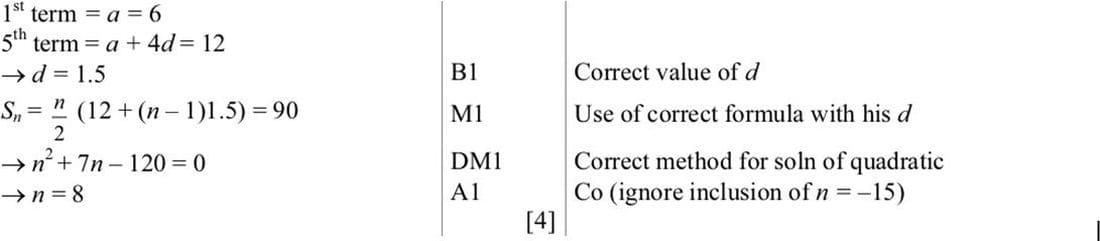
The first term of an arithmetic progression is 6 and the fifth term is 12. The progression has n terms and the sum of all the terms is 90. Find the value of n.
9709 P1 - Nov 2006 - Q6
Find the sum of all the integers between 100 and 400 that are divisible by 7.

9709 P1 - Nov 2004 - Q2
Find the sum of all the terms in the arithmetic progression 180, 175, 170, \ldots, 25.

9709 P1 - Nov 2003 - Q3
A debt of $3726 is repaid by weekly payments which are in arithmetic progression. The first payment is $60 and the debt is fully repaid after 48 weeks. Find the third payment.

9709 P1 - Jun 2003 - Q4
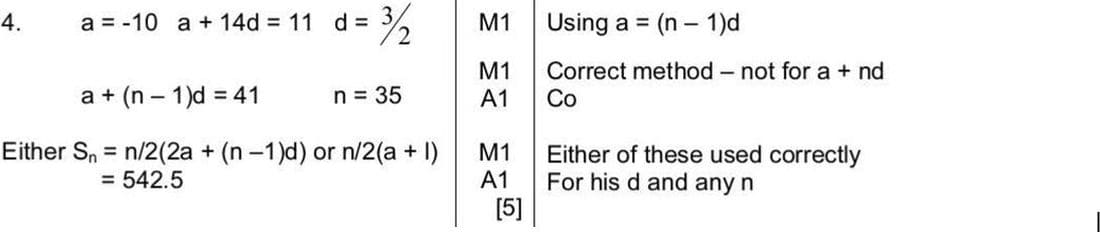
In an arithmetic progression, the 1st term is -10, the 15th term is 11 and the last term is 41. Find the sum of all the terms in the progression.
9709 P11 - Jun 2022 - Q2
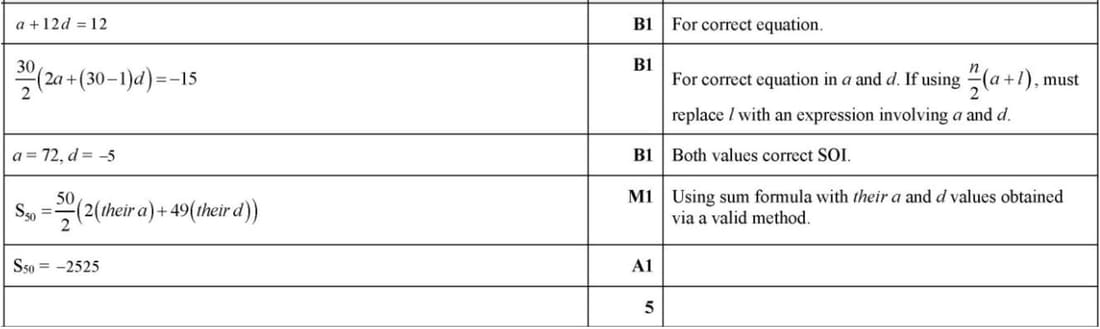
The thirteenth term of an arithmetic progression is 12 and the sum of the first 30 terms is -15.
Find the sum of the first 50 terms of the progression.
9709 P13 - Nov 2021 - Q4
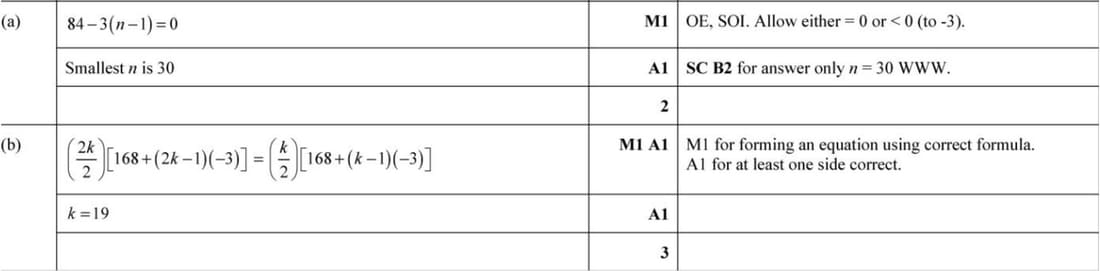
The first term of an arithmetic progression is 84 and the common difference is \(-3\).
(a) Find the smallest value of \(n\) for which the \(n\)th term is negative.
(b) It is given that the sum of the first \(2k\) terms of this progression is equal to the sum of the first \(k\) terms. Find the value of \(k\).
9709 P13 - Jun 2021 - Q9
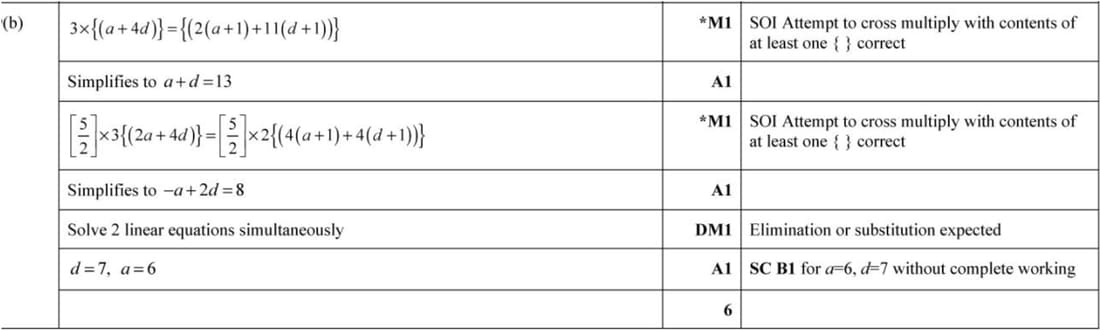
An arithmetic progression P has first term a and common difference d. An arithmetic progression Q has first term 2(a + 1) and common difference (d + 1). It is given that
\(\frac{\text{5th term of } P}{\text{12th term of } Q} = \frac{1}{3}\) and \(\frac{\text{Sum of first 5 terms of } P}{\text{Sum of first 5 terms of } Q} = \frac{2}{3}.\)
Find the value of a and the value of d.
9709 P11 - Jun 2021 - Q2
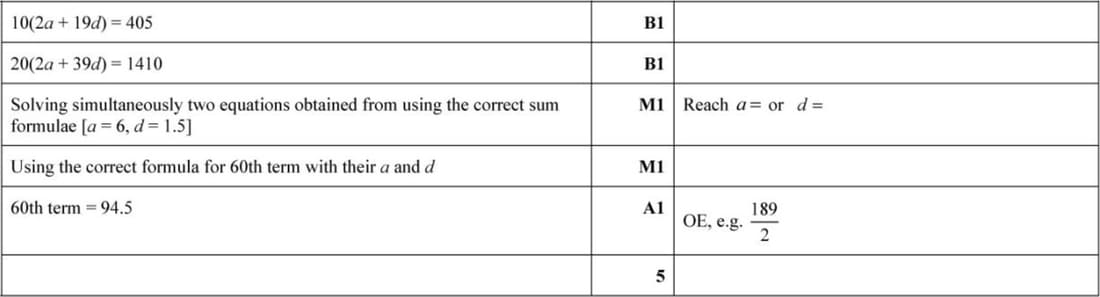
The sum of the first 20 terms of an arithmetic progression is 405 and the sum of the first 40 terms is 1410.
Find the 60th term of the progression.
9709 P13 - Nov 2023 - Q5
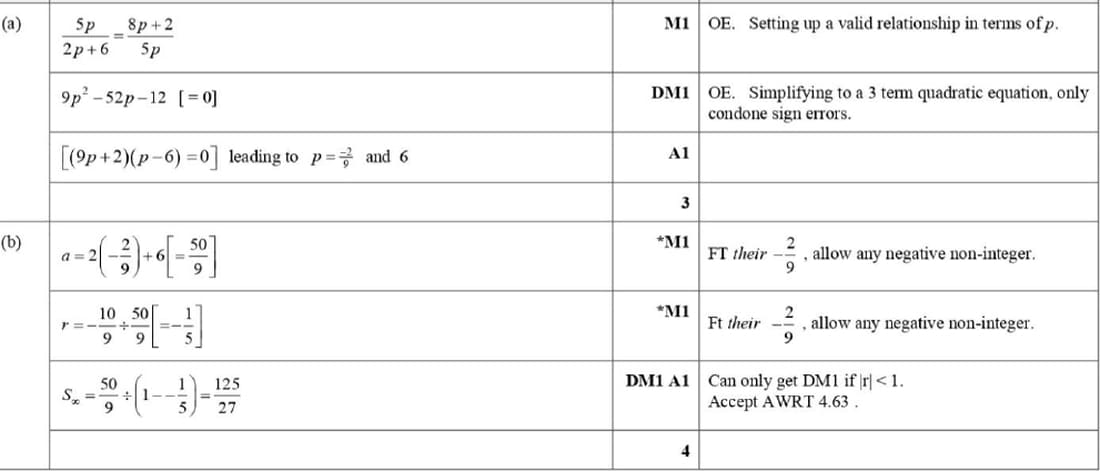
The first, second and third terms of a geometric progression are \(2p + 6\), \(5p\) and \(8p + 2\) respectively.
(a) Find the possible values of the constant \(p\).
(b) One of the values of \(p\) found in (a) is a negative fraction. Use this value of \(p\) to find the sum to infinity of this progression.
9709 P12 - Nov 2021 - Q6
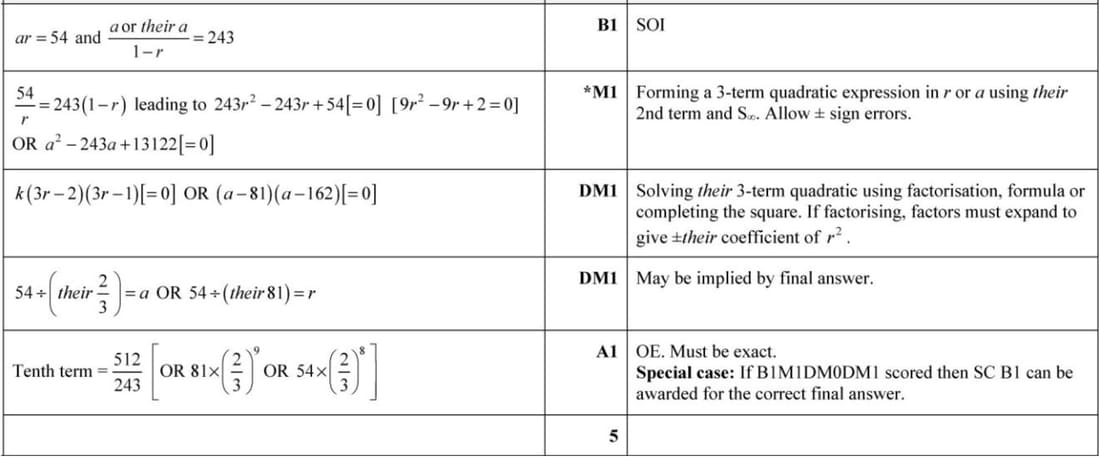
The second term of a geometric progression is 54 and the sum to infinity of the progression is 243. The common ratio is greater than \(\frac{1}{2}\).
Find the tenth term, giving your answer in exact form.
9709 P13 - Jun 2021 - Q9
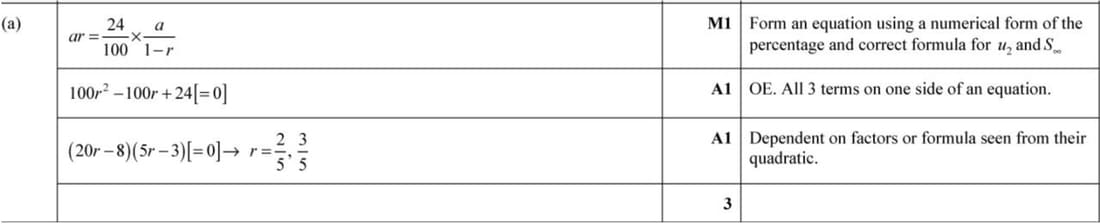
A geometric progression is such that the second term is equal to 24% of the sum to infinity.
Find the possible values of the common ratio.