A geometric progression, for which the common ratio is positive, has a second term of 18 and a fourth term of 8. Find
- the first term and the common ratio of the progression,
- the sum to infinity of the progression.
Solution
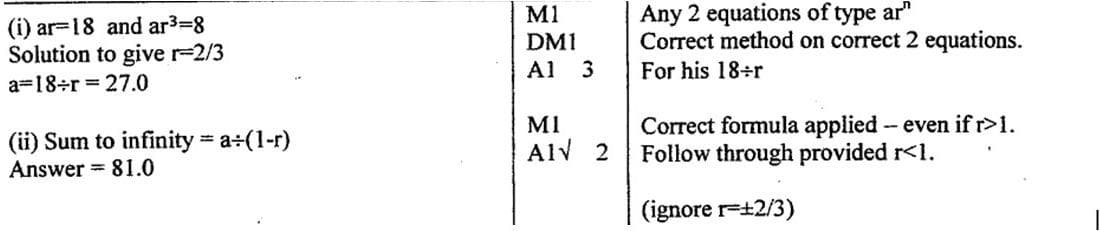
(i) Let the first term be \(a\) and the common ratio be \(r\). The second term is \(ar = 18\) and the fourth term is \(ar^3 = 8\).
From \(ar = 18\), we have \(a = \frac{18}{r}\).
Substitute \(a\) in \(ar^3 = 8\):
\(\frac{18}{r} \cdot r^3 = 8\)
\(18r^2 = 8\)
\(r^2 = \frac{8}{18} = \frac{4}{9}\)
\(r = \frac{2}{3}\) (since \(r\) is positive)
Substitute \(r = \frac{2}{3}\) back into \(a = \frac{18}{r}\):
\(a = \frac{18}{\frac{2}{3}} = 27\)
(ii) The sum to infinity of a geometric progression is given by \(S = \frac{a}{1-r}\), where \(|r| < 1\).
\(S = \frac{27}{1 - \frac{2}{3}} = \frac{27}{\frac{1}{3}} = 81\)
Log in to record attempts.