Past Exam Questions
← Back9709 P11 - Jun 2021 - Q5
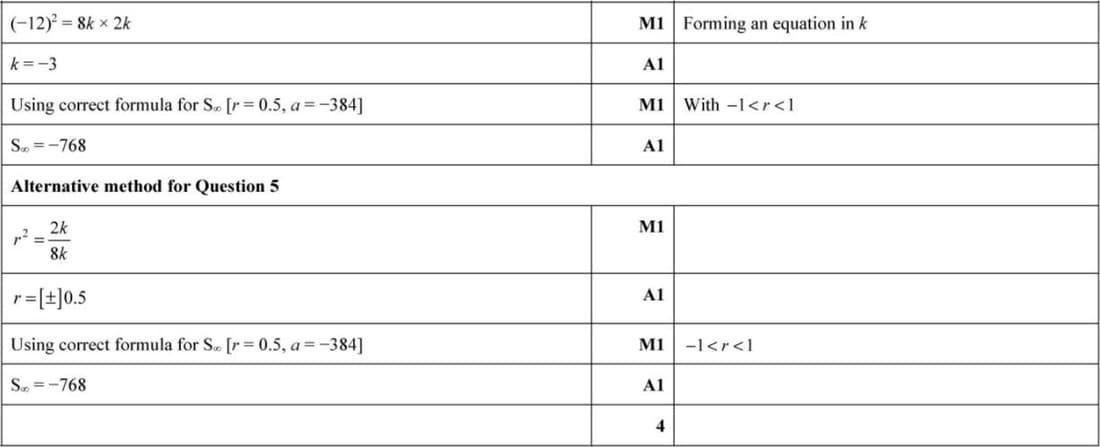
The fifth, sixth and seventh terms of a geometric progression are \(8k\), \(-12\) and \(2k\) respectively.
Given that \(k\) is negative, find the sum to infinity of the progression.
9709 P13 - Nov 2020 - Q5
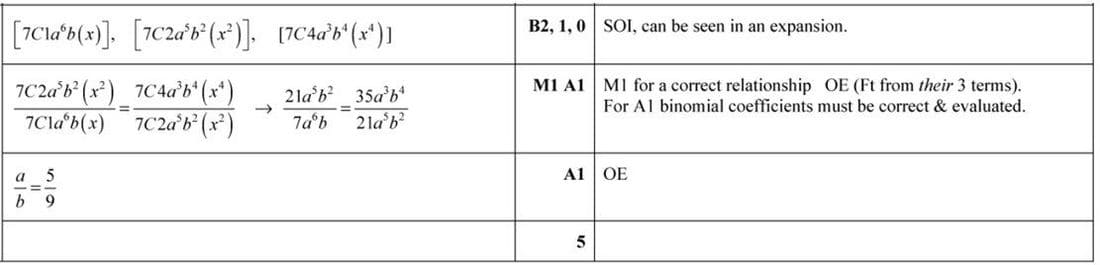
In the expansion of \((a + bx)^7\), where \(a\) and \(b\) are non-zero constants, the coefficients of \(x\), \(x^2\) and \(x^4\) are the first, second and third terms respectively of a geometric progression.
Find the value of \(\frac{a}{b}\).
9709 P12 - Nov 2020 - Q2
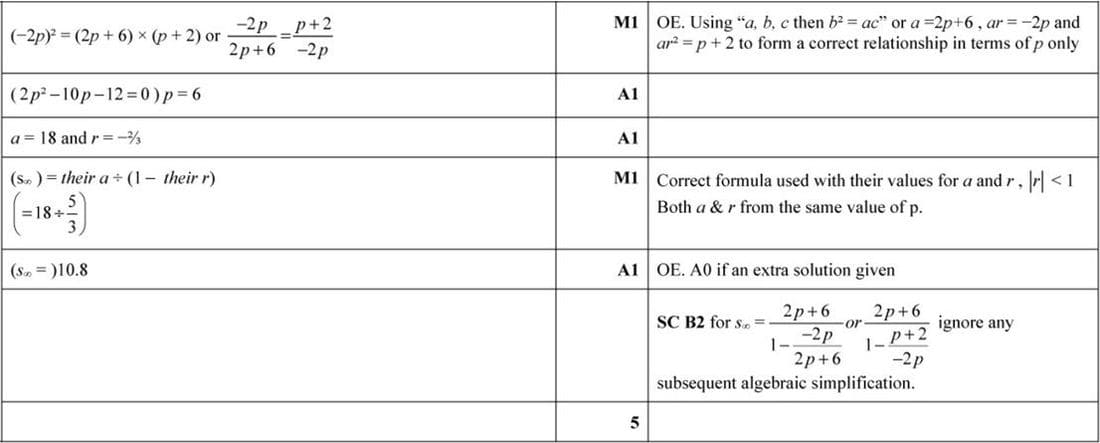
The first, second and third terms of a geometric progression are \(2p + 6\), \(-2p\) and \(p + 2\) respectively, where \(p\) is positive.
Find the sum to infinity of the progression.
9709 P11 - Nov 2020 - Q8
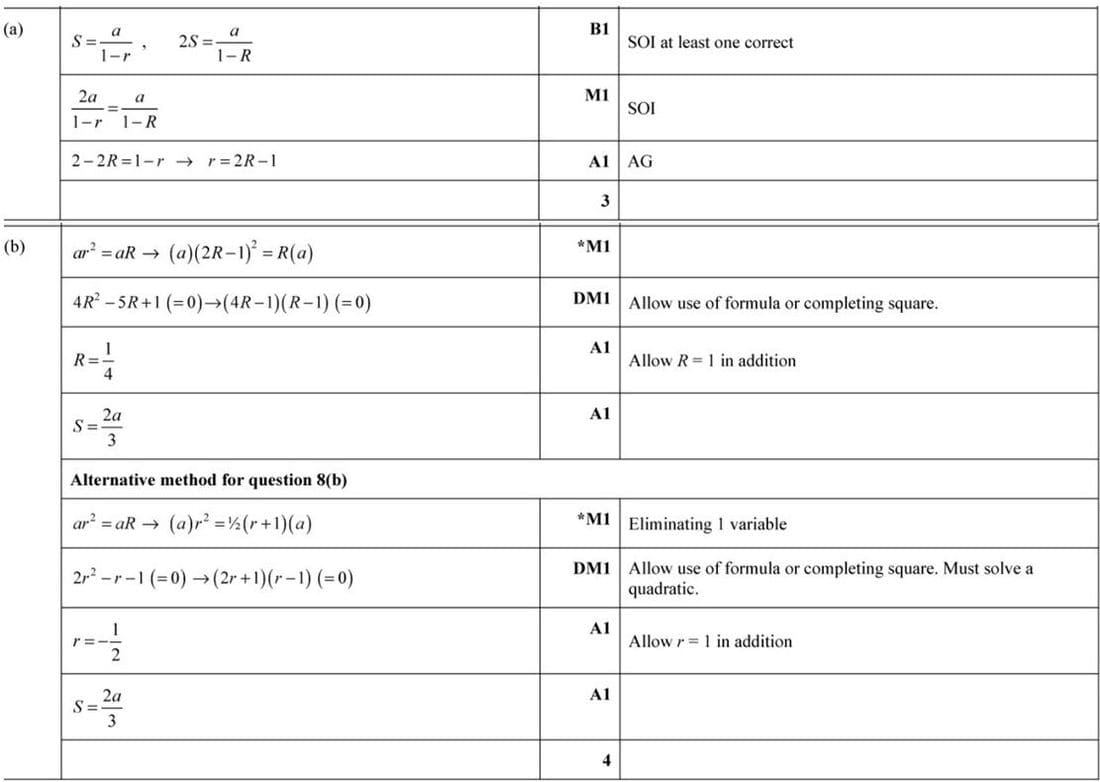
A geometric progression has first term a, common ratio r and sum to infinity S. A second geometric progression has first term a, common ratio R and sum to infinity 2S.
\((a) Show that r = 2R - 1.\)
It is now given that the 3rd term of the first progression is equal to the 2nd term of the second progression.
(b) Express S in terms of a.
9709 P11 - Jun 2020 - Q3
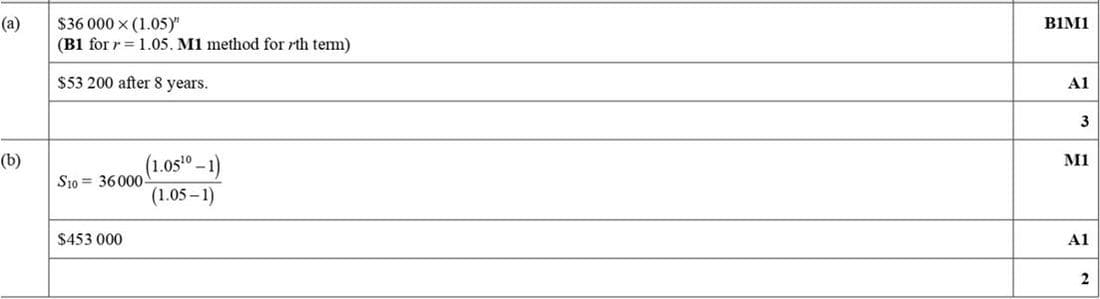
Each year the selling price of a diamond necklace increases by 5% of the price the year before. The selling price of the necklace in the year 2000 was $36,000.
(a) Write down an expression for the selling price of the necklace n years later and hence find the selling price in 2008.
(b) The company that makes the necklace only sells one each year. Find the total amount of money obtained in the ten-year period starting in the year 2000.
Question #886
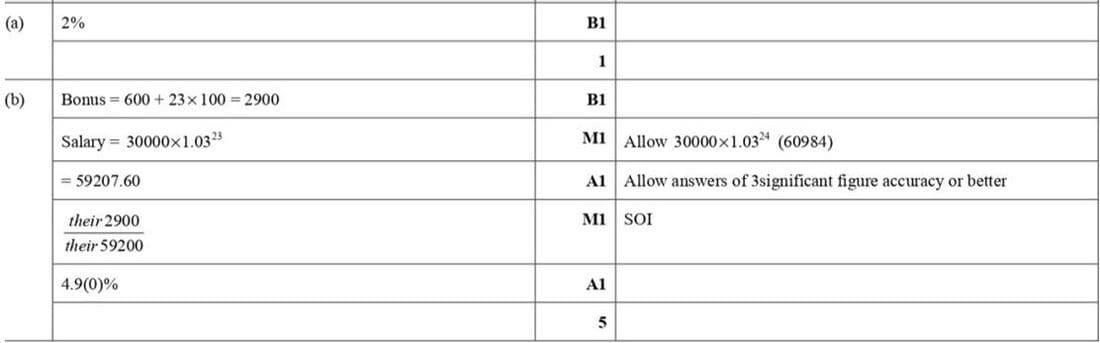
A woman’s basic salary for her first year with a particular company is $30,000 and at the end of the year she also gets a bonus of $600.
(a) For her first year, express her bonus as a percentage of her basic salary.
At the end of each complete year, the woman’s basic salary will increase by 3% and her bonus will increase by $100.
(b) Express the bonus she will be paid at the end of her 24th year as a percentage of the basic salary paid during that year.
9709 P13 - Nov 2019 - Q9
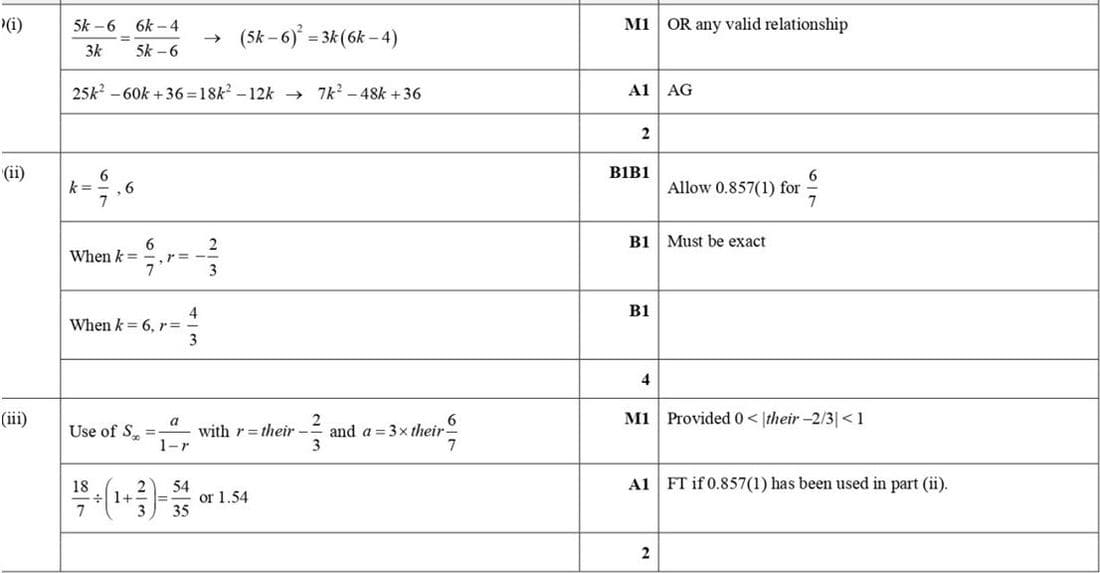
The first, second and third terms of a geometric progression are \(3k\), \(5k - 6\) and \(6k - 4\), respectively.
- Show that \(k\) satisfies the equation \(7k^2 - 48k + 36 = 0\).
- Find, showing all necessary working, the exact values of the common ratio corresponding to each of the possible values of \(k\).
- One of these ratios gives a progression which is convergent. Find the sum to infinity.
9709 P12 - Nov 2019 - Q8
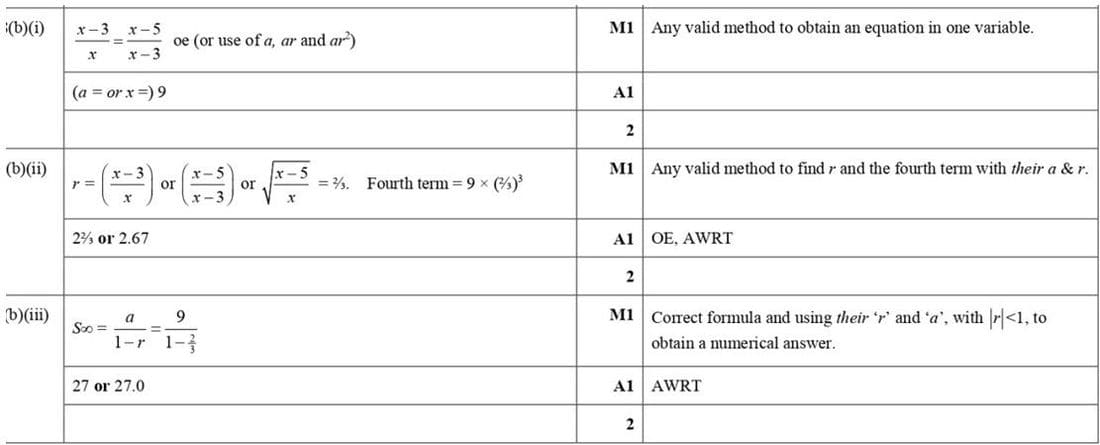
The first, second and third terms of a geometric progression are \(x\), \(x - 3\) and \(x - 5\) respectively.
- Find the value of \(x\).
- Find the fourth term of the progression.
- Find the sum to infinity of the progression.
9709 P11 - Nov 2023 - Q7
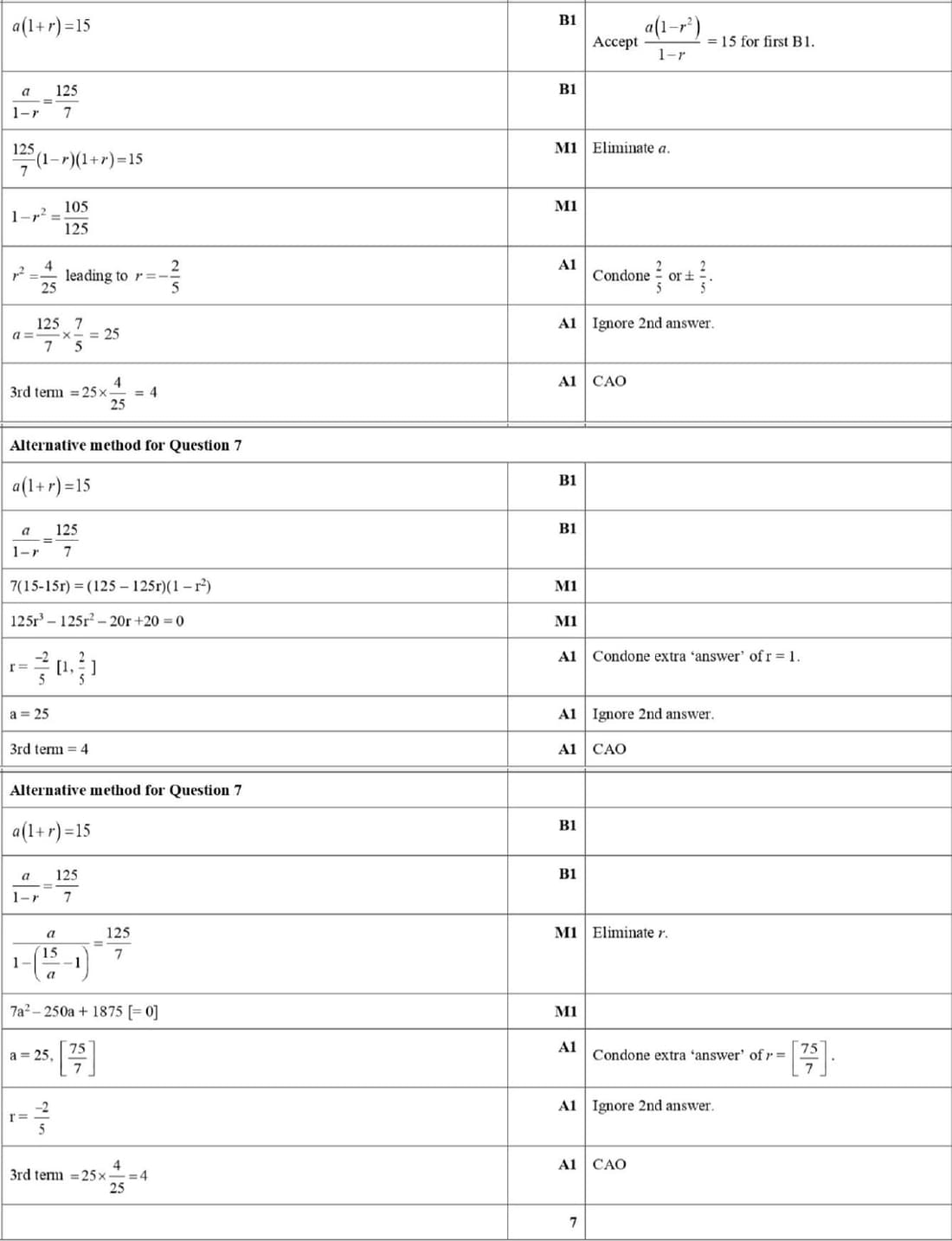
The sum of the first two terms of a geometric progression is 15 and the sum to infinity is \(\frac{125}{7}\). The common ratio of the progression is negative.
Find the third term of the progression.
9709 P11 - Nov 2019 - Q4
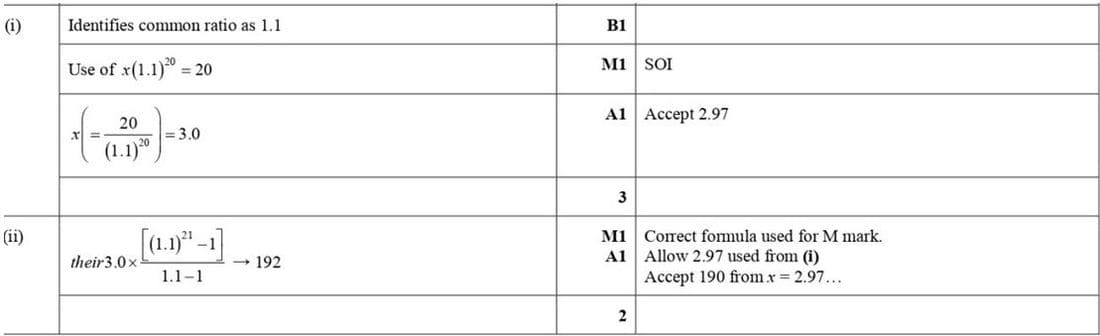
A runner who is training for a long-distance race plans to run increasing distances each day for 21 days. She will run x km on day 1, and on each subsequent day she will increase the distance by 10% of the previous day's distance. On day 21 she will run 20 km.
(i) Find the distance she must run on day 1 in order to achieve this. Give your answer in km correct to 1 decimal place.
(ii) Find the total distance she runs over the 21 days.
9709 P12 - Jun 2019 - Q10
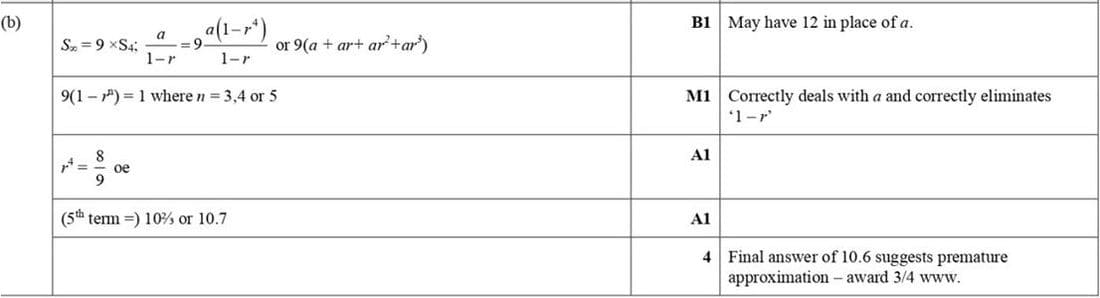
The sum to infinity of a geometric progression is 9 times the sum of the first four terms. Given that the first term is 12, find the value of the fifth term.
9709 P11 - Jun 2019 - Q8
The third and fourth terms of a geometric progression are 48 and 32 respectively. Find the sum to infinity of the progression.

9709 P12 - Mar 2019 - Q6
The first and second terms of a geometric progression are p and 2p respectively, where p is a positive constant. The sum of the first n terms is greater than 1000p. Show that 2n > 1001.

9709 P11 - Nov 2018 - Q4
The first term of a series is 6 and the second term is 2. For the case where the series is a geometric progression, find the sum to infinity.

9709 P13 - Jun 2018 - Q3
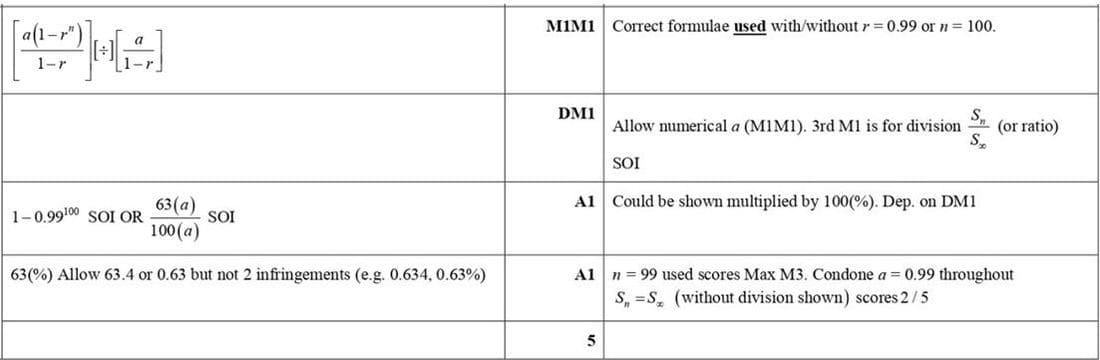
The common ratio of a geometric progression is 0.99. Express the sum of the first 100 terms as a percentage of the sum to infinity, giving your answer correct to 2 significant figures.
9709 P12 - Jun 2018 - Q3
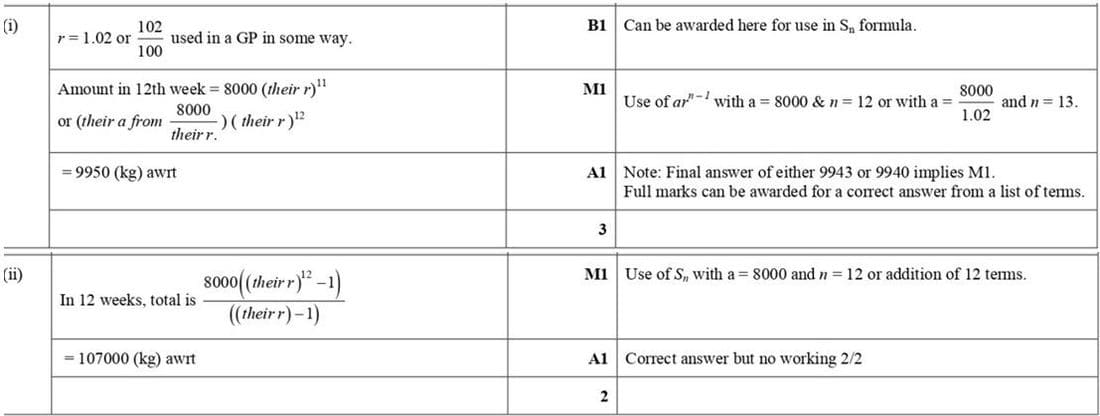
A company producing salt from sea water changed to a new process. The amount of salt obtained each week increased by 2% of the amount obtained in the preceding week. It is given that in the first week after the change the company obtained 8000 kg of salt.
(i) Find the amount of salt obtained in the 12th week after the change.
(ii) Find the total amount of salt obtained in the first 12 weeks after the change.
9709 P11 - Jun 2018 - Q8
A geometric progression has a second term of 12 and a sum to infinity of 54. Find the possible values of the first term of the progression.

9709 P12 - Nov 2017 - Q3
Each year, the value of a certain rare stamp increases by 5% of its value at the beginning of the year. A collector bought the stamp for $10,000 at the beginning of 2005. Find its value at the beginning of 2015 correct to the nearest $100.

9709 P11 - Nov 2017 - Q3
A geometric progression has first term \(3a\) and common ratio \(r\). A second geometric progression has first term \(a\) and common ratio \(-2r\). The two progressions have the same sum to infinity. Find the value of \(r\).

9709 P13 - Jun 2023 - Q8
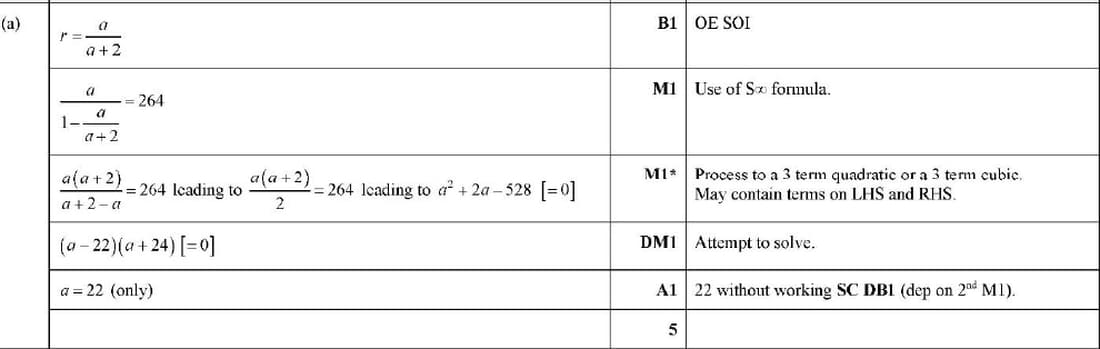
A progression has first term a and second term \(\frac{a^2}{a+2}\), where a is a positive constant.
For the case where the progression is geometric and the sum to infinity is 264, find the value of a.