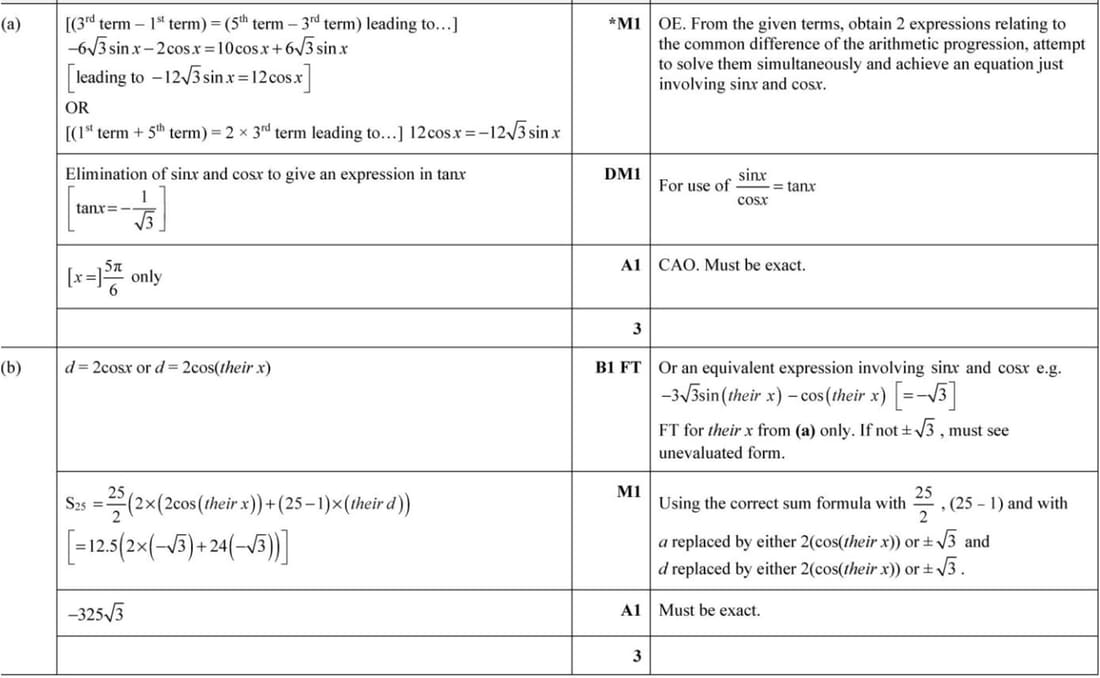
(a) The terms of the arithmetic progression are given by:
First term: \(a = 2 \cos x\)
Third term: \(a + 2d = -6\sqrt{3} \sin x\)
Fifth term: \(a + 4d = 10 \cos x\)
From the third and first terms: \(-6\sqrt{3} \sin x - 2 \cos x = 2d\)
From the fifth and third terms: \(10 \cos x + 6\sqrt{3} \sin x = 2d\)
Equating the expressions for \(2d\):
\(-6\sqrt{3} \sin x - 2 \cos x = 10 \cos x + 6\sqrt{3} \sin x\)
\(-12\sqrt{3} \sin x = 12 \cos x\)
\(\tan x = -\frac{1}{\sqrt{3}}\)
\(x = \frac{5\pi}{6}\) (since \(\frac{1}{2}\pi < x < \pi\))
(b) The first term \(a = 2 \cos x = -\sqrt{3}\) and common difference \(d = 2 \cos x = -\sqrt{3}\).
The sum of the first 25 terms is given by:
\(S_{25} = \frac{25}{2} \left(2a + (25-1)d\right)\)
\(S_{25} = \frac{25}{2} \left(2(-\sqrt{3}) + 24(-\sqrt{3})\right)\)
\(S_{25} = \frac{25}{2} \times (-50\sqrt{3})\)
\(S_{25} = -325\sqrt{3}\)