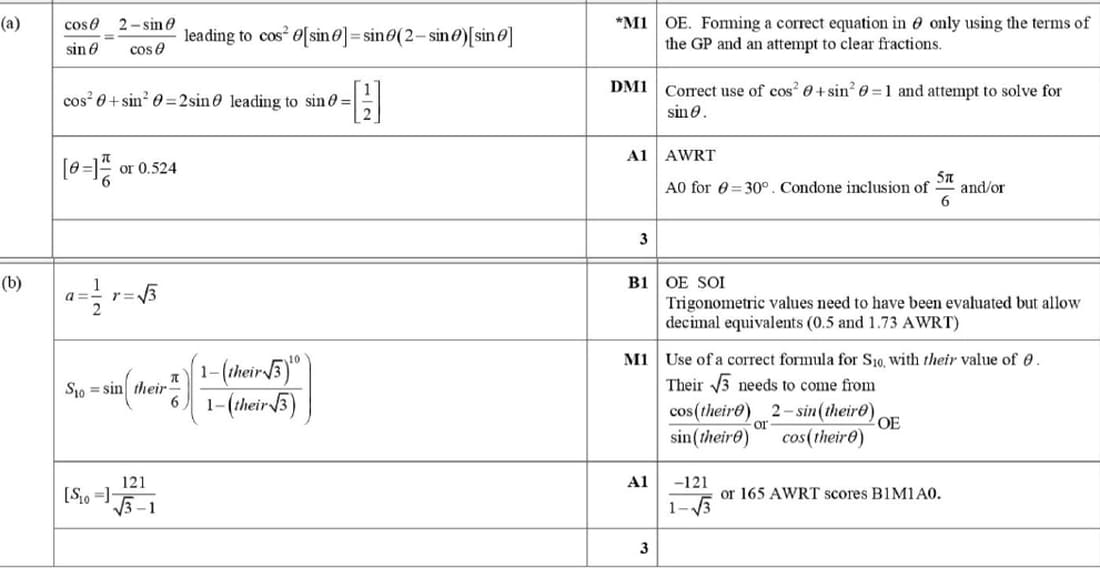
(a) Given the terms of the geometric progression: \(a = \sin \theta\), \(ar = \cos \theta\), \(ar^2 = 2 - \sin \theta\).
From \(\frac{\cos \theta}{\sin \theta} = \frac{2 - \sin \theta}{\cos \theta}\), we have:
\(\cos^2 \theta = \sin \theta (2 - \sin \theta)\).
Using \(\cos^2 \theta + \sin^2 \theta = 1\), substitute \(\cos^2 \theta = 1 - \sin^2 \theta\) into the equation:
\(1 - \sin^2 \theta = \sin \theta (2 - \sin \theta)\).
Simplifying gives \(\sin^2 \theta + \sin \theta - 1 = 0\).
Solving this quadratic equation for \(\sin \theta\), we find \(\sin \theta = \frac{1}{2}\).
Thus, \(\theta = \frac{\pi}{6}\) or 0.524 radians.
(b) With \(\theta = \frac{\pi}{6}\), \(a = \sin \frac{\pi}{6} = \frac{1}{2}\) and \(r = \sqrt{3}\).
The sum of the first 10 terms is given by:
\(S_{10} = a \frac{1 - r^{10}}{1 - r}\).
Substitute \(a = \frac{1}{2}\) and \(r = \sqrt{3}\):
\(S_{10} = \frac{1}{2} \left( \frac{1 - (\sqrt{3})^{10}}{1 - \sqrt{3}} \right)\).
Calculate \((\sqrt{3})^{10}\) and simplify:
\(S_{10} = \frac{121}{\sqrt{3} - 1}\).