Past Exam Questions
← Back9709 P12 - Nov 2012 - Q8
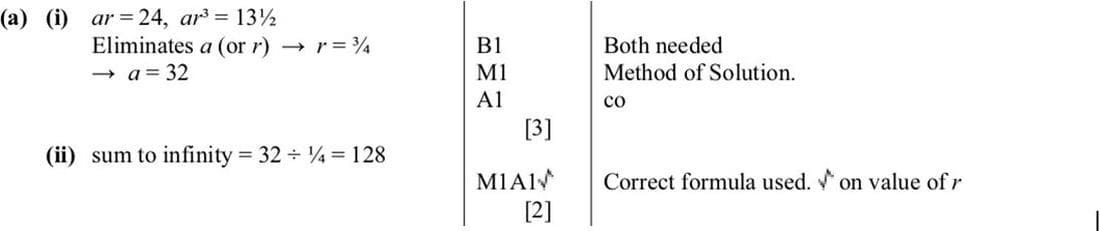
In a geometric progression, all the terms are positive, the second term is 24 and the fourth term is 13\(\frac{1}{2}\). Find
(i) the first term,
(ii) the sum to infinity of the progression.
Question #922
The circumference round the trunk of a large tree is measured and found to be 5.00 m. After one year the circumference is measured again and found to be 5.02 m.
Given instead that the circumferences at yearly intervals form a geometric progression, find the circumference 20 years after the first measurement.

9709 P12 - Jun 2012 - Q7
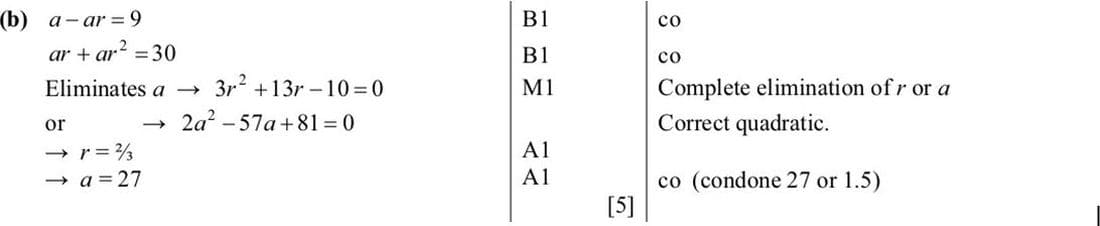
In a geometric progression, the second term is 9 less than the first term. The sum of the second and third terms is 30. Given that all the terms of the progression are positive, find the first term.
9709 P12 - Nov 2011 - Q10
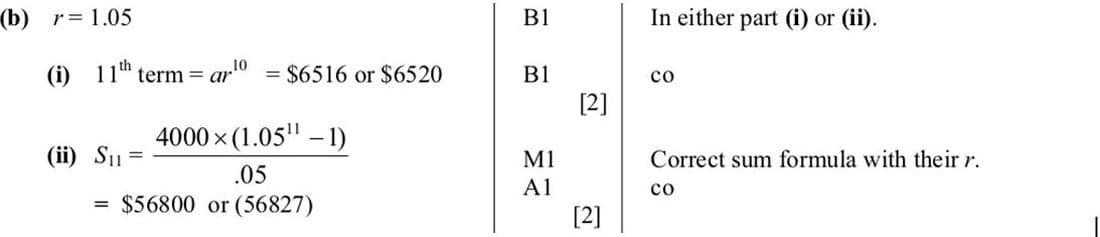
A college agrees a sponsorship deal in which grants will be received each year for sports equipment. This grant will be $4000 in 2012 and will increase by 5% each year. Calculate
(i) the value of the grant in 2022,
(ii) the total amount the college will receive in the years 2012 to 2022 inclusive.
9709 P11 - Nov 2011 - Q6
A geometric progression has first term 1 and common ratio \(r\). A second geometric progression has first term 4 and common ratio \(\frac{1}{4}r\). The two progressions have the same sum to infinity, \(S\). Find the values of \(r\) and \(S\).

9709 P13 - Jun 2011 - Q6
A geometric progression has a third term of 20 and a sum to infinity which is three times the first term. Find the first term.

9709 P12 - Jun 2011 - Q10
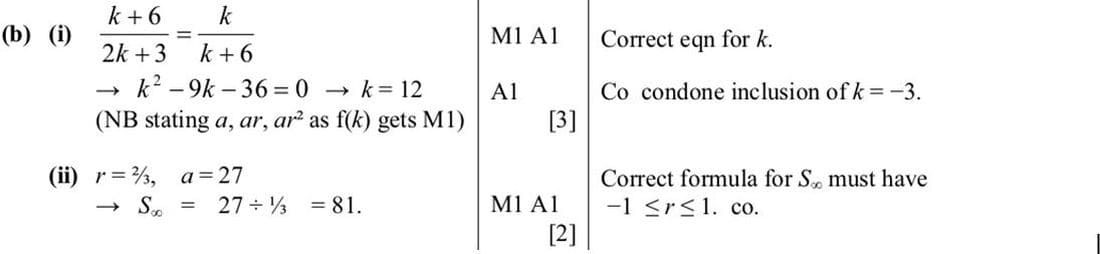
The first, second and third terms of a geometric progression are \(2k + 3\), \(k + 6\) and \(k\), respectively. Given that all the terms of the geometric progression are positive, calculate
(i) the value of the constant \(k\),
(ii) the sum to infinity of the progression.
9709 P13 - Nov 2010 - Q9
A geometric progression has first term 100 and sum to infinity 2000. Find the second term. [3]

9709 P12 - Nov 2010 - Q5
A geometric progression, in which all the terms are positive, has common ratio \(r\). The sum of the first \(n\) terms is less than 90\% of the sum to infinity. Show that \(r^n > 0.1\).

9709 P11 - Nov 2010 - Q6
The first term of a geometric progression is 16 and the fourth term is \(\frac{27}{4}\). Find the sum to infinity of the progression.

9709 P13 - Jun 2010 - Q1
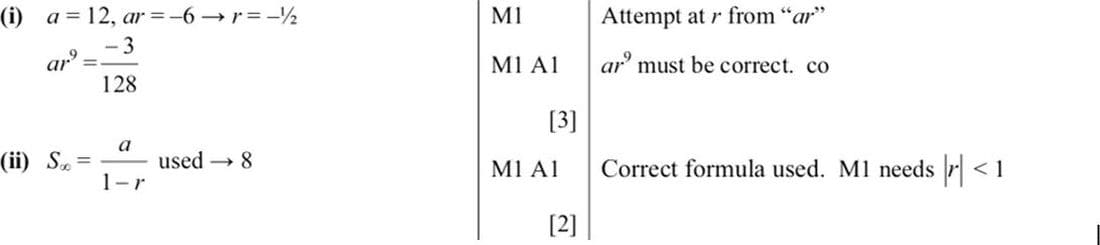
The first term of a geometric progression is 12 and the second term is -6. Find
- the tenth term of the progression,
- the sum to infinity.
9709 P12 - Jun 2010 - Q7
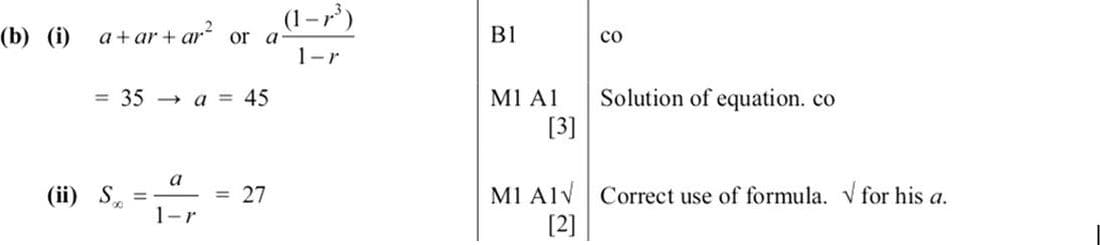
A geometric progression has a common ratio of \(-\frac{2}{3}\) and the sum of the first 3 terms is 35. Find
- the first term of the progression,
- the sum to infinity.
9709 P13 - Nov 2022 - Q9
The first term of a geometric progression is 216 and the fourth term is 64.
Find the sum to infinity of the progression.

9709 P1 - Jun 2009 - Q7
Find the sum to infinity of the geometric progression with first three terms 0.5, 0.5^3 and 0.5^5.

9709 P1 - Nov 2006 - Q6
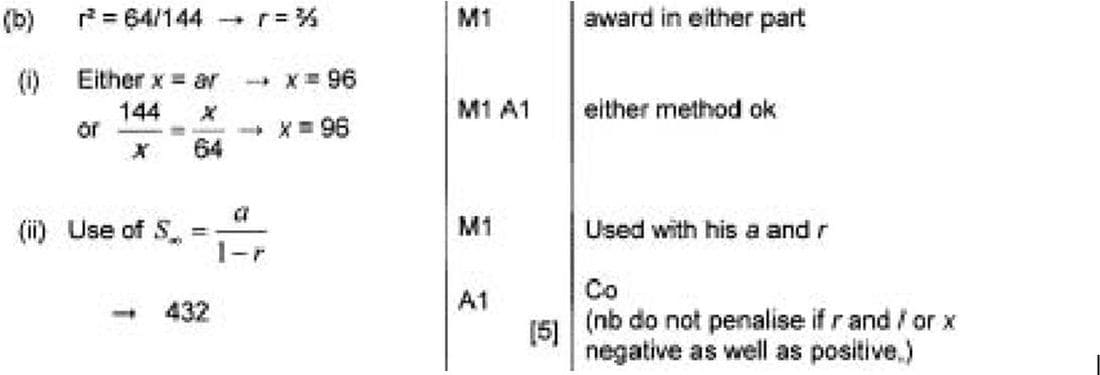
The first three terms in a geometric progression are 144, x and 64 respectively, where x is positive. Find
- the value of x,
- the sum to infinity of the progression.
9709 P1 - Jun 2006 - Q3
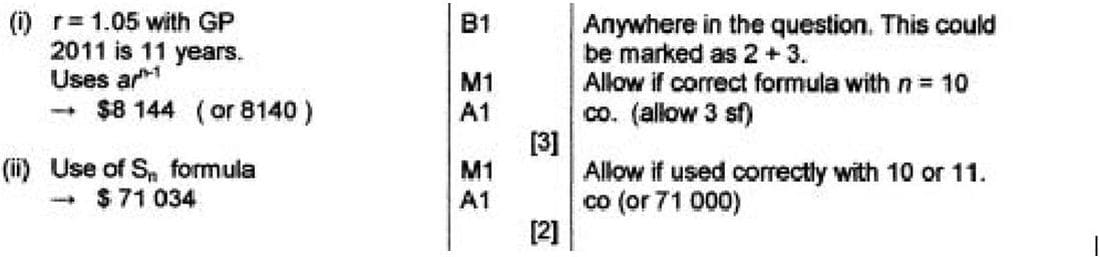
Each year a company gives a grant to a charity. The amount given each year increases by 5% of its value in the preceding year. The grant in 2001 was $5000. Find
(i) the grant given in 2011,
(ii) the total amount of money given to the charity during the years 2001 to 2011 inclusive.
9709 P1 - Nov 2004 - Q2
Find the sum of the first ten terms of the geometric progression 81, 54, 36, ...

9709 P1 - Jun 2004 - Q1
A geometric progression has first term 64 and sum to infinity 256. Find
- the common ratio,
- the sum of the first ten terms.

9709 P1 - Nov 2003 - Q3
Find the sum to infinity of the geometric progression whose first term is 6 and whose second term is 4.

9709 P1 - Nov 2002 - Q2
A geometric progression, for which the common ratio is positive, has a second term of 18 and a fourth term of 8. Find
- the first term and the common ratio of the progression,
- the sum to infinity of the progression.