Past Exam Questions
← Back9709 P13 - Jun 2013 - Q9
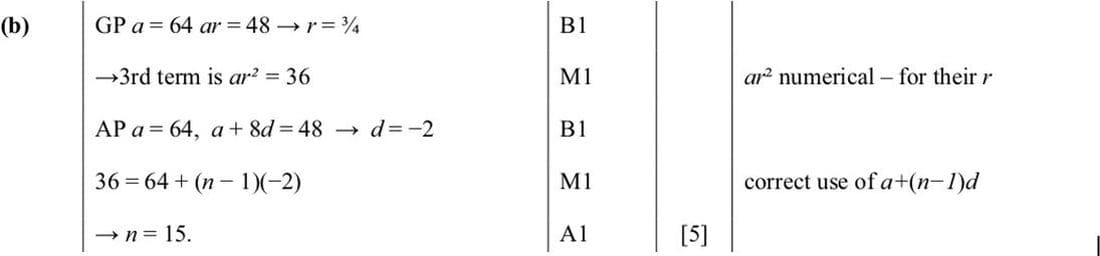
The first 2 terms of a geometric progression are 64 and 48 respectively. The first 3 terms of the geometric progression are also the 1st term, the 9th term and the nth term respectively of an arithmetic progression. Find the value of n.
9709 P13 - Jun 2012 - Q6
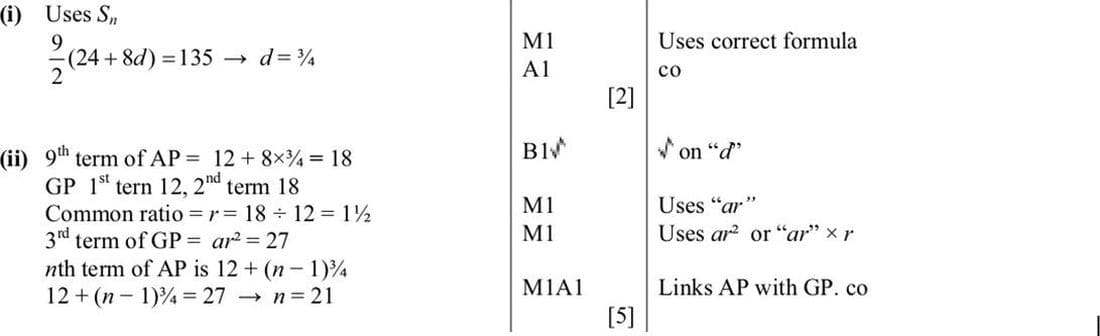
The first term of an arithmetic progression is 12 and the sum of the first 9 terms is 135.
(i) Find the common difference of the progression.
The first term, the ninth term and the nth term of this arithmetic progression are the first term, the second term and the third term respectively of a geometric progression.
(ii) Find the common ratio of the geometric progression and the value of n.
9709 P13 - Nov 2011 - Q2
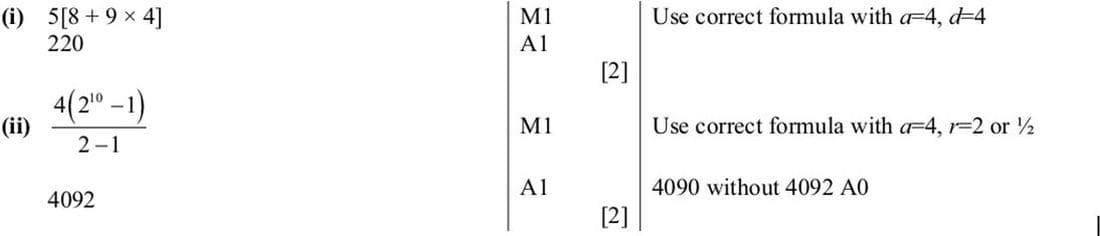
The first and second terms of a progression are 4 and 8 respectively. Find the sum of the first 10 terms given that the progression is
(i) an arithmetic progression,
(ii) a geometric progression.
9709 P11 - Jun 2011 - Q8
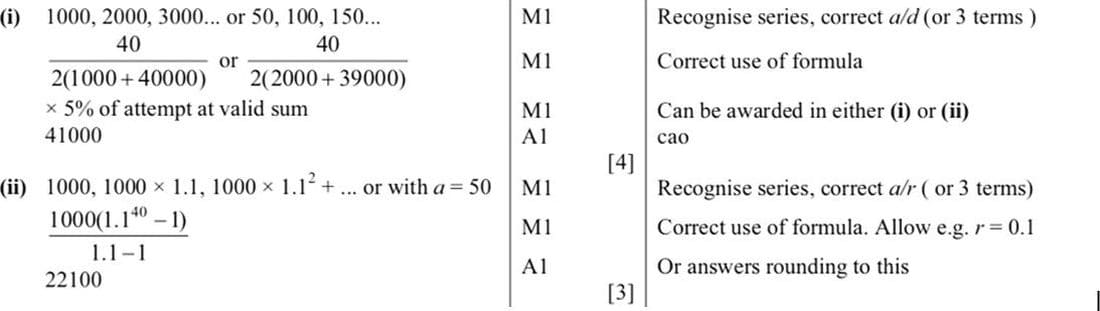
A television quiz show takes place every day. On day 1 the prize money is $1000. If this is not won the prize money is increased for day 2. The prize money is increased in a similar way every day until it is won. The television company considered the following two different models for increasing the prize money.
Model 1: Increase the prize money by $1000 each day.
Model 2: Increase the prize money by 10% each day.
On each day that the prize money is not won the television company makes a donation to charity. The amount donated is 5% of the value of the prize on that day. After 40 days the prize money has still not been won. Calculate the total amount donated to charity
(i) if Model 1 is used,
(ii) if Model 2 is used.
9709 P12 - Nov 2009 - Q3
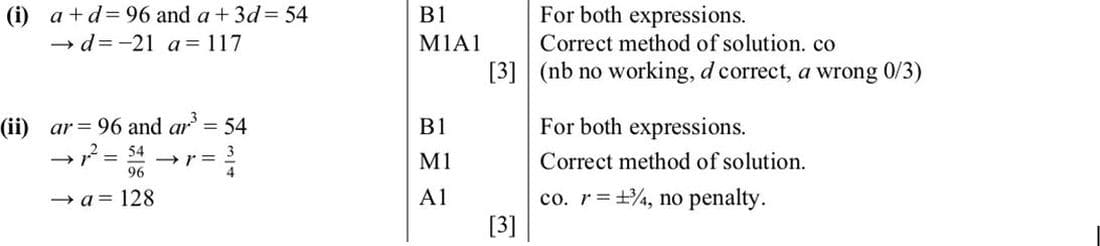
A progression has a second term of 96 and a fourth term of 54. Find the first term of the progression in each of the following cases:
(i) the progression is arithmetic,
(ii) the progression is geometric with a positive common ratio.
9709 P13 - Nov 2022 - Q9
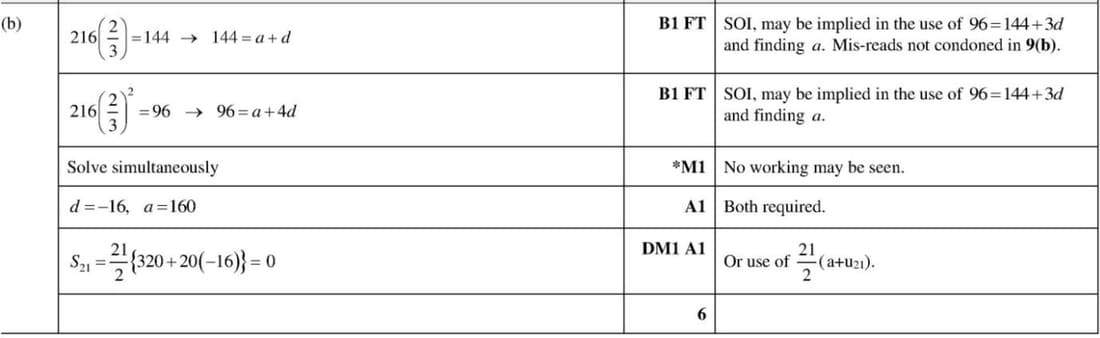
The first term of a geometric progression is 216 and the fourth term is 64.
The second term of the geometric progression is equal to the second term of an arithmetic progression.
The third term of the geometric progression is equal to the fifth term of the same arithmetic progression.
Find the sum of the first 21 terms of the arithmetic progression.
9709 P11 - Nov 2009 - Q8
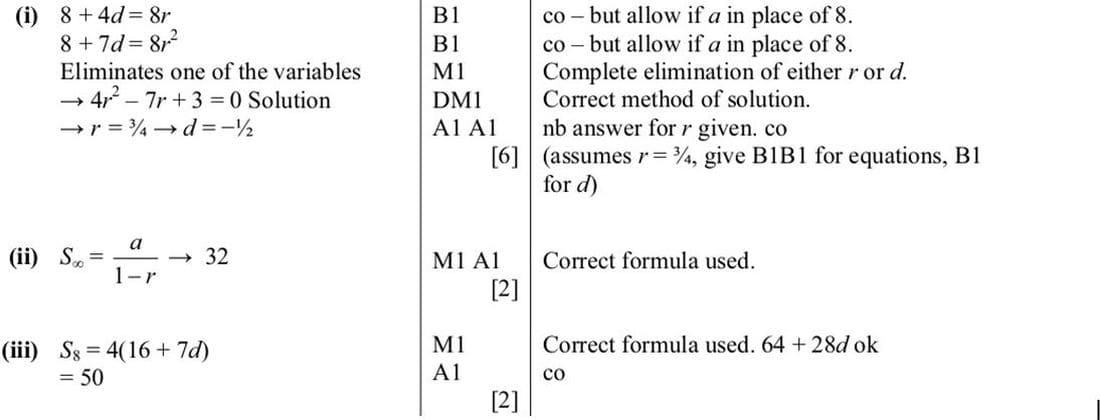
The first term of an arithmetic progression is 8 and the common difference is \(d\), where \(d \neq 0\). The first term, the fifth term and the eighth term of this arithmetic progression are the first term, the second term and the third term, respectively, of a geometric progression whose common ratio is \(r\).
(i) Write down two equations connecting \(d\) and \(r\). Hence show that \(r = \frac{3}{4}\) and find the value of \(d\). [6]
(ii) Find the sum to infinity of the geometric progression. [2]
(iii) Find the sum of the first 8 terms of the arithmetic progression. [2]
9709 P1 - Jun 2008 - Q7
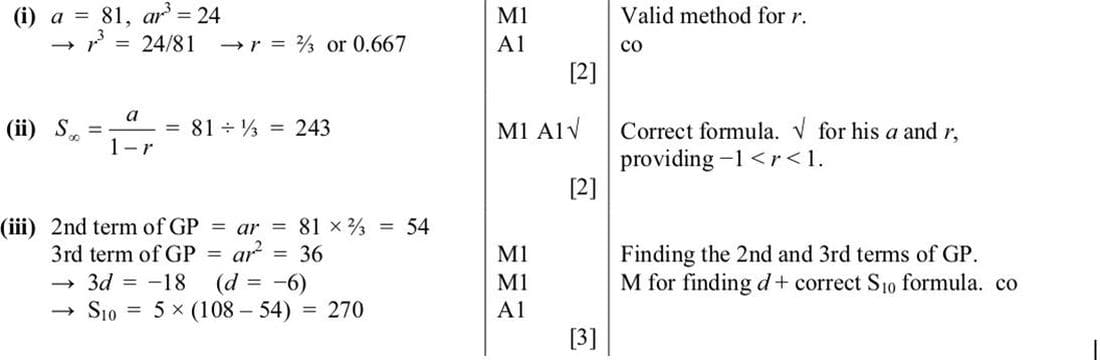
The first term of a geometric progression is 81 and the fourth term is 24. Find
(i) the common ratio of the progression,
(ii) the sum to infinity of the progression.
The second and third terms of this geometric progression are the first and fourth terms respectively of an arithmetic progression.
(iii) Find the sum of the first ten terms of the arithmetic progression.
9709 P1 - Nov 2007 - Q4
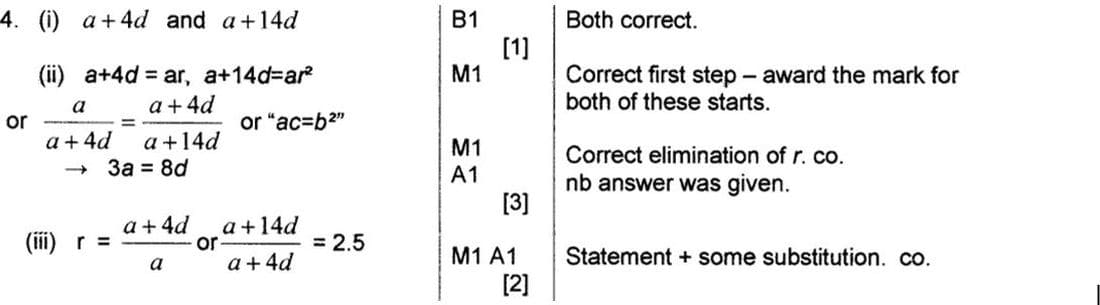
The 1st term of an arithmetic progression is \(a\) and the common difference is \(d\), where \(d \neq 0\).
(i) Write down expressions, in terms of \(a\) and \(d\), for the 5th term and the 15th term.
The 1st term, the 5th term and the 15th term of the arithmetic progression are the first three terms of a geometric progression.
(ii) Show that \(3a = 8d\).
(iii) Find the common ratio of the geometric progression.
9709 P1 - Jun 2007 - Q7
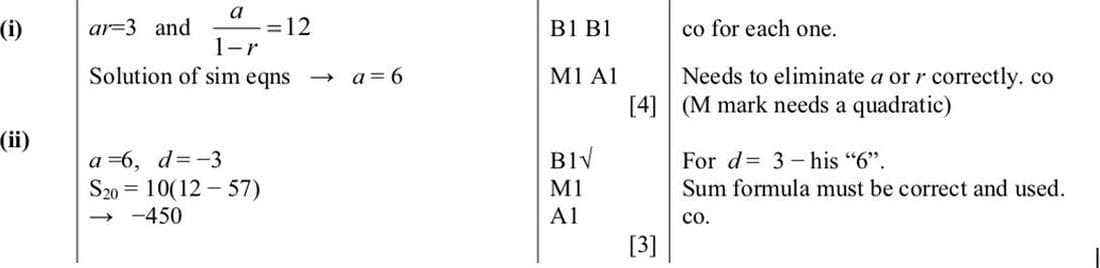
The second term of a geometric progression is 3 and the sum to infinity is 12.
(i) Find the first term of the progression.
An arithmetic progression has the same first and second terms as the geometric progression.
(ii) Find the sum of the first 20 terms of the arithmetic progression.
9709 P1 - Nov 2005 - Q6
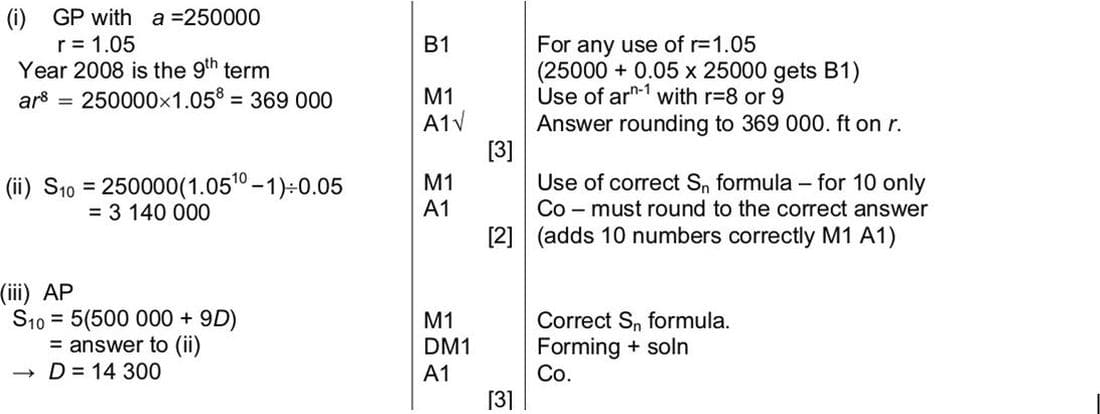
A small trading company made a profit of $250,000 in the year 2000. The company considered two different plans, plan A and plan B, for increasing its profits.
Under plan A, the annual profit would increase each year by 5% of its value in the preceding year. Find, for plan A,
(i) the profit for the year 2008,
(ii) the total profit for the 10 years 2000 to 2009 inclusive.
Under plan B, the annual profit would increase each year by a constant amount $D$.
(iii) Find the value of $D$ for which the total profit for the 10 years 2000 to 2009 inclusive would be the same for both plans.
9709 P1 - Jun 2005 - Q6
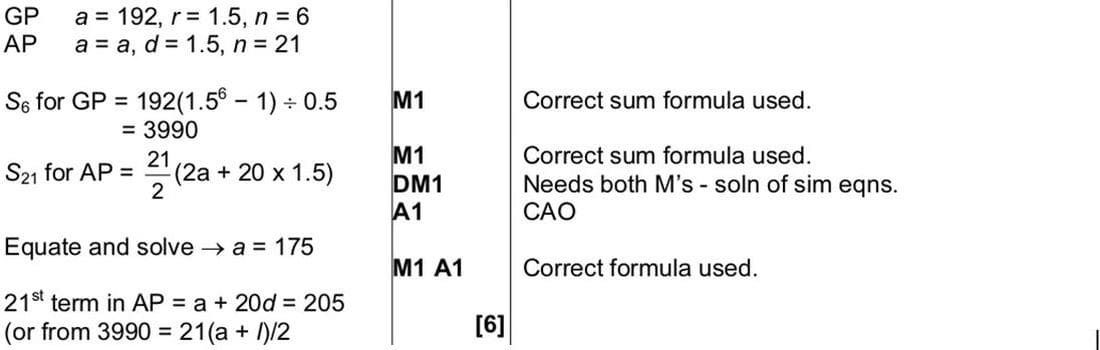
A geometric progression has 6 terms. The first term is 192 and the common ratio is 1.5. An arithmetic progression has 21 terms and common difference 1.5. Given that the sum of all the terms in the geometric progression is equal to the sum of all the terms in the arithmetic progression, find the first term and the last term of the arithmetic progression.
9709 P1 - Jun 2002 - Q4
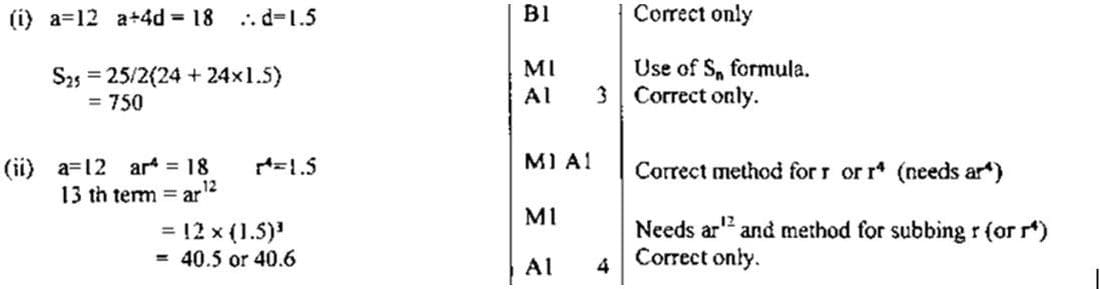
A progression has a first term of 12 and a fifth term of 18.
(i) Find the sum of the first 25 terms if the progression is arithmetic.
(ii) Find the 13th term if the progression is geometric.
9709 P12 - Mar 2022 - Q4
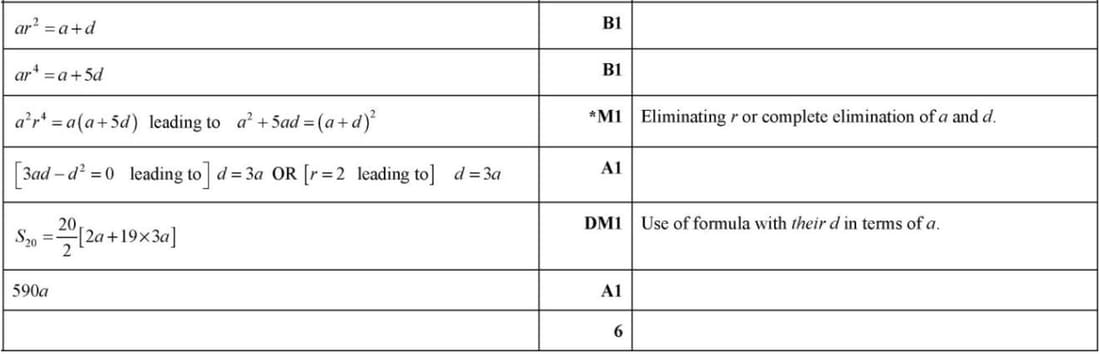
The first term of a geometric progression and the first term of an arithmetic progression are both equal to \(a\).
The third term of the geometric progression is equal to the second term of the arithmetic progression.
The fifth term of the geometric progression is equal to the sixth term of the arithmetic progression.
Given that the terms are all positive and not all equal, find the sum of the first twenty terms of the arithmetic progression in terms of \(a\).
9709 P11 - Nov 2021 - Q4
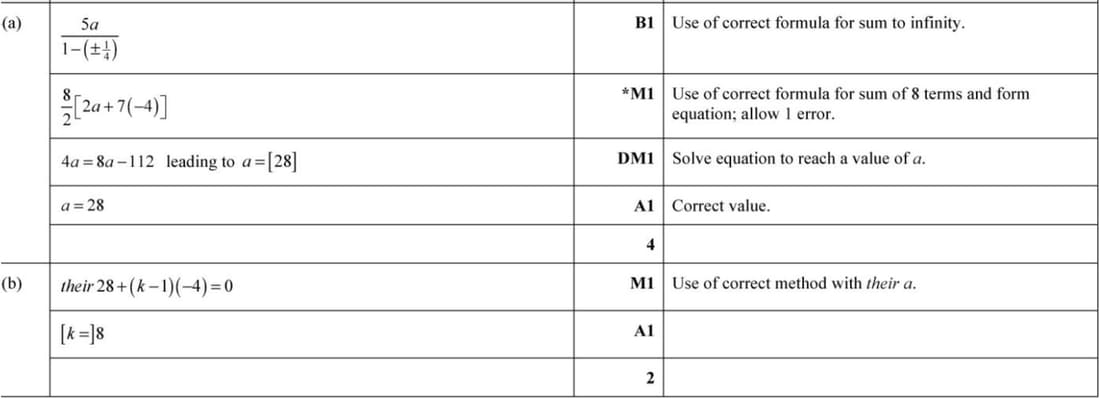
The first term of an arithmetic progression is \(a\) and the common difference is \(-4\). The first term of a geometric progression is \(5a\) and the common ratio is \(-\frac{1}{4}\). The sum to infinity of the geometric progression is equal to the sum of the first eight terms of the arithmetic progression.
(a) Find the value of \(a\).
The \(k\)th term of the arithmetic progression is zero.
(b) Find the value of \(k\).
9709 P12 - Jun 2021 - Q8
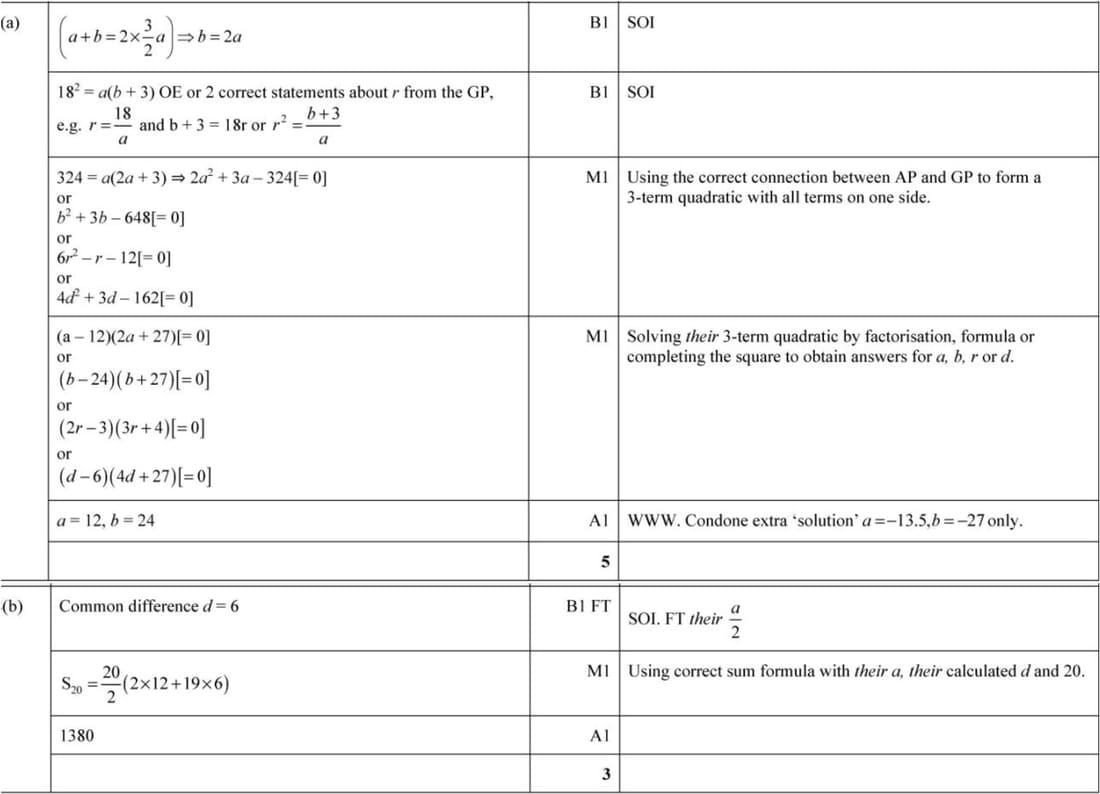
The first, second and third terms of an arithmetic progression are \(a\), \(\frac{3}{2}a\) and \(b\) respectively, where \(a\) and \(b\) are positive constants. The first, second and third terms of a geometric progression are \(a\), 18 and \(b + 3\) respectively.
(a) Find the values of \(a\) and \(b\).
(b) Find the sum of the first 20 terms of the arithmetic progression.
9709 P13 - Jun 2019 - Q5
Two heavyweight boxers decide that they would be more successful if they competed in a lower weight class. For each boxer this would require a total weight loss of 13 kg. At the end of week 1 they have each recorded a weight loss of 1 kg and they both find that in each of the following weeks their weight loss is slightly less than the week before.
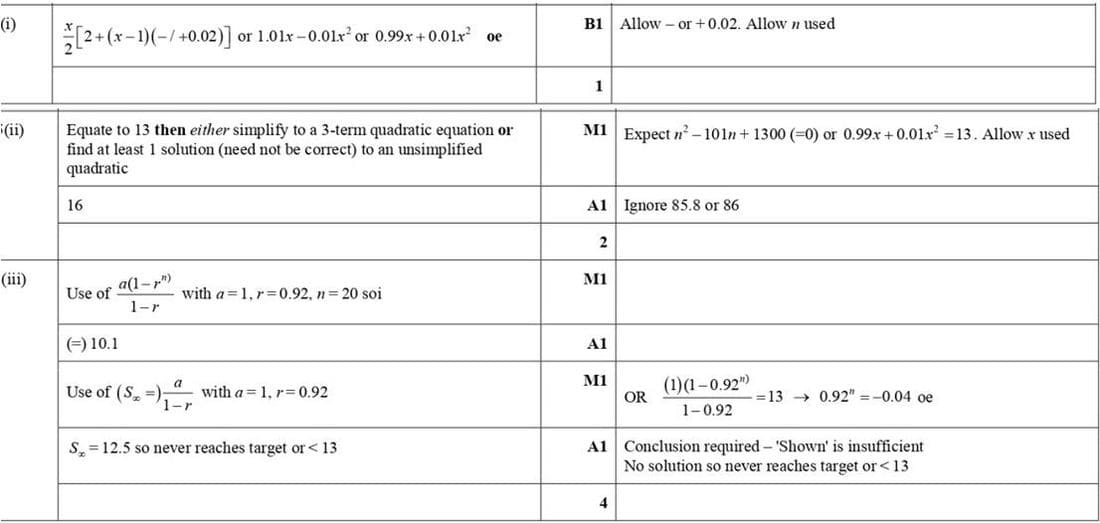
Boxer A’s weight loss in week 2 is 0.98 kg. It is given that his weekly weight loss follows an arithmetic progression.
- Write down an expression for his total weight loss after x weeks.
- He reaches his 13 kg target during week n. Use your answer to part (i) to find the value of n.
Boxer B’s weight loss in week 2 is 0.92 kg and it is given that his weekly weight loss follows a geometric progression.
- Calculate his total weight loss after 20 weeks and show that he can never reach his target.
9709 P11 - Jun 2019 - Q8
Two schemes are proposed for increasing the amount of household waste that is recycled each week.
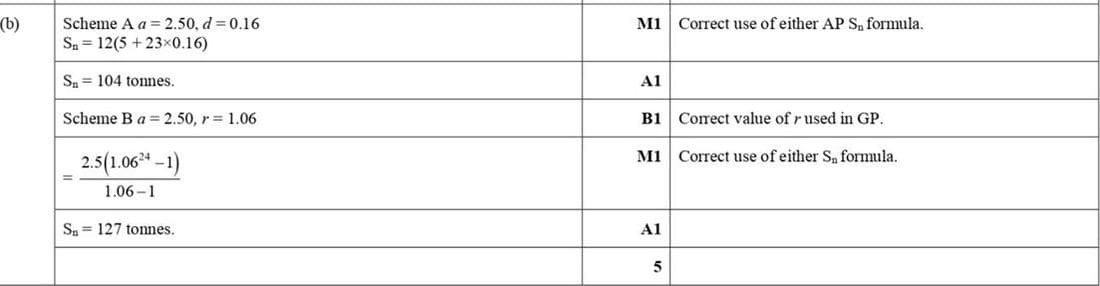
Scheme A is to increase the amount of waste recycled each month by 0.16 tonnes.
Scheme B is to increase the amount of waste recycled each month by 6% of the amount recycled in the previous month.
The proposal is to operate the scheme for a period of 24 months. The amount recycled in the first month is 2.5 tonnes.
For each scheme, find the total amount of waste that would be recycled over the 24-month period.
9709 P12 - Nov 2018 - Q5
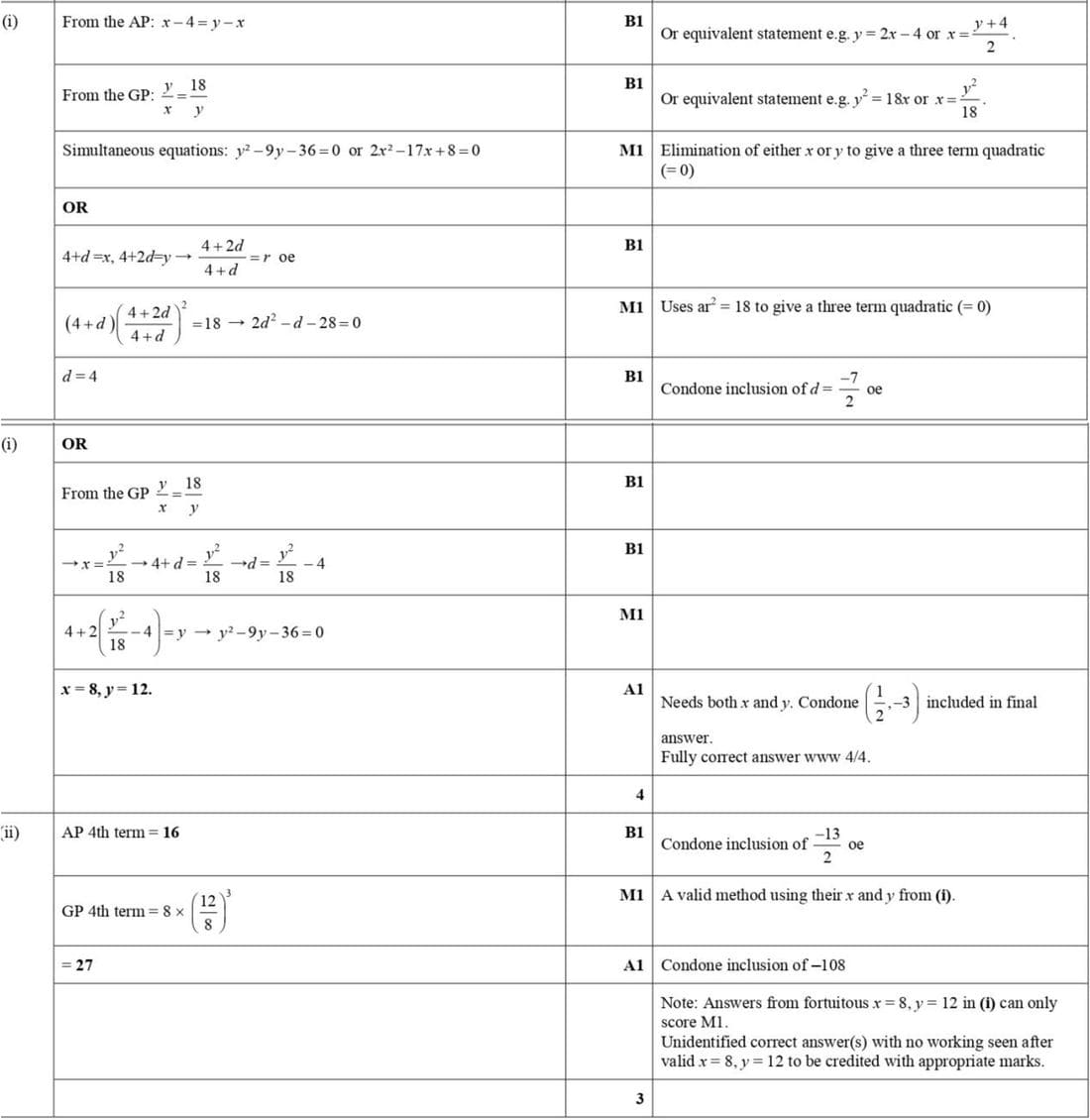
The first three terms of an arithmetic progression are 4, x and y respectively. The first three terms of a geometric progression are x, y and 18 respectively. It is given that both x and y are positive.
(i) Find the value of x and the value of y.
(ii) Find the fourth term of each progression.
9709 P12 - Mar 2018 - Q3
On a certain day, the height of a young bamboo plant was found to be 40 cm. After exactly one day its height was found to be 41.2 cm. Two different models are used to predict its height exactly 60 days after it was first measured.
- Model A assumes that the daily amount of growth continues to be constant at the amount found for the first day.
- Model B assumes that the daily percentage rate of growth continues to be constant at the percentage rate of growth found for the first day.
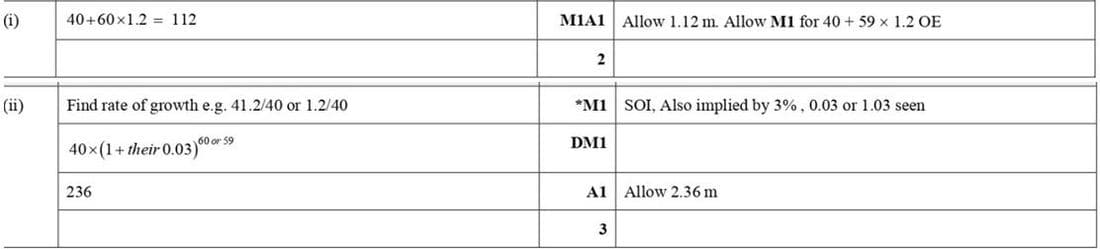
(i) Using model A, find the predicted height in cm of the bamboo plant exactly 60 days after it was first measured.
(ii) Using model B, find the predicted height in cm of the bamboo plant exactly 60 days after it was first measured.