Past Exam Questions
← Back9709 P12 - Nov 2022 - Q4
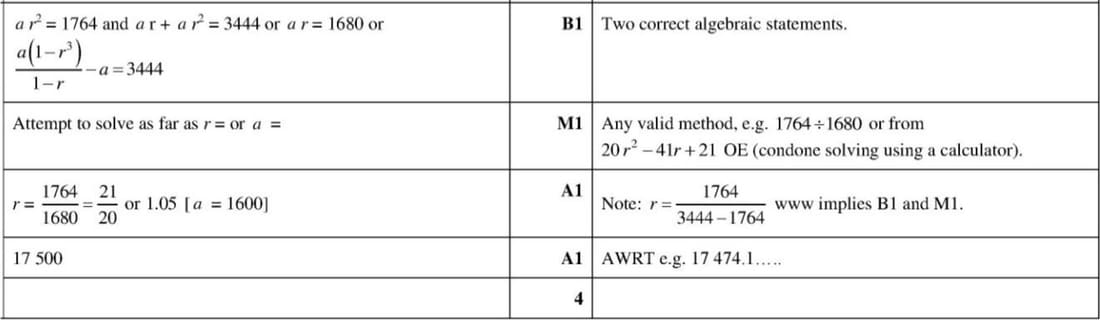
A geometric progression is such that the third term is 1764 and the sum of the second and third terms is 3444.
Find the 50th term.
9709 P11 - Nov 2022 - Q7
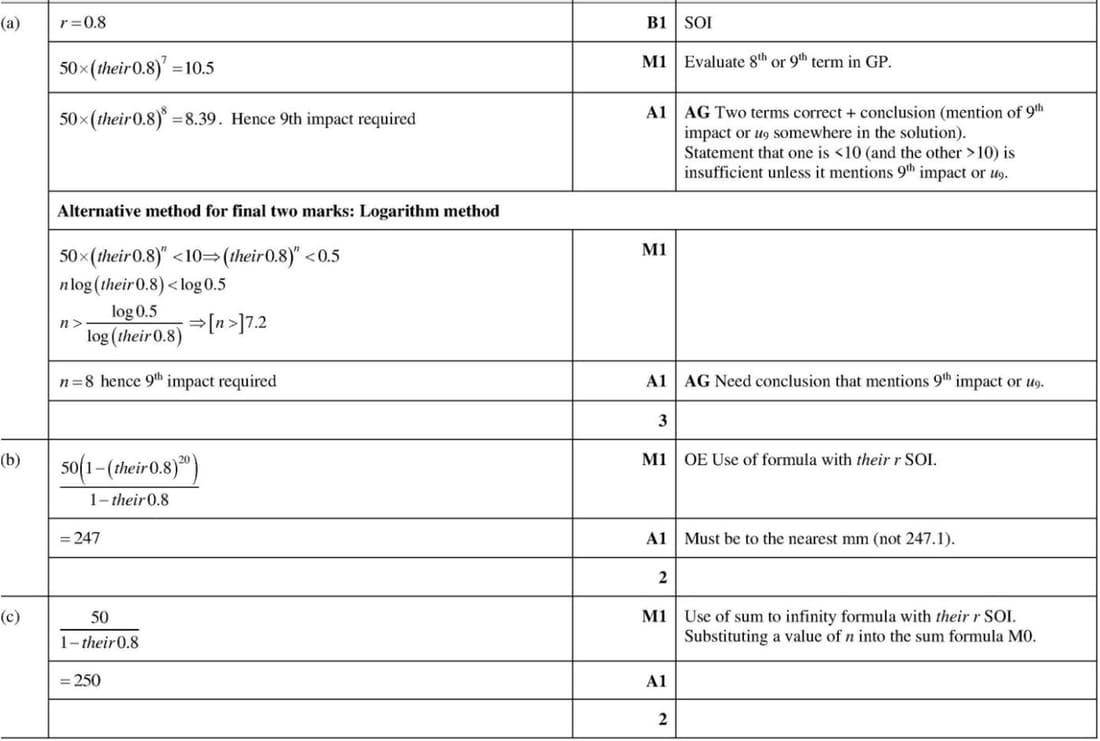
A tool for putting fence posts into the ground is called a 'post-rammer'. The distances in millimetres that the post sinks into the ground on each impact of the post-rammer follow a geometric progression. The first three impacts cause the post to sink into the ground by 50 mm, 40 mm and 32 mm respectively.
(a) Verify that the 9th impact is the first in which the post sinks less than 10 mm into the ground.
(b) Find, to the nearest millimetre, the total depth of the post in the ground after 20 impacts.
(c) Find the greatest total depth in the ground which could theoretically be achieved.
9709 P12 - Jun 2022 - Q2
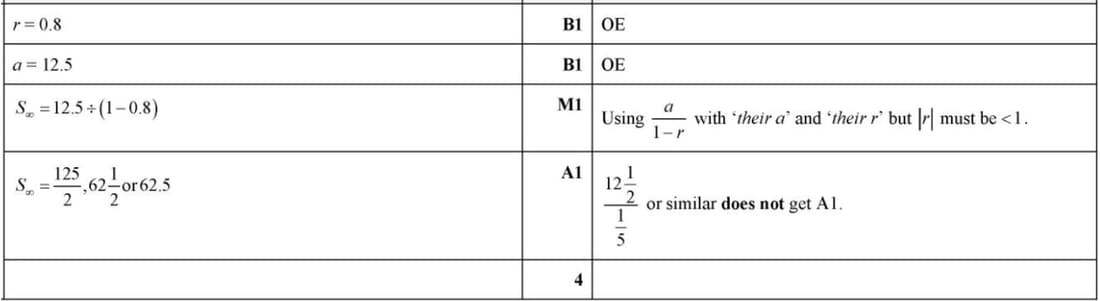
The second and third terms of a geometric progression are 10 and 8 respectively.
Find the sum to infinity.
9709 P12 - Nov 2021 - Q5
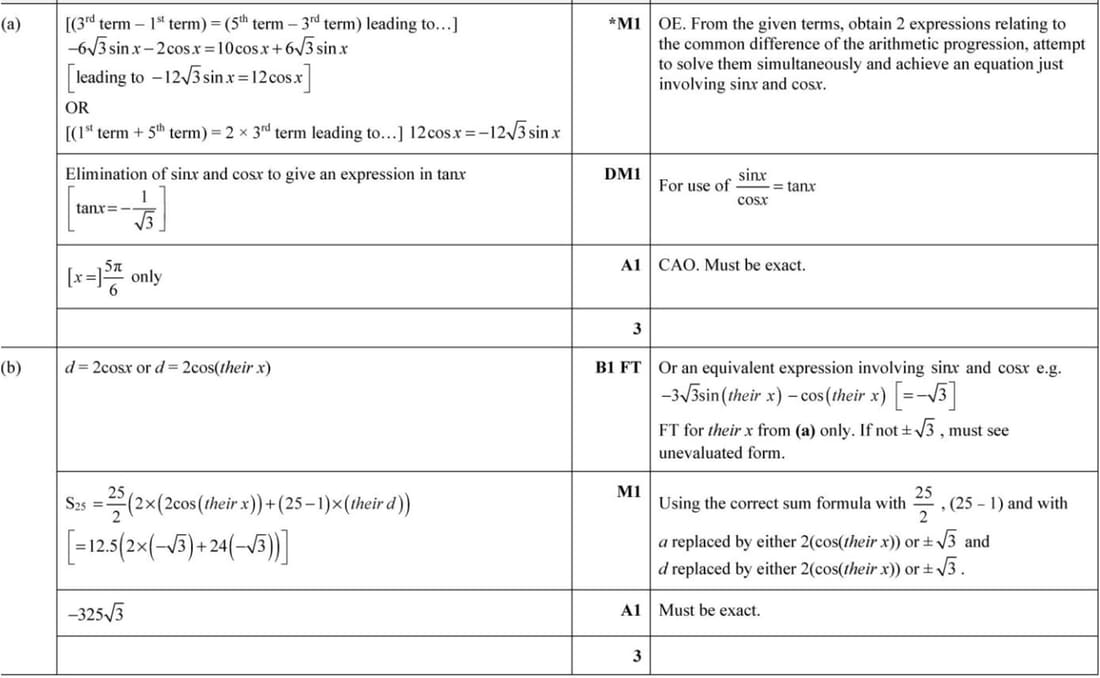
The first, third and fifth terms of an arithmetic progression are \(2 \cos x\), \(-6\sqrt{3} \sin x\) and \(10 \cos x\) respectively, where \(\frac{1}{2}\pi < x < \pi\).
(a) Find the exact value of \(x\). [3]
(b) Hence find the exact sum of the first 25 terms of the progression. [3]
9709 P13 - Nov 2020 - Q7
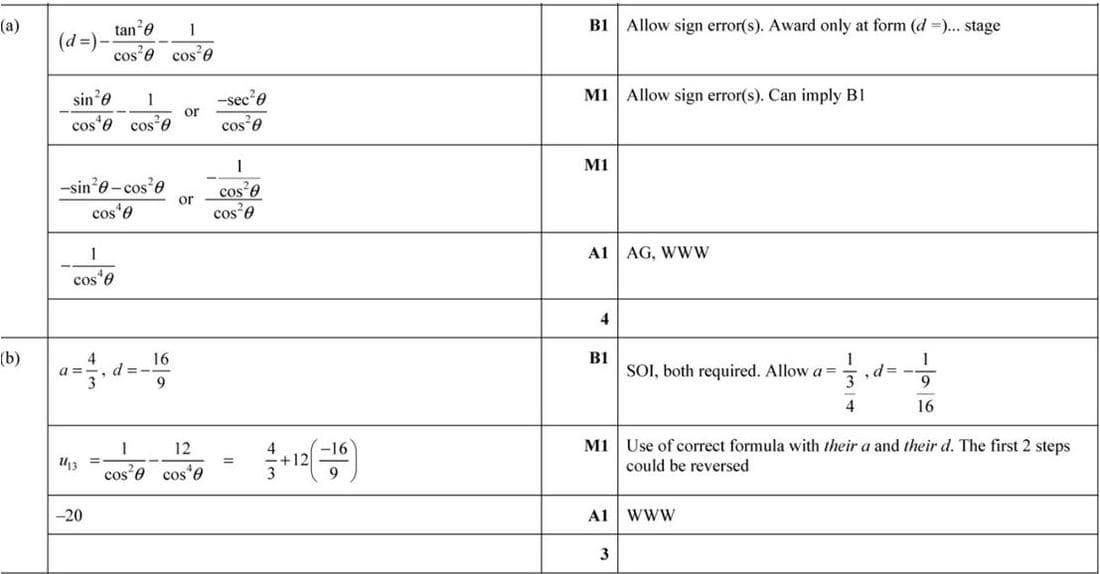
The first and second terms of an arithmetic progression are \(\frac{1}{\cos^2 \theta}\) and \(-\frac{\tan^2 \theta}{\cos^2 \theta}\), respectively, where \(0 < \theta < \frac{1}{2} \pi\).
(a) Show that the common difference is \(-\frac{1}{\cos^4 \theta}\).
(b) Find the exact value of the 13th term when \(\theta = \frac{1}{6} \pi\).
9709 P13 - Jun 2020 - Q8
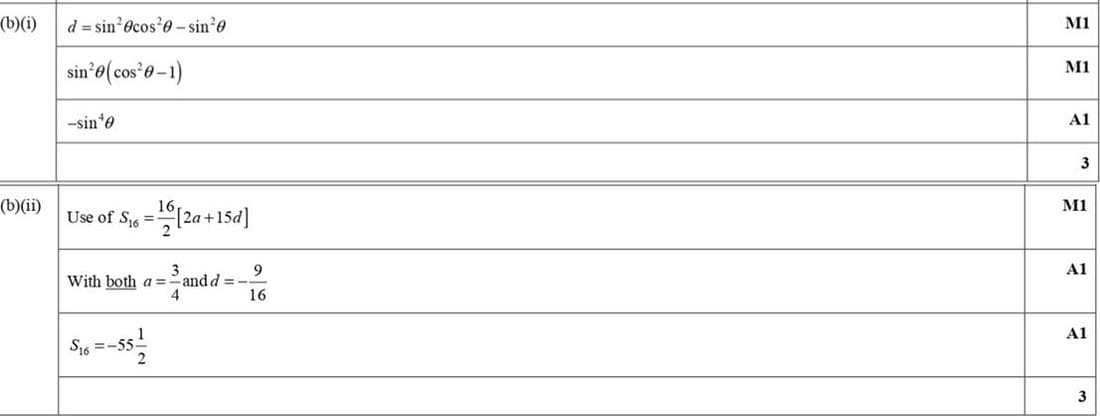
The first term of a progression is \(\sin^2 \theta\), where \(0 < \theta < \frac{1}{2} \pi\). The second term of the progression is \(\sin^2 \theta \cos^2 \theta\).
It is now given instead that the progression is arithmetic.
(i) Find the common difference of the progression in terms of \(\sin \theta\).
(ii) Find the sum of the first 16 terms when \(\theta = \frac{1}{3} \pi\).
9709 P13 - Nov 2016 - Q9
The first term of an arithmetic progression is \(\cos \theta\) and the second term is \(\cos \theta + \sin^2 \theta\), where \(0 \leq \theta \leq \pi\). The sum of the first 13 terms is 52. Find the possible values of \(\theta\).

9709 P11 - Jun 2016 - Q9
The first three terms of an arithmetic progression are \(2 \sin x\), \(3 \cos x\) and \((\sin x + 2 \cos x)\) respectively, where \(x\) is an acute angle.
(i) Show that \(\tan x = \frac{4}{3}\).
(ii) Find the sum of the first twenty terms of the progression.

9709 P11 - Jun 2012 - Q7
The first two terms of an arithmetic progression are 1 and \(\cos^2 x\) respectively. Show that the sum of the first ten terms can be expressed in the form \(a - b \sin^2 x\), where \(a\) and \(b\) are constants to be found.

9709 P12 - Nov 2023 - Q5
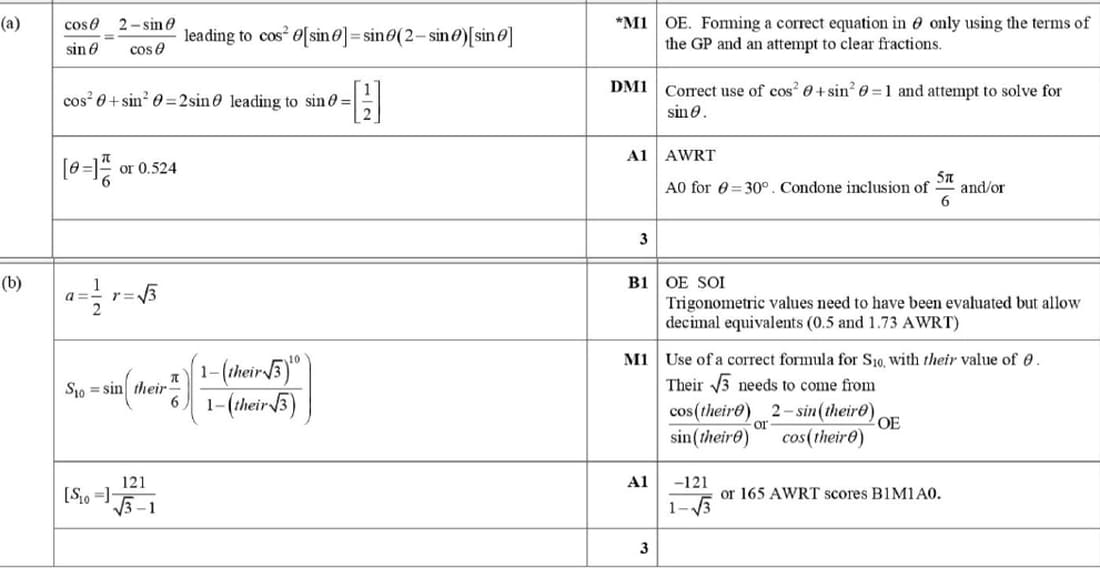
The first, second and third terms of a geometric progression are \(\sin \theta\), \(\cos \theta\) and \(2 - \sin \theta\) respectively, where \(\theta\) radians is an acute angle.
(a) Find the value of \(\theta\).
(b) Using this value of \(\theta\), find the sum of the first 10 terms of the progression. Give the answer in the form \(\frac{b}{\sqrt{c} - 1}\), where \(b\) and \(c\) are integers to be found.
9709 P12 - Mar 2021 - Q9
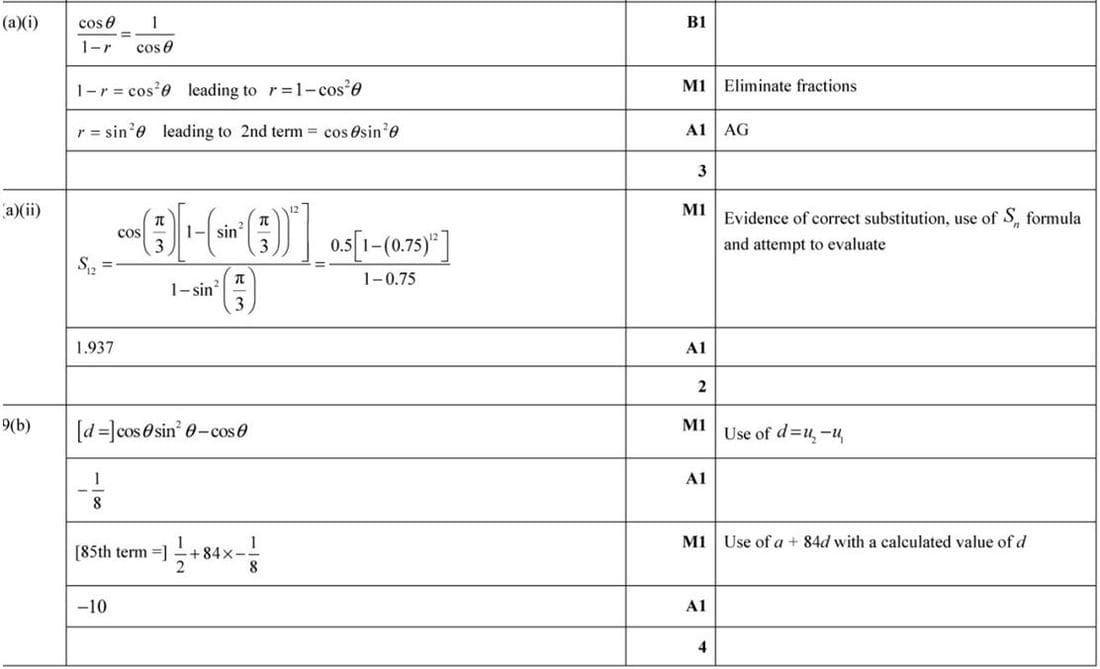
The first term of a progression is \(\cos \theta\), where \(0 < \theta < \frac{1}{2} \pi\).
(a) For the case where the progression is geometric, the sum to infinity is \(\frac{1}{\cos \theta}\).
(i) Show that the second term is \(\cos \theta \sin^2 \theta\).
(ii) Find the sum of the first 12 terms when \(\theta = \frac{1}{3} \pi\), giving your answer correct to 4 significant figures.
(b) For the case where the progression is arithmetic, the first two terms are again \(\cos \theta\) and \(\cos \theta \sin^2 \theta\) respectively.
Find the 85th term when \(\theta = \frac{1}{3} \pi\).
9709 P13 - Jun 2020 - Q8
The first term of a progression is \(\sin^2 \theta\), where \(0 < \theta < \frac{1}{2}\pi\). The second term of the progression is \(\sin^2 \theta \cos^2 \theta\).
Given that the progression is geometric, find the sum to infinity.

9709 P13 - Jun 2015 - Q9
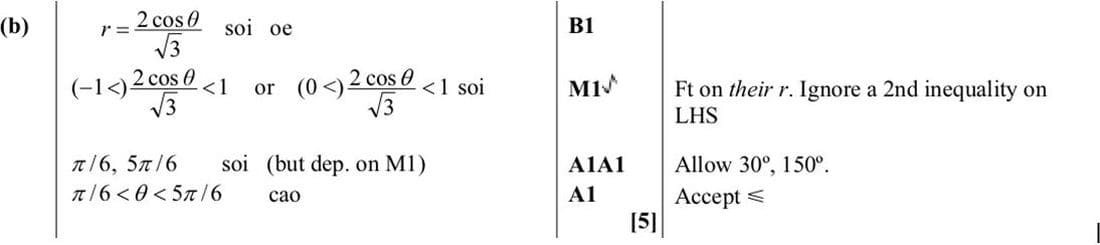
The first term of a geometric progression is \(\sqrt{3}\) and the second term is \(2 \cos \theta\), where \(0 < \theta < \pi\). Find the set of values of \(\theta\) for which the progression is convergent.
9709 P11 - Jun 2012 - Q7
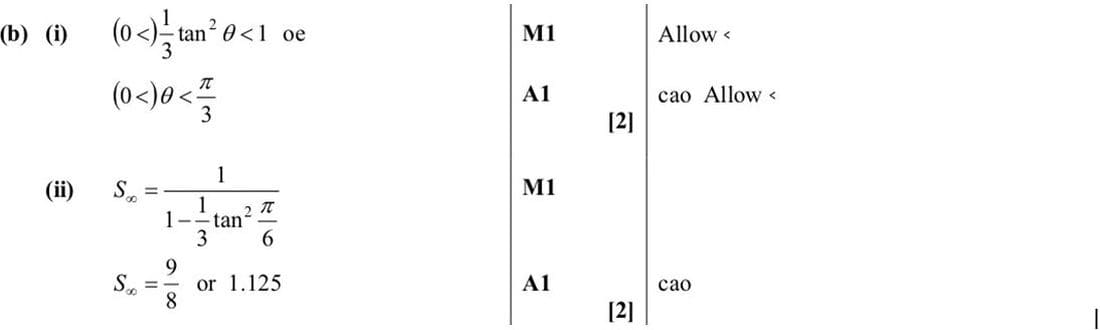
The first two terms of a geometric progression are 1 and \(\frac{1}{3} \tan^2 \theta\) respectively, where \(0 < \theta < \frac{1}{2} \pi\).
(i) Find the set of values of \(\theta\) for which the progression is convergent.
(ii) Find the exact value of the sum to infinity when \(\theta = \frac{1}{6} \pi\).
9709 P11 - Jun 2023 - Q6
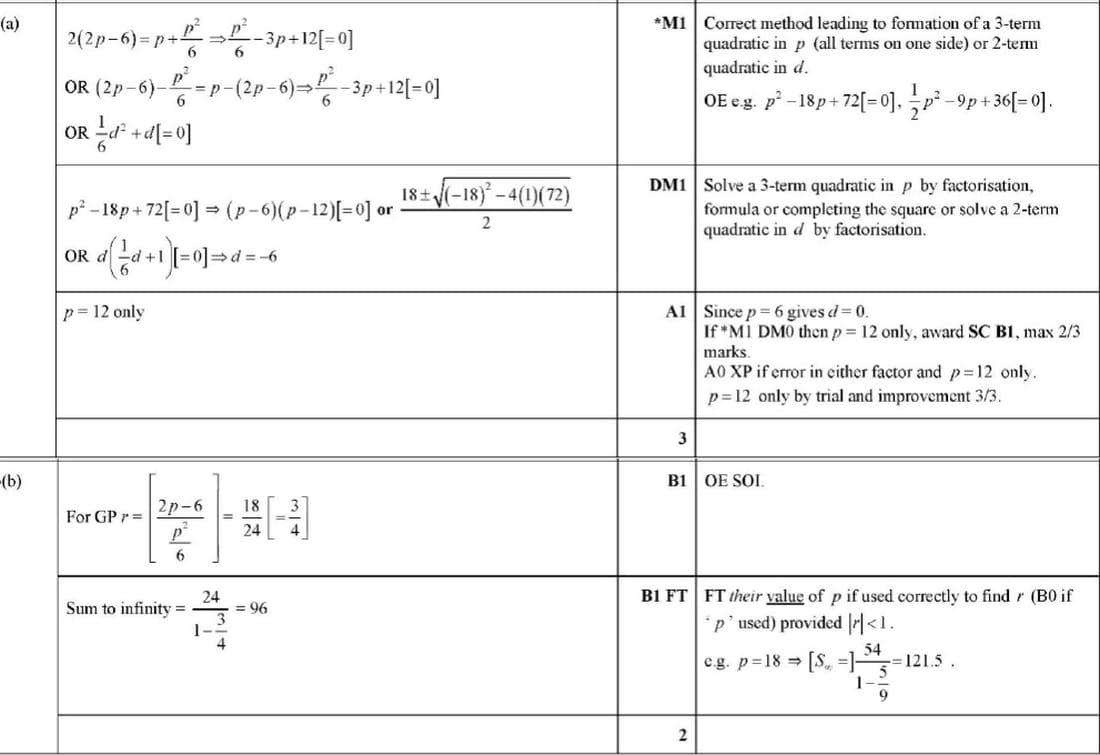
The first three terms of an arithmetic progression are \(\frac{p^2}{6}\), \(2p - 6\) and \(p\).
(a) Given that the common difference of the progression is not zero, find the value of \(p\).
(b) Using this value, find the sum to infinity of the geometric progression with first two terms \(\frac{p^2}{6}\) and \(2p - 6\).
9709 P13 - Jun 2016 - Q4
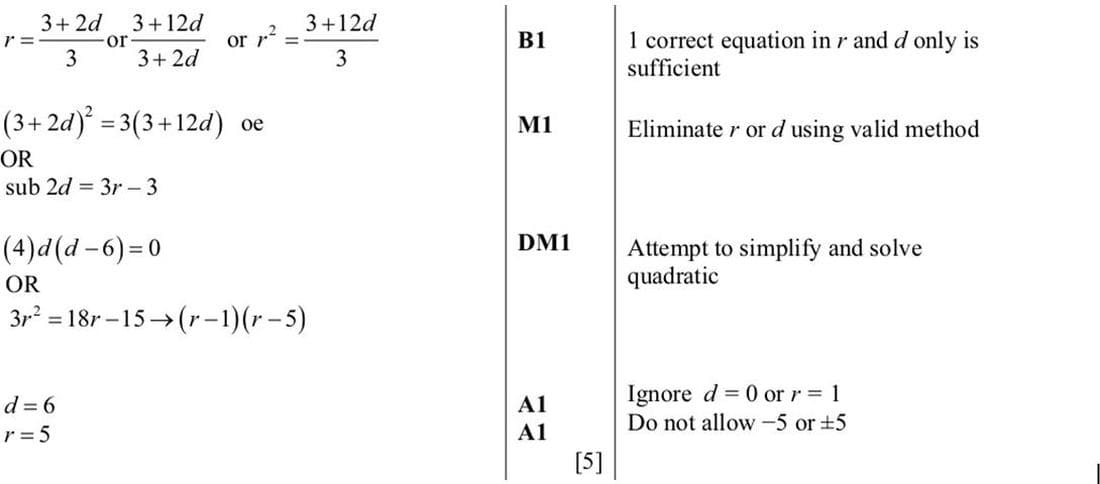
The 1st, 3rd and 13th terms of an arithmetic progression are also the 1st, 2nd and 3rd terms respectively of a geometric progression. The first term of each progression is 3. Find the common difference of the arithmetic progression and the common ratio of the geometric progression.
9709 P13 - Nov 2015 - Q6
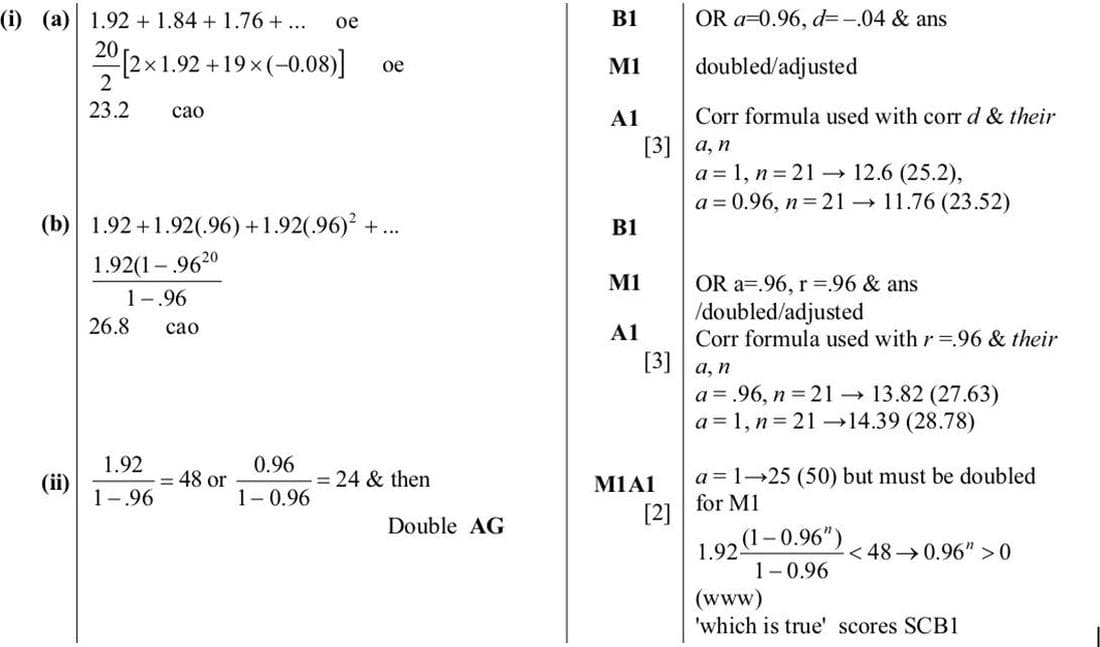
A ball is such that when it is dropped from a height of 1 metre it bounces vertically from the ground to a height of 0.96 metres. It continues to bounce on the ground and each time the height the ball reaches is reduced. Two different models, A and B, describe this.
Model A: The height reached is reduced by 0.04 metres each time the ball bounces.
Model B: The height reached is reduced by 4% each time the ball bounces.
(i) Find the total distance travelled vertically (up and down) by the ball from the 1st time it hits the ground until it hits the ground for the 21st time,
(a) using model A,
(b) using model B.
(ii) Show that, under model B, even if there is no limit to the number of times the ball bounces, the total vertical distance travelled after the first time it hits the ground cannot exceed 48 metres.
9709 P13 - Nov 2014 - Q4
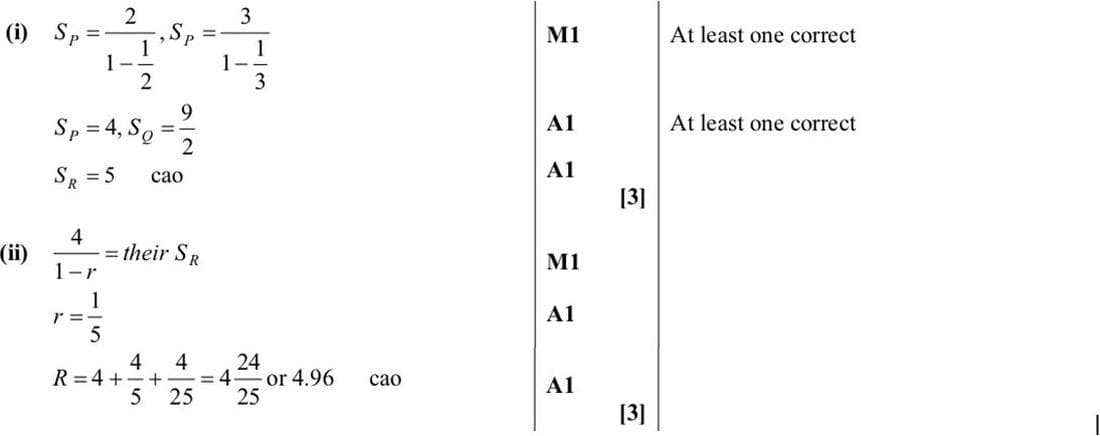
Three geometric progressions, \(P, Q\) and \(R\), are such that their sums to infinity are the first three terms respectively of an arithmetic progression.
Progression \(P\) is \(2, 1, \frac{1}{2}, \frac{1}{4}, \ldots\).
Progression \(Q\) is \(3, 1, \frac{1}{3}, \frac{1}{9}, \ldots\).
(i) Find the sum to infinity of progression \(R\).
(ii) Given that the first term of \(R\) is 4, find the sum of the first three terms of \(R\).
9709 P13 - Jun 2014 - Q2
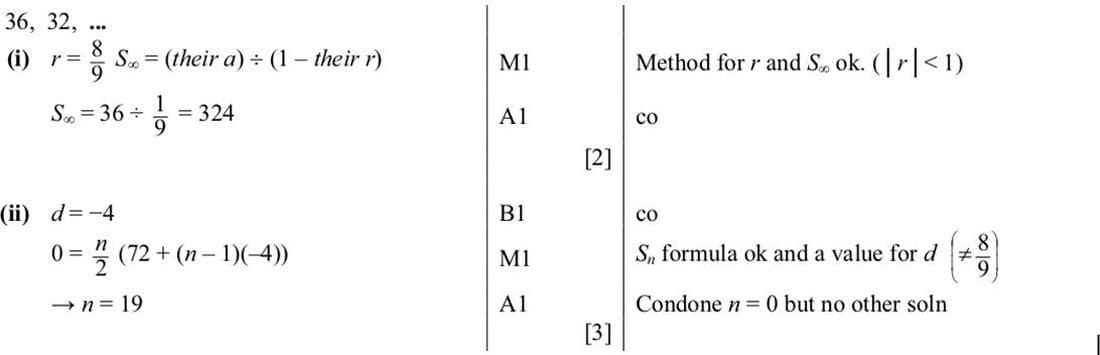
The first term in a progression is 36 and the second term is 32.
(i) Given that the progression is geometric, find the sum to infinity.
(ii) Given instead that the progression is arithmetic, find the number of terms in the progression if the sum of all the terms is 0.
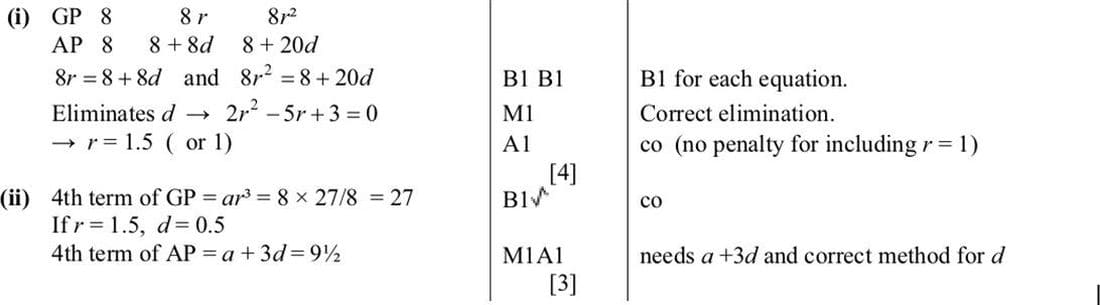
9709 P12 - Jun 2014 - Q6
The 1st, 2nd and 3rd terms of a geometric progression are the 1st, 9th and 21st terms respectively of an arithmetic progression. The 1st term of each progression is 8 and the common ratio of the geometric progression is \(r\), where \(r \neq 1\). Find
(i) the value of \(r\),
(ii) the 4th term of each progression.