Browsing as Guest. Progress, bookmarks and attempts are disabled.
Log in to track your work.
Nov 2021 p32 q11
1842
The equation of a curve is \(y = \sqrt{\tan x}\), for \(0 \leq x < \frac{1}{2}\pi\).
(a) Express \(\frac{dy}{dx}\) in terms of \(\tan x\), and verify that \(\frac{dy}{dx} = 1\) when \(x = \frac{1}{4}\pi\).
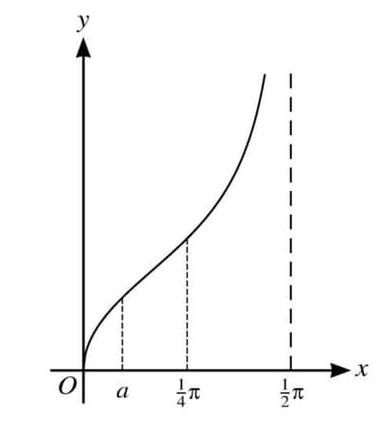
The value of \(\frac{dy}{dx}\) is also 1 at another point on the curve where \(x = a\), as shown in the diagram.
(b) Show that \(t^3 + t^2 + 3t - 1 = 0\), where \(t = \tan a\).
(c) Use the iterative formula \(a_{n+1} = \arctan \left( \frac{1}{3} (1 - \tan^2 a_n - \tan^3 a_n) \right)\) to determine \(a\) correct to 2 decimal places, giving the result of each iteration to 4 decimal places.
Solution
(a) To find \(\frac{dy}{dx}\), use the chain rule. Let \(u = \tan x\), then \(y = \sqrt{u}\). The derivative \(\frac{dy}{du} = \frac{1}{2\sqrt{u}}\) and \(\frac{du}{dx} = \sec^2 x\). Therefore, \(\frac{dy}{dx} = \frac{dy}{du} \cdot \frac{du}{dx} = \frac{1}{2\sqrt{\tan x}} \cdot \sec^2 x = \frac{1 + \tan^2 x}{2\sqrt{\tan x}}\).
Verify at \(x = \frac{1}{4}\pi\): \(\tan \frac{1}{4}\pi = 1\), so \(\frac{dy}{dx} = \frac{1 + 1^2}{2\sqrt{1}} = 1\).
(b) Substitute \(t = \tan a\) into the equation from part (a): \(\frac{1 + t^2}{2\sqrt{t}} = 1\). Rearrange to get \((1 + t^2)^2 = 4t\), leading to \(t^4 + 2t^2 - 4t + 1 = 0\). Divide by \(t - 1\) to obtain \(t^3 + t^2 + 3t - 1 = 0\).
(c) Use the iterative formula \(a_{n+1} = \arctan \left( \frac{1}{3} (1 - \tan^2 a_n - \tan^3 a_n) \right)\). Start with an initial guess, e.g., \(a_0 = 0.3\), and iterate: \(a_1 = 0.2854\), \(a_2 = 0.2894\), \(a_3 = 0.2883\), etc. Continue until \(a\) stabilizes to 2 decimal places: \(a = 0.29\).