9709 P31 - Jun 2015 - Q10
1833
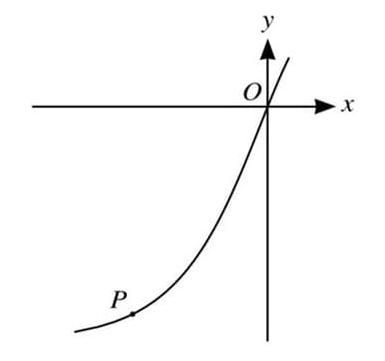
The diagram shows part of the curve with parametric equations
\(x = 2 \ln(t + 2)\), \(y = t^3 + 2t + 3\).
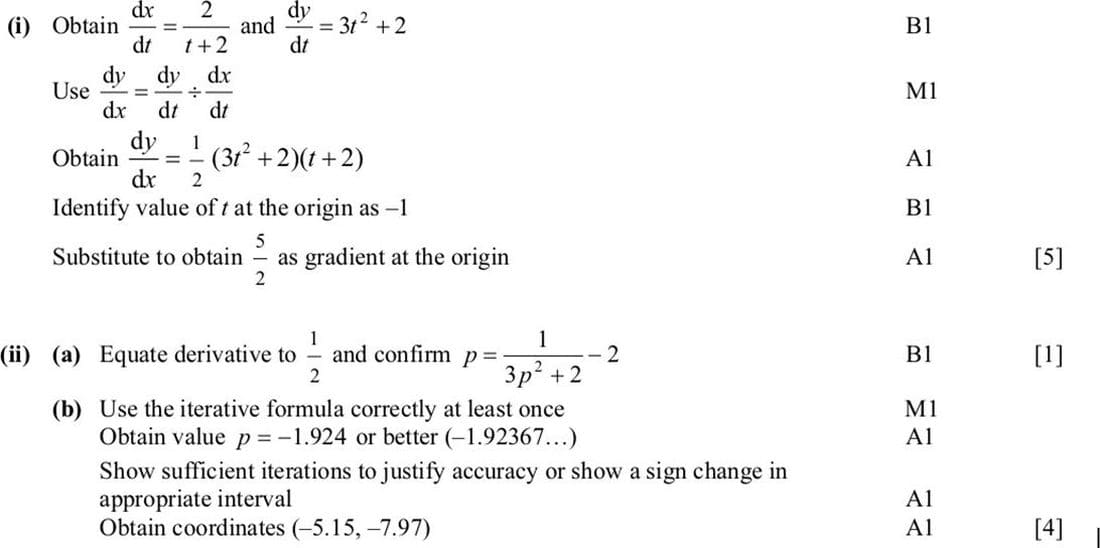
- Find the gradient of the curve at the origin. [5]
- At the point \(P\) on the curve, the value of the parameter is \(p\). It is given that the gradient of the curve at \(P\) is \(\frac{1}{2}\).
- Show that \(p = \frac{1}{3p^2 + 2} - 2\). [1]
- By first using an iterative formula based on the equation in part (a), determine the coordinates of the point \(P\). Give the result of each iteration to 5 decimal places and each coordinate of \(P\) correct to 2 decimal places. [4]