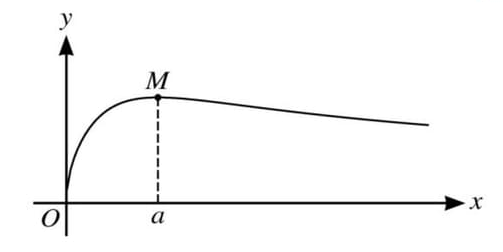
(a) To find the maximum point, we differentiate \(y = \frac{\arctan x}{\sqrt{x}}\) using the quotient rule:
\(\frac{dy}{dx} = \frac{\sqrt{x} \cdot \frac{1}{1+x^2} - \arctan x \cdot \frac{1}{2\sqrt{x}}}{x}\).
Setting \(\frac{dy}{dx} = 0\) gives:
\(\sqrt{x} \cdot \frac{1}{1+x^2} = \arctan x \cdot \frac{1}{2\sqrt{x}}\).
Rearranging and simplifying leads to:
\(a = \tan \left( \frac{2a}{1 + a^2} \right)\).
(b) Calculate \(a = \tan \left( \frac{2a}{1 + a^2} \right)\) for \(a = 1.3\) and \(a = 1.5\):
For \(a = 1.3\), \(\tan \left( \frac{2 \times 1.3}{1 + 1.3^2} \right) \approx 1.448\).
For \(a = 1.5\), \(\tan \left( \frac{2 \times 1.5}{1 + 1.5^2} \right) \approx 1.322\).
Since \(1.3 < 1.448\) and \(1.5 > 1.322\), \(a\) lies between 1.3 and 1.5.
(c) Using the iterative formula \(a_{n+1} = \tan \left( \frac{2a_n}{1 + a_n^2} \right)\):
Start with \(a_0 = 1.4\).
\(a_1 = \tan \left( \frac{2 \times 1.4}{1 + 1.4^2} \right) \approx 1.3914\).
\(a_2 = \tan \left( \frac{2 \times 1.3914}{1 + 1.3914^2} \right) \approx 1.3900\).
\(a_3 = \tan \left( \frac{2 \times 1.3900}{1 + 1.3900^2} \right) \approx 1.3900\).
Thus, \(a \approx 1.39\) correct to 2 decimal places.