9709 P32 - Jun 2016 - Q8
1831
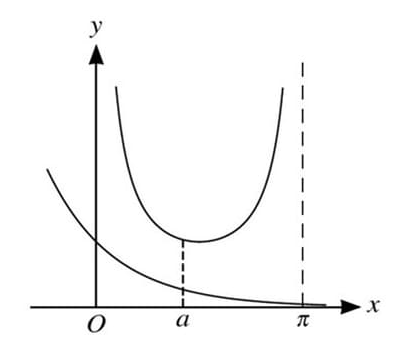
The diagram shows the curve \(y = \csc x\) for \(0 < x < \pi\) and part of the curve \(y = e^{-x}\). When \(x = a\), the tangents to the curves are parallel.
(i) By differentiating \(\frac{1}{\sin x}\), show that if \(y = \csc x\) then \(\frac{dy}{dx} = -\csc x \cot x\). [3]
(ii) By equating the gradients of the curves at \(x = a\), show that \(a = \arctan \left( \frac{e^a}{\sin a} \right)\). [2]
(iii) Verify by calculation that \(a\) lies between 1 and 1.5. [2]
(iv) Use an iterative formula based on the equation in part (ii) to determine \(a\) correct to 3 decimal places. Give the result of each iteration to 5 decimal places. [3]
Solutions locked. Please sign in with access to view them.