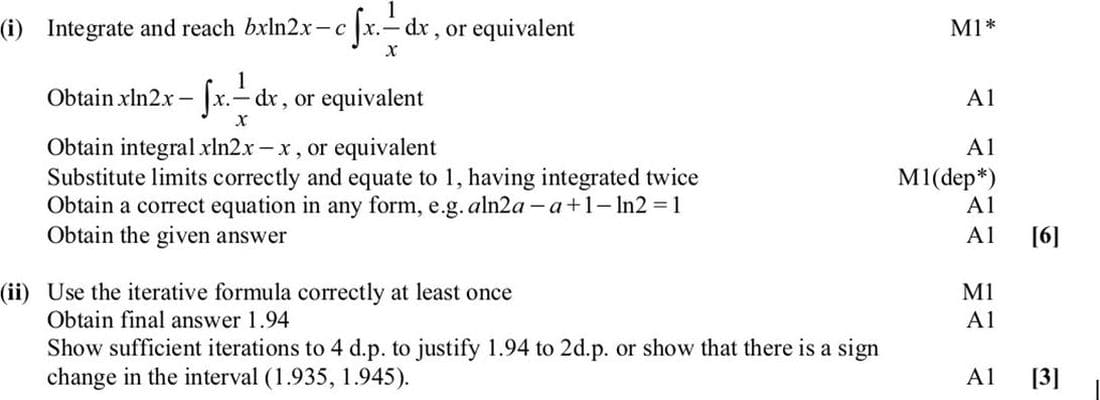
(i) To solve \(\int_{1}^{a} \ln(2x) \, dx = 1\), we first integrate:
\(\int \ln(2x) \, dx = x \ln(2x) - \int x \cdot \frac{1}{x} \, dx = x \ln(2x) - x + C\).
Evaluating from 1 to \(a\):
\([a \ln(2a) - a] - [1 \ln(2) - 1] = 1\).
Simplifying gives:
\(a \ln(2a) - a - \ln(2) + 1 = 1\).
\(a \ln(2a) - a = \ln(2)\).
\(a(\ln 2 + \ln a) - a = \ln(2)\).
\(a \ln a + a \ln 2 - a = \ln(2)\).
\(a \ln a = a - a \ln 2 + \ln(2)\).
\(a \ln a = a(1 - \ln 2) + \ln(2)\).
Rearranging gives:
\(a = \frac{1}{2} \exp \left( 1 + \frac{\ln 2}{a} \right)\).
(ii) Using the iterative formula:
Start with an initial guess, say \(a_1 = 2\).
\(a_2 = \frac{1}{2} \exp \left( 1 + \frac{\ln 2}{2} \right) \approx 1.9358\).
\(a_3 = \frac{1}{2} \exp \left( 1 + \frac{\ln 2}{1.9358} \right) \approx 1.9406\).
\(a_4 = \frac{1}{2} \exp \left( 1 + \frac{\ln 2}{1.9406} \right) \approx 1.9398\).
\(a_5 = \frac{1}{2} \exp \left( 1 + \frac{\ln 2}{1.9398} \right) \approx 1.9400\).
The value of \(a\) correct to 2 decimal places is \(1.94\).