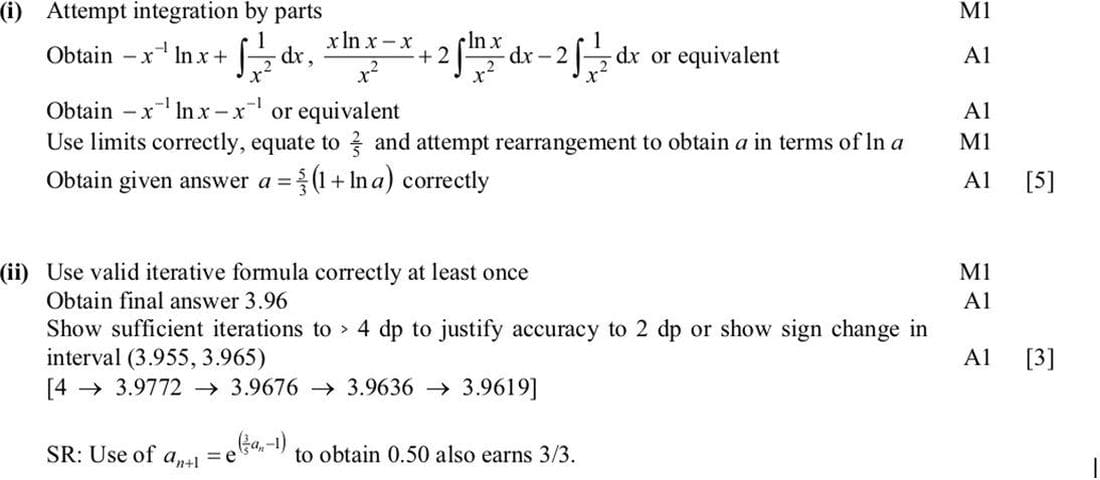
(i) To solve \(\int_1^a \frac{\ln x}{x^2} \, dx = \frac{2}{5}\), we use integration by parts. Let \(u = \ln x\) and \(dv = \frac{1}{x^2} \, dx\). Then \(du = \frac{1}{x} \, dx\) and \(v = -\frac{1}{x}\).
Applying integration by parts:
\(\int \frac{\ln x}{x^2} \, dx = -\frac{\ln x}{x} + \int \frac{1}{x^2} \, dx = -\frac{\ln x}{x} - \frac{1}{x} + C\)
Evaluating from 1 to \(a\):
\(\left[ -\frac{\ln x}{x} - \frac{1}{x} \right]_1^a = \left( -\frac{\ln a}{a} - \frac{1}{a} \right) - \left( -0 - 1 \right) = -\frac{\ln a}{a} - \frac{1}{a} + 1\)
Equating to \(\frac{2}{5}\):
\(-\frac{\ln a}{a} - \frac{1}{a} + 1 = \frac{2}{5}\)
Rearranging gives:
\(1 - \frac{2}{5} = \frac{\ln a + 1}{a}\)
\(\frac{3}{5} = \frac{\ln a + 1}{a}\)
\(a = \frac{5}{3}(1 + \ln a)\)
(ii) Using the iteration formula \(a_{n+1} = \frac{5}{3}(1 + \ln a_n)\) with \(a_0 = 4\):
\(a_1 = \frac{5}{3}(1 + \ln 4) \approx 3.9772\)
\(a_2 = \frac{5}{3}(1 + \ln 3.9772) \approx 3.9676\)
\(a_3 = \frac{5}{3}(1 + \ln 3.9676) \approx 3.9636\)
\(a_4 = \frac{5}{3}(1 + \ln 3.9636) \approx 3.9619\)
The value of \(a\) correct to 2 decimal places is \(a \approx 3.96\).