9709 P32 - Jun 2017 - Q10
1860
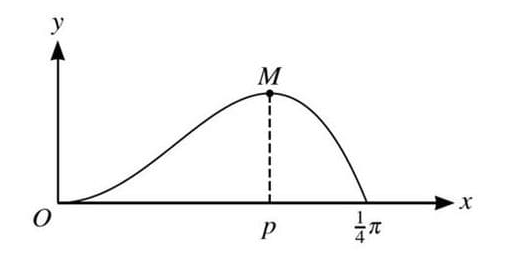
The diagram shows the curve \(y = x^2 \cos 2x\) for \(0 \leq x \leq \frac{1}{4}\pi\). The curve has a maximum point at \(M\) where \(x = p\).
(i) Show that \(p\) satisfies the equation \(p = \frac{1}{2} \arctan \left( \frac{1}{p} \right)\).
(ii) Use the iterative formula \(p_{n+1} = \frac{1}{2} \arctan \left( \frac{1}{p_n} \right)\) to determine the value of \(p\) correct to 2 decimal places. Give the result of each iteration to 4 decimal places.
(iii) Find, showing all necessary working, the exact area of the region bounded by the curve and the \(x\)-axis.
Solutions locked. Please sign in with access to view them.