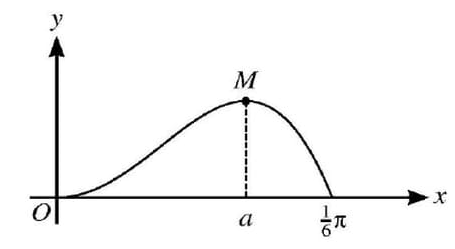
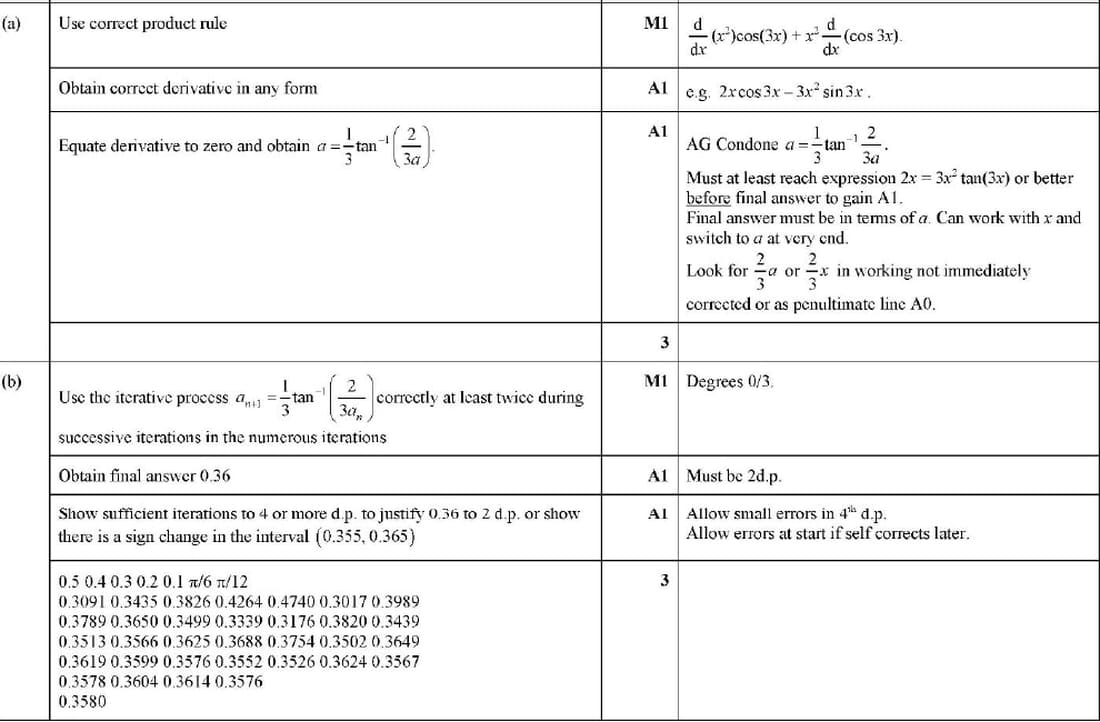
(a) To find the maximum point, we need to differentiate \(y = x^2 \cos 3x\) and set the derivative to zero. Using the product rule:
\(\frac{d}{dx}(x^2 \cos 3x) = \frac{d}{dx}(x^2) \cdot \cos 3x + x^2 \cdot \frac{d}{dx}(\cos 3x)\).
\(= 2x \cos 3x - 3x^2 \sin 3x\).
Setting the derivative to zero for maximum point:
\(2x \cos 3x - 3x^2 \sin 3x = 0\).
\(2x \cos 3x = 3x^2 \sin 3x\).
\(\frac{2}{3x} = \tan 3x\).
\(x = \frac{1}{3} \arctan \left( \frac{2}{3x} \right)\).
At maximum point \(x = a\), so \(a = \frac{1}{3} \arctan \left( \frac{2}{3a} \right)\).
(b) Using the iterative formula \(a_{n+1} = \frac{1}{3} \arctan \left( \frac{2}{3a_n} \right)\), start with an initial guess and iterate:
1. \(a_1 = 0.5\)
2. \(a_2 = \frac{1}{3} \arctan \left( \frac{2}{3 \times 0.5} \right) \approx 0.3435\)
3. \(a_3 = \frac{1}{3} \arctan \left( \frac{2}{3 \times 0.3435} \right) \approx 0.3826\)
4. \(a_4 = \frac{1}{3} \arctan \left( \frac{2}{3 \times 0.3826} \right) \approx 0.4264\)
5. \(a_5 = \frac{1}{3} \arctan \left( \frac{2}{3 \times 0.4264} \right) \approx 0.4740\)
6. \(a_6 = \frac{1}{3} \arctan \left( \frac{2}{3 \times 0.4740} \right) \approx 0.3017\)
7. \(a_7 = \frac{1}{3} \arctan \left( \frac{2}{3 \times 0.3017} \right) \approx 0.3989\)
Continue iterating until the value stabilizes to 2 decimal places: \(a \approx 0.36\).