9709 P33 - Jun 2019 - Q6
1821
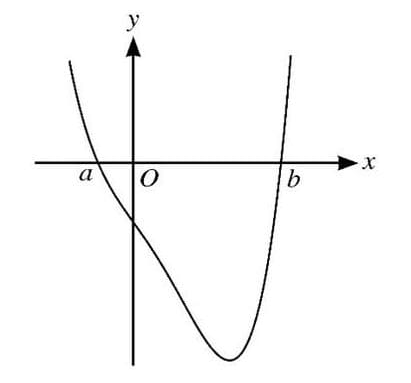
The diagram shows the curve \(y = x^4 - 2x^3 - 7x - 6\). The curve intersects the \(x\)-axis at the points \((a, 0)\) and \((b, 0)\), where \(a < b\). It is given that \(b\) is an integer.
- Find the value of \(b\).
- Hence show that \(a\) satisfies the equation \(a = -\frac{1}{3}(2 + a^2 + a^3)\).
- Use an iterative formula based on the equation in part (ii) to determine \(a\) correct to 3 decimal places. Give the result of each iteration to 5 decimal places.
Solutions locked. Please sign in with access to view them.