9709 P32 - Jun 2020 - Q9
1820
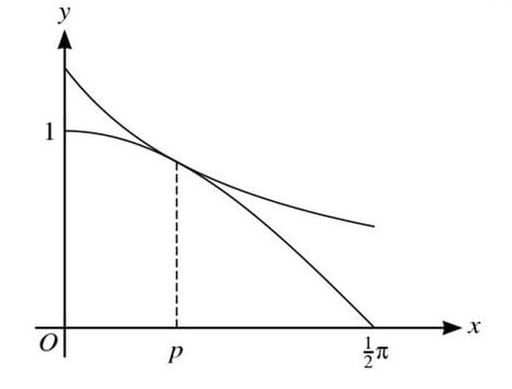
The diagram shows the curves \(y = \cos x\) and \(y = \frac{k}{1+x}\), where \(k\) is a constant, for \(0 \leq x \leq \frac{1}{2}\pi\). The curves touch at the point where \(x = p\).
(a) Show that \(p\) satisfies the equation \(\tan p = \frac{1}{1+p}\).
(b) Use the iterative formula \(p_{n+1} = \arctan\left(\frac{1}{1+p_n}\right)\) to determine the value of \(p\) correct to 3 decimal places. Give the result of each iteration to 5 decimal places.
(c) Hence find the value of \(k\) correct to 2 decimal places.
Solutions locked. Please sign in with access to view them.