Browsing as Guest. Progress, bookmarks and attempts are disabled.
Log in to track your work.
Nov 2014 p13 q4
799
Three geometric progressions, \(P, Q\) and \(R\), are such that their sums to infinity are the first three terms respectively of an arithmetic progression.
Progression \(P\) is \(2, 1, \frac{1}{2}, \frac{1}{4}, \ldots\).
Progression \(Q\) is \(3, 1, \frac{1}{3}, \frac{1}{9}, \ldots\).
(i) Find the sum to infinity of progression \(R\).
(ii) Given that the first term of \(R\) is 4, find the sum of the first three terms of \(R\).
Solution
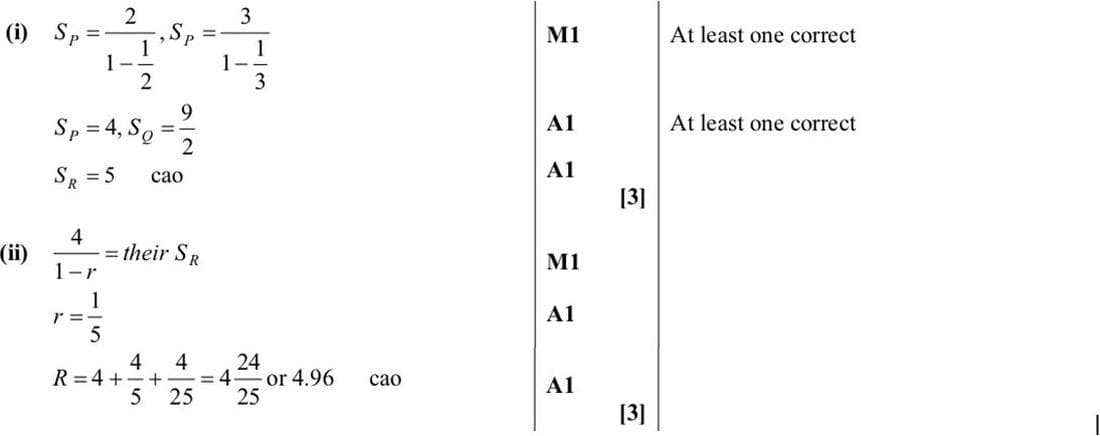
(i) The sum to infinity of a geometric progression is given by \(S = \frac{a}{1-r}\), where \(a\) is the first term and \(r\) is the common ratio.
For progression \(P\), \(a = 2\) and \(r = \frac{1}{2}\), so \(S_P = \frac{2}{1 - \frac{1}{2}} = 4\).
For progression \(Q\), \(a = 3\) and \(r = \frac{1}{3}\), so \(S_Q = \frac{3}{1 - \frac{1}{3}} = \frac{9}{2}\).
The sums \(S_P, S_Q, S_R\) form an arithmetic progression, so \(S_R = 5\).
(ii) Given the first term of \(R\) is 4, and \(S_R = \frac{4}{1-r} = 5\), solving for \(r\) gives \(r = \frac{1}{5}\).
The sum of the first three terms of \(R\) is \(4 + 4 \times \frac{1}{5} + 4 \times \left(\frac{1}{5}\right)^2 = 4 + \frac{4}{5} + \frac{4}{25} = \frac{24}{5}\) or 4.96.