The first three terms of an arithmetic progression are \(\frac{p^2}{6}\), \(2p - 6\) and \(p\).
(a) Given that the common difference of the progression is not zero, find the value of \(p\).
(b) Using this value, find the sum to infinity of the geometric progression with first two terms \(\frac{p^2}{6}\) and \(2p - 6\).
Solution
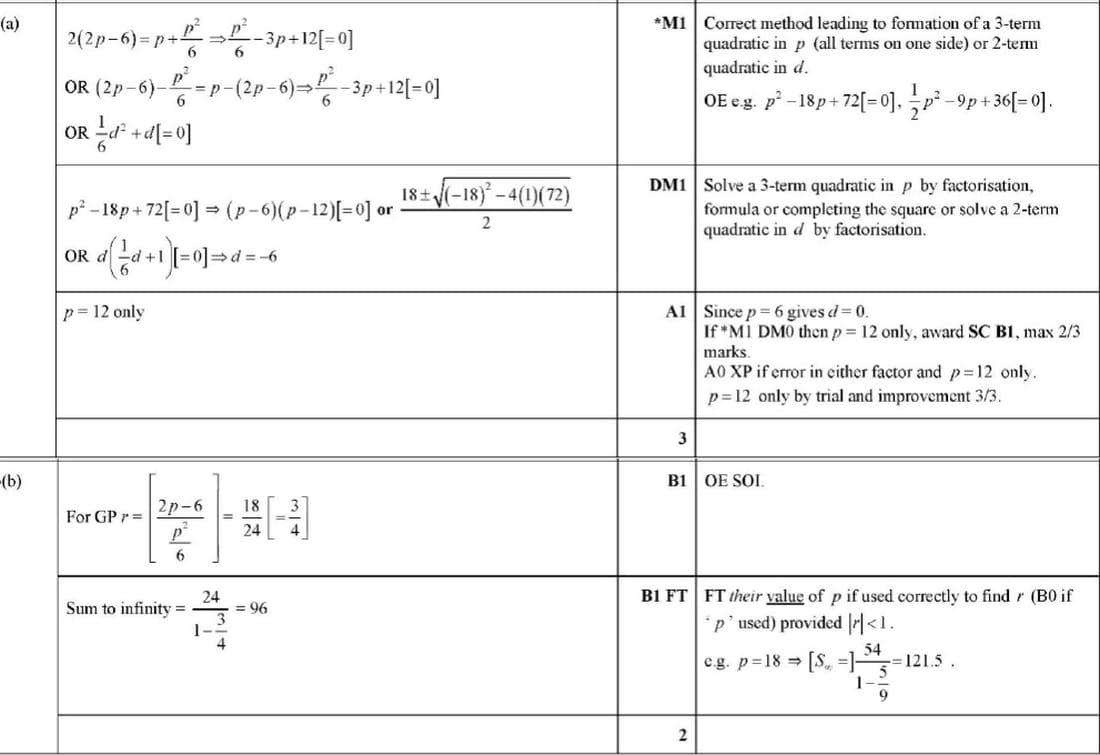
(a) The common difference \(d\) of the arithmetic progression is given by:
\(d = (2p - 6) - \frac{p^2}{6} = p - (2p - 6)\)
Equating the two expressions for \(d\):
\(2(2p - 6) = p + \frac{p^2}{6}\)
\(\Rightarrow p^2 - 18p + 72 = 0\)
Solving this quadratic equation by factorization:
\((p - 6)(p - 12) = 0\)
Since \(d \neq 0\), \(p = 12\).
(b) For the geometric progression, the common ratio \(r\) is:
\(r = \frac{2p - 6}{\frac{p^2}{6}} = \frac{18}{24} = \frac{3}{4}\)
The sum to infinity \(S\) is given by:
\(S = \frac{24}{1 - \frac{3}{4}} = 96\)
Log in to record attempts.