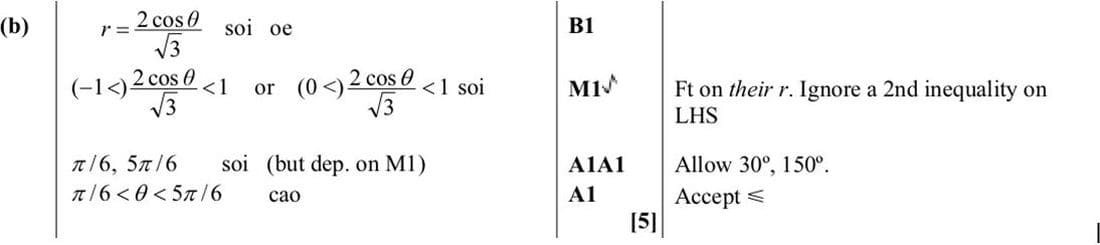
For a geometric progression to be convergent, the common ratio \(r\) must satisfy \(-1 < r < 1\).
The common ratio \(r\) is given by:
\(r = \frac{2 \cos \theta}{\sqrt{3}}\)
Thus, the inequality becomes:
\(-1 < \frac{2 \cos \theta}{\sqrt{3}} < 1\)
We solve the inequality \(0 < \frac{2 \cos \theta}{\sqrt{3}} < 1\) since \(0 < \theta < \pi\):
\(0 < 2 \cos \theta < \sqrt{3}\)
\(0 < \cos \theta < \frac{\sqrt{3}}{2}\)
The values of \(\theta\) for which \(\cos \theta = \frac{\sqrt{3}}{2}\) are \(\theta = \frac{\pi}{6}\) and \(\theta = \frac{5\pi}{6}\).
Therefore, the set of values of \(\theta\) for which the progression is convergent is:
\(\frac{\pi}{6} < \theta < \frac{5\pi}{6}\).