In an arithmetic progression, the 1st term is -10, the 15th term is 11 and the last term is 41. Find the sum of all the terms in the progression.
Solution
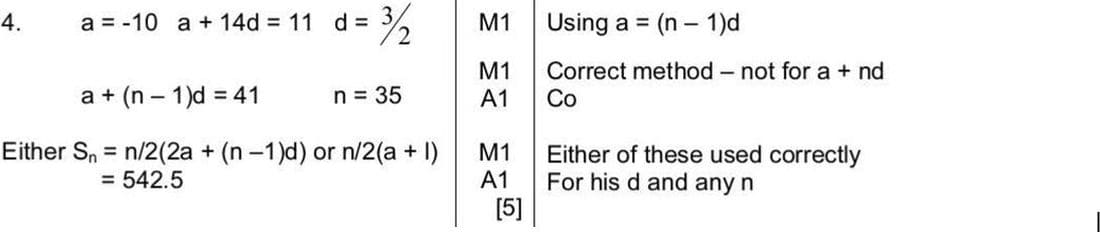
Let the first term be \(a = -10\) and the common difference be \(d\).
The 15th term is given by \(a + 14d = 11\).
Substituting \(a = -10\), we have:
\(-10 + 14d = 11\)
\(14d = 21\)
\(d = \frac{3}{2}\)
The last term is given by \(a + (n-1)d = 41\).
Substituting \(a = -10\) and \(d = \frac{3}{2}\), we have:
\(-10 + (n-1) \times \frac{3}{2} = 41\)
\((n-1) \times \frac{3}{2} = 51\)
\(n-1 = 34\)
\(n = 35\)
The sum of the arithmetic progression is given by:
\(S_n = \frac{n}{2} (a + l)\)
\(S_{35} = \frac{35}{2} (-10 + 41)\)
\(S_{35} = \frac{35}{2} \times 31\)
\(S_{35} = 542.5\)
Log in to record attempts.