The first, second and third terms of an arithmetic progression are \(k\), \(6k\) and \(k + 6\) respectively.
(a) Find the value of the constant \(k\).
(b) Find the sum of the first 30 terms of the progression.
Solution
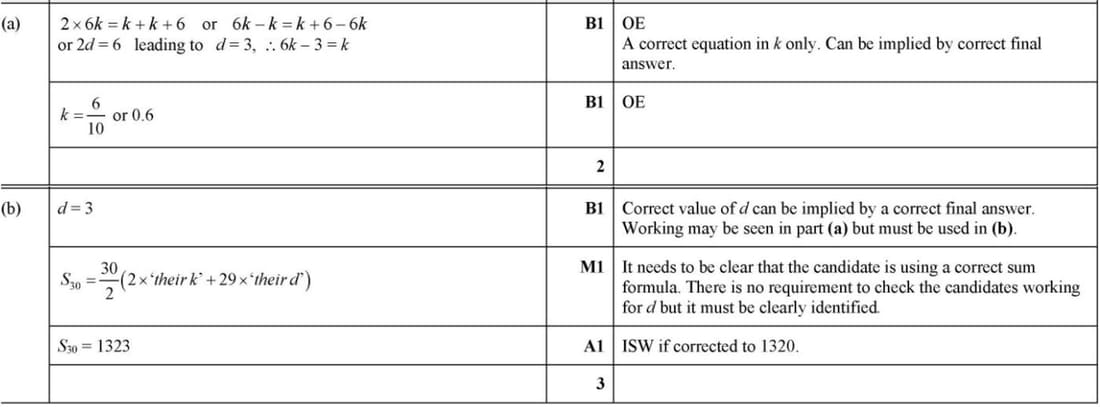
(a) For an arithmetic progression, the difference between consecutive terms is constant. Therefore, we have:
\(6k - k = k + 6 - 6k\)
\(5k = k + 6 - 6k\)
\(5k = k + 6 - 6k\)
\(5k + 6k = k + 6\)
\(11k = k + 6\)
\(10k = 6\)
\(k = \frac{6}{10} = 0.6\)
(b) The common difference \(d\) is \(6k - k = 5k\). Substituting \(k = 0.6\), we get \(d = 3\).
The sum of the first 30 terms \(S_{30}\) is given by:
\(S_{30} = \frac{30}{2} (2 \times 0.6 + 29 \times 3)\)
\(S_{30} = 15 (1.2 + 87)\)
\(S_{30} = 15 \times 88.2\)
\(S_{30} = 1323\)
Log in to record attempts.