The sum of the first 20 terms of an arithmetic progression is 405 and the sum of the first 40 terms is 1410.
Find the 60th term of the progression.
Solution
The sum of the first n terms of an arithmetic progression is given by:
\(S_n = \frac{n}{2} (2a + (n-1)d)\)
For the first 20 terms:
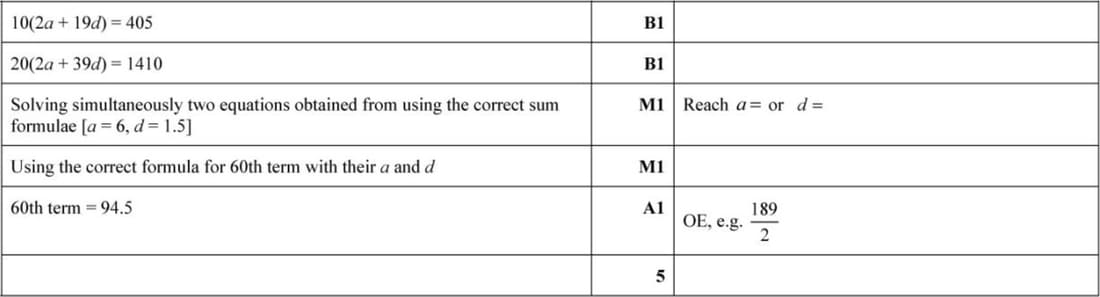
\(\frac{20}{2} (2a + 19d) = 405\)
\(10(2a + 19d) = 405\)
For the first 40 terms:
\(\frac{40}{2} (2a + 39d) = 1410\)
\(20(2a + 39d) = 1410\)
We have the equations:
1. \(10(2a + 19d) = 405\)
2. \(20(2a + 39d) = 1410\)
Solving these simultaneously:
From equation 1: \(2a + 19d = 40.5\)
From equation 2: \(2a + 39d = 70.5\)
Subtract equation 1 from equation 2:
\(20d = 30\)
\(d = 1.5\)
Substitute \(d = 1.5\) into equation 1:
\(2a + 19(1.5) = 40.5\)
\(2a + 28.5 = 40.5\)
\(2a = 12\)
\(a = 6\)
Now, find the 60th term \(T_{60}\):
\(T_{60} = a + 59d\)
\(T_{60} = 6 + 59(1.5)\)
\(T_{60} = 6 + 88.5\)
\(T_{60} = 94.5\)
Log in to record attempts.