Let the first term be \(a\) and the common difference be \(d\).
The formula for the \(n\)-th term of an arithmetic progression is \(a_n = a + (n-1)d\).
Given the 13th term is 12, we have:
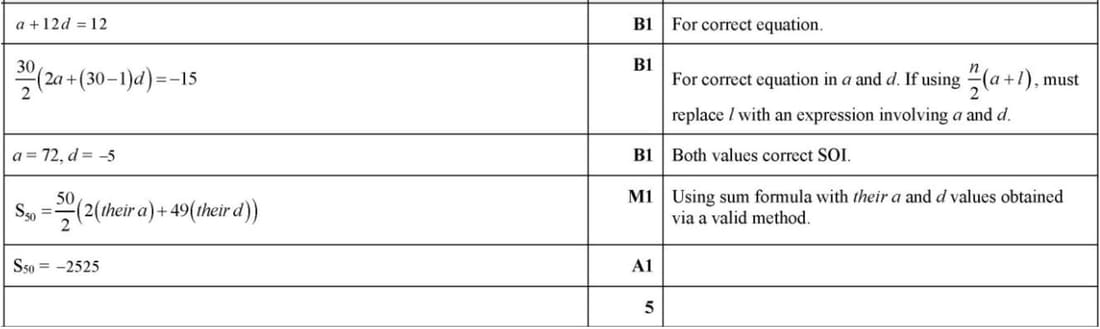
\(a + 12d = 12\) (Equation 1)
The formula for the sum of the first \(n\) terms is \(S_n = \frac{n}{2} (2a + (n-1)d)\).
Given the sum of the first 30 terms is -15, we have:
\(\frac{30}{2} (2a + 29d) = -15\)
\(15(2a + 29d) = -15\)
\(2a + 29d = -1\) (Equation 2)
Solving Equations 1 and 2 simultaneously:
From Equation 1: \(a = 12 - 12d\)
Substitute into Equation 2:
\(2(12 - 12d) + 29d = -1\)
\(24 - 24d + 29d = -1\)
\(5d = -25\)
\(d = -5\)
Substitute \(d = -5\) back into Equation 1:
\(a + 12(-5) = 12\)
\(a - 60 = 12\)
\(a = 72\)
Now, find the sum of the first 50 terms:
\(S_{50} = \frac{50}{2} (2a + 49d)\)
\(S_{50} = 25 (2(72) + 49(-5))\)
\(S_{50} = 25 (144 - 245)\)
\(S_{50} = 25 (-101)\)
\(S_{50} = -2525\)