Past Exam Questions
← Back0606 P11 - Jun 2024 - Q3 - 9 marks
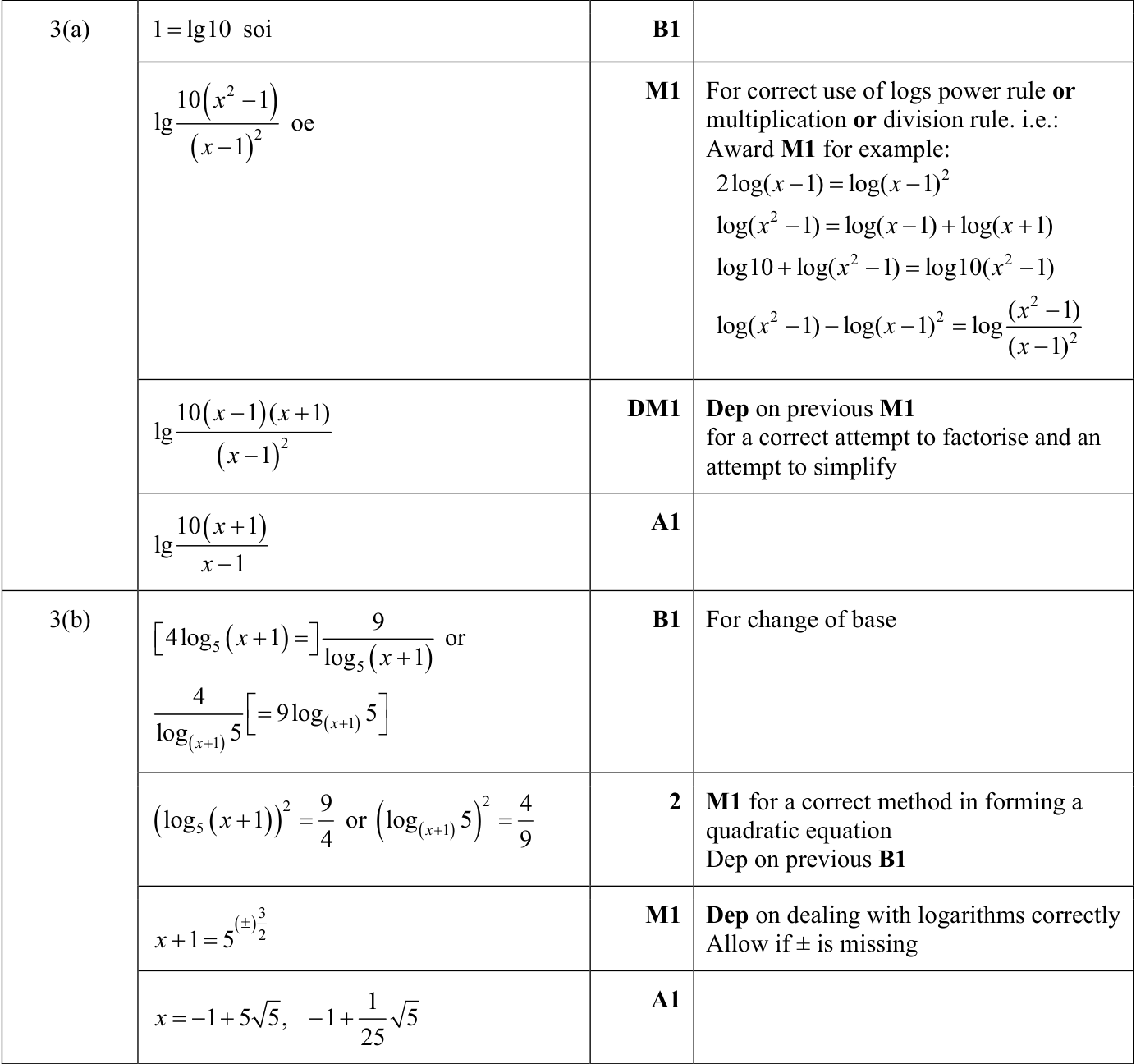
(a) Write \(1+\lg \left(x^{2}-1\right)-2 \lg (x-1)\), where \(x\gt 1\), as a single logarithm to base 10 . Give your answer in its simplest form. (b) Solve the equation \(4 \log _{5}(x+1)=9 \log _{(x+1)} 5\), giving your answers in the form \(a+b \sqrt{c}\), where \(a, b\) and \(c\) are constants.
0606 P13 - Jun 2024 - Q11 - 6 marks
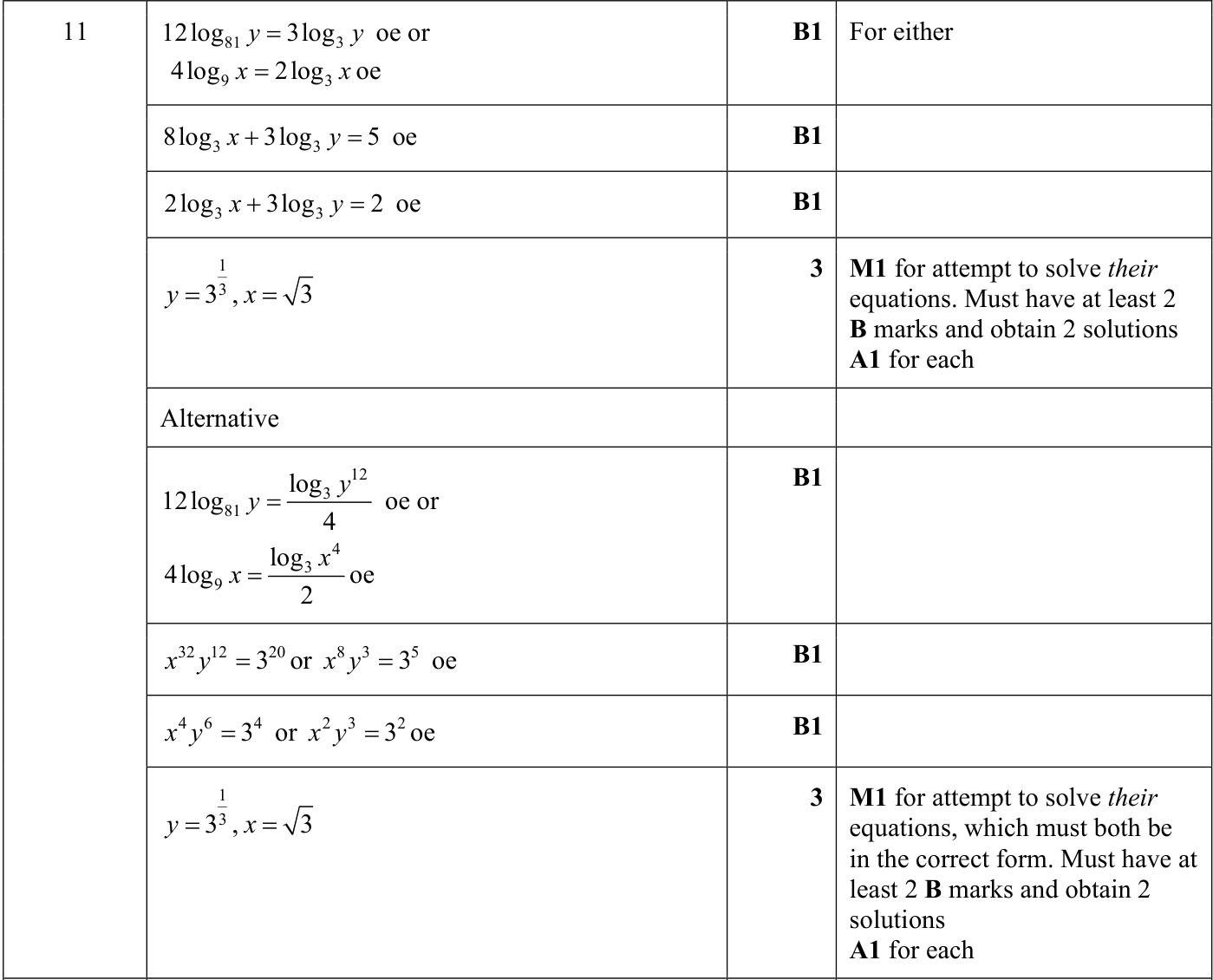
Solve the following simultaneous equations, giving your answers in exact form. \(\begin{array}{c} 8 \log _{3} x+12 \log _{81} y=5 \\ 4 \log _{9} x+3 \log _{3} y=2 \end{array}\)
0606 P23 - Nov 2023 - Q3 - 9 marks
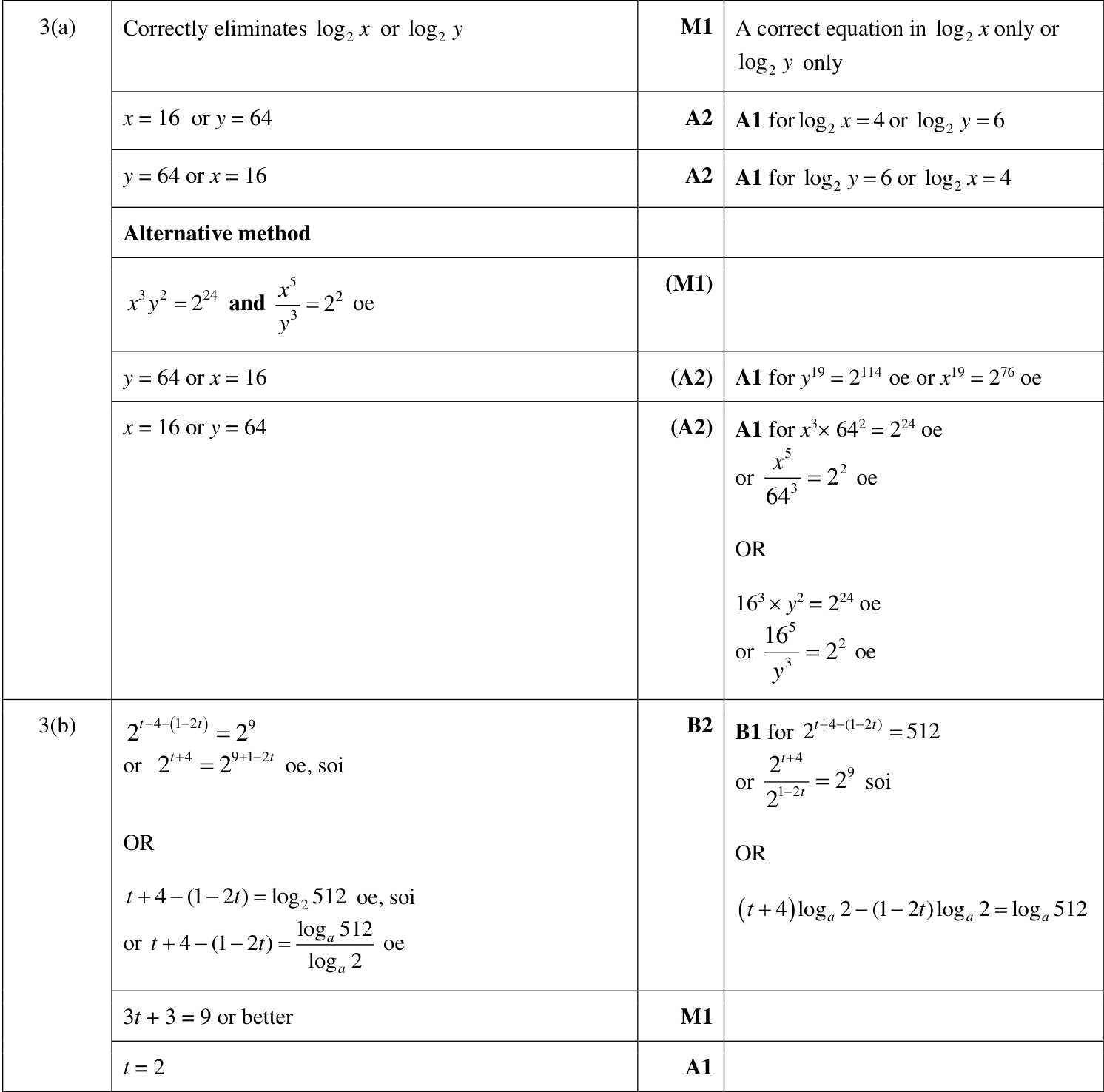
(a) Solve the following simultaneous equations.
\(3\log_2x+2\log_2y=24\)
\(5\log_2x-3\log_2y=2\)
(b) Solve the equation
\(\frac{2^{t+4}}{2^{1-2t}}=512\).
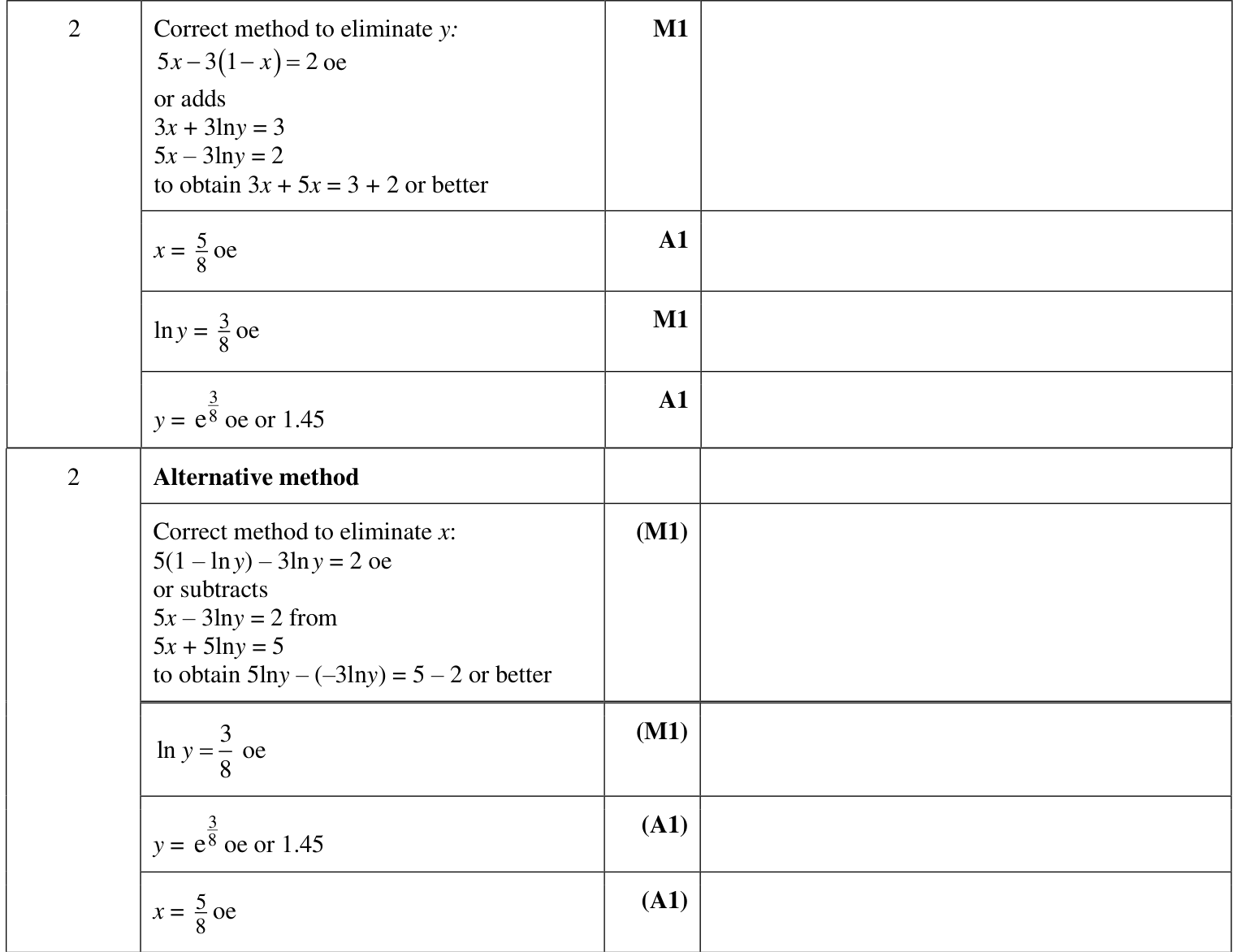
0606 P21 - Nov 2023 - Q2 - 4 marks
Solve the following simultaneous equations.
\(5x-3\ln y=2\)
\(x+\ln y=1\)
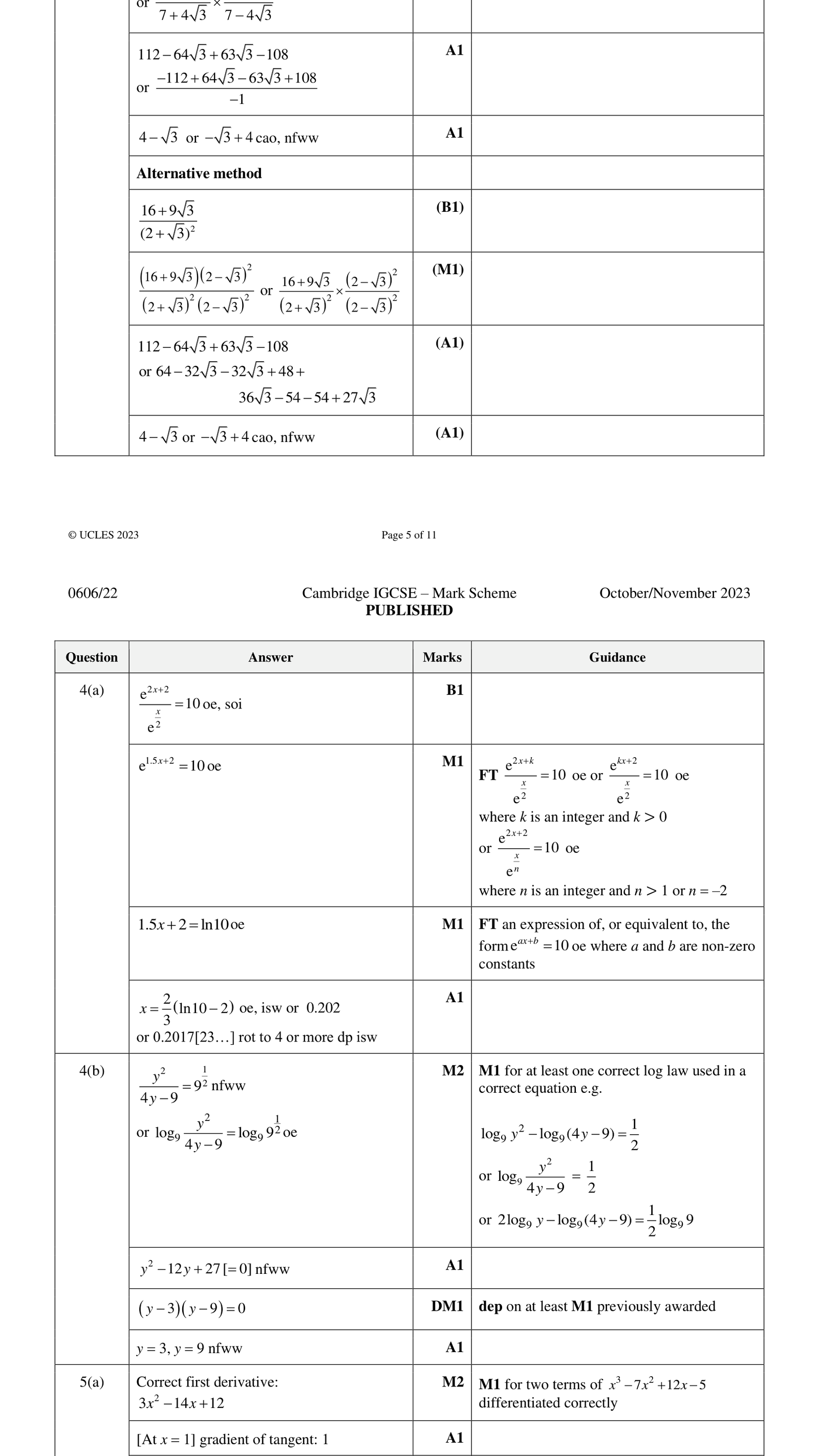
0606 P22 - Nov 2023 - Q4 - 9 marks
Solve the following equations.
(a) \(\displaystyle \frac{(\mathrm e^{x+1})^2}{\sqrt{\mathrm e^x}}=10\)
(b) \(2\log_9y-\log_9(4y-9)=\frac12\)
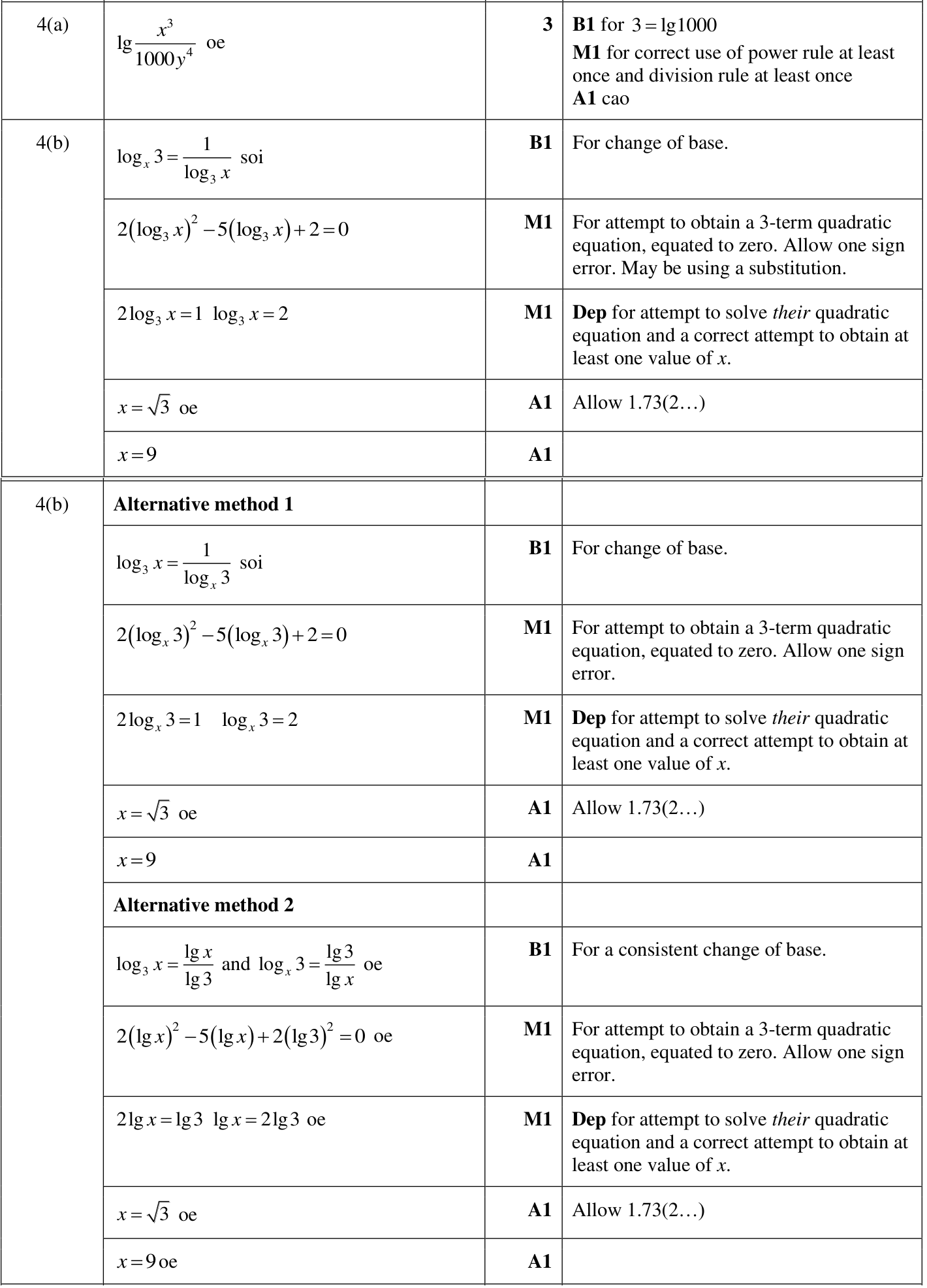
0606 P12 - Mar 2023 - Q4 - 8 marks
(a) Write
\(3\lg x-2\lg y^2-3\)
as a single logarithm to base 10.
(b) Solve the equation
\(\log_3 x+\log_x 3=\frac52.\)
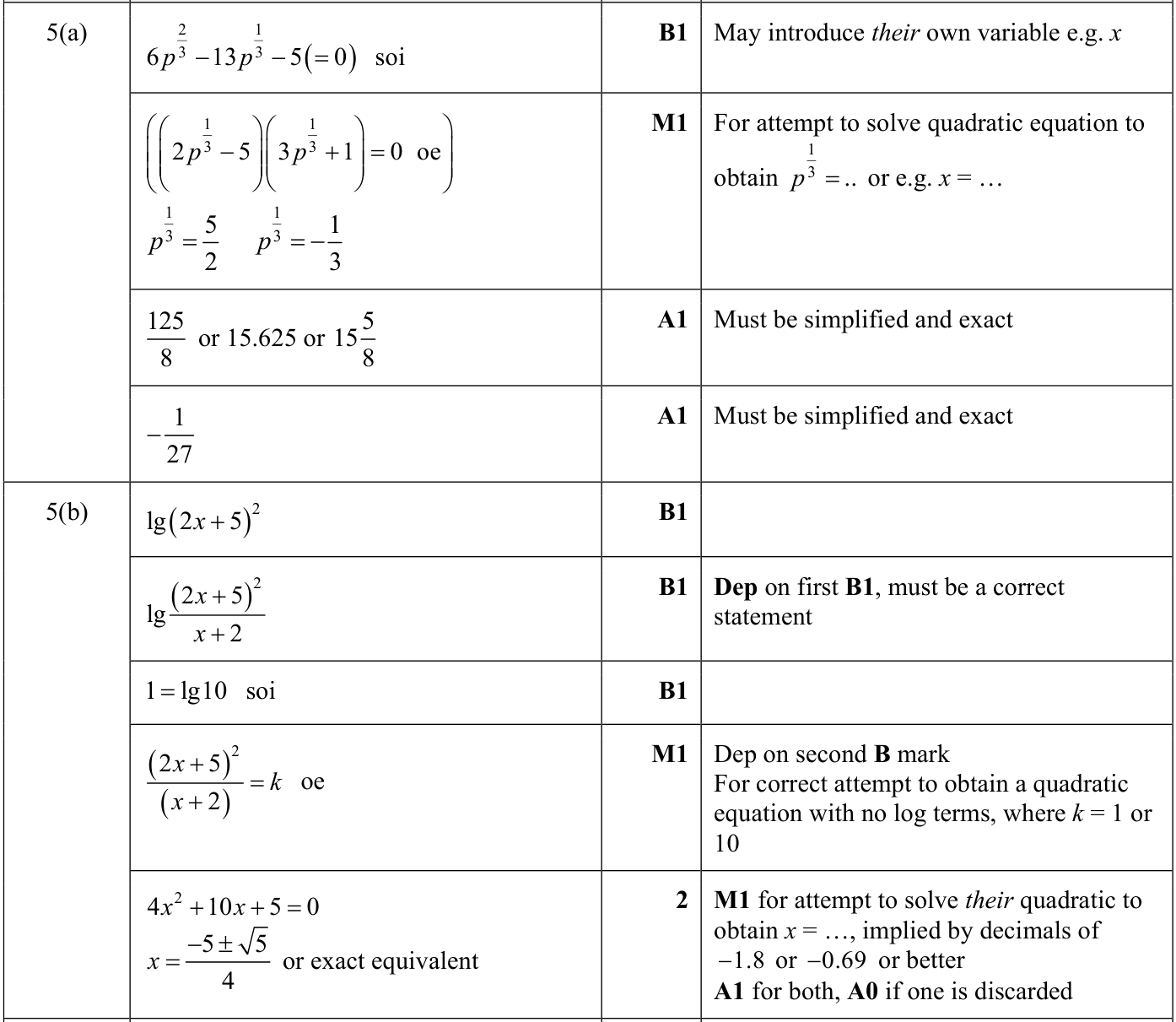
0606 P12 - Jun 2023 - Q5 - 10 marks
(a) Find the exact solutions of the equation
\(6p^{\frac13}-5p^{-\frac13}-13=0.\)
(b) Solve the equation
\(2\lg(2x+5)-\lg(x+2)=1,\)
giving your answers in exact form.
0606 P13 - Jun 2023 - Q3 - 8 marks
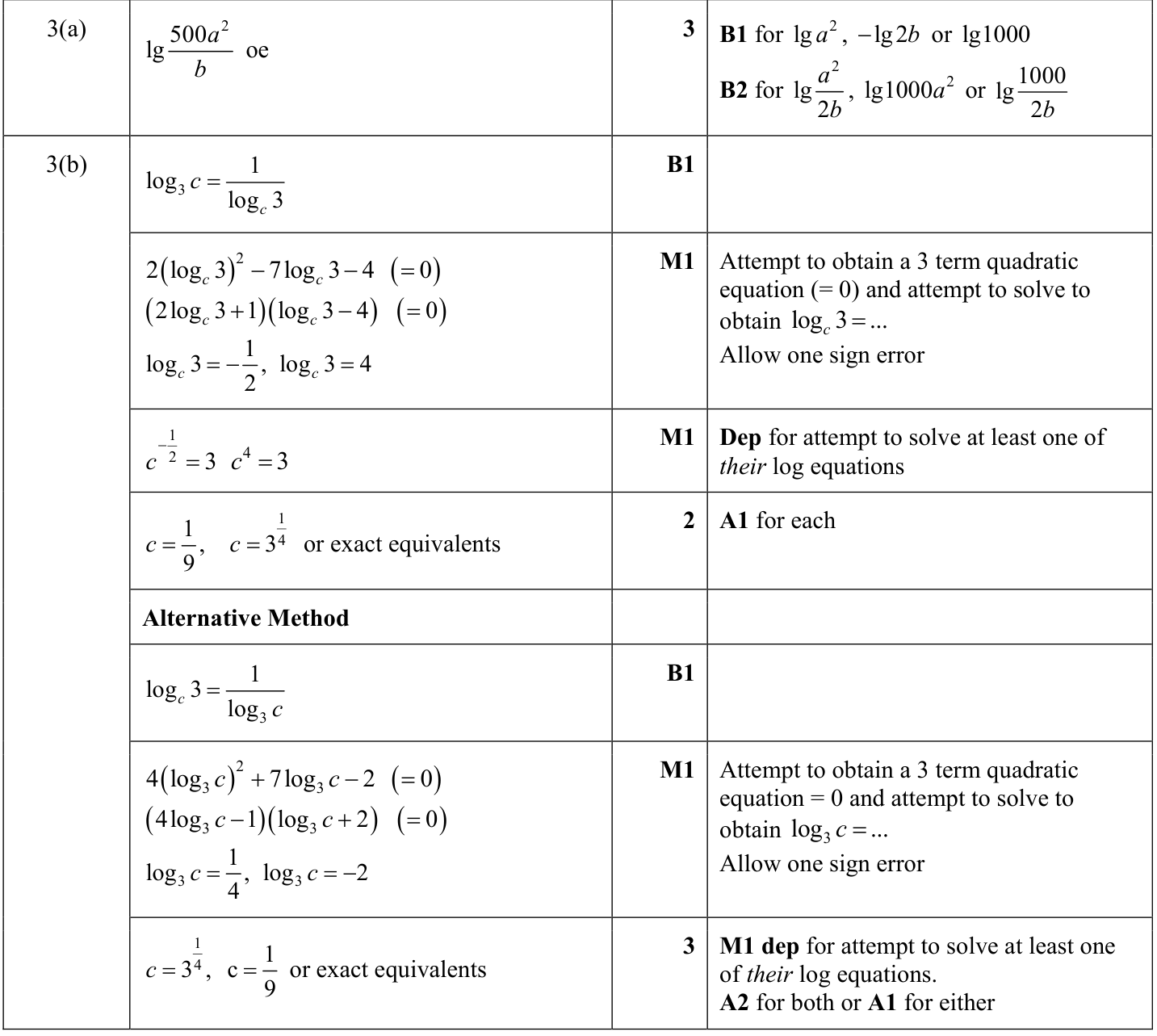
(a) Write
\(3+2\lg a-\frac12\lg(4b^2),\)
where \(a\) and \(b\) are both positive, as a single logarithm to base 10. Give your answer in its simplest form.
(b) Given that \(2\log_c3=7+4\log_3c\), find the possible values of the positive constant \(c\), giving your answers in exact form.
0606 P11 - Nov 2023 - Q6 - 8 marks
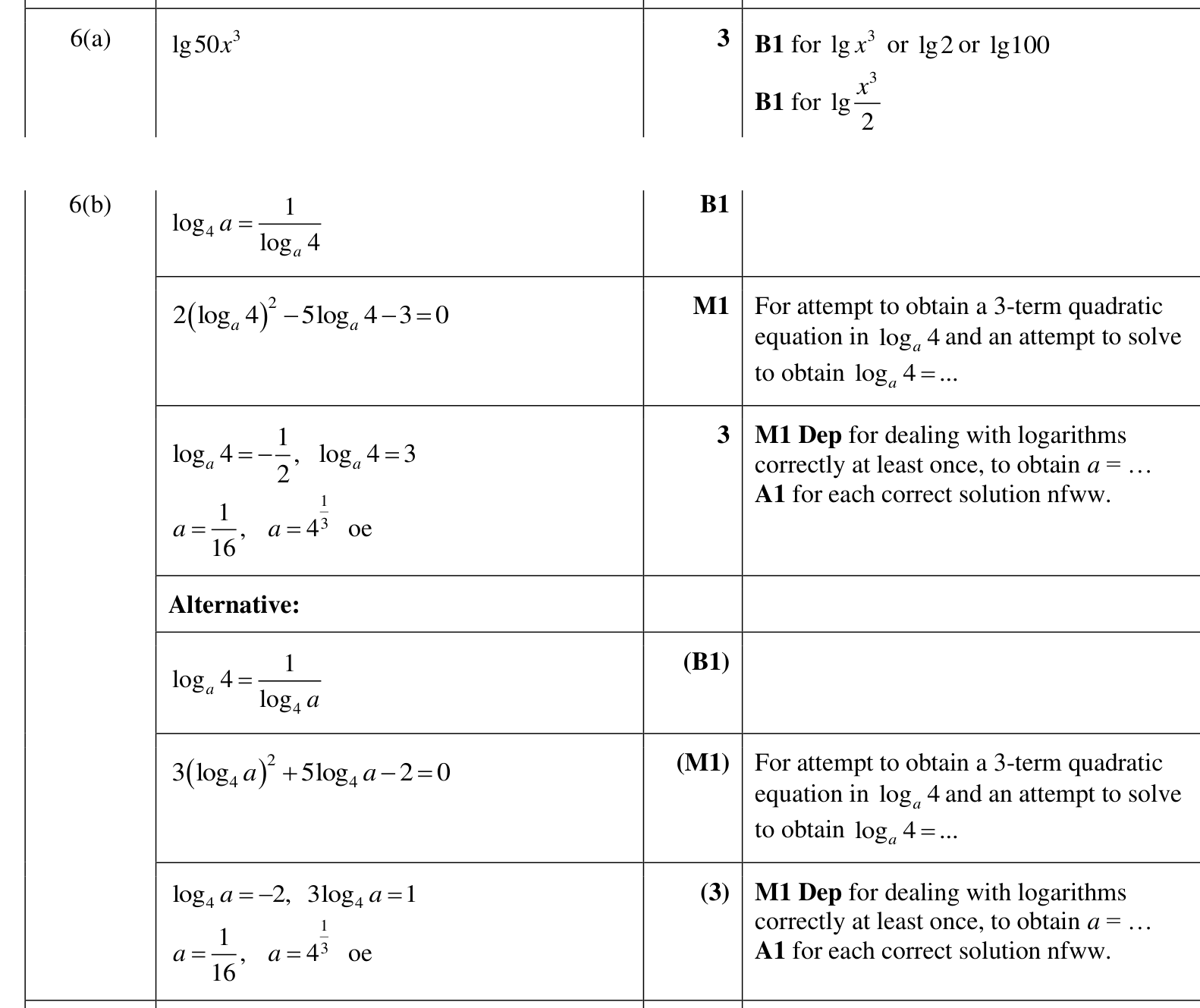
(a) Write \(3\lg x-\frac12\lg4+2\) as a single logarithm to base 10.
(b) Solve the equation
\(2\log_a4-3\log_4a-5=0\),
giving your answers exactly.
0606 P22 - Mar 2022 - Q2 - 3 marks
Solve the equation
\(\log_5(8x+7)-\log_5(2x)=2.\)

0606 P11 - Jun 2022 - Q3 - 10 marks
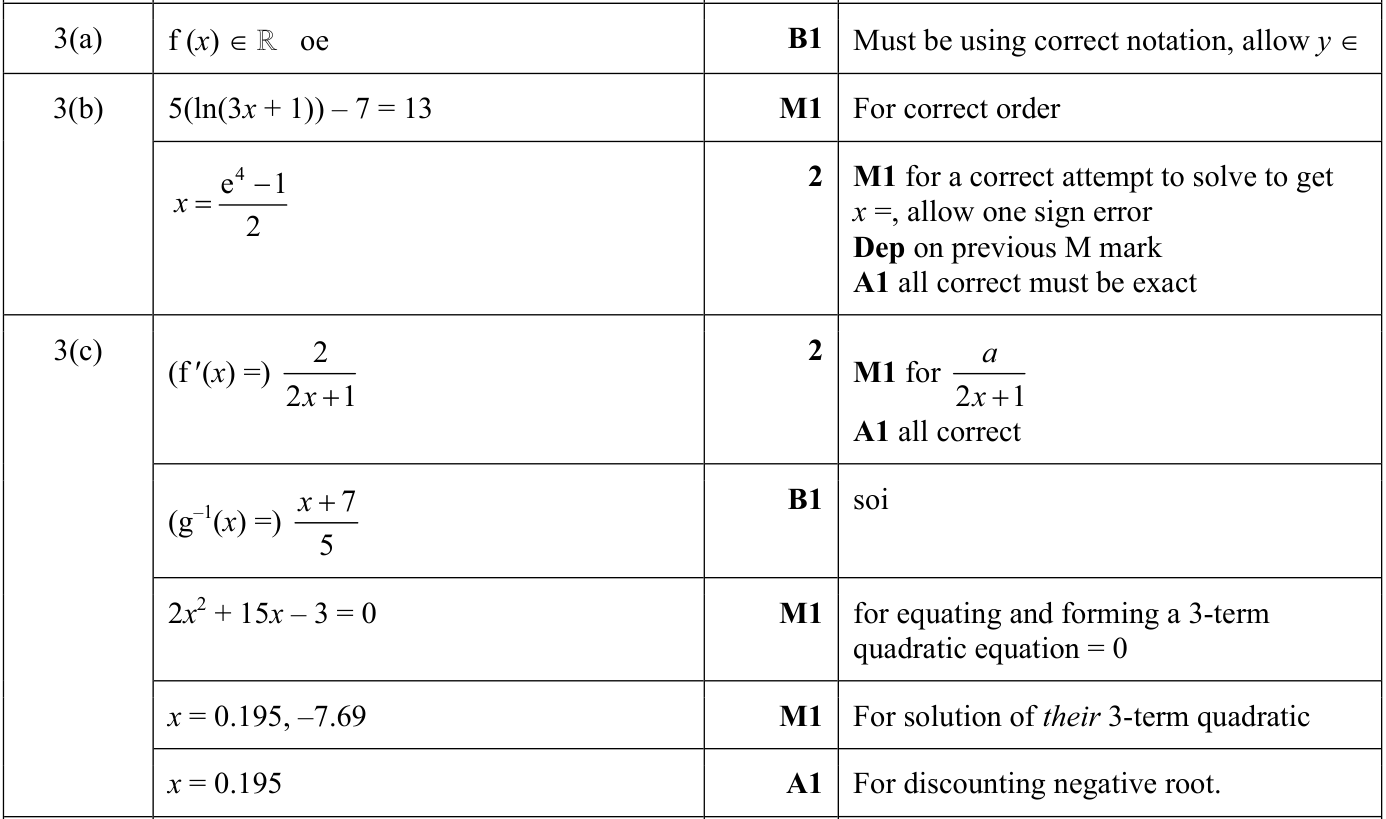
A function \(f\) is such that \(f(x)=\ln(2x+1)\), for \(x\gt -\frac12\).
(a) Write down the range of \(f\).
A function \(g\) is such that \(g(x)=5x-7\), for \(x\in\mathbb R\).
(b) Find the exact solution of \(gf(x)=13\).
(c) Find the solution of \(f'(x)=g^{-1}(x)\).
0606 P12 - Jun 2022 - Q10 - 11 marks
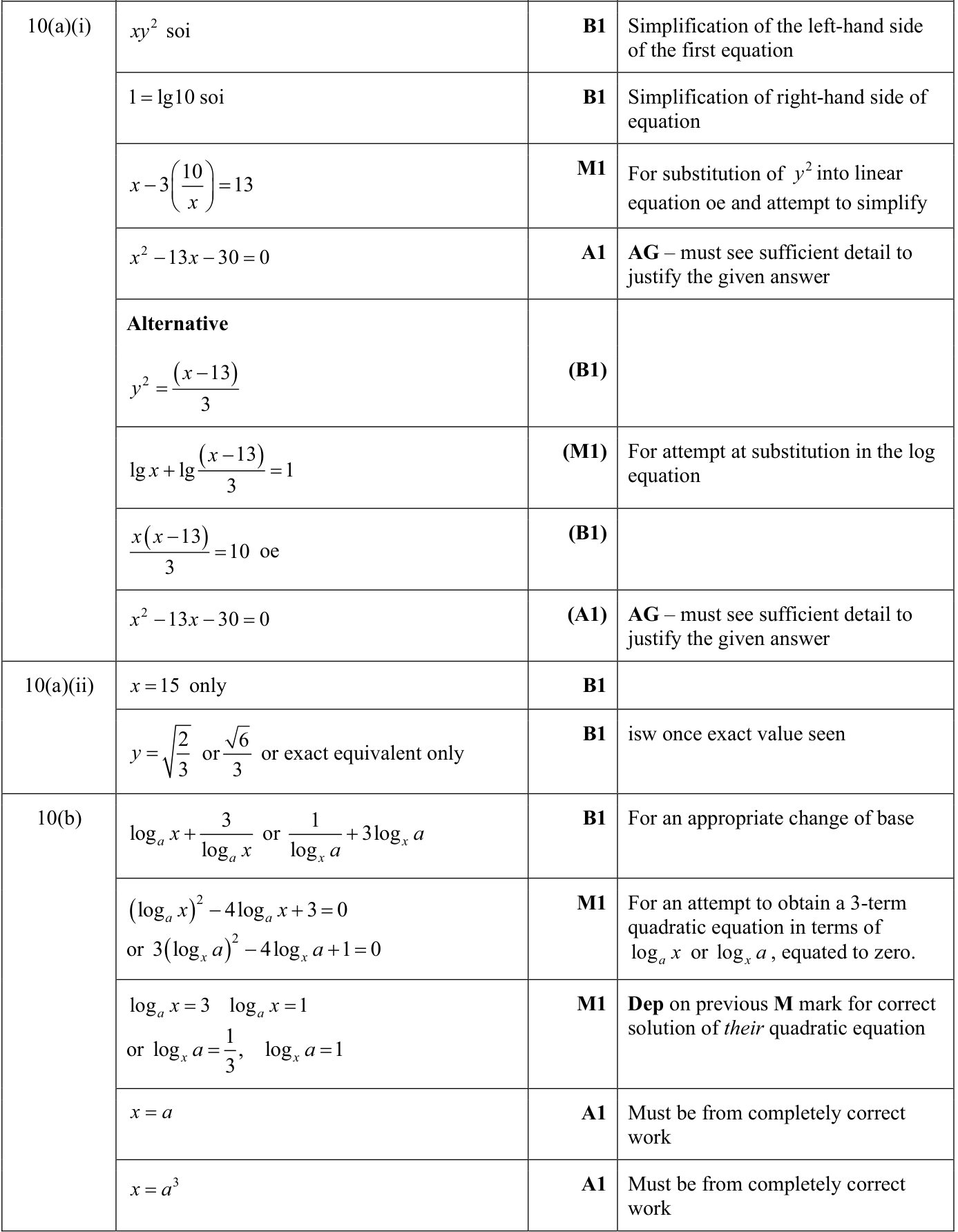
(a) Given the simultaneous equations
\(\lg x+2\lg y=1,\)
\(x-3y^2=13,\)
(i) show that \(x^2-13x-30=0\).
(ii) Solve these simultaneous equations, giving your answers in exact form.
(b) Solve the equation
\(\log_a x+3\log_x a=4,\)
where \(a\) is a positive constant, giving \(x\) in terms of \(a\).
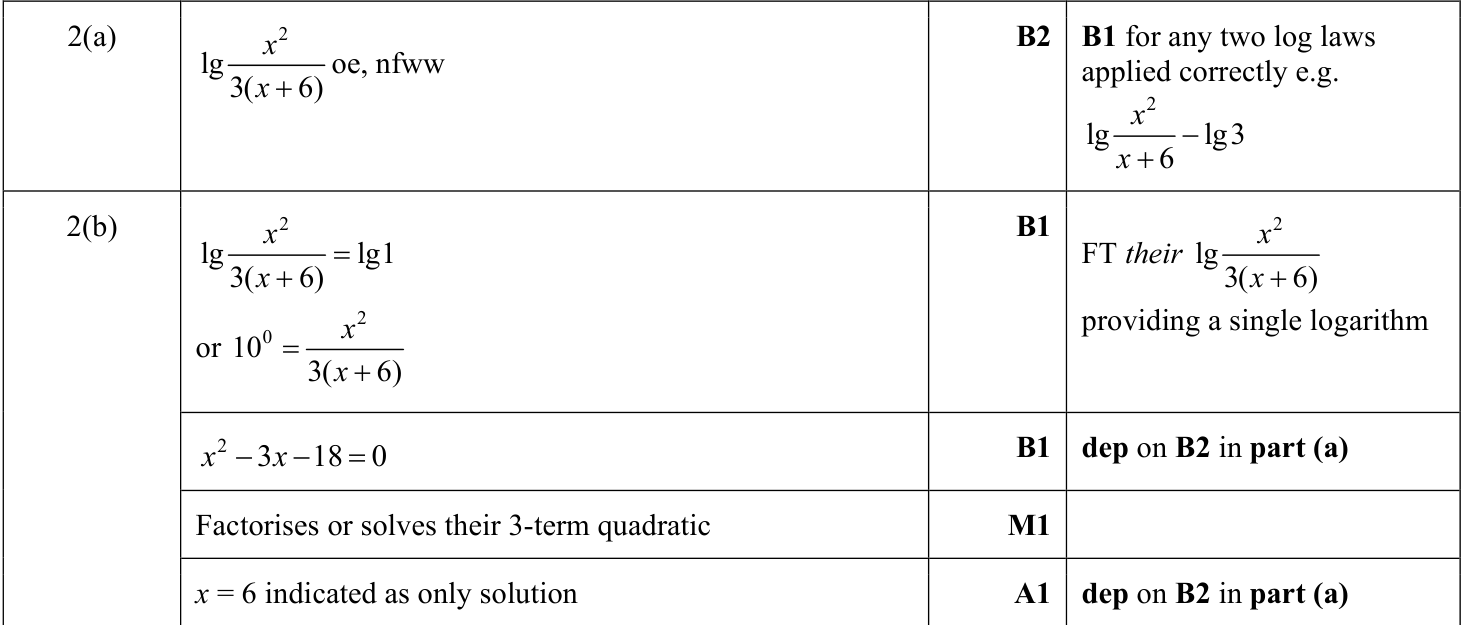
0606 P21 - Jun 2022 - Q2 - 6 marks
(a) Write \(2\lg x-\{\lg(x+6)+\lg 3\}\) as a single logarithm to base 10.
(b) Hence solve the equation \(2\lg x-\{\lg(x+6)+\lg 3\}=0\).
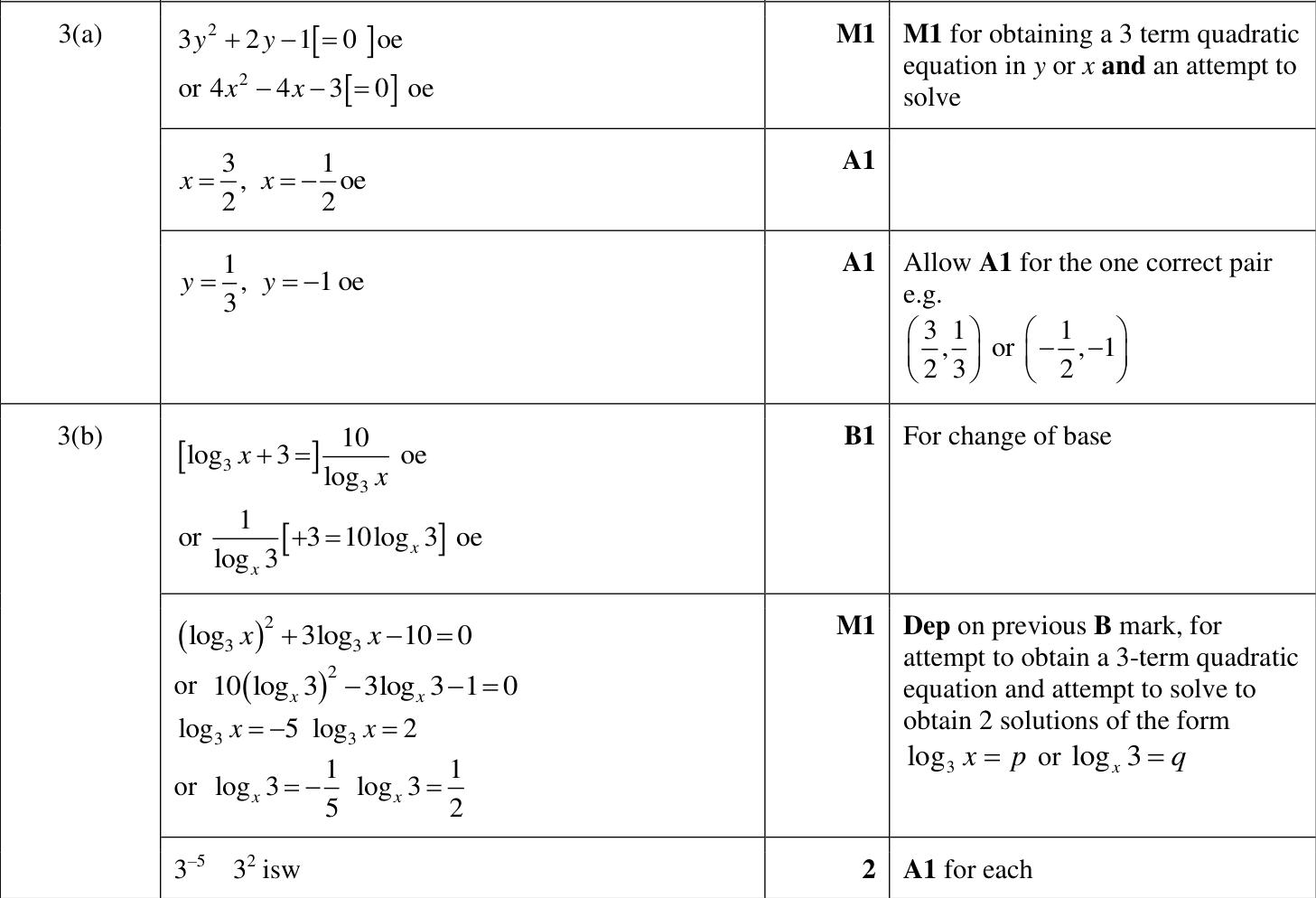
0606 P13 - Nov 2022 - Q3 - 7 marks
(a) Solve the following simultaneous equations.
\(3y-2x+2=0,\qquad xy=\frac12.\)
(b) Solve the equation
\(\log_3x+3=10\log_x3,\)
giving your answers as powers of \(3\).
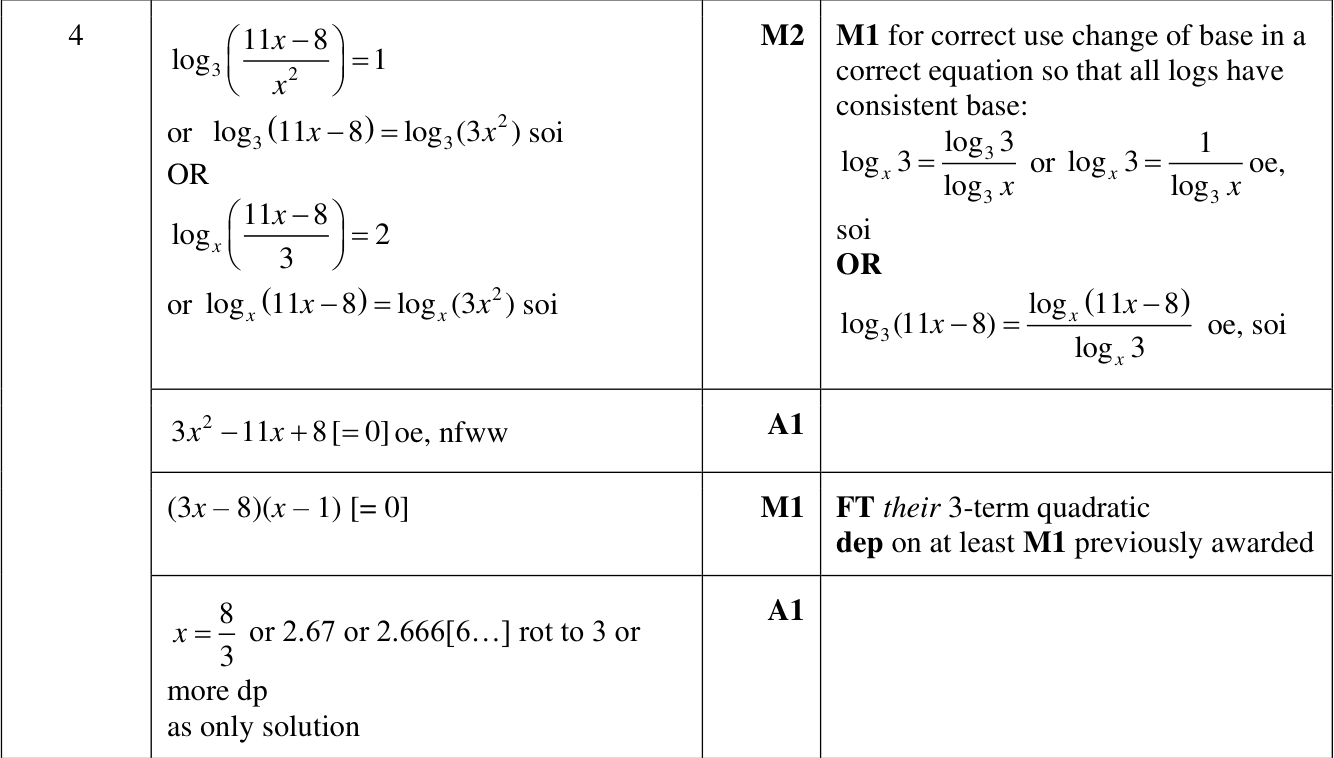
0606 P22 - Nov 2022 - Q4 - 5 marks
Solve the equation
\(\log_3(11x-8)=1+\frac{2}{\log_x3},\)
given that \(x\gt 1\).
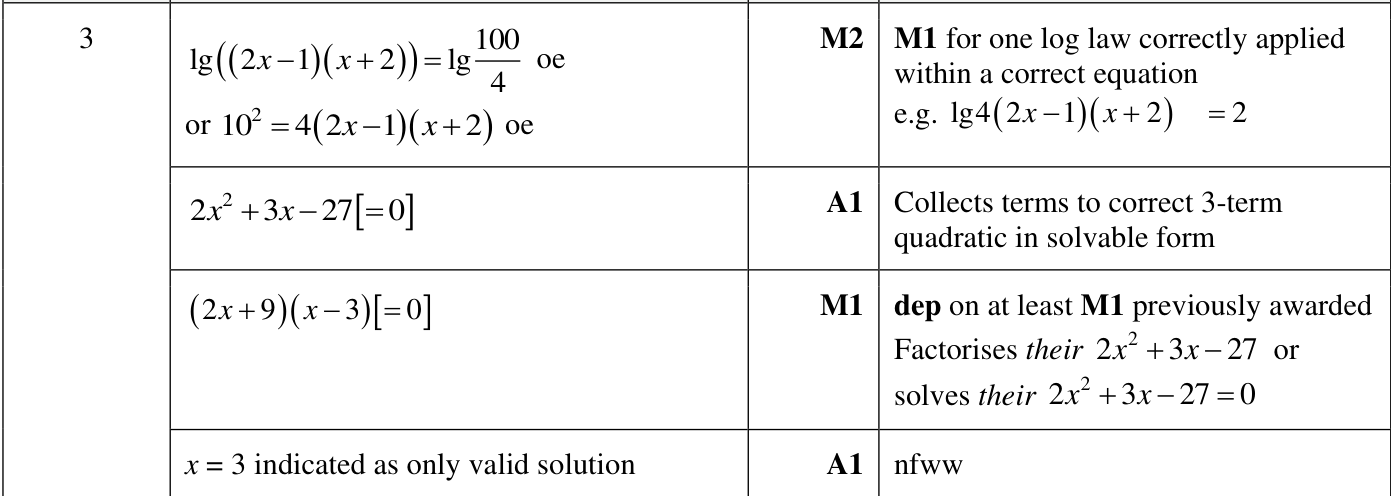
0606 P23 - Nov 2022 - Q3 - 5 marks
Solve the equation
\(\lg(2x-1)+\lg(x+2)=2-\lg 4.\)
0606 P12 - Mar 2021 - Q1 - 4 marks
Find the exact solutions of the equation
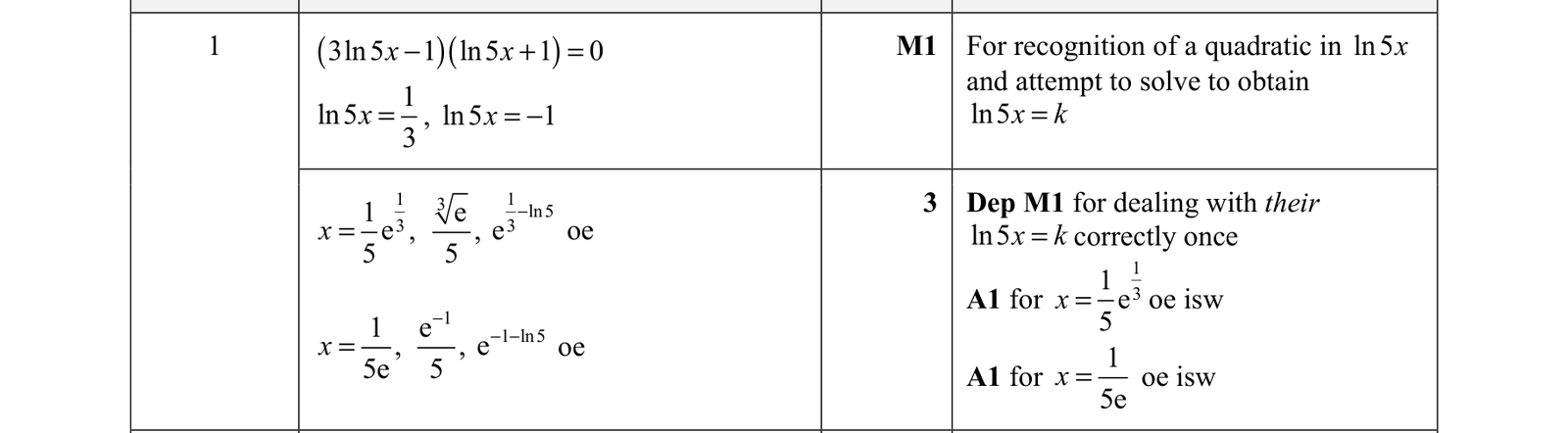
\(3(\ln 5x)^2+2\ln 5x-1=0.\)
0606 P12 - Jun 2021 - Q5 - 8 marks
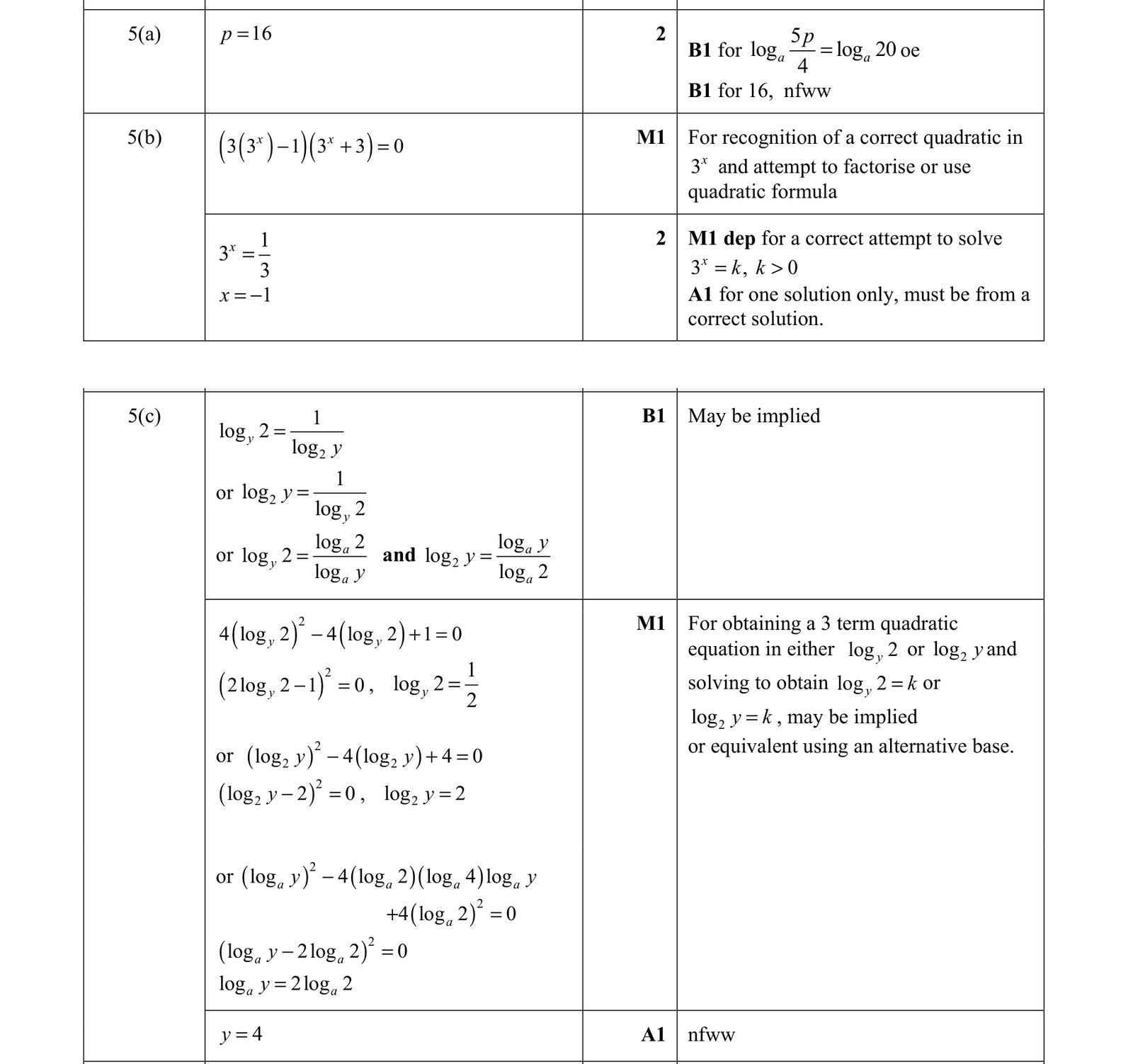
(a) Given that
\(\log_a p+\log_a 5-\log_a 4=\log_a 20,\)
find the value of \(p\).
(b) Solve the equation
\(3^{2x+1}+8(3^x)-3=0.\)
(c) Solve the equation
\(4\log_y 2+\log_2 y=4.\)
0606 P21 - Jun 2021 - Q8 - 8 marks
In this question, \(a\), \(b\), \(c\) and \(d\) are positive constants.
(a)
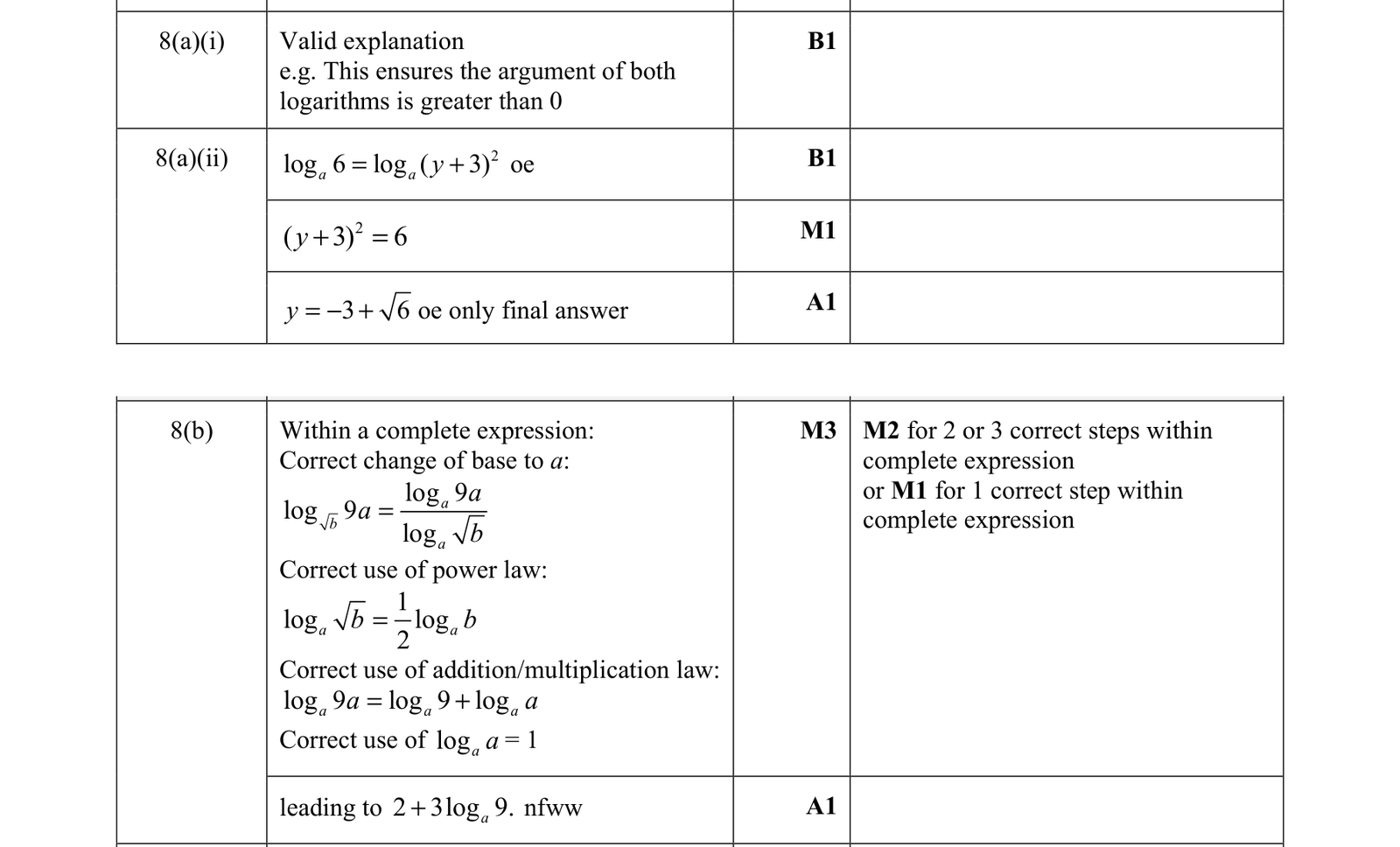
(i) It is given that
\(y=\log_a(x+3)+\log_a(2x-1).\)
Explain why \(x\) must be greater than \(\frac12\).
(ii) Find the exact solution of the equation
\(\frac{\log_a6}{\log_a(y+3)}=2.\)
(b) Write the expression
\(\log_a9+(\log_a b)\bigl(\log_{\sqrt b}9a\bigr)\)
in the form \(c+d\log_a9\), where \(c\) and \(d\) are integers.
0606 P23 - Jun 2021 - Q3 - 7 marks
(a) Write
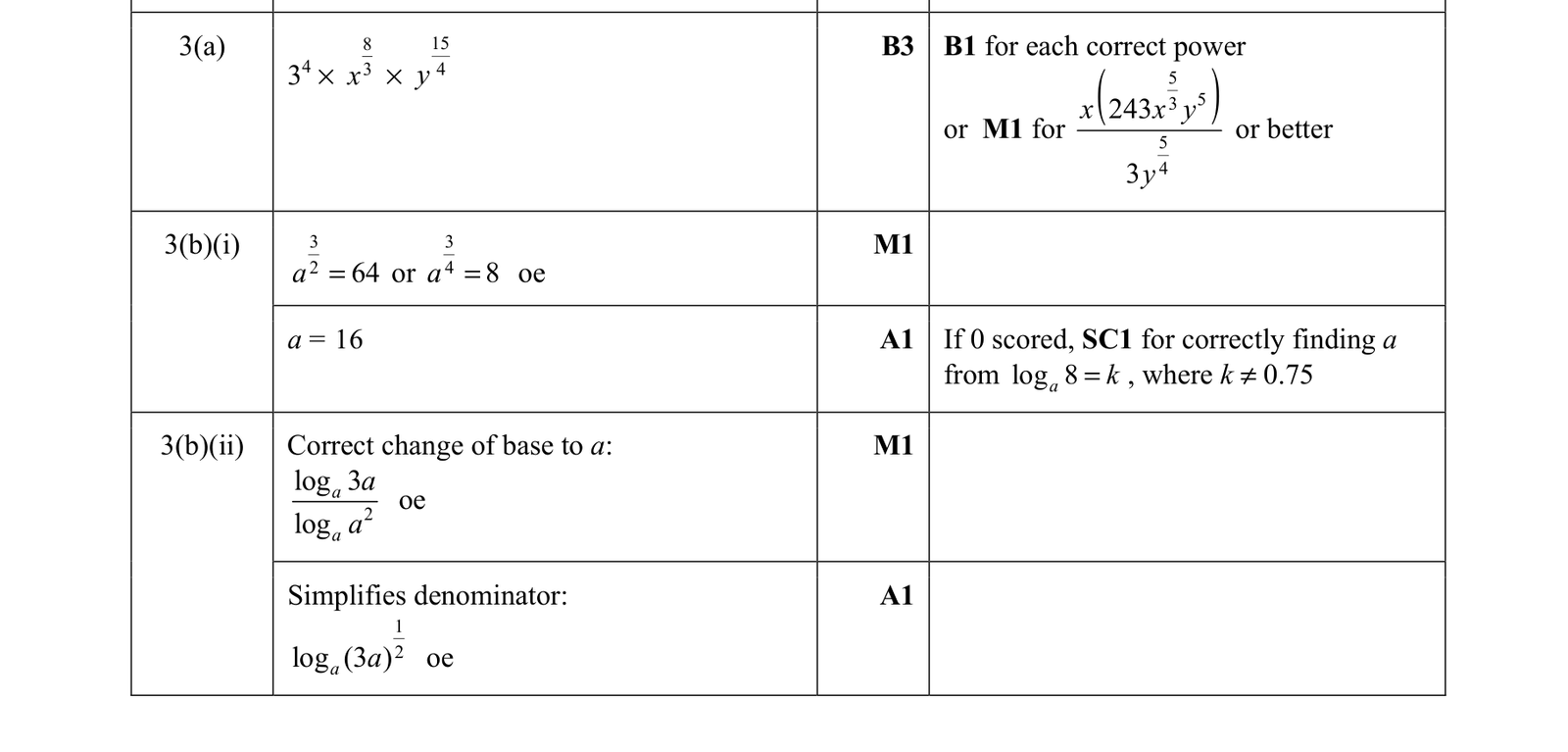
\(\frac{x(27xy^3)^{\frac53}}{\sqrt[4]{81y^5}}\)
in the form \(3^a x^b y^c\), where \(a\), \(b\) and \(c\) are constants.
(b)
(i) Find the value of \(a\) such that
\(2\log_a8=\frac32.\)
(ii) Write \(\log_{a^2}3a\) as a single logarithm to base \(a\).