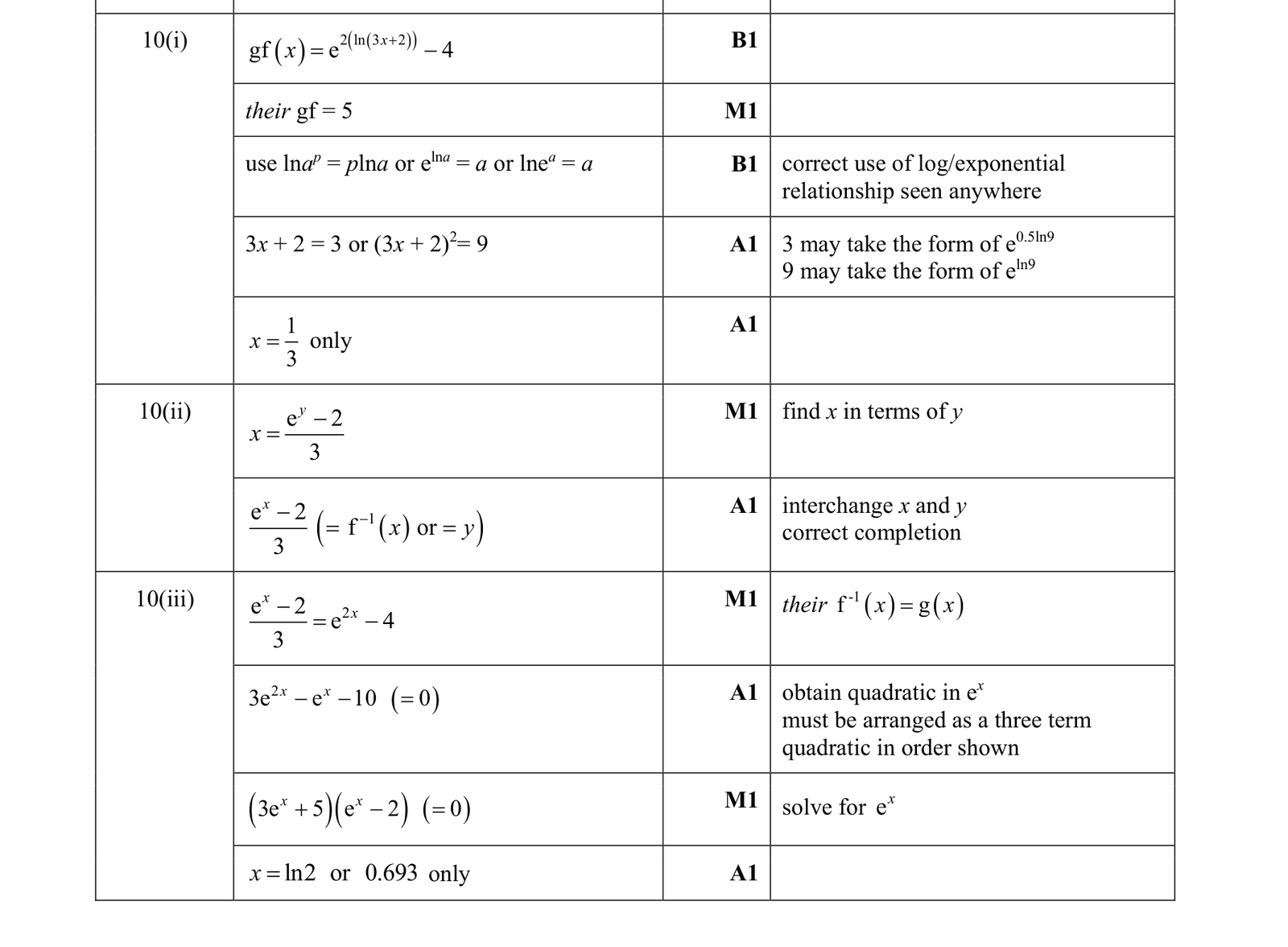
0606 P23 - Nov 2019 - Q10 - 11 marks
8385
The functions \(f\) and \(g\) are defined by
\(f(x)=\ln(3x+2),\quad x\gt-\frac23,\)
and
\(g(x)=e^{2x}-4,\quad x\in\mathbb{R}.\)
(i) Solve \(gf(x)=5\).
(ii) Find \(f^{-1}(x)\).
(iii) Solve \(f^{-1}(x)=g(x)\).
Solution
Answer: (i) \(x=\frac13\). (ii) \(f^{-1}(x)=\frac{e^x-2}{3}\). (iii) \(x=\ln2\).
(i) Since
\(f(x)=\ln(3x+2),\)
we have
\(g(f(x))=e^{2\ln(3x+2)}-4.\)
Using \(e^{2\ln u}=u^2\),
\(g(f(x))=(3x+2)^2-4.\)
So \(gf(x)=5\) gives
\((3x+2)^2-4=5.\)
Hence
\((3x+2)^2=9.\)
Since \(3x+2\gt0\),
\(3x+2=3.\)
Therefore
\(x=\frac13.\)
(ii) Let \(y=\ln(3x+2)\). Then
\(e^y=3x+2.\)
So
\(x=\frac{e^y-2}{3}.\)
Hence
\(f^{-1}(x)=\frac{e^x-2}{3}.\)
(iii) Solve
\(\frac{e^x-2}{3}=e^{2x}-4.\)
Multiplying by \(3\),
\(e^x-2=3e^{2x}-12.\)
So
\(3e^{2x}-e^x-10=0.\)
Let \(u=e^x\). Then
\(3u^2-u-10=0.\)
Factorising,
\((3u+5)(u-2)=0.\)
Since \(u=e^x\gt0\), \(u=2\). Therefore
\(\boxed{x=\ln2}.\)