Past Exam Questions
← Back9709 P12 - Nov 2015 - Q4I - 4 marks
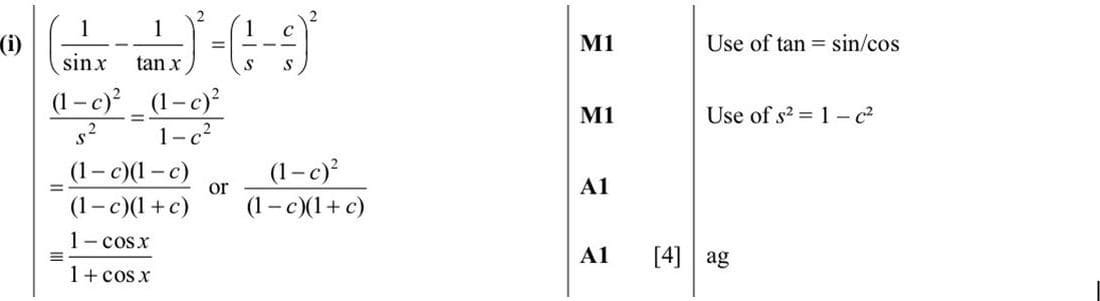
Prove the identity \(\left( \frac{1}{\sin x} - \frac{1}{\tan x} \right)^2 \equiv \frac{1 - \cos x}{1 + \cos x}\).
9709 P12 - Jun 2015 - Q5I - 1 mark
Prove the identity \(\frac{\sin \theta - \cos \theta}{\sin \theta + \cos \theta} \equiv \frac{\tan \theta - 1}{\tan \theta + 1}\).

9709 P13 - Nov 2014 - Q5I - 3 marks
Show that \(\sin^4 \theta - \cos^4 \theta \equiv 2 \sin^2 \theta - 1\).

9709 P13 - Jun 2014 - Q4I - 3 marks
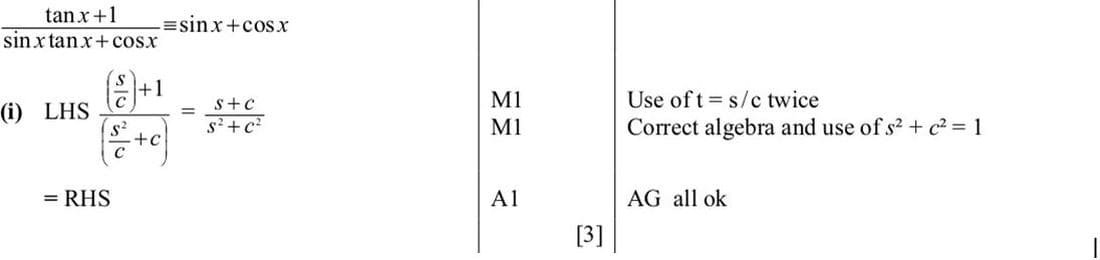
Prove the identity \(\frac{\tan x + 1}{\sin x \tan x + \cos x} \equiv \sin x + \cos x\).
9709 P12 - Jun 2014 - Q5I - 4 marks
Prove the identity \(\frac{1}{\cos \theta} - \frac{\cos \theta}{1 + \sin \theta} \equiv \tan \theta\).

9709 P11 - Jun 2014 - Q9I - 4 marks
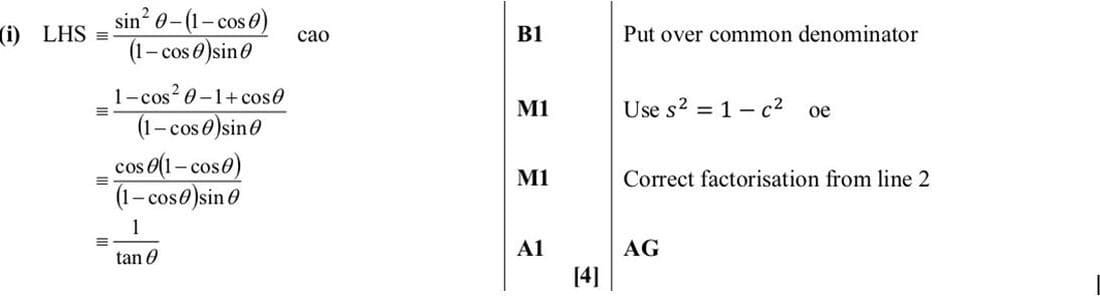
Prove the identity \(\frac{\sin \theta}{1 - \cos \theta} - \frac{1}{\sin \theta} \equiv \frac{1}{\tan \theta}\).
9709 P11 - Jun 2013 - Q5I - 3 marks
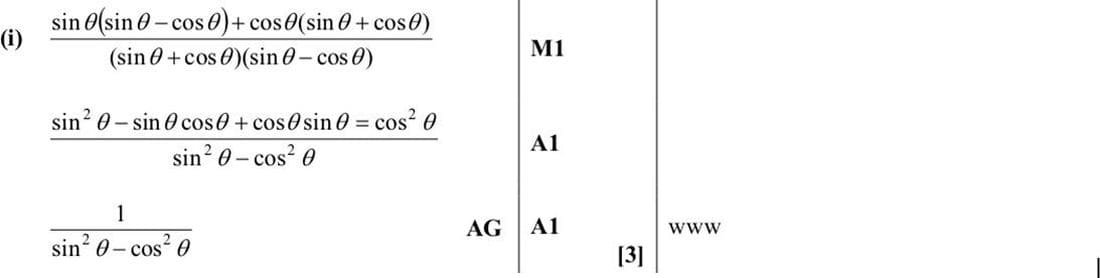
Show that \(\frac{\sin \theta}{\sin \theta + \cos \theta} + \frac{\cos \theta}{\sin \theta - \cos \theta} \equiv \frac{1}{\sin^2 \theta - \cos^2 \theta}\).
9709 P13 - Jun 2012 - Q1I - 3 marks
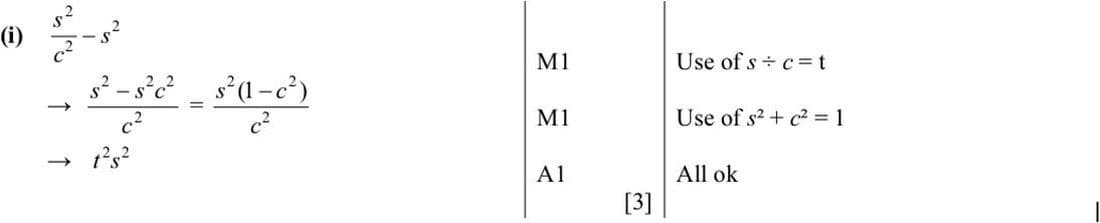
Prove the identity \(\tan^2 \theta - \sin^2 \theta \equiv \tan^2 \theta \sin^2 \theta\).
9709 P12 - Mar 2023 - Q7B - 3 marks
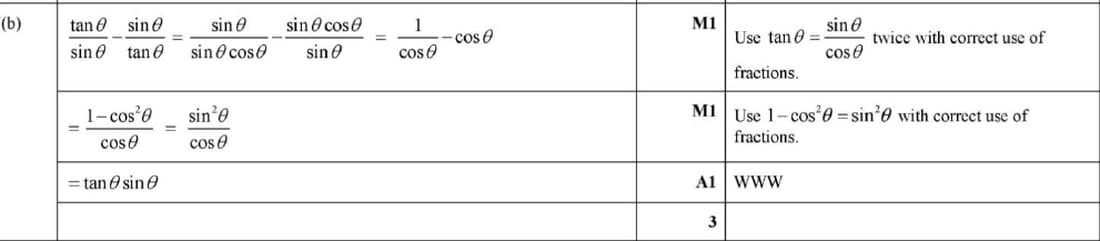
Show that \(\frac{\tan \theta}{\sin \theta} - \frac{\sin \theta}{\tan \theta} \equiv \tan \theta \sin \theta\).
9709 P12 - Jun 2012 - Q5I - 2 marks
Prove the identity \(\tan x + \frac{1}{\tan x} = \frac{1}{\sin x \cos x}\).

9709 P13 - Jun 2011 - Q8I - 3 marks
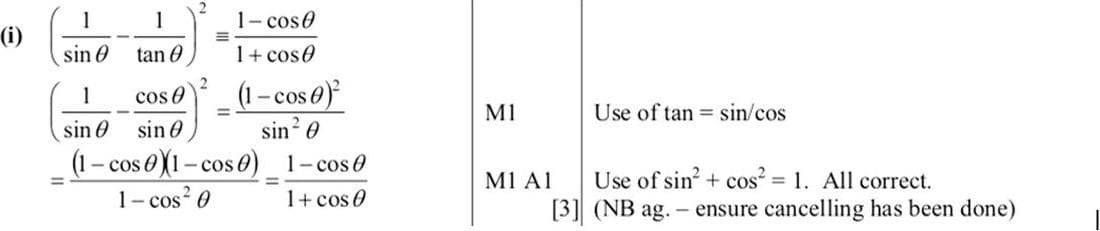
Prove the identity \(\left( \frac{1}{\sin \theta} - \frac{1}{\tan \theta} \right)^2 \equiv \frac{1 - \cos \theta}{1 + \cos \theta}\).
9709 P12 - Jun 2011 - Q5I - 3 marks
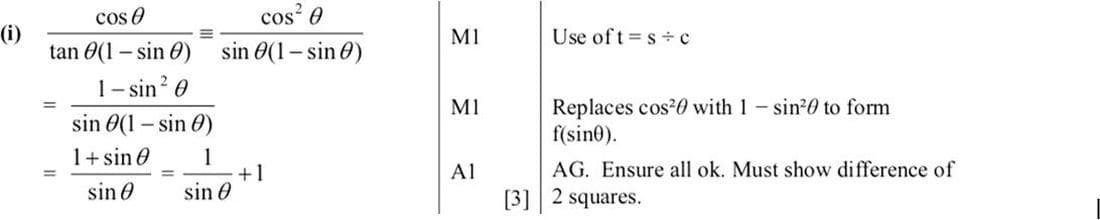
Prove the identity \(\frac{\cos \theta}{\tan \theta (1 - \sin \theta)} \equiv 1 + \frac{1}{\sin \theta}\).
9709 P12 - Nov 2010 - Q2 - 4 marks
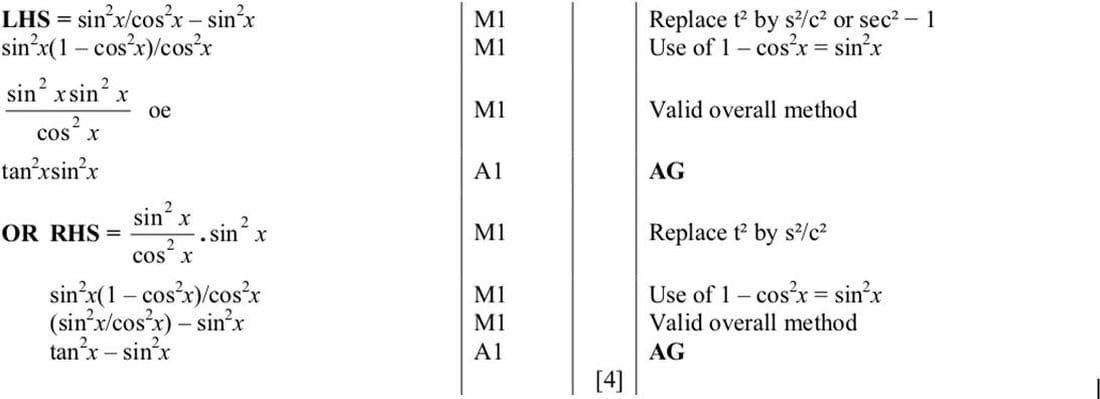
Prove the identity
\(\tan^2 x - \sin^2 x \equiv \tan^2 x \sin^2 x\).
9709 P11 - Nov 2010 - Q4I - 3 marks
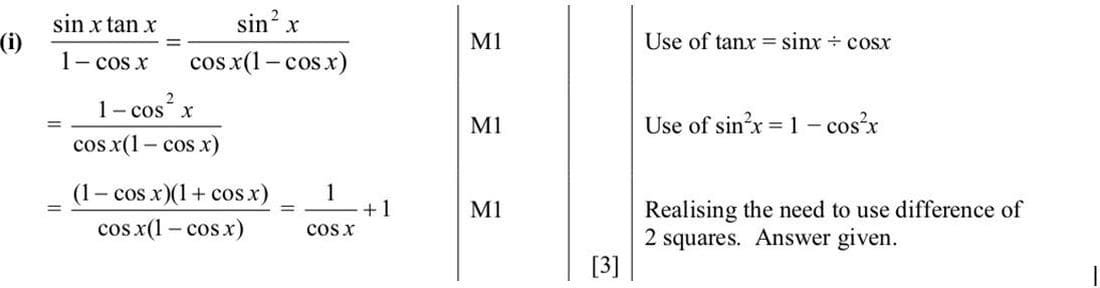
Prove the identity \(\frac{\sin x \tan x}{1 - \cos x} \equiv 1 + \frac{1}{\cos x}\).
9709 P12 - Nov 2009 - Q5I - 3 marks
Prove the identity \((\sin x + \cos x)(1 - \sin x \cos x) \equiv \sin^3 x + \cos^3 x\).

9709 P1 - Jun 2009 - Q1 - 3 marks
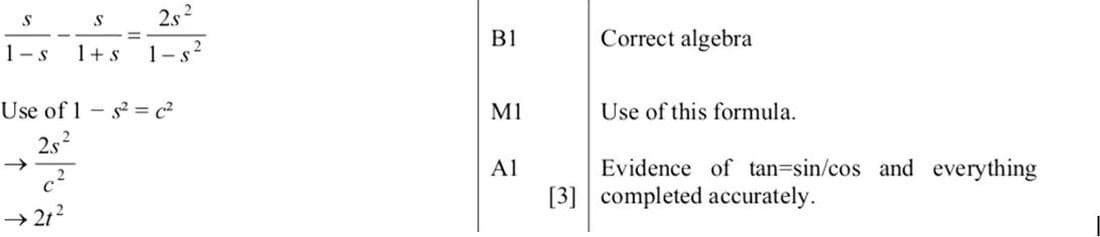
Prove the identity \(\frac{\sin x}{1 - \sin x} - \frac{\sin x}{1 + \sin x} \equiv 2 \tan^2 x\).
9709 P1 - Nov 2008 - Q2 - 4 marks
Prove the identity
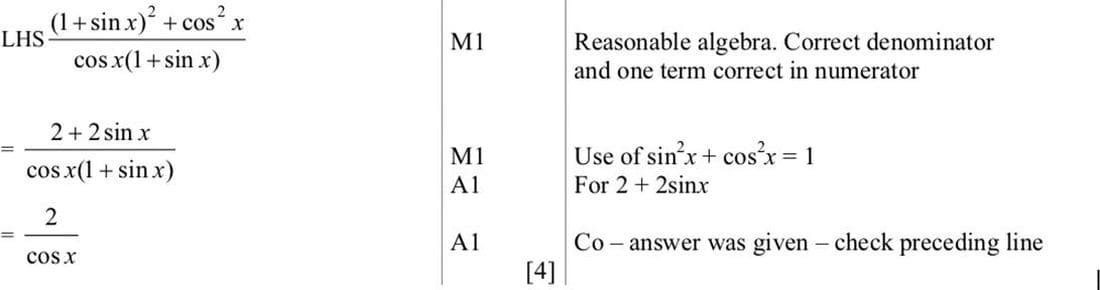
\(\frac{1 + \sin x}{\cos x} + \frac{\cos x}{1 + \sin x} = \frac{2}{\cos x}.\)
9709 P1 - Jun 2007 - Q3 - 4 marks
Prove the identity \(\frac{1 - \tan^2 x}{1 + \tan^2 x} \equiv 1 - 2 \sin^2 x\).

9709 P12 - Nov 2022 - Q7A - 3 marks
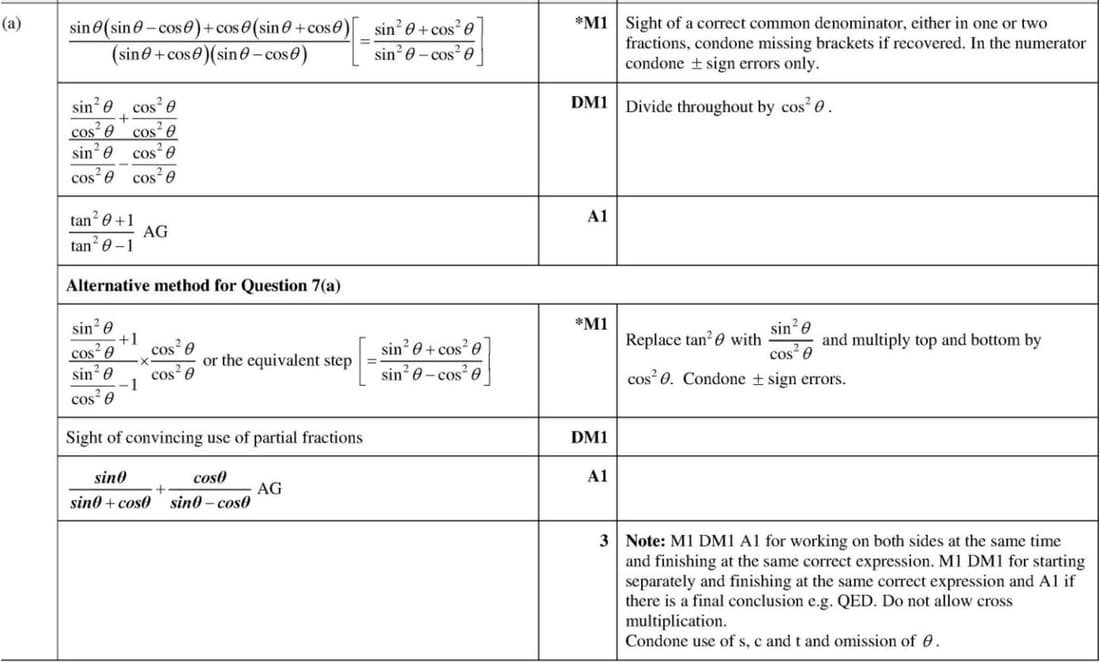
Prove the identity \(\frac{\sin \theta}{\sin \theta + \cos \theta} + \frac{\cos \theta}{\sin \theta - \cos \theta} \equiv \frac{\tan^2 \theta + 1}{\tan^2 \theta - 1}\).
9709 P11 - Jun 2022 - Q4A - 4 marks
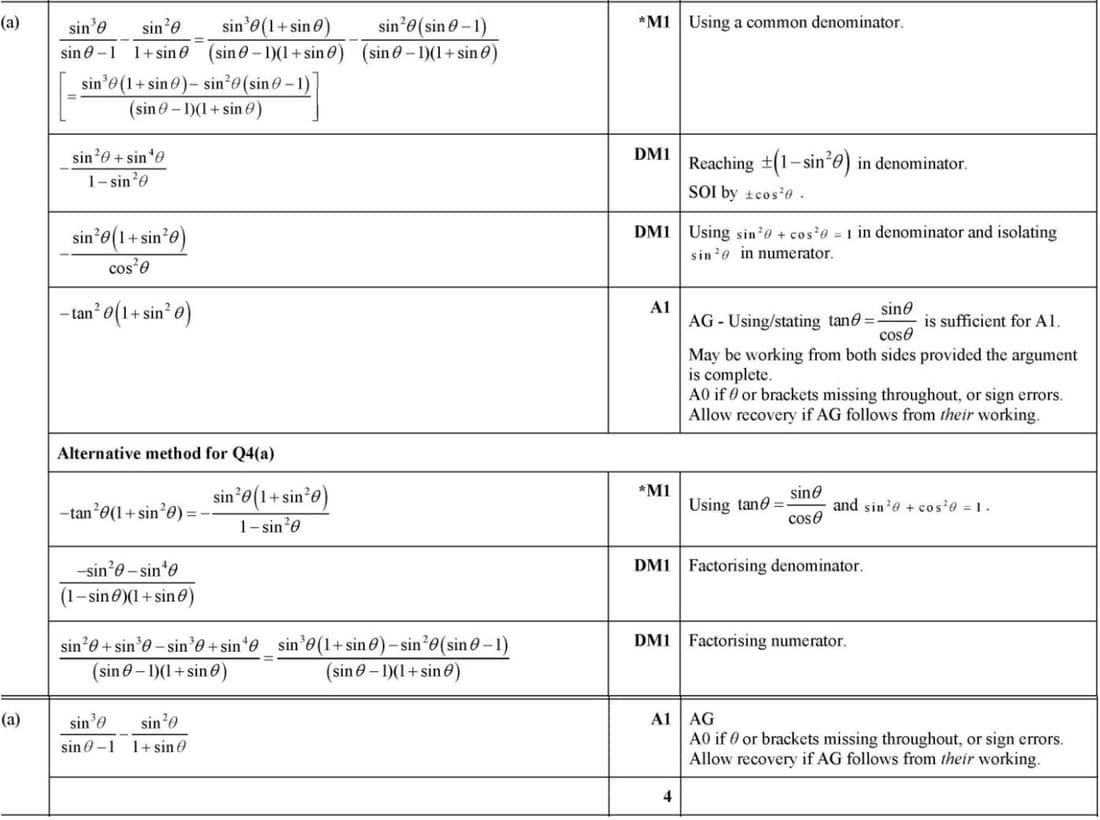
Prove the identity \(\frac{\sin^3 \theta}{\sin \theta - 1} - \frac{\sin^2 \theta}{1 + \sin \theta} \equiv -\tan^2 \theta (1 + \sin^2 \theta)\).