(i) Given that \(4 \tan x + 3 \cos x + \frac{1}{\cos x} = 0\), show, without using a calculator, that \(\sin x = -\frac{2}{3}\).
(ii) Hence, showing all necessary working, solve the equation \(4 \tan(2x - 20^\circ) + 3 \cos(2x - 20^\circ) + \frac{1}{\cos(2x - 20^\circ)} = 0\) for \(0^\circ \leq x \leq 180^\circ\).
Solution
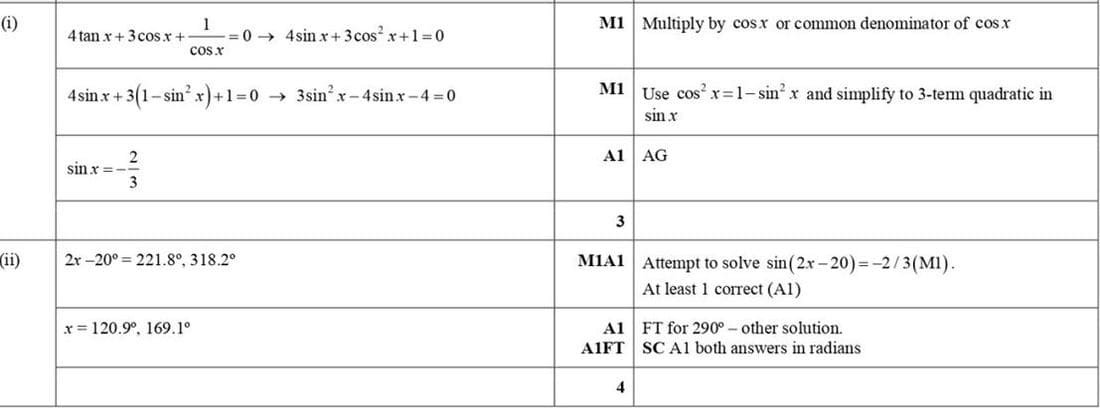
(i) Start with the equation:
\(4 \tan x + 3 \cos x + \frac{1}{\cos x} = 0\)
Multiply through by \(\cos x\) to eliminate the fraction:
\(4 \sin x + 3 \cos^2 x + 1 = 0\)
Use the identity \(\cos^2 x = 1 - \sin^2 x\):
\(4 \sin x + 3(1 - \sin^2 x) + 1 = 0\)
Simplify to form a quadratic in \(\sin x\):
\(3 \sin^2 x - 4 \sin x - 4 = 0\)
Solving this quadratic gives \(\sin x = -\frac{2}{3}\).
(ii) Substitute \(\sin(2x - 20^\circ) = -\frac{2}{3}\) into the equation:
\(2x - 20^\circ = 221.8^\circ, 318.2^\circ\)
Solve for \(x\):
\(x = 120.9^\circ, 169.1^\circ\)
Log in to record attempts.