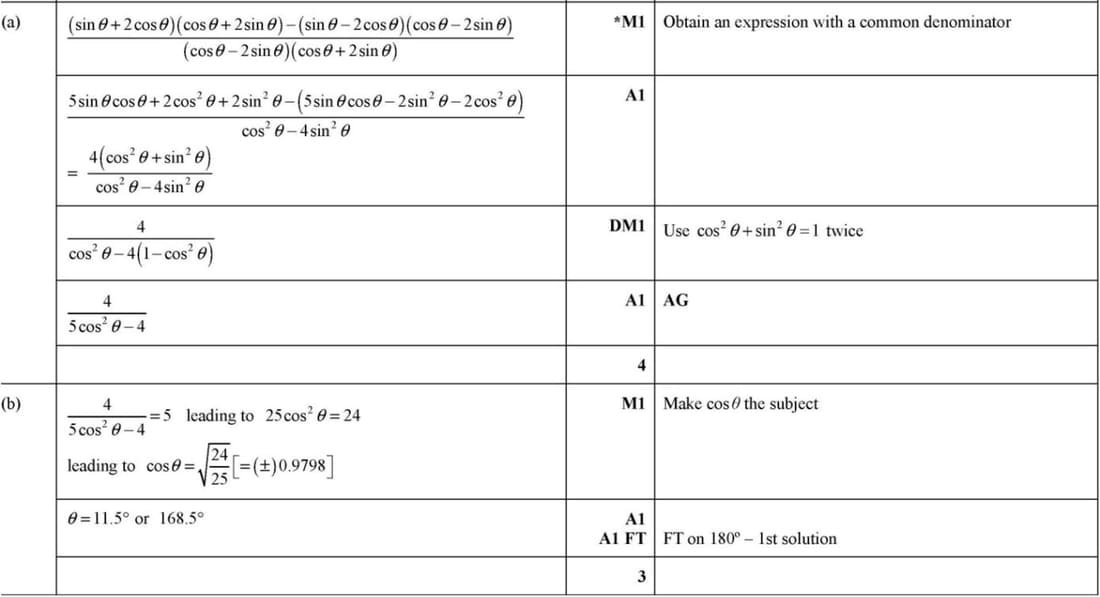
(a) To show the given identity, start by obtaining a common denominator:
\(\frac{(\sin \theta + 2 \cos \theta)(\cos \theta + 2 \sin \theta) - (\sin \theta - 2 \cos \theta)(\cos \theta - 2 \sin \theta)}{(\cos \theta - 2 \sin \theta)(\cos \theta + 2 \sin \theta)}\)
Expanding the numerators:
\(5 \sin \theta \cos \theta + 2 \sin^2 \theta + 2 \cos^2 \theta - (5 \sin \theta \cos \theta - 2 \sin^2 \theta - 2 \cos^2 \theta)\)
\(= 4(\cos^2 \theta + \sin^2 \theta)\)
Using \(\cos^2 \theta + \sin^2 \theta = 1\), the expression simplifies to:
\(\frac{4}{\cos^2 \theta - 4 \sin^2 \theta}\)
\(= \frac{4}{5 \cos^2 \theta - 4}\)
(b) For the equation:
\(\frac{4}{5 \cos^2 \theta - 4} = 5\)
Multiply both sides by \(5 \cos^2 \theta - 4\):
\(4 = 5(5 \cos^2 \theta - 4)\)
\(25 \cos^2 \theta = 24\)
\(\cos^2 \theta = \frac{24}{25}\)
\(\cos \theta = \pm \sqrt{\frac{24}{25}} = \pm 0.9798\)
For \(0^\circ < \theta < 180^\circ\), \(\theta = 11.5^\circ\) or \(168.5^\circ\).