Past Exam Questions
← Back9709 P12 - Mar 2022 - Q7A - 4 marks
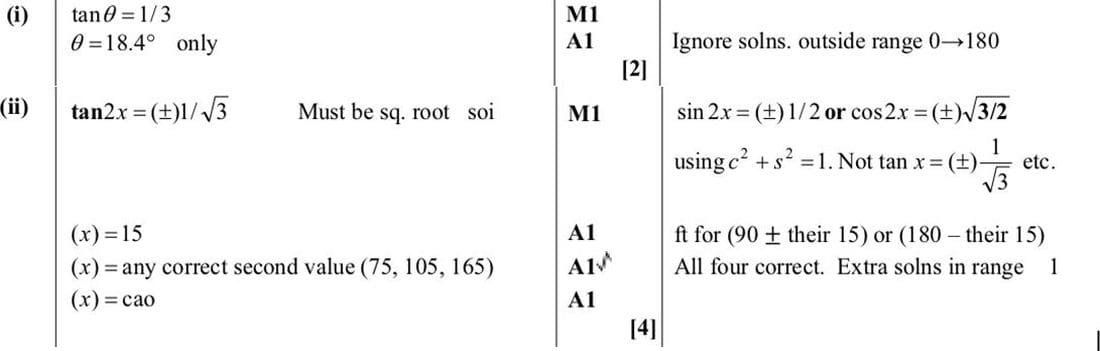
Show that \(\frac{\sin \theta + 2 \cos \theta}{\cos \theta - 2 \sin \theta} - \frac{\sin \theta - 2 \cos \theta}{\cos \theta + 2 \sin \theta} \equiv \frac{4}{5 \cos^2 \theta - 4}\).
9709 P13 - Nov 2021 - Q7A - 4 marks
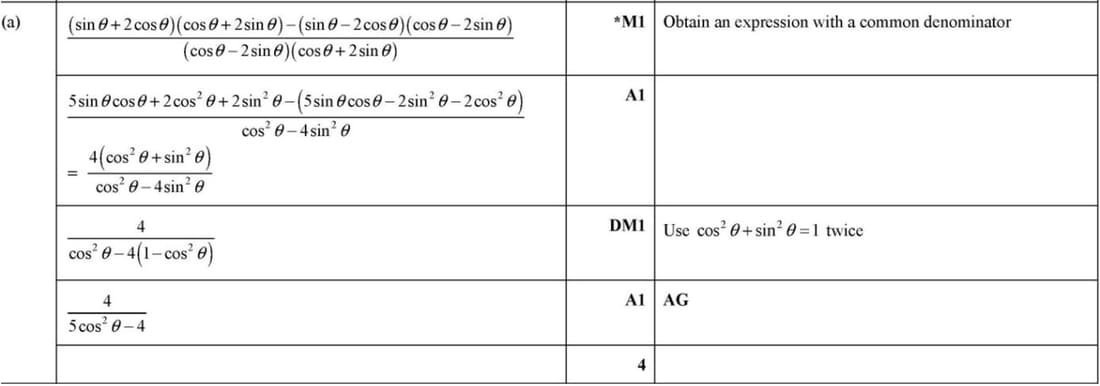
Show that the equation \(\frac{\tan x + \cos x}{\tan x - \cos x} = k\), where \(k\) is a constant, can be expressed as
\((k+1) \sin^2 x + (k-1) \sin x - (k+1) = 0\).
9709 P13 - Jun 2021 - Q4A - 2 marks
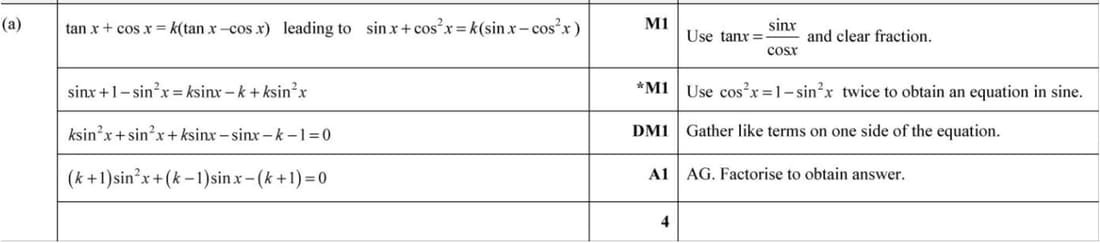
Show that the equation
\(\frac{\tan x + \sin x}{\tan x - \sin x} = k,\)
where \(k\) is a constant, may be expressed as
\(\frac{1 + \cos x}{1 - \cos x} = k.\)
9709 P12 - Jun 2021 - Q10A - 4 marks
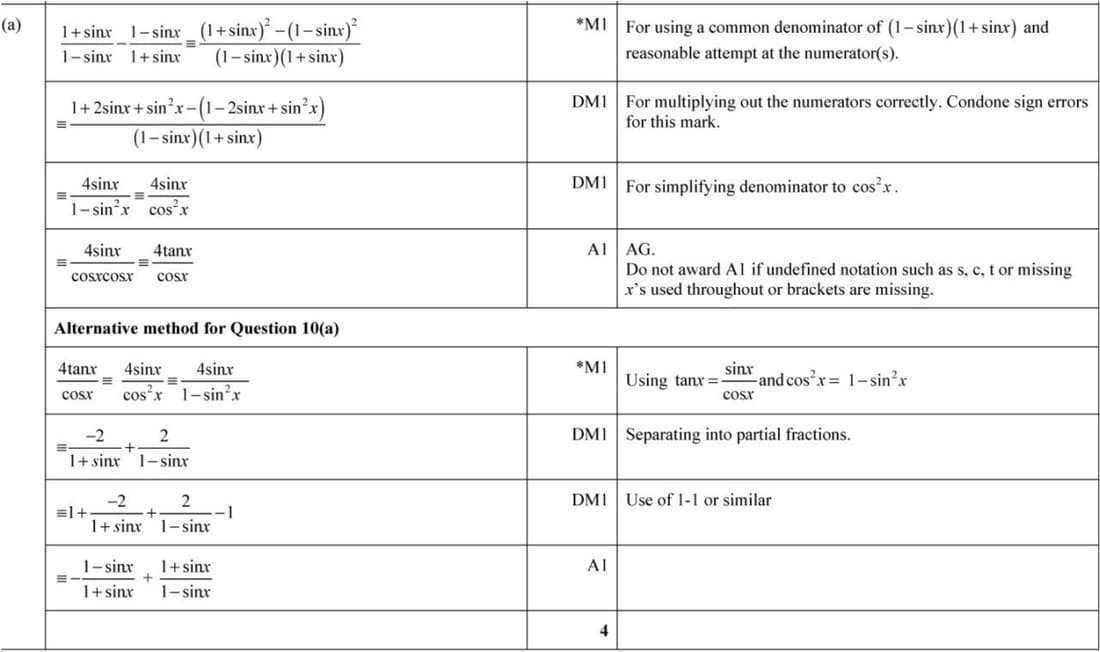
Prove the identity \(\frac{1 + \\sin x}{1 - \\sin x} - \frac{1 - \\sin x}{1 + \\sin x} \equiv \frac{4 \\tan x}{\\cos x}\).
9709 P11 - Jun 2023 - Q1 - 3 marks
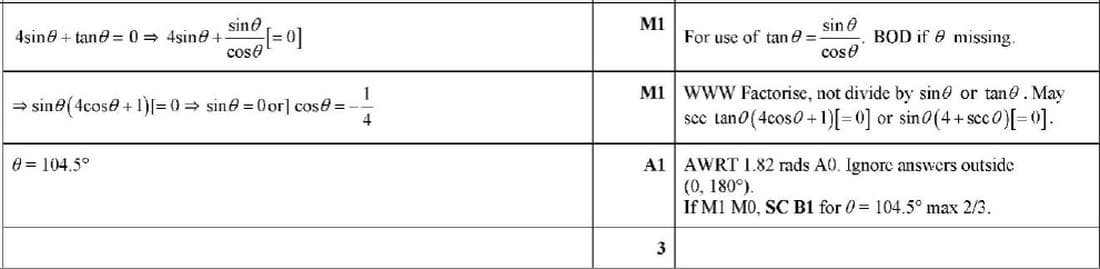
Solve the equation \(4 \sin \theta + \tan \theta = 0\) for \(0^\circ < \theta < 180^\circ\).
9709 P11 - Jun 2020 - Q7 - 6 marks
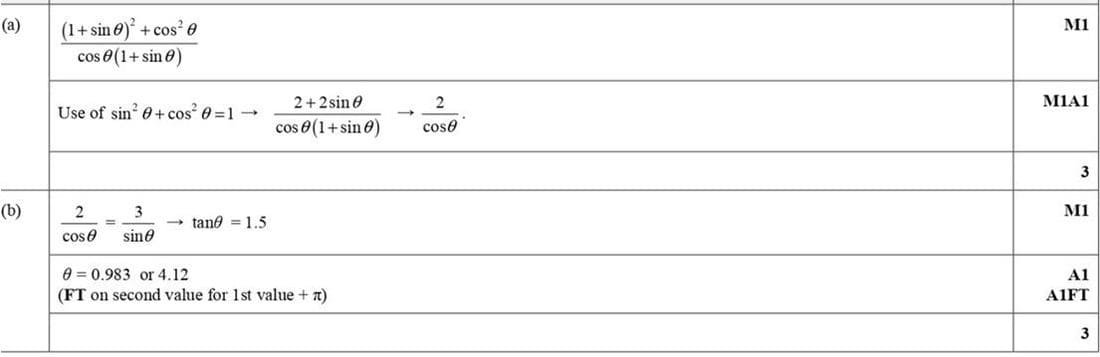
(a) Prove the identity \(\frac{1 + \sin \theta}{\cos \theta} + \frac{\cos \theta}{1 + \sin \theta} \equiv \frac{2}{\cos \theta}\).
(b) Hence solve the equation \(\frac{1 + \sin \theta}{\cos \theta} + \frac{\cos \theta}{1 + \sin \theta} = \frac{3}{\sin \theta}\), for \(0 \leq \theta \leq 2\pi\).
9709 P12 - Mar 2020 - Q5 - 5 marks
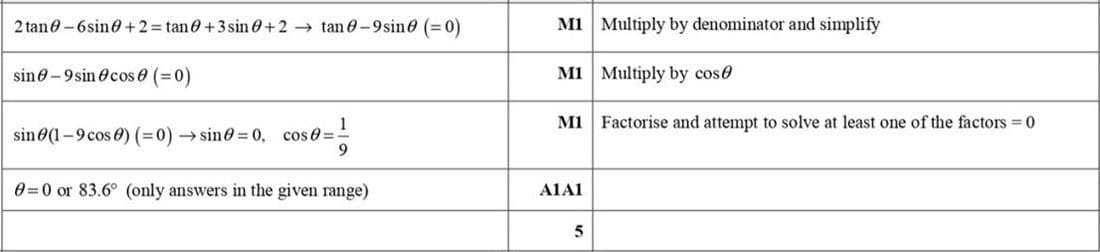
Solve the equation
\(\frac{\tan \theta + 3 \sin \theta + 2}{\tan \theta - 3 \sin \theta + 1} = 2\)
for \(0^\circ \leq \theta \leq 90^\circ\).
9709 P12 - Nov 2019 - Q6A - 4 marks
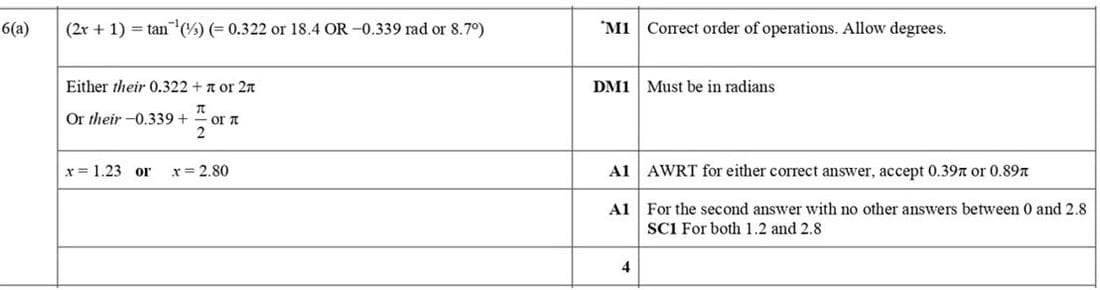
Given that \(x > 0\), find the two smallest values of \(x\), in radians, for which \(3 \tan(2x + 1) = 1\). Show all necessary working.
9709 P11 - Jun 2019 - Q6 - 7 marks
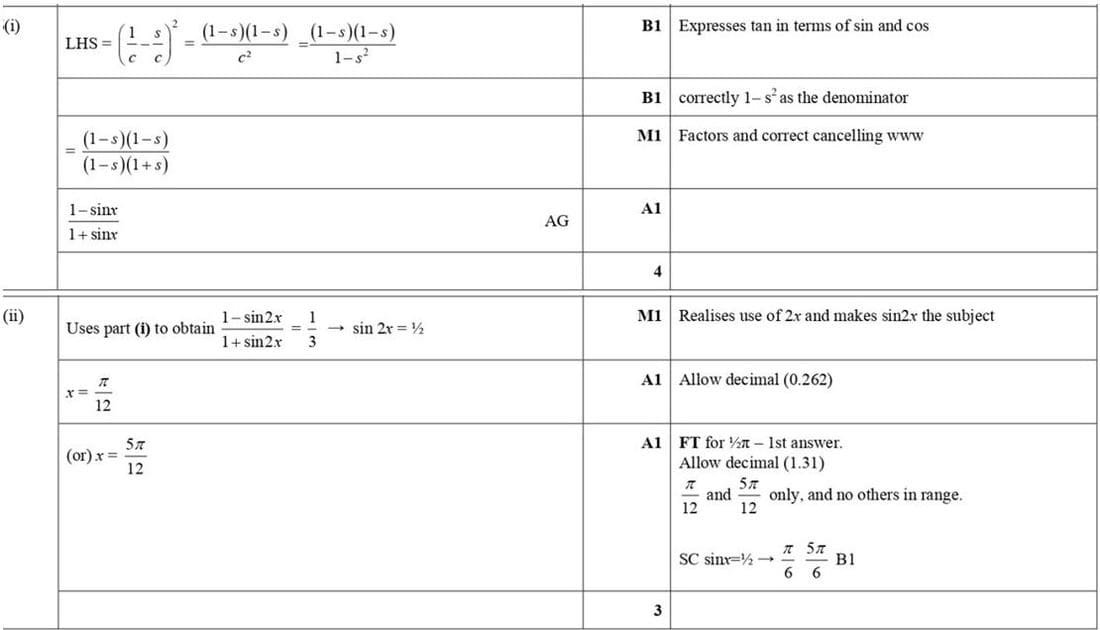
(i) Prove the identity \(\left( \frac{1}{\cos x} - \tan x \right)^2 \equiv \frac{1 - \sin x}{1 + \sin x}\).
(ii) Hence solve the equation \(\left( \frac{1}{\cos 2x} - \tan 2x \right)^2 = \frac{1}{3}\) for \(0 \leq x \leq \pi\).
9709 P13 - Jun 2018 - Q7A - 5 marks
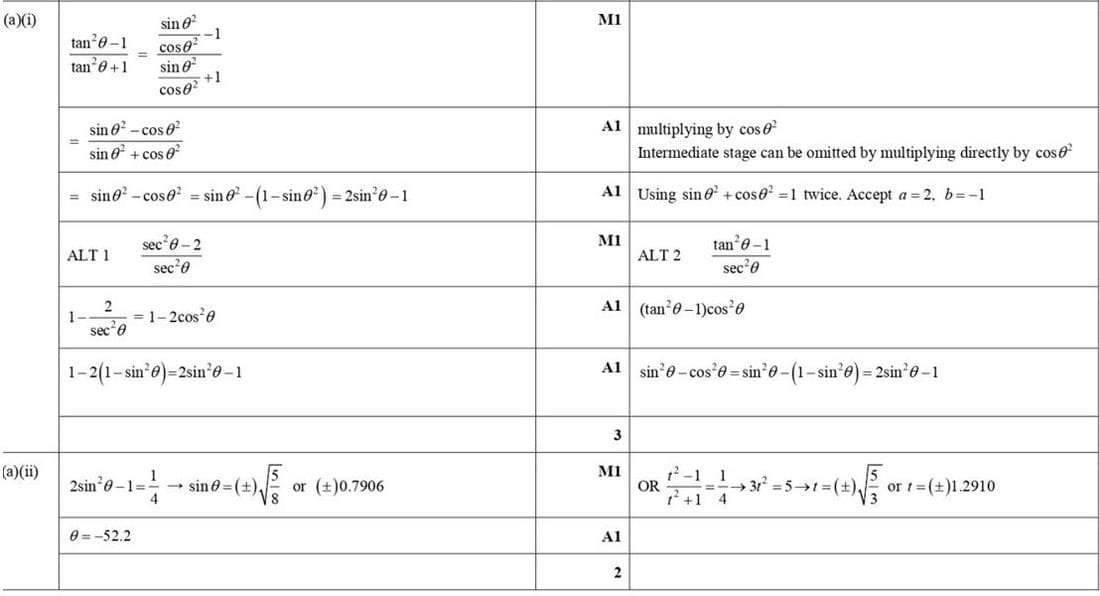
(i) Express \(\frac{\tan^2 \theta - 1}{\tan^2 \theta + 1}\) in the form \(a \sin^2 \theta + b\), where \(a\) and \(b\) are constants to be found.
(ii) Hence, or otherwise, and showing all necessary working, solve the equation \(\frac{\tan^2 \theta - 1}{\tan^2 \theta + 1} = \frac{1}{4}\) for \(-90^\circ \leq \theta \leq 0^\circ\).
9709 P11 - Jun 2018 - Q4 - 6 marks
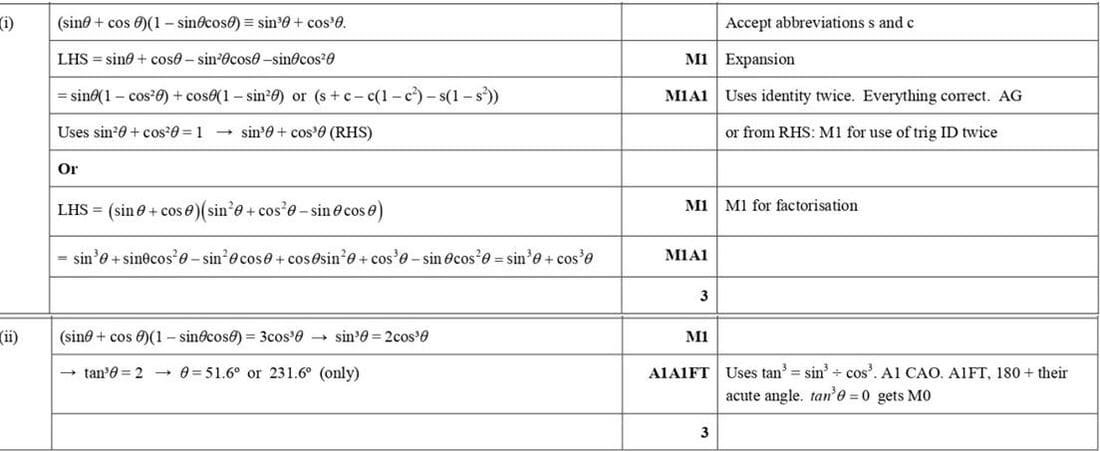
(i) Prove the identity \((\sin \theta + \cos \theta)(1 - \sin \theta \cos \theta) \equiv \sin^3 \theta + \cos^3 \theta\).
(ii) Hence solve the equation \((\sin \theta + \cos \theta)(1 - \sin \theta \cos \theta) = 3 \cos^3 \theta\) for \(0^\circ \leq \theta \leq 360^\circ\).
9709 P13 - Jun 2017 - Q5 - 6 marks
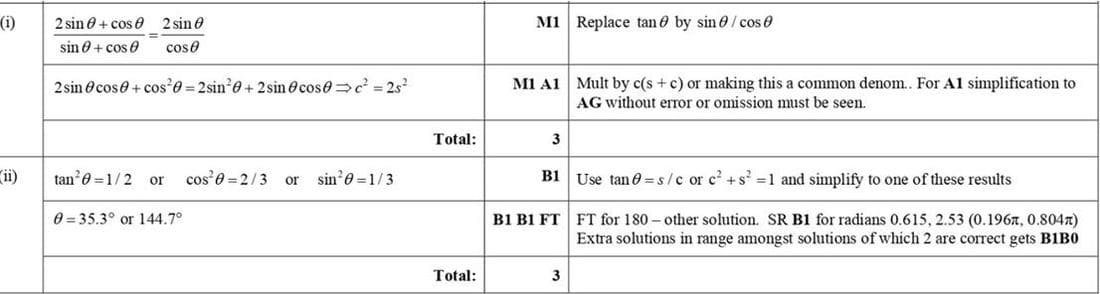
(i) Show that the equation \(\frac{2 \sin \theta + \cos \theta}{\sin \theta + \cos \theta} = 2 \tan \theta\) may be expressed as \(\cos^2 \theta = 2 \sin^2 \theta\).
(ii) Hence solve the equation \(\frac{2 \sin \theta + \cos \theta}{\sin \theta + \cos \theta} = 2 \tan \theta\) for \(0^\circ < \theta < 180^\circ\).
9709 P12 - Jun 2017 - Q3 - 6 marks
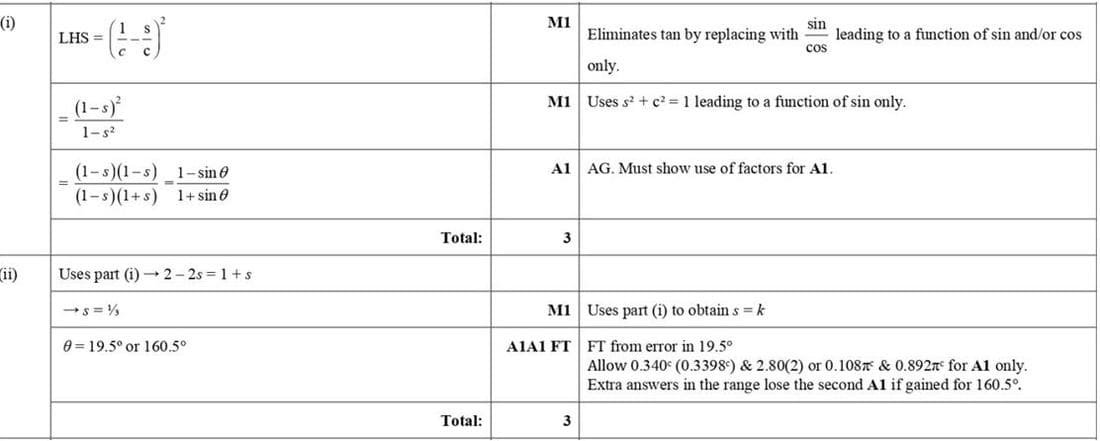
(i) Prove the identity \(\left( \frac{1}{\cos \theta} - \tan \theta \right)^2 \equiv \frac{1 - \sin \theta}{1 + \sin \theta}\).
(ii) Hence solve the equation \(\left( \frac{1}{\cos \theta} - \tan \theta \right)^2 = \frac{1}{2}\), for \(0^\circ \leq \theta \leq 360^\circ\).
9709 P11 - Jun 2017 - Q3 - 6 marks
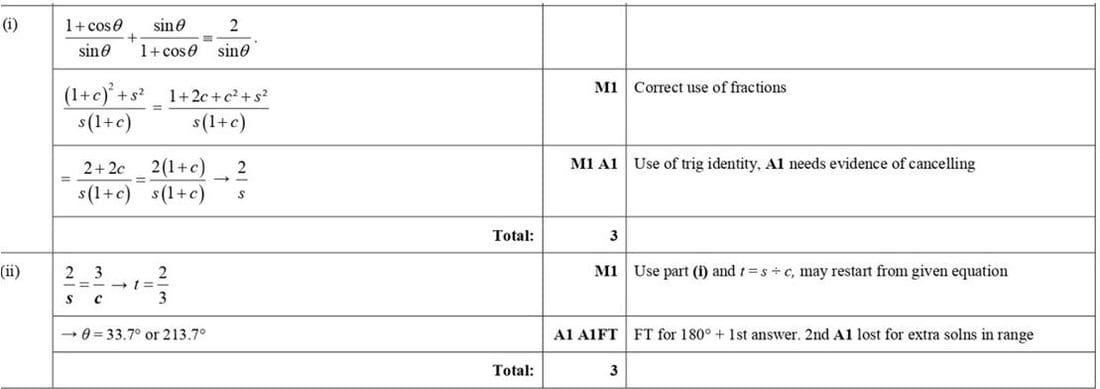
(i) Prove the identity \(\frac{1 + \cos \theta}{\sin \theta} + \frac{\sin \theta}{1 + \cos \theta} \equiv \frac{2}{\sin \theta}\).
(ii) Hence solve the equation \(\frac{1 + \cos \theta}{\sin \theta} + \frac{\sin \theta}{1 + \cos \theta} = \frac{3}{\cos \theta}\) for \(0^\circ \leq \theta \leq 360^\circ\).
9709 P13 - Nov 2016 - Q3 - 4 marks
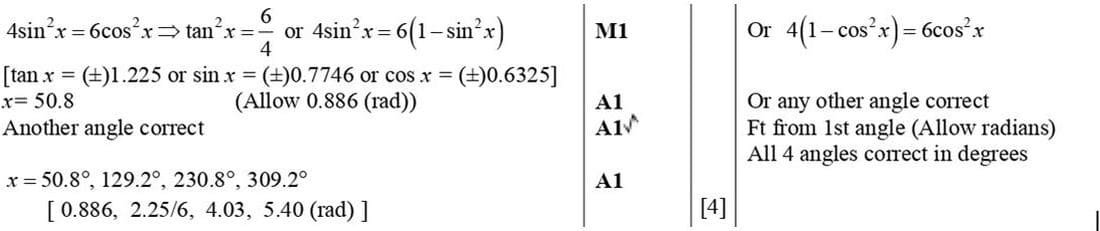
Showing all necessary working, solve the equation \(6 \sin^2 x - 5 \cos^2 x = 2 \sin^2 x + \cos^2 x\) for \(0^\circ \leq x \leq 360^\circ\).
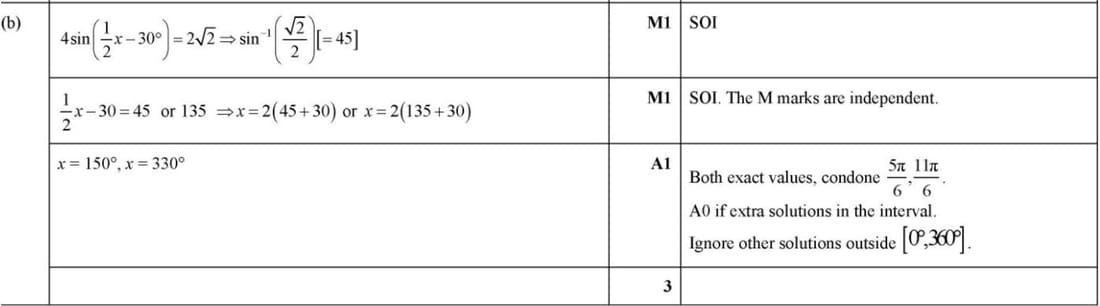
9709 P11 - Jun 2022 - Q8B - 3 marks
Find the exact solutions of the equation \(4 \sin\left(\frac{1}{2}x - 30^\circ\right) = 2\sqrt{2}\) for \(0^\circ \leq x \leq 360^\circ\).
9709 P12 - Nov 2016 - Q2 - 5 marks
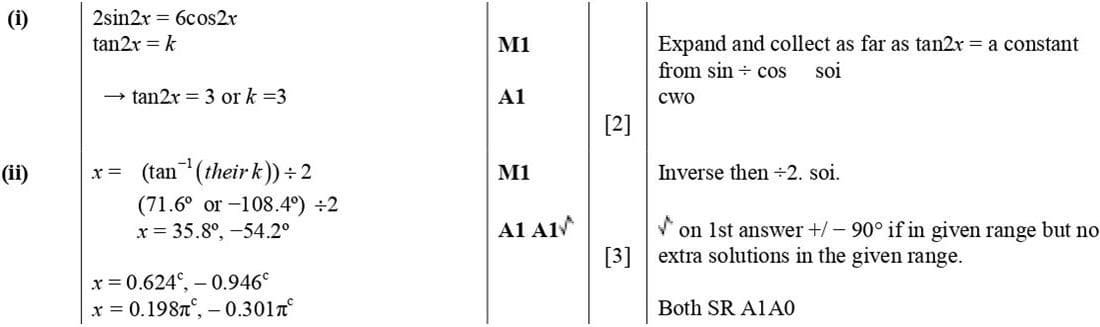
(i) Express the equation \(\sin 2x + 3 \cos 2x = 3(\sin 2x - \cos 2x)\) in the form \(\tan 2x = k\), where \(k\) is a constant.
(ii) Hence solve the equation for \(-90^\circ \leq x \leq 90^\circ\).
9709 P12 - Jun 2016 - Q7 - 7 marks
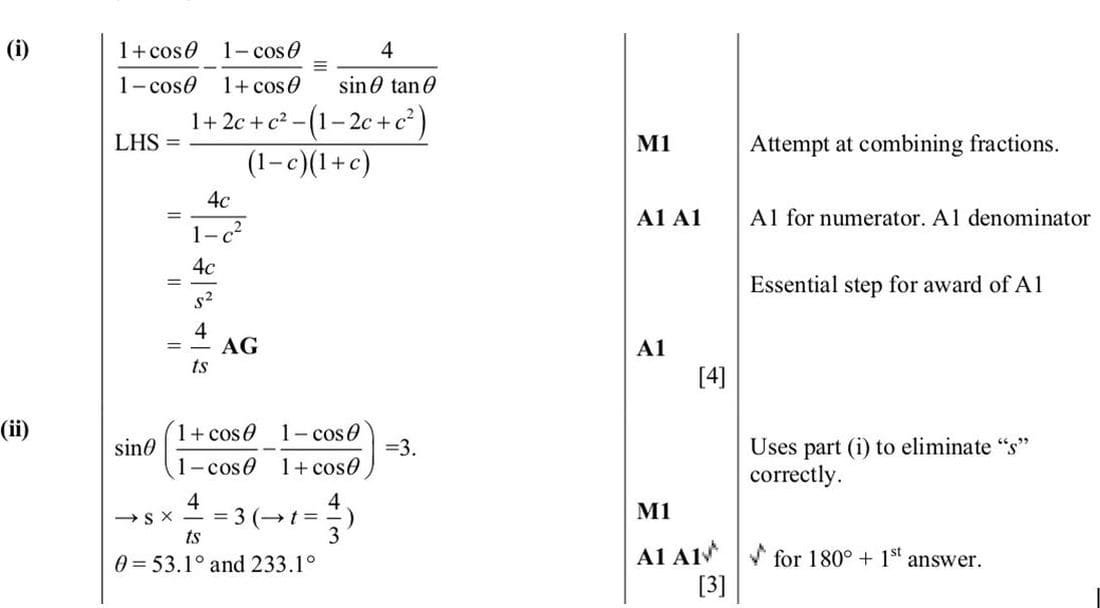
(i) Prove the identity \(\frac{1 + \cos \theta}{1 - \cos \theta} - \frac{1 - \cos \theta}{1 + \cos \theta} \equiv \frac{4}{\sin \theta \tan \theta}\).
(ii) Hence solve, for \(0^\circ < \theta < 360^\circ\), the equation \(\sin \theta \left( \frac{1 + \cos \theta}{1 - \cos \theta} - \frac{1 - \cos \theta}{1 + \cos \theta} \right) = 3\).
9709 P12 - Nov 2015 - Q4 - 7 marks
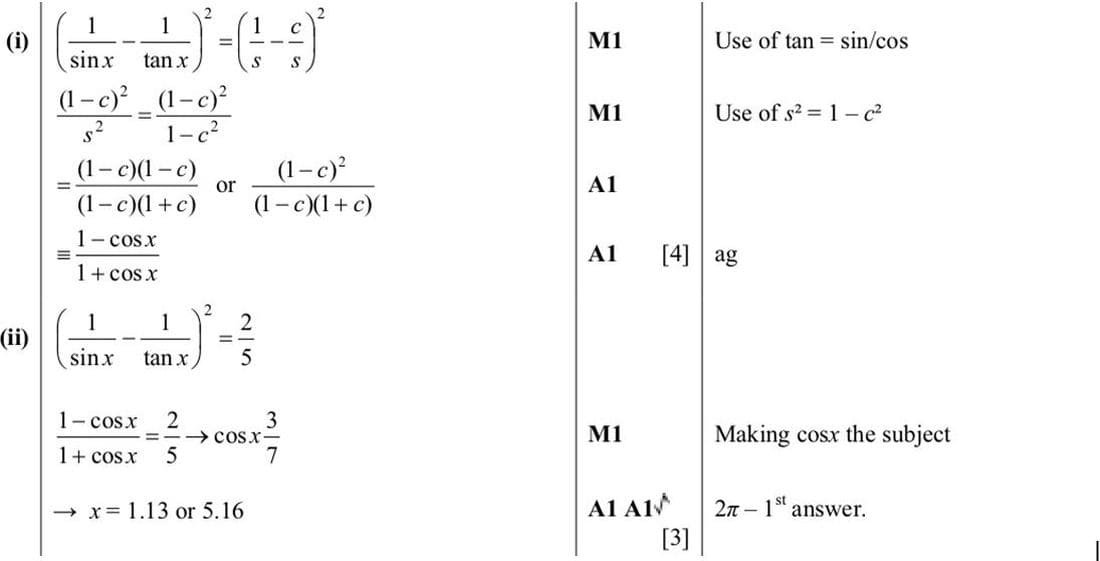
(i) Prove the identity \(\left( \frac{1}{\sin x} - \frac{1}{\tan x} \right)^2 \equiv \frac{1 - \cos x}{1 + \cos x}\).
(ii) Hence solve the equation \(\left( \frac{1}{\sin x} - \frac{1}{\tan x} \right)^2 = \frac{2}{5}\) for \(0 \leq x \leq 2\pi\).
9709 P13 - Jun 2015 - Q4 - 6 marks
(i) Express the equation \(3 \sin \theta = \cos \theta\) in the form \(\tan \theta = k\) and solve the equation for \(0^\circ < \theta < 180^\circ\).
(ii) Solve the equation \(3 \sin^2 2x = \cos^2 2x\) for \(0^\circ < x < 180^\circ\).