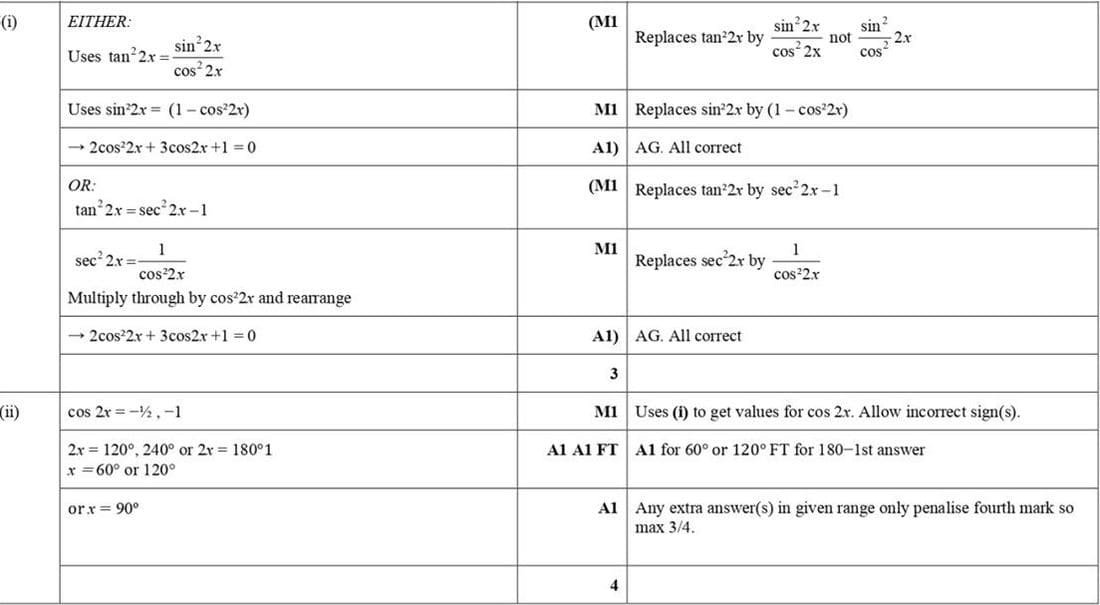
(i) Start with the equation \(\cos 2x(\tan^2 2x + 3) + 3 = 0\).
Use the identity \(\tan^2 2x = \frac{\sin^2 2x}{\cos^2 2x}\).
Replace \(\sin^2 2x\) with \(1 - \cos^2 2x\):
\(\tan^2 2x = \frac{1 - \cos^2 2x}{\cos^2 2x} = \sec^2 2x - 1\).
Substitute back into the equation:
\(\cos 2x((\sec^2 2x - 1) + 3) + 3 = 0\).
Simplify to get:
\(\cos 2x(\sec^2 2x + 2) + 3 = 0\).
Multiply through by \(\cos^2 2x\) and rearrange:
\(2 \cos^2 2x + 3 \cos 2x + 1 = 0\).
(ii) Solve \(2 \cos^2 2x + 3 \cos 2x + 1 = 0\).
Let \(y = \cos 2x\), then the equation becomes:
\(2y^2 + 3y + 1 = 0\).
Factorize to find \(y = -\frac{1}{2}\) or \(y = -1\).
For \(\cos 2x = -\frac{1}{2}\), \(2x = 120^\circ\) or \(240^\circ\), so \(x = 60^\circ\) or \(120^\circ\).
For \(\cos 2x = -1\), \(2x = 180^\circ\), so \(x = 90^\circ\).
Thus, the solutions are \(x = 60^\circ, 90^\circ, 120^\circ\).