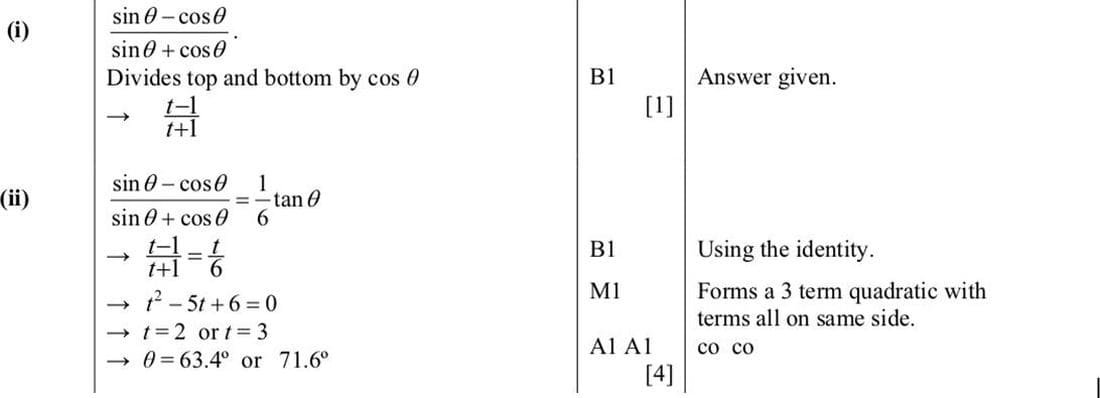
(i) Start with \(\frac{\sin \theta - \cos \theta}{\sin \theta + \cos \theta}\).
Divide the numerator and the denominator by \(\cos \theta\):
\(\frac{\frac{\sin \theta}{\cos \theta} - 1}{\frac{\sin \theta}{\cos \theta} + 1} = \frac{\tan \theta - 1}{\tan \theta + 1}\).
This proves the identity.
(ii) Using the identity from part (i), \(\frac{\tan \theta - 1}{\tan \theta + 1} = \frac{\tan \theta}{6}\).
Let \(t = \tan \theta\), then \(\frac{t - 1}{t + 1} = \frac{t}{6}\).
Cross-multiply to get:
\(6(t - 1) = t(t + 1)\).
Expand and simplify:
\(6t - 6 = t^2 + t\).
Rearrange to form a quadratic equation:
\(t^2 - 5t + 6 = 0\).
Factorize the quadratic:
\((t - 2)(t - 3) = 0\).
So, \(t = 2\) or \(t = 3\).
Thus, \(\tan \theta = 2\) or \(\tan \theta = 3\).
Find \(\theta\) using inverse tangent:
\(\theta = \tan^{-1}(2) \approx 63.4^\circ\) or \(\theta = \tan^{-1}(3) \approx 71.6^\circ\).