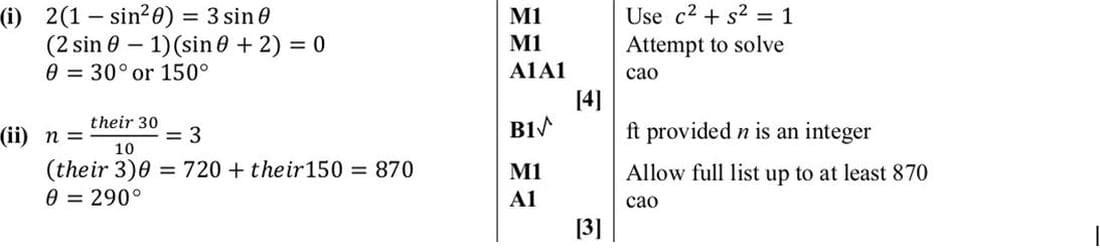
(i) Start with the equation \(2 \cos^2 \theta = 3 \sin \theta\). Using the identity \(\cos^2 \theta = 1 - \sin^2 \theta\), rewrite the equation as:
\(2(1 - \sin^2 \theta) = 3 \sin \theta\)
\(2 - 2 \sin^2 \theta = 3 \sin \theta\)
Rearrange to form a quadratic equation:
\(2 \sin^2 \theta + 3 \sin \theta - 2 = 0\)
Factor the quadratic:
\((2 \sin \theta - 1)(\sin \theta + 2) = 0\)
Solving gives \(\sin \theta = \frac{1}{2}\) or \(\sin \theta = -2\). Since \(\sin \theta = -2\) is not possible, we have:
\(\theta = 30^\circ\) or \(150^\circ\).
(ii) Given the smallest positive solution is \(10^\circ\), we have \(n \cdot 10^\circ = 30^\circ\), so \(n = 3\).
For the largest solution, consider \(n \cdot \theta = 150^\circ + 360^\circ k\) for integer \(k\). The largest \(\theta\) in \(0^\circ \leq \theta \leq 360^\circ\) is:
\(3 \cdot \theta = 870^\circ\)
\(\theta = 290^\circ\).