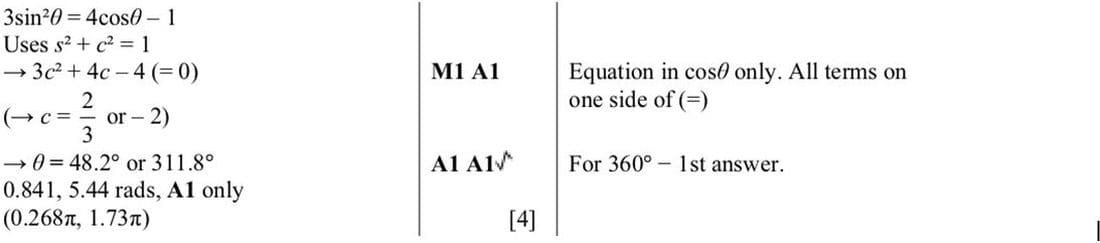
Start with the equation \(3 \sin^2 \theta = 4 \cos \theta - 1\).
Use the identity \(\sin^2 \theta = 1 - \cos^2 \theta\) to rewrite the equation:
\(3(1 - \cos^2 \theta) = 4 \cos \theta - 1\)
Expand and simplify:
\(3 - 3 \cos^2 \theta = 4 \cos \theta - 1\)
Rearrange to form a quadratic equation in \(\cos \theta\):
\(3 \cos^2 \theta + 4 \cos \theta - 4 = 0\)
Let \(c = \cos \theta\). The equation becomes:
\(3c^2 + 4c - 4 = 0\)
Use the quadratic formula \(c = \frac{-b \pm \sqrt{b^2 - 4ac}}{2a}\) with \(a = 3\), \(b = 4\), \(c = -4\):
\(c = \frac{-4 \pm \sqrt{4^2 - 4 \times 3 \times (-4)}}{2 \times 3}\)
\(c = \frac{-4 \pm \sqrt{16 + 48}}{6}\)
\(c = \frac{-4 \pm \sqrt{64}}{6}\)
\(c = \frac{-4 \pm 8}{6}\)
Solutions for \(c\) are \(c = \frac{2}{3}\) or \(c = -2\).
Since \(\cos \theta\) must be between -1 and 1, \(c = -2\) is not valid.
Thus, \(\cos \theta = \frac{2}{3}\).
Find \(\theta\) using \(\cos^{-1}\):
\(\theta = \cos^{-1}\left(\frac{2}{3}\right) \approx 48.2^\circ\)
The second solution in the range \(0^\circ \leq \theta \leq 360^\circ\) is:
\(\theta = 360^\circ - 48.2^\circ = 311.8^\circ\)
Therefore, \(\theta = 48.2^\circ\) or \(\theta = 311.8^\circ\).