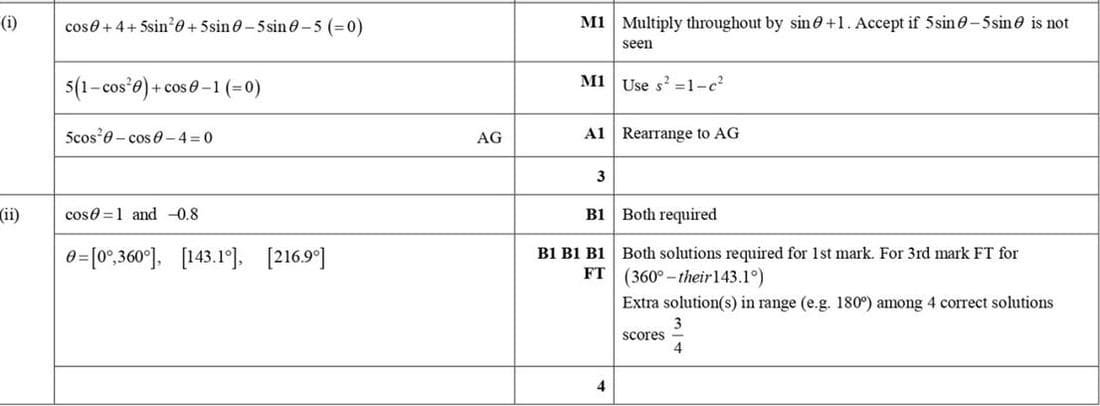
(i) Start with the equation:
\(\frac{\cos \theta + 4}{\sin \theta + 1} + 5 \sin \theta - 5 = 0\)
Multiply throughout by \(\sin \theta + 1\):
\(\cos \theta + 4 + 5 \sin \theta (\sin \theta + 1) - 5(\sin \theta + 1) = 0\)
\(\cos \theta + 4 + 5 \sin^2 \theta + 5 \sin \theta - 5 \sin \theta - 5 = 0\)
\(\cos \theta + 4 + 5 \sin^2 \theta - 5 = 0\)
\(\cos \theta - 1 + 5 \sin^2 \theta = 0\)
Use \(\sin^2 \theta = 1 - \cos^2 \theta\):
\(\cos \theta - 1 + 5(1 - \cos^2 \theta) = 0\)
\(\cos \theta - 1 + 5 - 5 \cos^2 \theta = 0\)
\(5 \cos^2 \theta - \cos \theta - 4 = 0\)
(ii) Solve \(5 \cos^2 \theta - \cos \theta - 4 = 0\).
Factorize or use the quadratic formula:
\(\cos \theta = 1 \quad \text{and} \quad \cos \theta = -0.8\)
For \(\cos \theta = 1\), \(\theta = 0^\circ, 360^\circ\).
For \(\cos \theta = -0.8\), \(\theta = 143.1^\circ, 216.9^\circ\).
Thus, \(\theta = [0^\circ, 360^\circ], [143.1^\circ], [216.9^\circ]\).