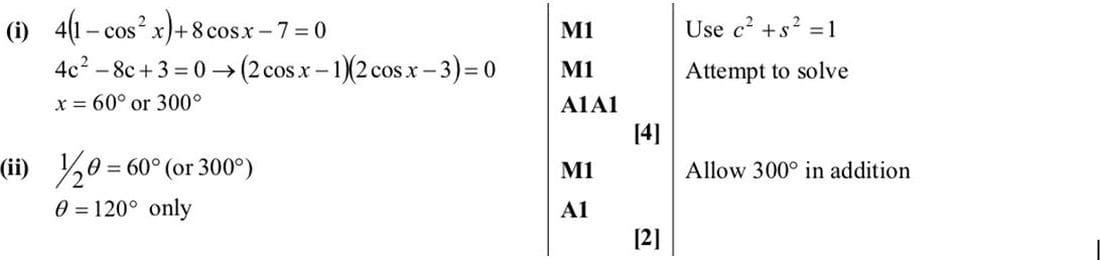
(i) Start with the equation \(4 \sin^2 x + 8 \cos x - 7 = 0\). Use the identity \(\sin^2 x = 1 - \cos^2 x\) to rewrite the equation as:
\(4(1 - \cos^2 x) + 8 \cos x - 7 = 0\)
Simplify to get:
\(4 - 4 \cos^2 x + 8 \cos x - 7 = 0\)
\(-4 \cos^2 x + 8 \cos x - 3 = 0\)
Let \(c = \cos x\), then:
\(4c^2 - 8c + 3 = 0\)
Factor the quadratic equation:
\((2c - 1)(2c - 3) = 0\)
Thus, \(c = \frac{1}{2}\) or \(c = \frac{3}{2}\). Since \(\cos x\) must be between -1 and 1, \(c = \frac{3}{2}\) is not valid.
For \(c = \frac{1}{2}\), \(\cos x = \frac{1}{2}\) gives \(x = 60^\circ\) or \(x = 300^\circ\).
(ii) For \(4 \sin^2 \left(\frac{1}{2} \theta\right) + 8 \cos \left(\frac{1}{2} \theta\right) - 7 = 0\), let \(x = \frac{1}{2} \theta\).
From part (i), \(x = 60^\circ\) or \(x = 300^\circ\).
Thus, \(\frac{1}{2} \theta = 60^\circ\) or \(\frac{1}{2} \theta = 300^\circ\).
Therefore, \(\theta = 120^\circ\) or \(\theta = 600^\circ\). Since \(\theta\) must be between \(0^\circ\) and \(360^\circ\), \(\theta = 120^\circ\) is the only valid solution.