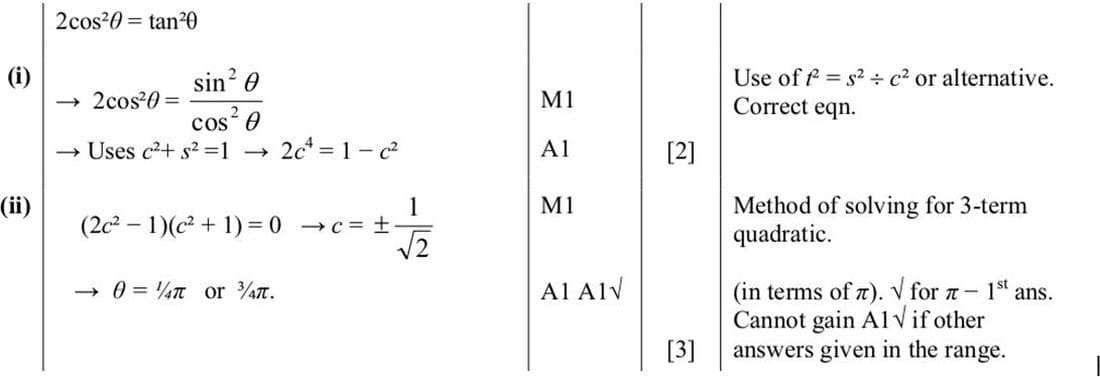
(i) Start with the equation \(2 \cos^2 \theta = \tan^2 \theta\).
We know \(\tan^2 \theta = \frac{\sin^2 \theta}{\cos^2 \theta}\).
Thus, \(2 \cos^2 \theta = \frac{\sin^2 \theta}{\cos^2 \theta}\).
Using the identity \(\sin^2 \theta + \cos^2 \theta = 1\), we have \(\sin^2 \theta = 1 - \cos^2 \theta\).
Substitute to get \(2 \cos^4 \theta = 1 - \cos^2 \theta\).
Rearrange to form a quadratic: \(2c^4 - c^2 - 1 = 0\), where \(c = \cos \theta\).
(ii) Solve the quadratic equation \((2c^2 - 1)(c^2 + 1) = 0\).
This gives \(c^2 = \frac{1}{2}\) or \(c^2 = -1\).
Since \(c^2 = -1\) has no real solutions, we consider \(c^2 = \frac{1}{2}\).
Thus, \(c = \pm \frac{1}{\sqrt{2}}\).
For \(c = \frac{1}{\sqrt{2}}\), \(\theta = \frac{\pi}{4}\).
For \(c = -\frac{1}{\sqrt{2}}\), \(\theta = \frac{3\pi}{4}\).
Therefore, the solutions are \(\theta = \frac{\pi}{4}\) or \(\frac{3\pi}{4}\).