Past Exam Questions
← Back9709 P11 - Nov 2011 - Q3 - 5 marks
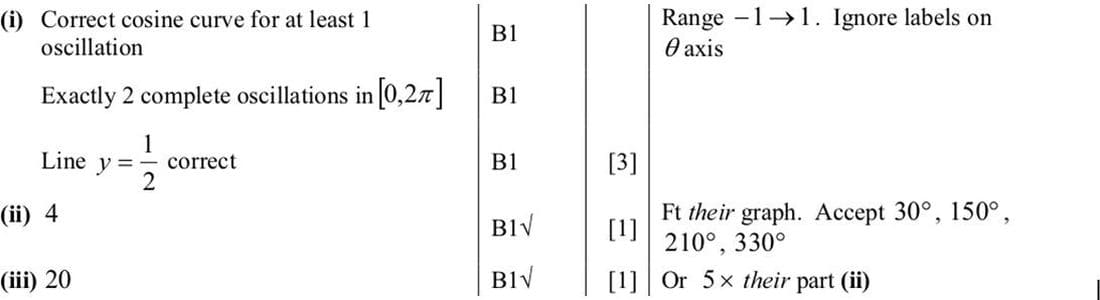
(i) Sketch, on a single diagram, the graphs of \(y = \cos 2\theta\) and \(y = \frac{1}{2}\) for \(0 \leq \theta \leq 2\pi\).
(ii) Write down the number of roots of the equation \(2\cos 2\theta - 1 = 0\) in the interval \(0 \leq \theta \leq 2\pi\).
(iii) Deduce the number of roots of the equation \(2\cos 2\theta - 1 = 0\) in the interval \(10\pi \leq \theta \leq 20\pi\).
9709 P13 - Nov 2010 - Q4 - 4 marks
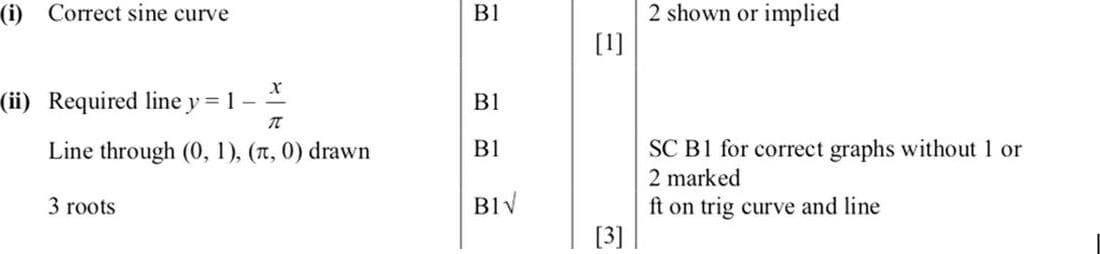
(i) Sketch the curve \(y = 2 \sin x\) for \(0 \leq x \leq 2\pi\).
(ii) By adding a suitable straight line to your sketch, determine the number of real roots of the equation \(2\pi \sin x = \pi - x\). State the equation of the straight line.
Question #536
The equation of a curve is \(y = 3 \cos 2x\). The equation of a line is \(x + 2y = \pi\). On the same diagram, sketch the curve and the line for \(0 \leq x \leq \pi\).

Question #537
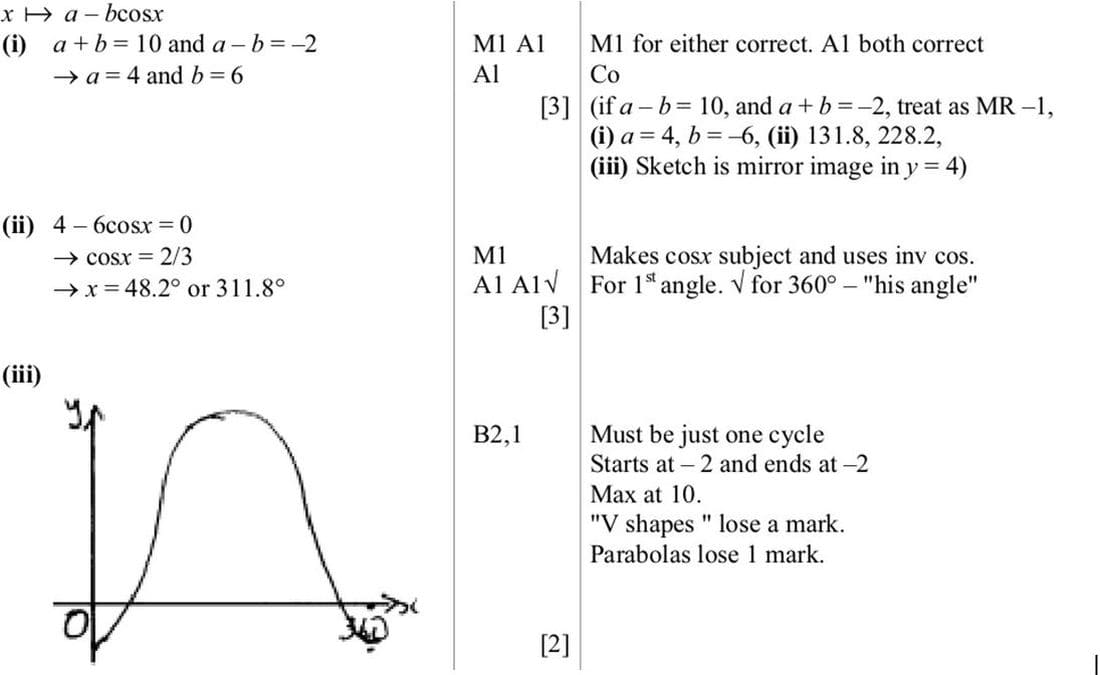
The function \(f\) is such that \(f(x) = a - b \cos x\) for \(0^\circ \leq x \leq 360^\circ\), where \(a\) and \(b\) are positive constants. The maximum value of \(f(x)\) is 10 and the minimum value is \(-2\).
- Find the values of \(a\) and \(b\).
- Solve the equation \(f(x) = 0\).
- Sketch the graph of \(y = f(x)\).
9709 P13 - Nov 2023 - Q8B - 3 marks
Another curve, with equation \(y = f(x)\), has a single stationary point at the point \((p, q)\), where \(p\) and \(q\) are constants. This curve is transformed to a curve with equation
\(y = -3f\left(\frac{1}{4}(x + 8)\right).\)
For the transformed curve, find the coordinates of the stationary point, giving your answer in terms of \(p\) and \(q\).

9709 P12 - Jun 2023 - Q8D - 6 marks
Describe fully a sequence of three transformations which can be combined to transform the graph of \(y = \sin x\) for \(0 \leq x \leq \frac{1}{2}\pi\) to the graph of \(y = f(x)\), where \(f(x) = 3 + 2 \sin \frac{1}{4}x\), making clear the order in which the transformations are applied.
9709 P11 - Jun 2022 - Q8A - 5 marks
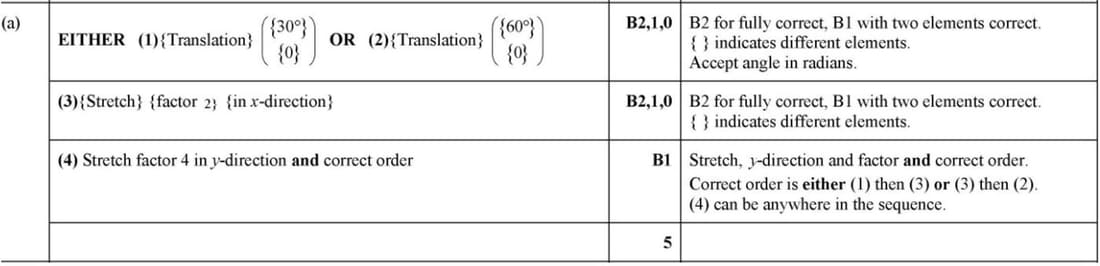
The curve \(y = \sin x\) is transformed to the curve \(y = 4 \sin\left(\frac{1}{2}x - 30^\circ\right)\).
Describe fully a sequence of transformations that have been combined, making clear the order in which the transformations are applied.
9709 P12 - Jun 2021 - Q2B - 2 marks
The curve \(y = \\sin 2x - 5x\) is reflected in the \(y\)-axis and then stretched by scale factor \(\frac{1}{3}\) in the \(x\)-direction.
Write down the equation of the transformed curve.

9709 P12 - Nov 2020 - Q11DE - 4 marks
Functions f, g and h are defined for \(x \in \mathbb{R}\) by
\(f(x) = 3 \cos 2x + 2\),
\(g(x) = f(2x) + 4\),
\(h(x) = 2f\left(x + \frac{1}{2}\pi\right)\).
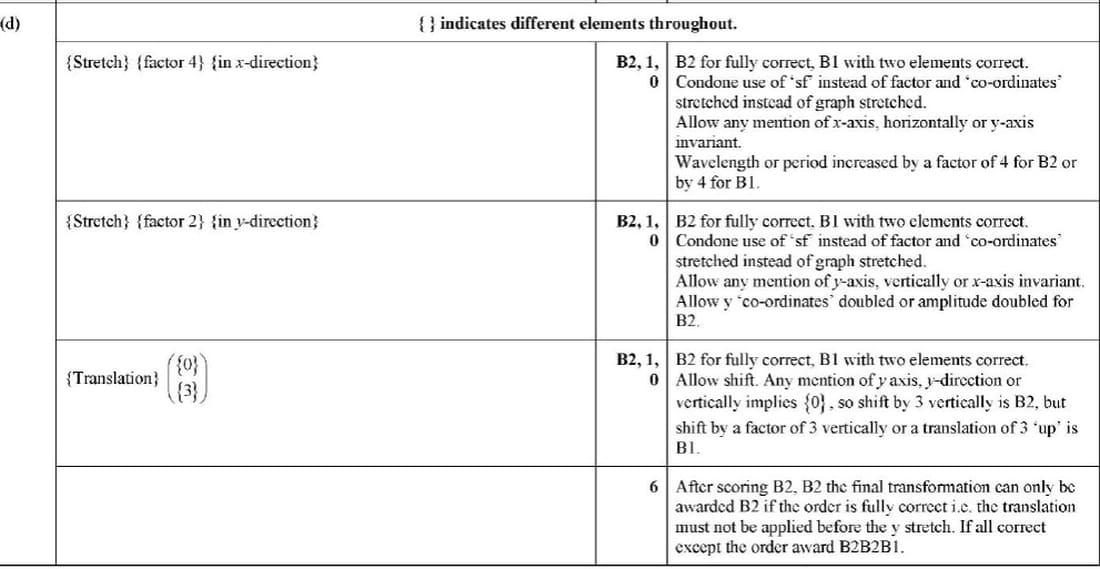
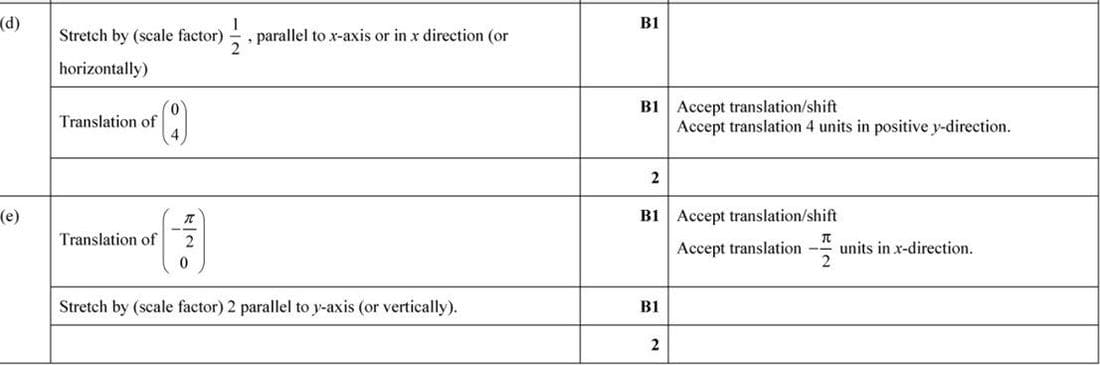
(d) Describe fully a sequence of transformations that maps the graph of \(y = f(x)\) on to \(y = g(x)\). [2]
(e) Describe fully a sequence of transformations that maps the graph of \(y = f(x)\) on to \(y = h(x)\). [2]
9709 P11 - Nov 2020 - Q4 - 3 marks
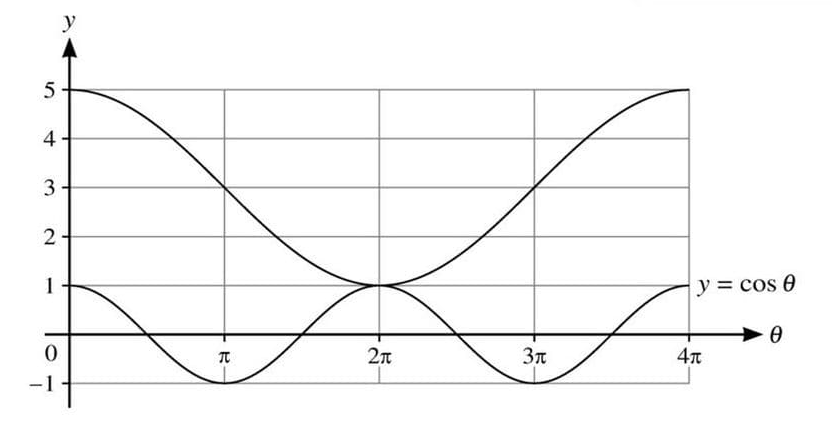
In the diagram, the lower curve has equation \(y = \cos \theta\). The upper curve shows the result of applying a combination of transformations to \(y = \cos \theta\).
Find, in terms of a cosine function, the equation of the upper curve.

Question #558
Functions f and g are such that
\(f(x) = 2 - 3 \sin 2x \quad \text{for} \; 0 \leq x \leq \pi,\)
\(g(x) = -2f(x) \quad \text{for} \; 0 \leq x \leq \pi.\)
(a) State the ranges of f and g.
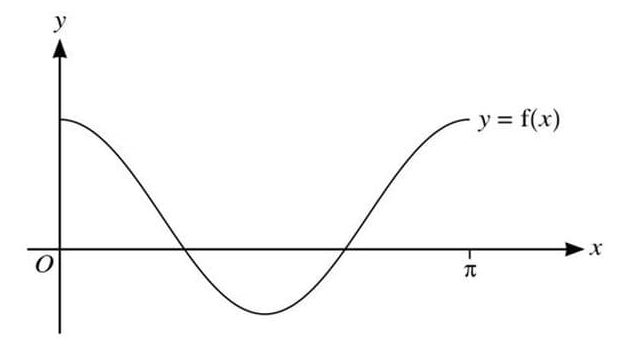
The diagram below shows the graph of \(y = f(x)\).
(b) Sketch, on this diagram, the graph of \(y = g(x)\).
The function h is such that
\(h(x) = g(x + \pi) \quad \text{for} \; -\pi \leq x \leq 0.\)
(c) Describe fully a sequence of transformations that maps the curve \(y = f(x)\) on to \(y = h(x)\).


Question #559
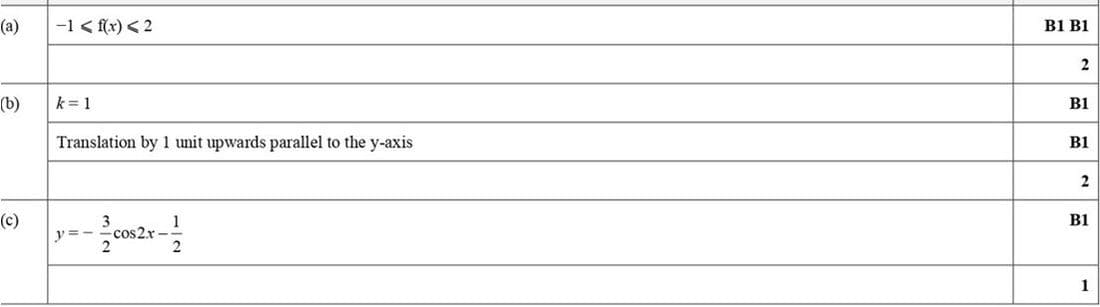
The diagram shows the graph of \(y = f(x)\), where \(f(x) = \frac{3}{2} \cos 2x + \frac{1}{2}\) for \(0 \leq x \leq \pi\).
(a) State the range of \(f\).
A function \(g\) is such that \(g(x) = f(x) + k\), where \(k\) is a positive constant. The x-axis is a tangent to the curve \(y = g(x)\).
(b) State the value of \(k\) and hence describe fully the transformation that maps the curve \(y = f(x)\) on to \(y = g(x)\).
(c) State the equation of the curve which is the reflection of \(y = f(x)\) in the x-axis. Give your answer in the form \(y = a \cos 2x + b\), where \(a\) and \(b\) are constants.
Question #538
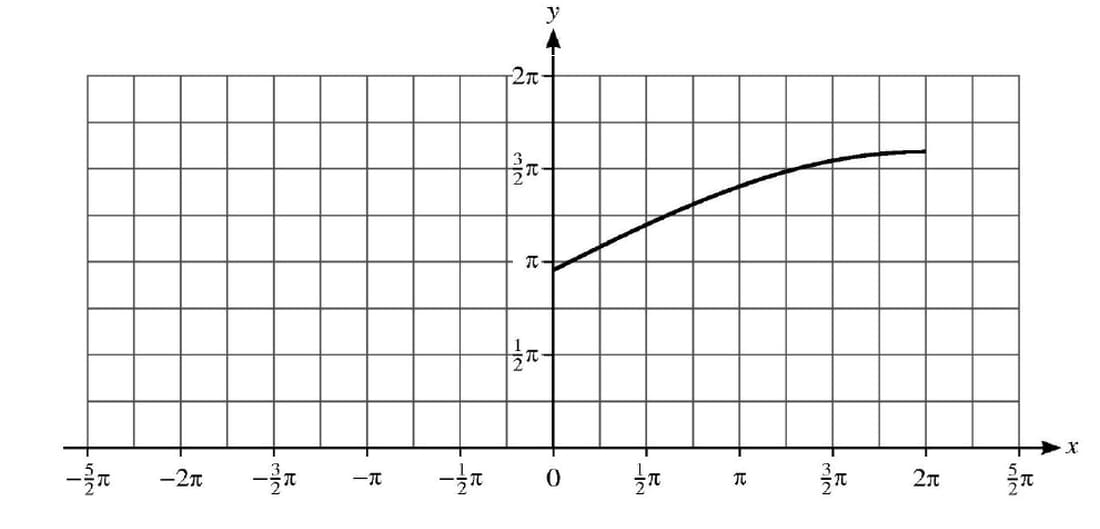
The diagram shows the graph of \(y = f(x)\) where the function \(f\) is defined by
\(f(x) = 3 + 2 \sin \frac{1}{4}x\) for \(0 \leq x \leq 2\pi\).
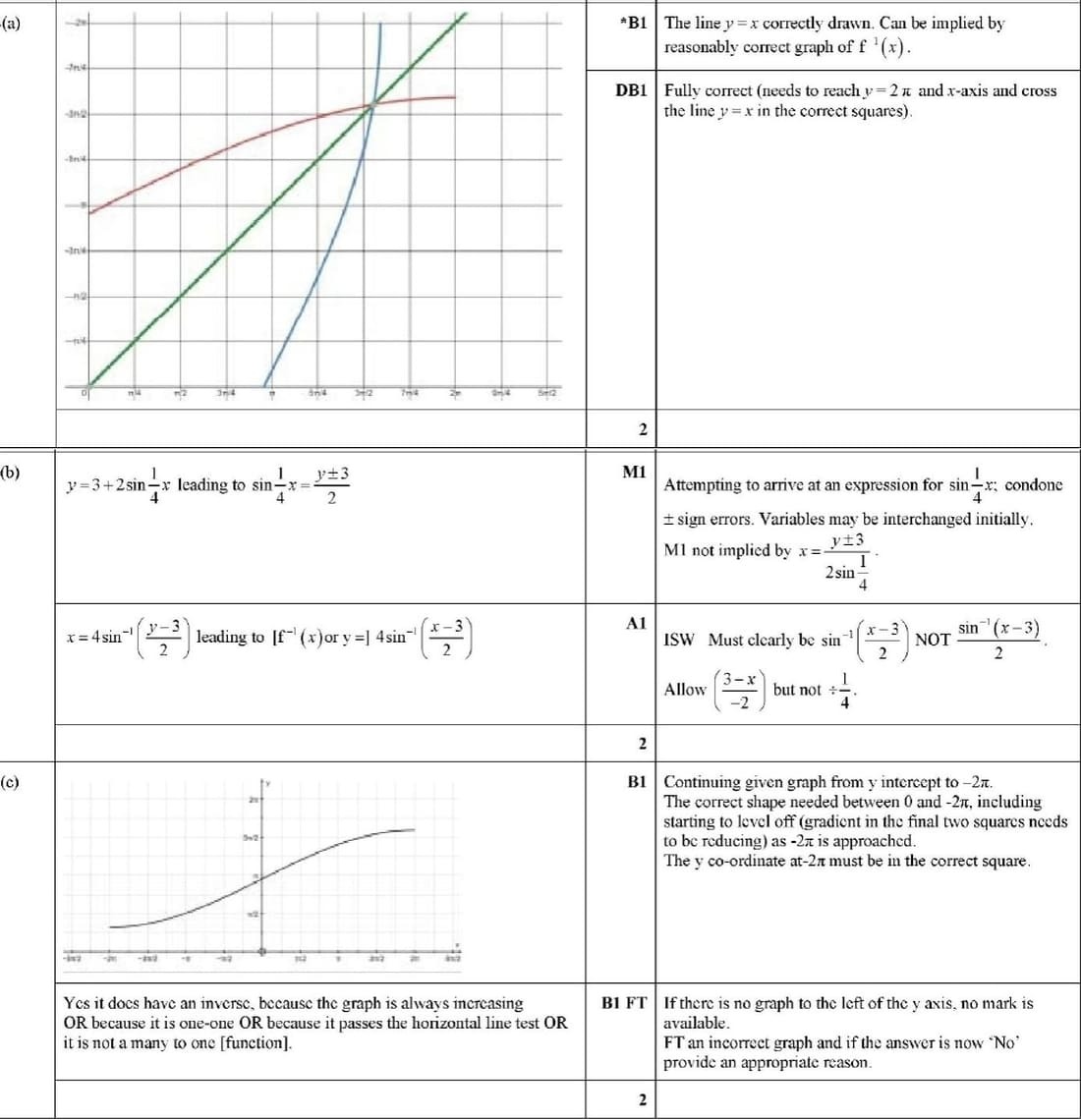
(a) On the diagram above, sketch the graph of \(y = f^{-1}(x)\). [2]
(b) Find an expression for \(f^{-1}(x)\). [2]
(c) The diagram above shows part of the graph of the function \(g(x) = 3 + 2 \sin \frac{1}{4}x\) for \(-2\pi \leq x \leq 2\pi\).
Complete the sketch of the graph of \(g(x)\) on the diagram above and hence explain whether the function \(g\) has an inverse. [2]
Question #539
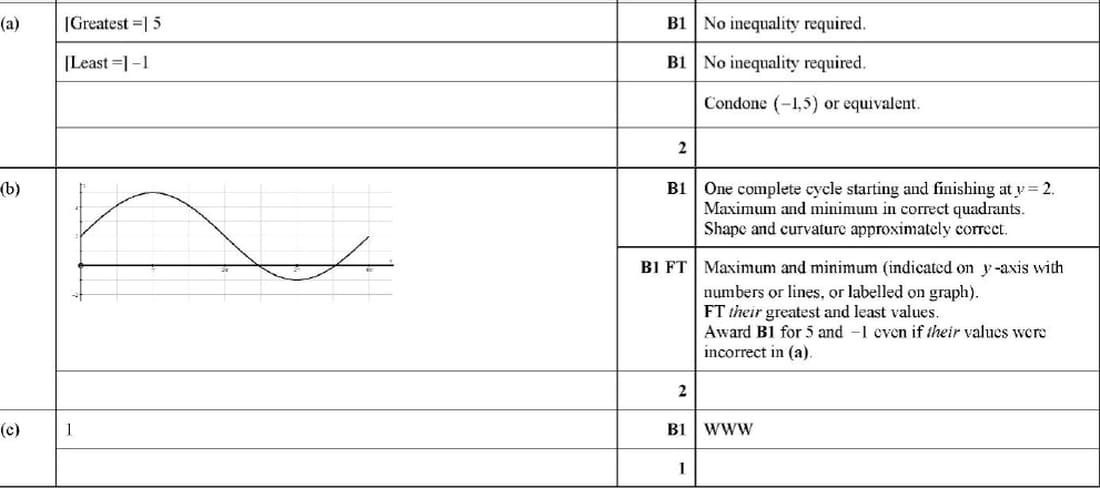
The function \(f\) is such that \(f(x) = 3 - 4 \cos^k x\), for \(0 \leq x \leq \pi\), where \(k\) is a constant.
(i) In the case where \(k = 2\),
(a) find the range of \(f\), [2]
(b) find the exact solutions of the equation \(f(x) = 1\). [3]
(ii) In the case where \(k = 1\),
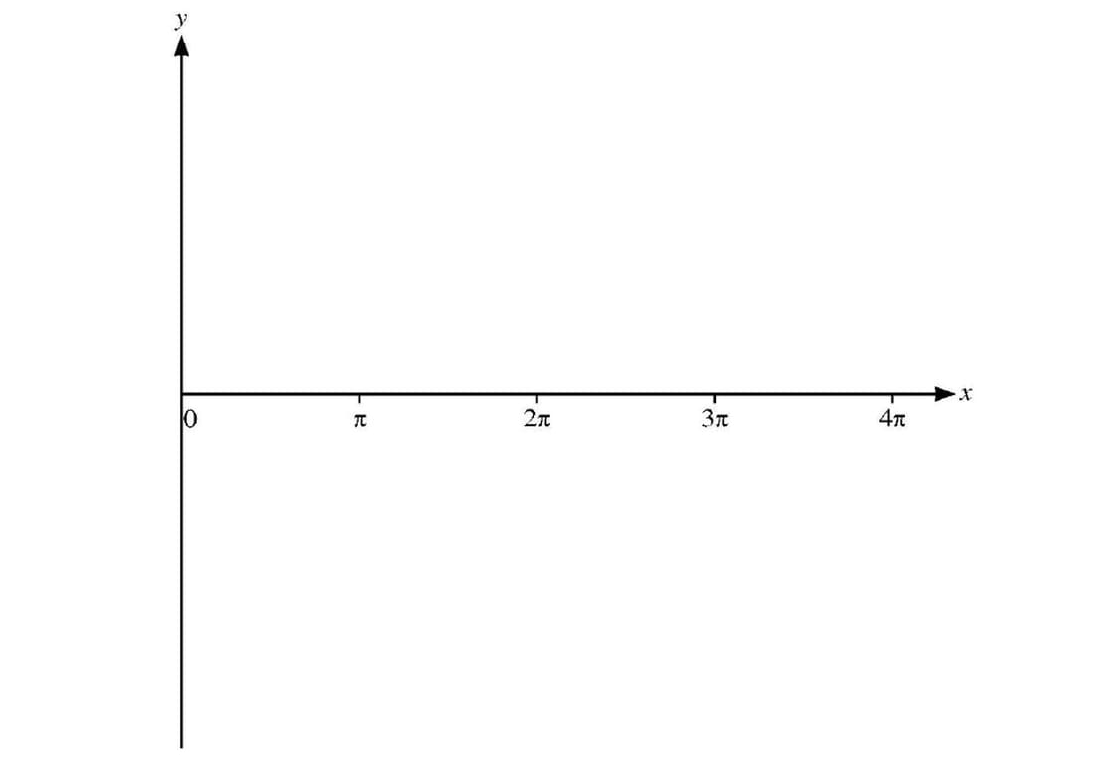
(a) sketch the graph of \(y = f(x)\), [2]
(b) state, with a reason, whether \(f\) has an inverse. [1]
Question #540
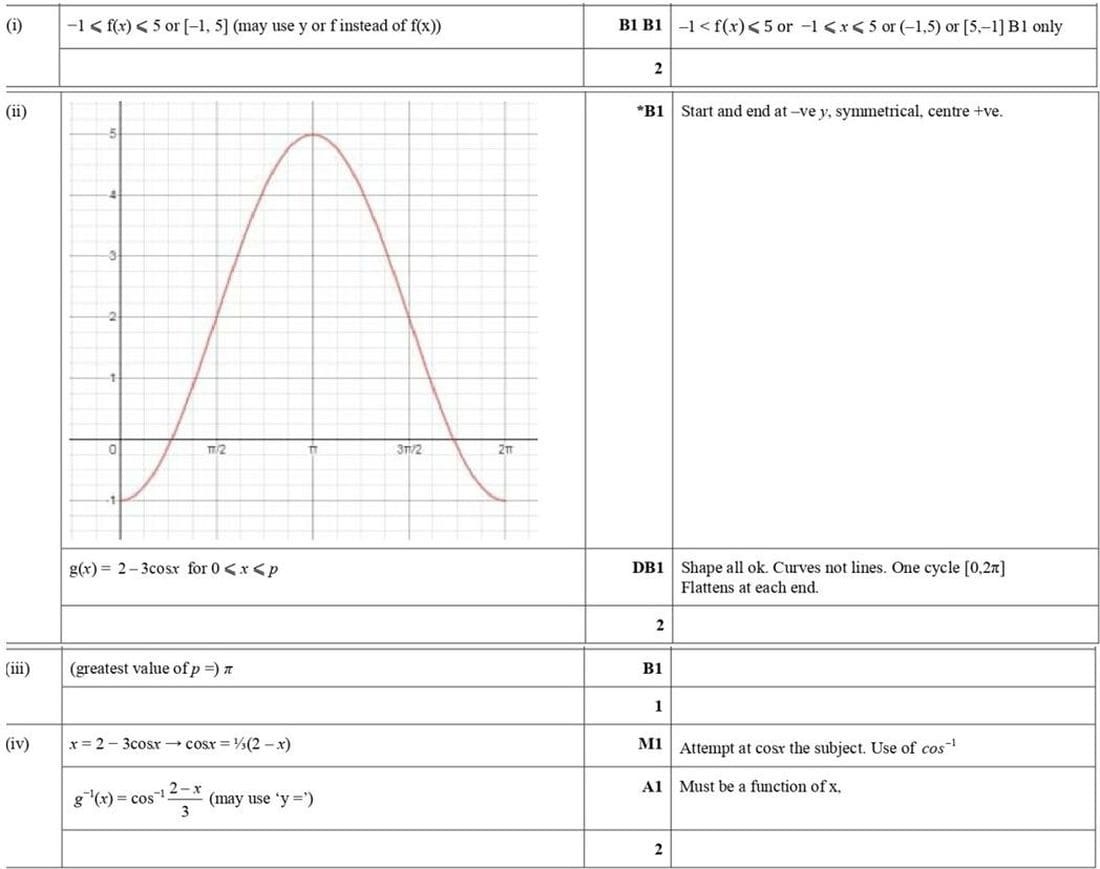
A function f is defined by \(f : x \mapsto 3 - 2 \tan\left(\frac{1}{2}x\right)\) for \(0 \leq x < \pi\).
- State the range of \(f\). [1]
- State the exact value of \(f\left(\frac{2}{3}\pi\right)\). [1]
- Sketch the graph of \(y = f(x)\). [2]
- Obtain an expression, in terms of \(x\), for \(f^{-1}(x)\). [3]
Question #541
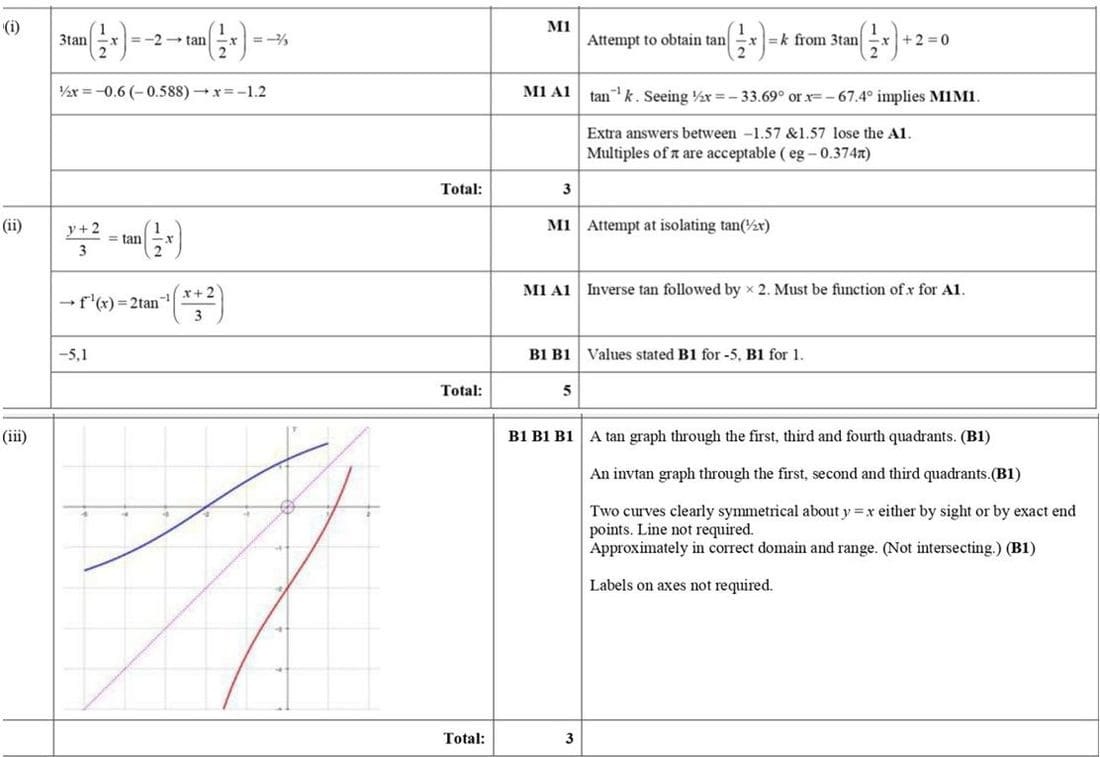
The function \(f : x \mapsto 4 - 3 \sin x\) is defined for the domain \(0 \leq x \leq 2\pi\).
(i) Solve the equation \(f(x) = 2\). [3]
(ii) Sketch the graph of \(y = f(x)\). [2]
(iii) Find the set of values of \(k\) for which the equation \(f(x) = k\) has no solution. [2]
The function \(g : x \mapsto 4 - 3 \sin x\) is defined for the domain \(\frac{1}{2}\pi \leq x \leq A\).
(iv) State the largest value of \(A\) for which \(g\) has an inverse. [1]
(v) For this value of \(A\), find the value of \(g^{-1}(3)\). [2]
Question #542
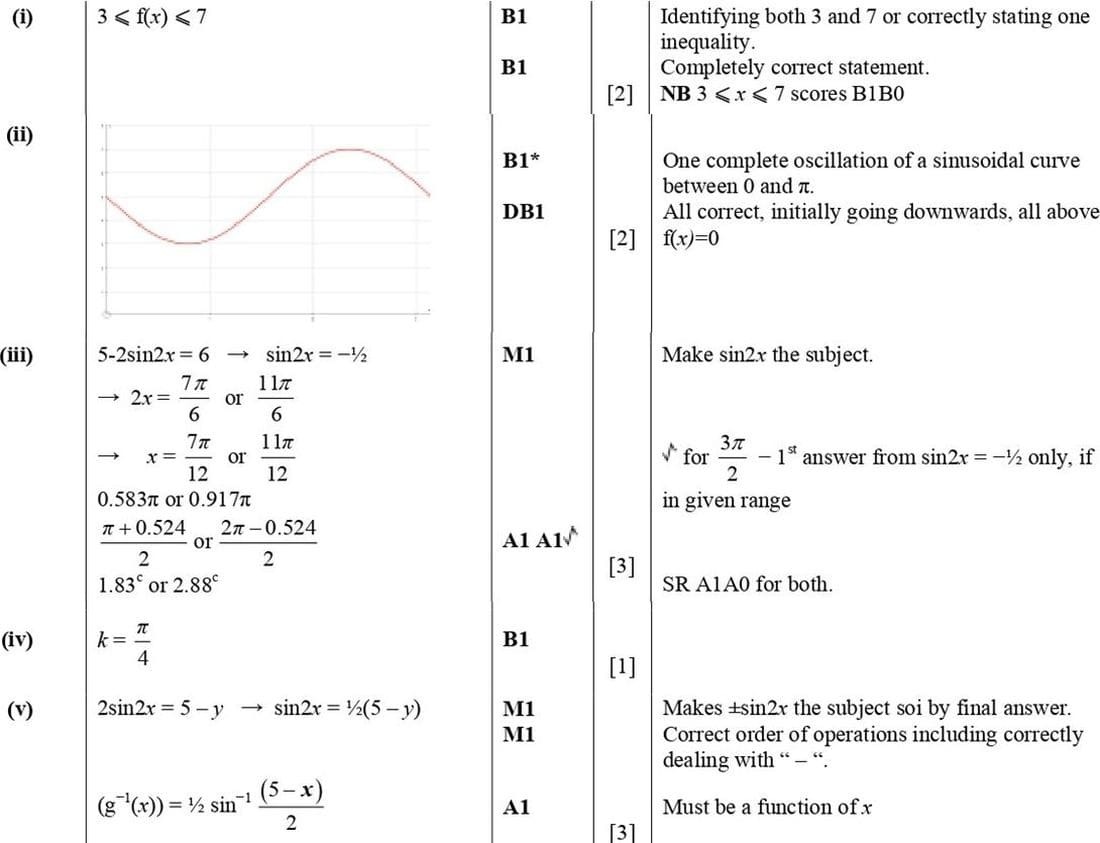
The function f is defined by \(f : x \mapsto 5 - 3 \sin 2x\) for \(0 \leq x \leq \pi\).
(i) Find the range of \(f\). [2]
(ii) Sketch the graph of \(y = f(x)\). [3]
(iii) State, with a reason, whether \(f\) has an inverse. [1]
9709 P1 - Jun 2005 - Q7 - 7 marks
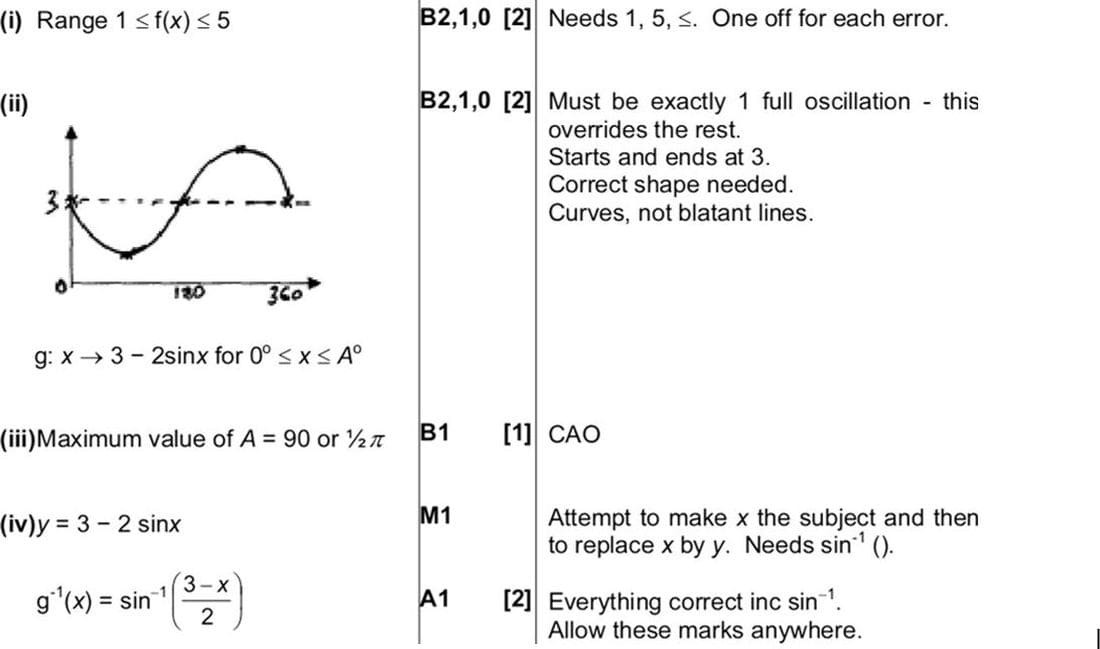
A function f is defined by \(f : x \mapsto 3 - 2 \sin x\), for \(0^\circ \leq x \leq 360^\circ\).
(i) Find the range of \(f\). [2]
(ii) Sketch the graph of \(y = f(x)\). [2]
A function \(g\) is defined by \(g : x \mapsto 3 - 2 \sin x\), for \(0^\circ \leq x \leq A^\circ\), where \(A\) is a constant.
(iii) State the largest value of \(A\) for which \(g\) has an inverse. [1]
(iv) When \(A\) has this value, obtain an expression, in terms of \(x\), for \(g^{-1}(x)\). [2]
9709 P11 - Jun 2023 - Q7 - 5 marks
A curve has equation \(y = 2 + 3 \, \sin \frac{1}{2}x\) for \(0 \leq x \leq 4\pi\).
(a) State greatest and least values of \(y\). [2]
(b) Sketch the curve. [2]
(c) State the number of solutions of the equation \(2 + 3 \, \sin \frac{1}{2}x = 5 - 2x\) for \(0 \leq x \leq 4\pi\). [1]
9709 P11 - Jun 2019 - Q9 - 7 marks
The function f is defined by \(f(x) = 2 - 3 \cos x\) for \(0 \leq x \leq 2\pi\).
- State the range of \(f\). [2]
- Sketch the graph of \(y = f(x)\). [2]
The function \(g\) is defined by \(g(x) = 2 - 3 \cos x\) for \(0 \leq x \leq p\), where \(p\) is a constant.
- State the largest value of \(p\) for which \(g\) has an inverse. [1]
- For this value of \(p\), find an expression for \(g^{-1}(x)\). [2]