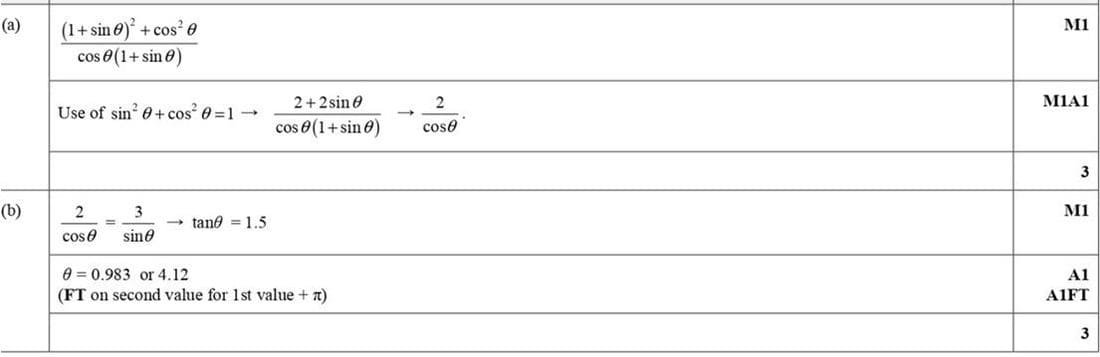
(a) Start with the left-hand side: \(\frac{1 + \sin \theta}{\cos \theta} + \frac{\cos \theta}{1 + \sin \theta}\).
Combine the fractions: \(\frac{(1 + \sin \theta)^2 + \cos^2 \theta}{\cos \theta (1 + \sin \theta)}\).
Expand the numerator: \((1 + \sin \theta)^2 + \cos^2 \theta = 1 + 2\sin \theta + \sin^2 \theta + \cos^2 \theta\).
Using \(\sin^2 \theta + \cos^2 \theta = 1\), the numerator becomes \(2 + 2\sin \theta\).
Thus, \(\frac{2 + 2\sin \theta}{\cos \theta (1 + \sin \theta)} = \frac{2}{\cos \theta}\), proving the identity.
(b) Given \(\frac{1 + \sin \theta}{\cos \theta} + \frac{\cos \theta}{1 + \sin \theta} = \frac{3}{\sin \theta}\), use the identity from part (a): \(\frac{2}{\cos \theta} = \frac{3}{\sin \theta}\).
Cross-multiply to get \(2\sin \theta = 3\cos \theta\).
Divide both sides by \(\cos \theta\): \(\tan \theta = 1.5\).
Find \(\theta\) using \(\tan^{-1}(1.5)\): \(\theta = 0.983\).
Since \(\tan \theta\) is periodic with period \(\pi\), the second solution is \(\theta = 0.983 + \pi = 4.12\).