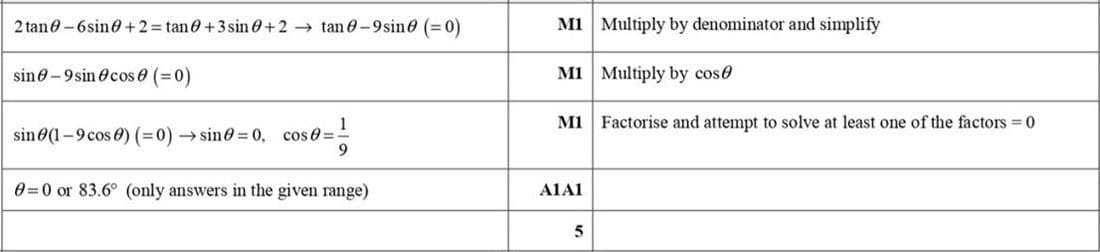
Start with the equation:
\(\frac{\tan \theta + 3 \sin \theta + 2}{\tan \theta - 3 \sin \theta + 1} = 2\)
Multiply both sides by the denominator:
\(\tan \theta + 3 \sin \theta + 2 = 2(\tan \theta - 3 \sin \theta + 1)\)
Expand and simplify:
\(\tan \theta + 3 \sin \theta + 2 = 2 \tan \theta - 6 \sin \theta + 2\)
Rearrange terms:
\(2 \tan \theta - \tan \theta - 6 \sin \theta - 3 \sin \theta + 2 - 2 = 0\)
\(\tan \theta - 9 \sin \theta = 0\)
Multiply by \(\cos \theta\):
\(\sin \theta - 9 \sin \theta \cos \theta = 0\)
Factorize:
\(\sin \theta (1 - 9 \cos \theta) = 0\)
Set each factor to zero:
\(\sin \theta = 0\) or \(1 - 9 \cos \theta = 0\)
For \(\sin \theta = 0\), \(\theta = 0^\circ\).
For \(1 - 9 \cos \theta = 0\), \(\cos \theta = \frac{1}{9}\).
Calculate \(\theta\) using \(\cos^{-1}\):
\(\theta \approx 83.6^\circ\).
Thus, \(\theta = 0^\circ\) or \(83.6^\circ\) (only answers in the given range).