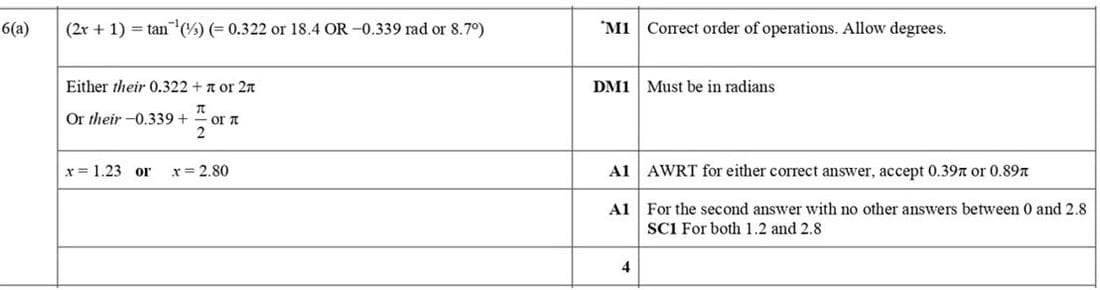
Start with the equation \(3 \tan(2x + 1) = 1\).
Divide both sides by 3: \(\tan(2x + 1) = \frac{1}{3}\).
Take the inverse tangent: \(2x + 1 = \tan^{-1}\left(\frac{1}{3}\right)\).
Using a calculator, \(\tan^{-1}\left(\frac{1}{3}\right) \approx 0.322\) radians.
Thus, \(2x + 1 = 0.322 + k\pi\) or \(2x + 1 = -0.339 + k\pi\) for integer \(k\).
Solving for \(x\):
\(2x = 0.322 - 1 + k\pi\) or \(2x = -0.339 - 1 + k\pi\).
\(x = \frac{-0.678 + k\pi}{2}\) or \(x = \frac{-1.339 + k\pi}{2}\).
For the smallest positive \(x\), set \(k = 1\):
\(x = \frac{-0.678 + \pi}{2} \approx 1.23\).
For the next smallest \(x\), set \(k = 2\):
\(x = \frac{-1.339 + 2\pi}{2} \approx 2.80\).