Past Exam Questions
← Back0606 P23 - Jun 2023 - Q2 - 4 marks
Do not use a calculator in this question.
Write
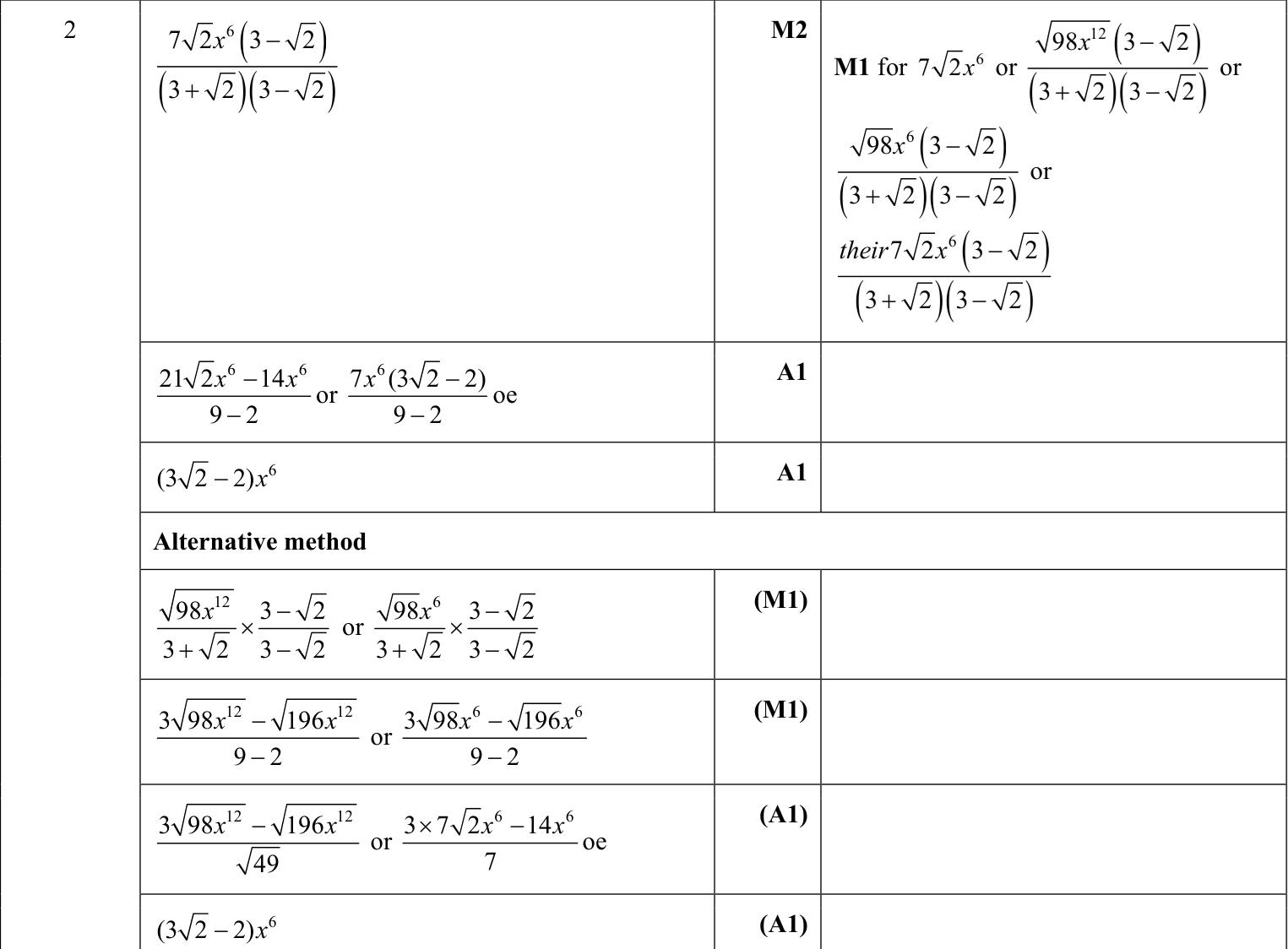
\(\frac{\sqrt{98x^{12}}}{3+\sqrt2}\)
in the form
\((a\sqrt b+c)x^d,\)
where \(a\), \(b\), \(c\) and \(d\) are integers.
0606 P12 - Nov 2023 - Q9 - 4 marks
Solve the equation
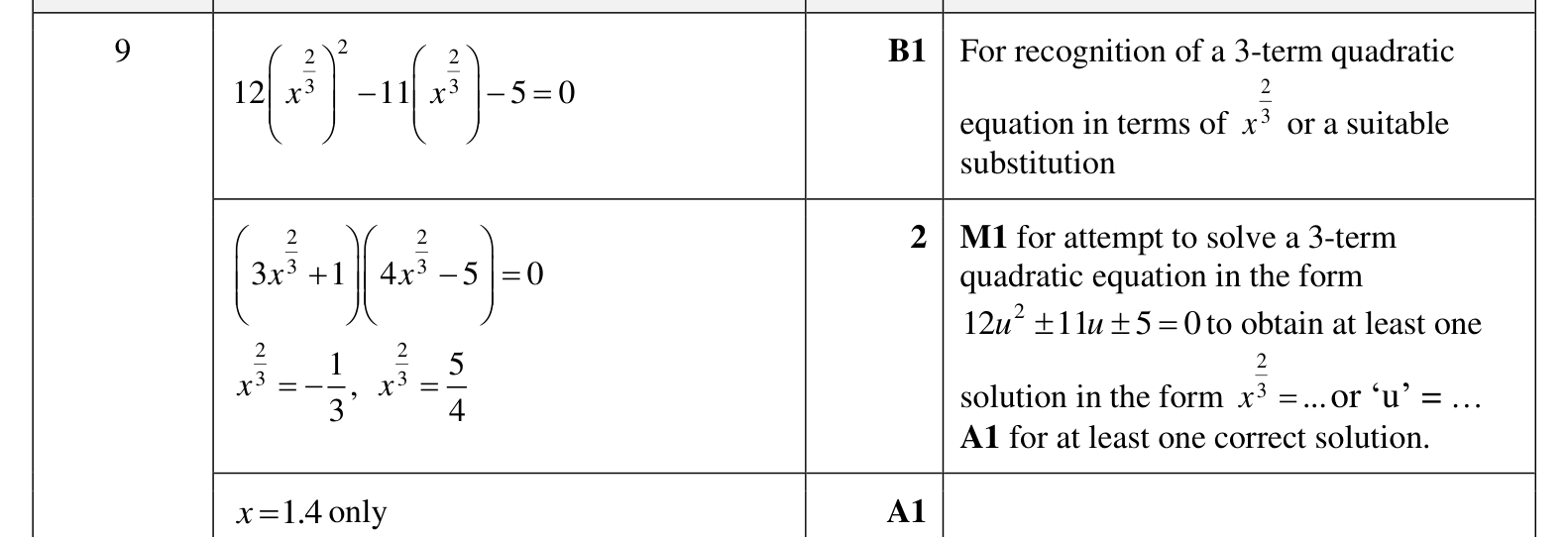
\(12x^{2/3}-5x^{-2/3}-11=0\)
for \(x\gt 0\). Give your answer correct to one decimal place.
0606 P13 - Nov 2023 - Q7 - 4 marks
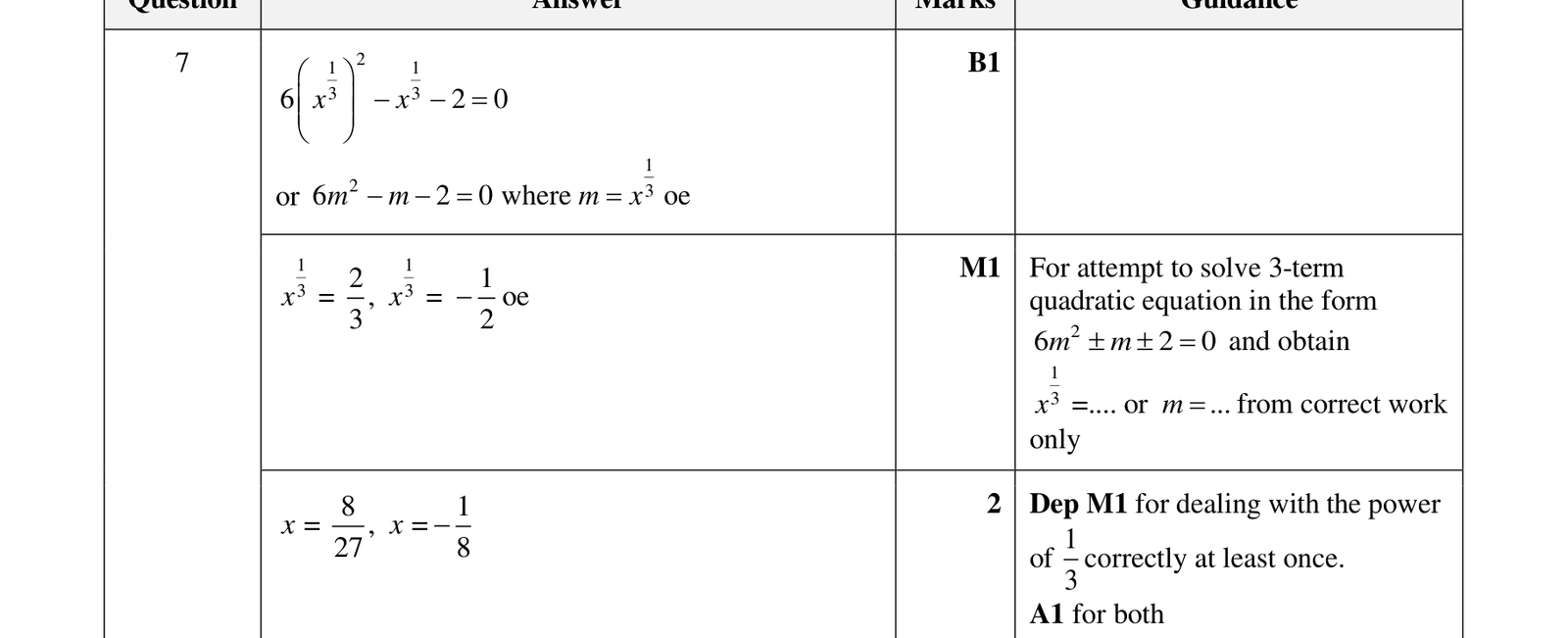
Solve the equation
\(6x^{\frac13}-2x^{-\frac13}-1=0.\)
Give your answers in exact form.
0606 P12 - Mar 2022 - Q2 - 6 marks
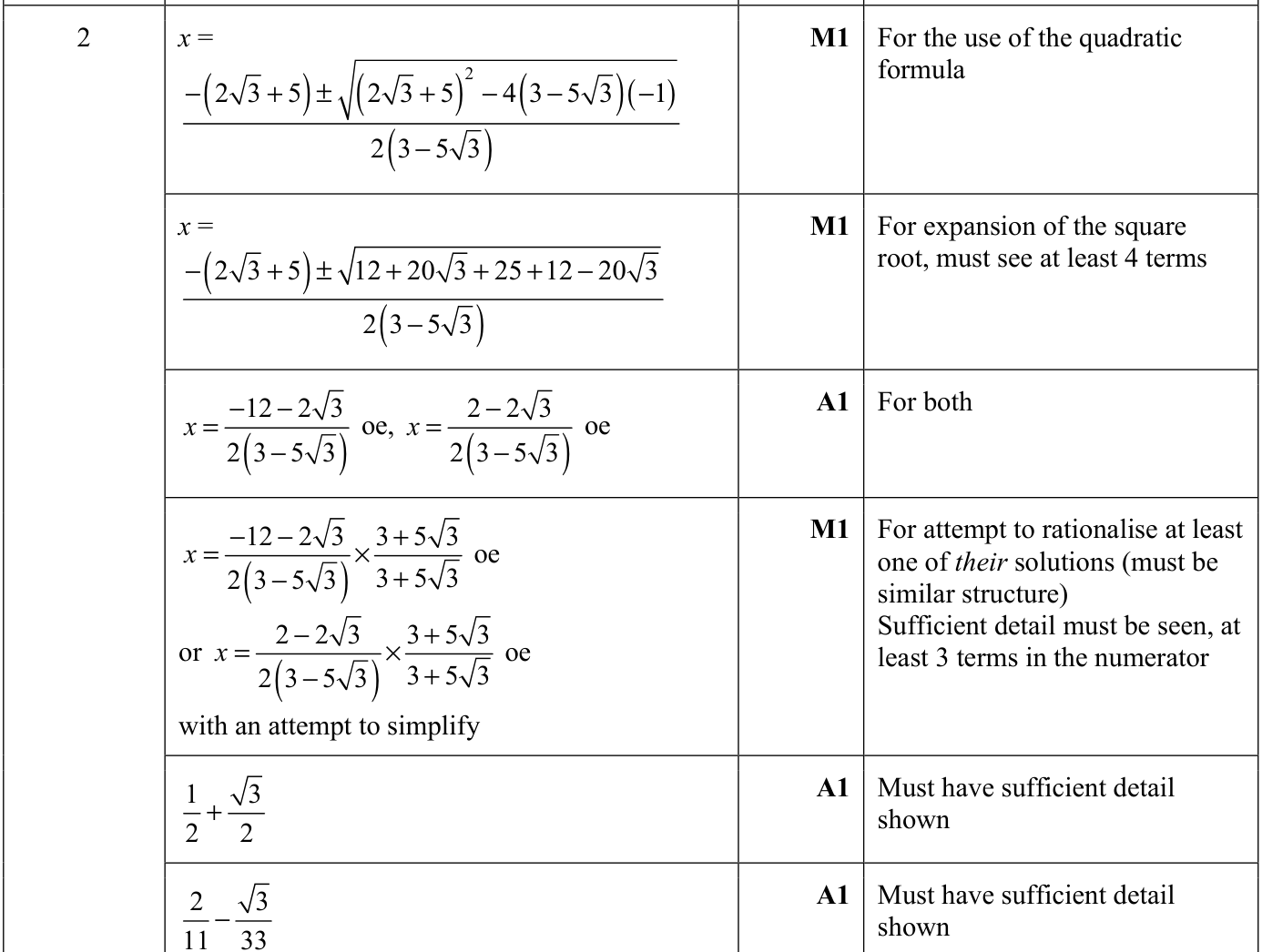
Do not use a calculator in this question.
Solve the equation \((3-5\sqrt3)x^2+(2\sqrt3+5)x-1=0\), giving your solutions in the form \(a+b\sqrt3\), where \(a\) and \(b\) are rational numbers.
0606 P22 - Mar 2022 - Q4 - 5 marks
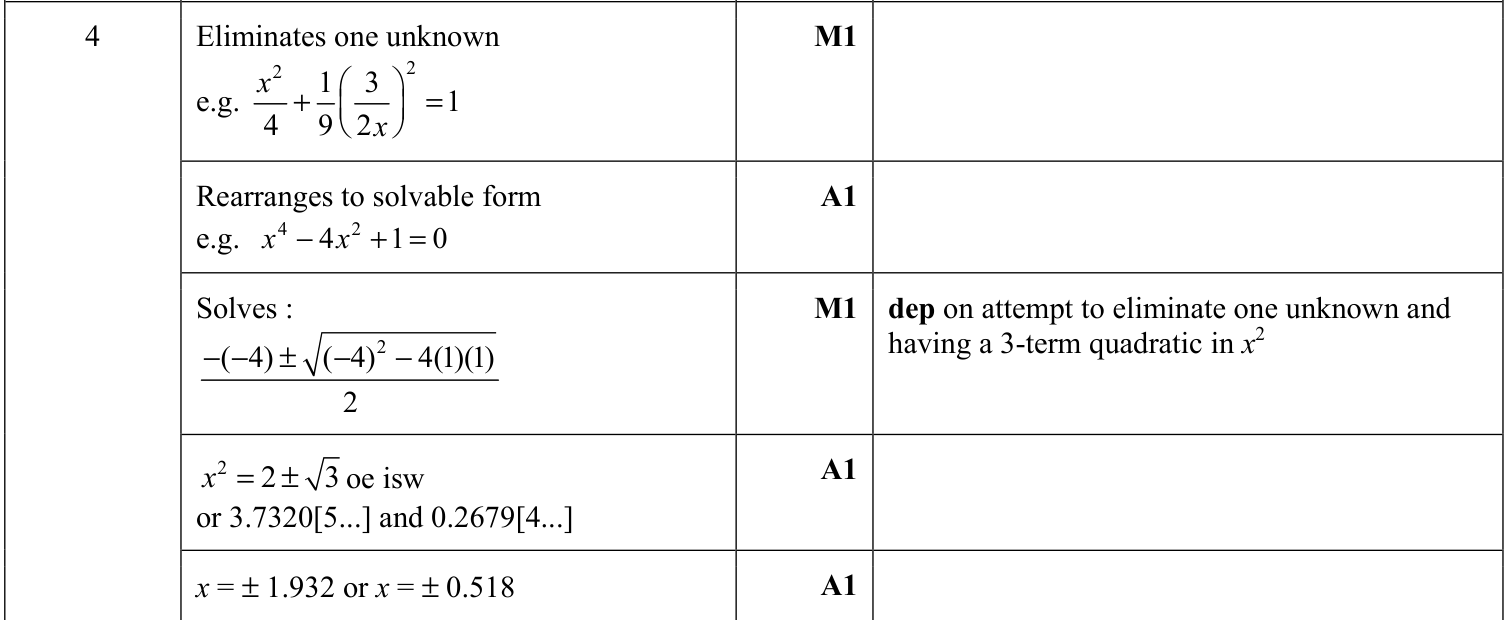
Find the \(x\)-coordinates of the points of intersection of the curves
\(\frac{x^2}{4}+\frac{y^2}{9}=1 \quad\text{and}\quad y=\frac{3}{2x}.\)
Give your answers correct to \(3\) decimal places.
0606 P22 - Mar 2023 - Q2 - 4 marks
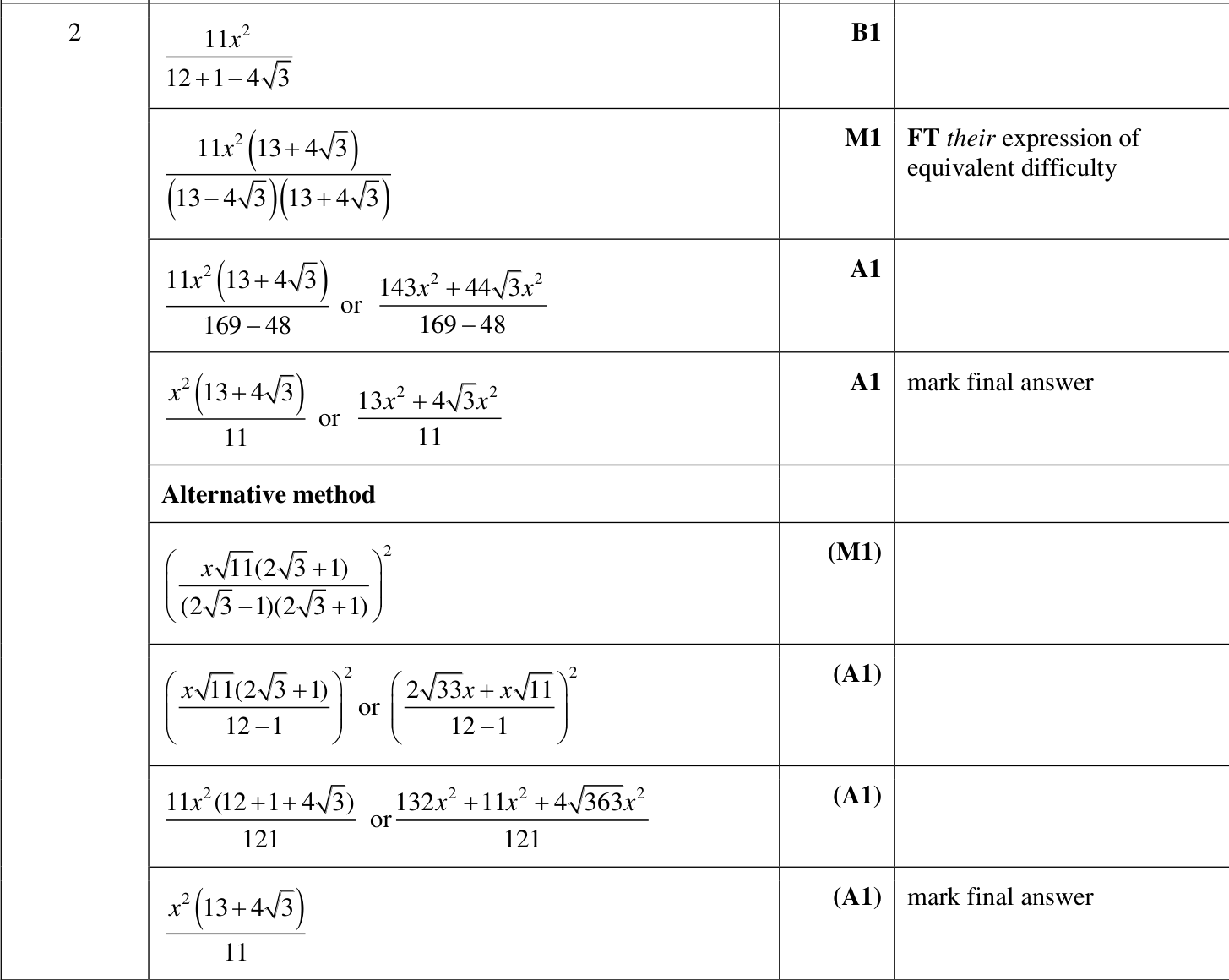
Do not use a calculator in this question.
Expand and simplify
\(\left(\frac{x\sqrt{11}}{2\sqrt3-1}\right)^2,\)
giving your answer with a rational denominator.
0606 P21 - Jun 2022 - Q1 - 5 marks
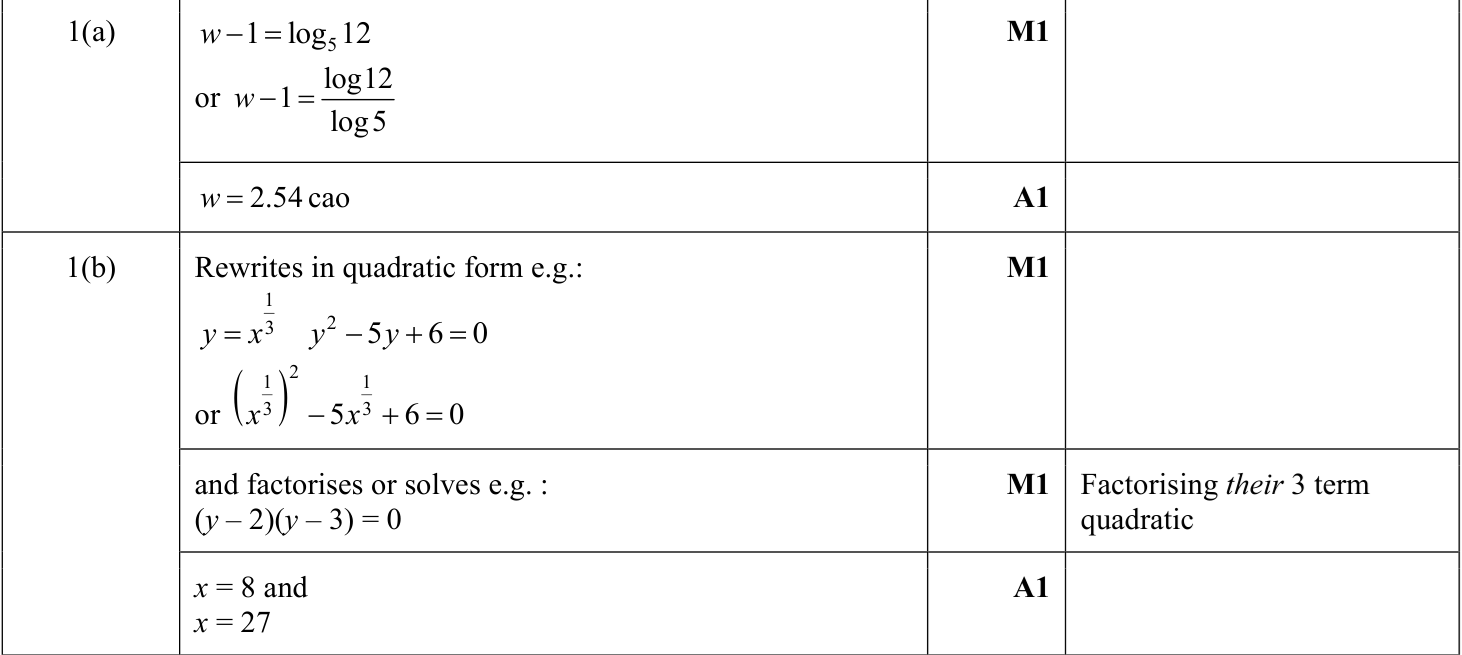
(a) Solve the equation \(5^{w-1}=12\), giving your answer correct to 2 decimal places.
(b) Solve the equation \(x^{2/3}-5x^{1/3}+6=0\).
0606 P11 - Nov 2022 - Q4 - 6 marks
Do not use a calculator in this question.
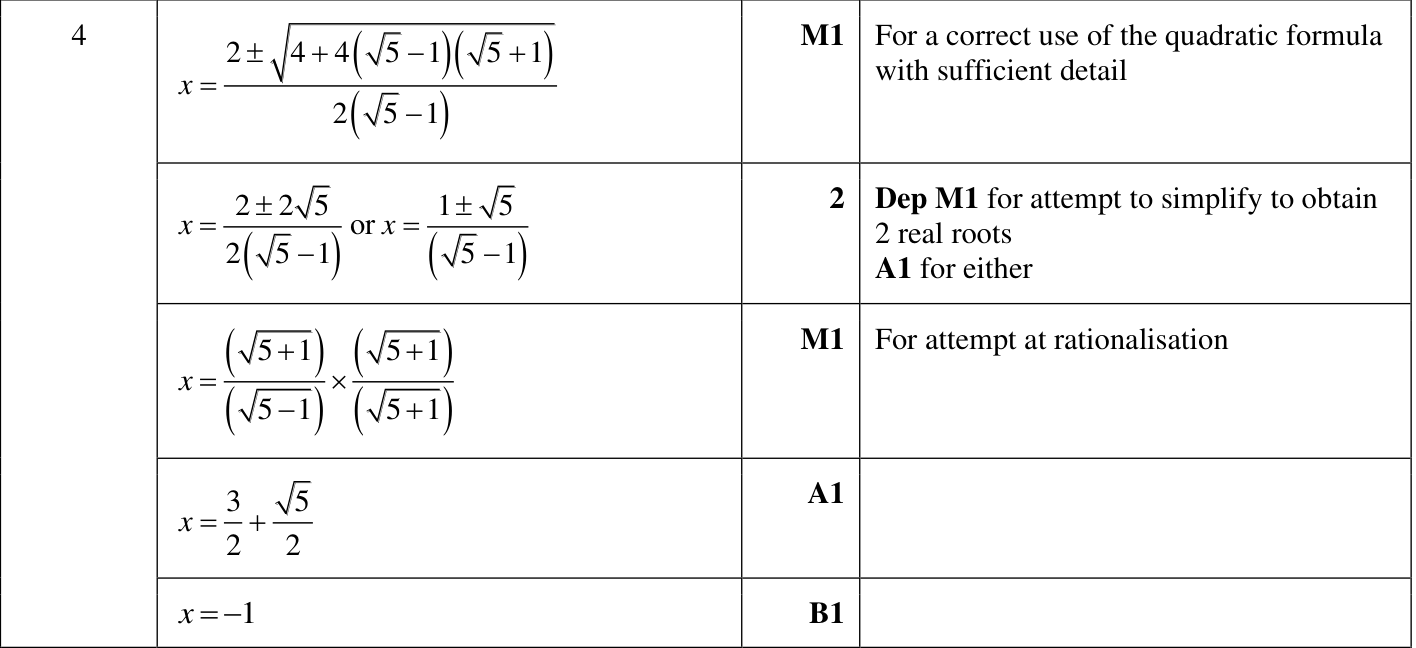
Solve the equation
\((\sqrt5-1)x^2-2x-(\sqrt5+1)=0,\)
giving your answers in the form \(a+b\sqrt5\), where \(a\) and \(b\) are constants.
0606 P11 - Nov 2021 - Q4 - 7 marks
(a) Given that
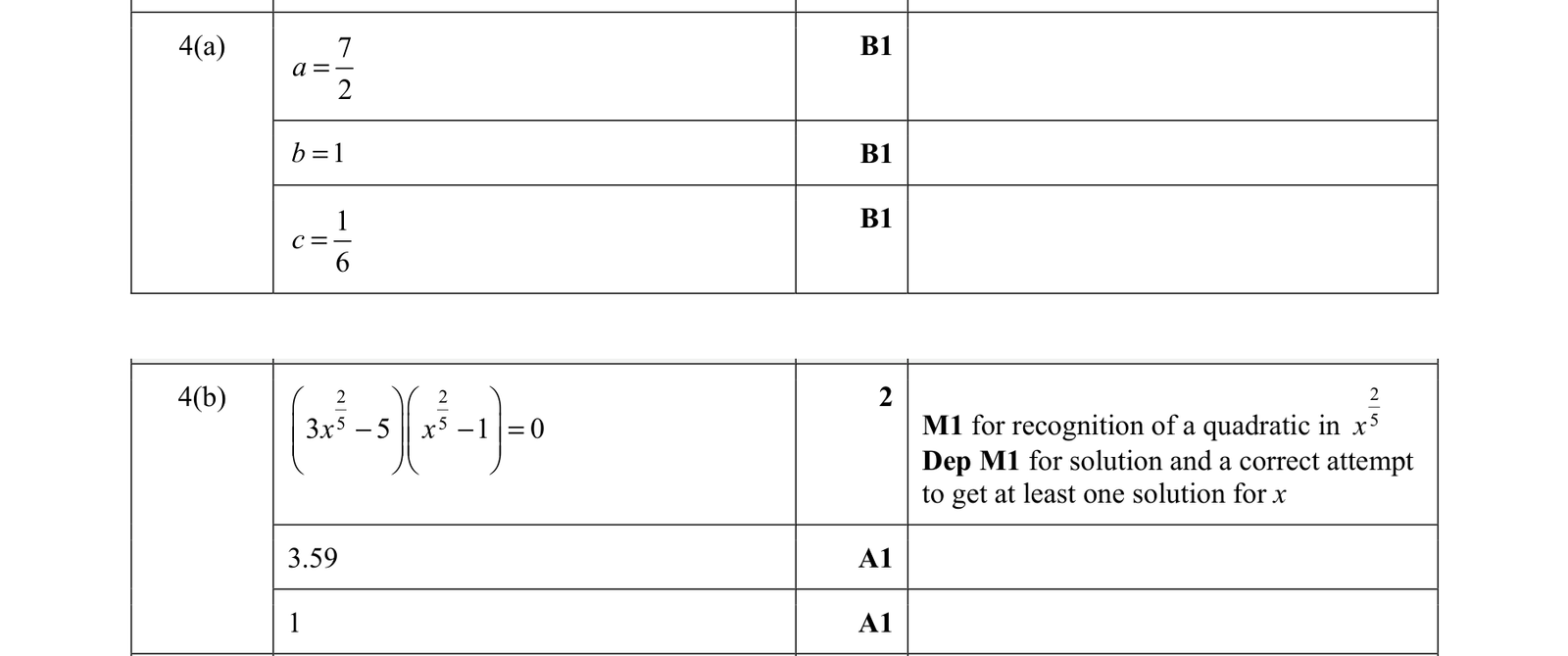
\(\displaystyle \frac{q^{-2}\sqrt{pr}}{\sqrt[3]{r}(pq)^{-3}}=p^a q^b r^c,\)
find the value of each of the constants \(a\), \(b\) and \(c\).
(b) Solve the equation
\(\displaystyle 3x^{\frac45}-8x^{\frac25}+5=0.\)
0606 P21 - Nov 2021 - Q4 - 5 marks
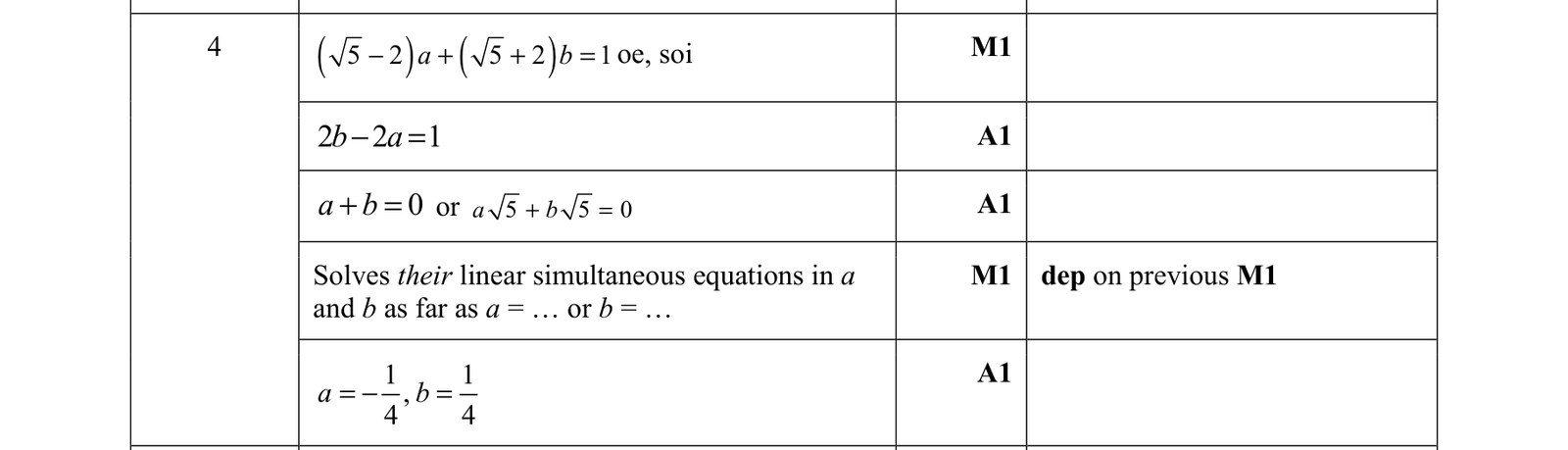
Find rational numbers \(a\) and \(b\) such that
\(\frac{a}{\sqrt5+2}+\frac{b}{\sqrt5-2}=1.\)
0606 P11 - Nov 2020 - Q3 - 6 marks
(a) Write
\(\frac{\sqrt{p}\,(qr^2)^{1/3}}{(q^3p)^{-1}r^3}\)
in the form \(p^aq^br^c\), where \(a\), \(b\) and \(c\) are constants.
(b) Solve \(6x^{2/3}-5x^{1/3}+1=0\).

0606 P12 - Jun 2019 - Q4 - 6 marks
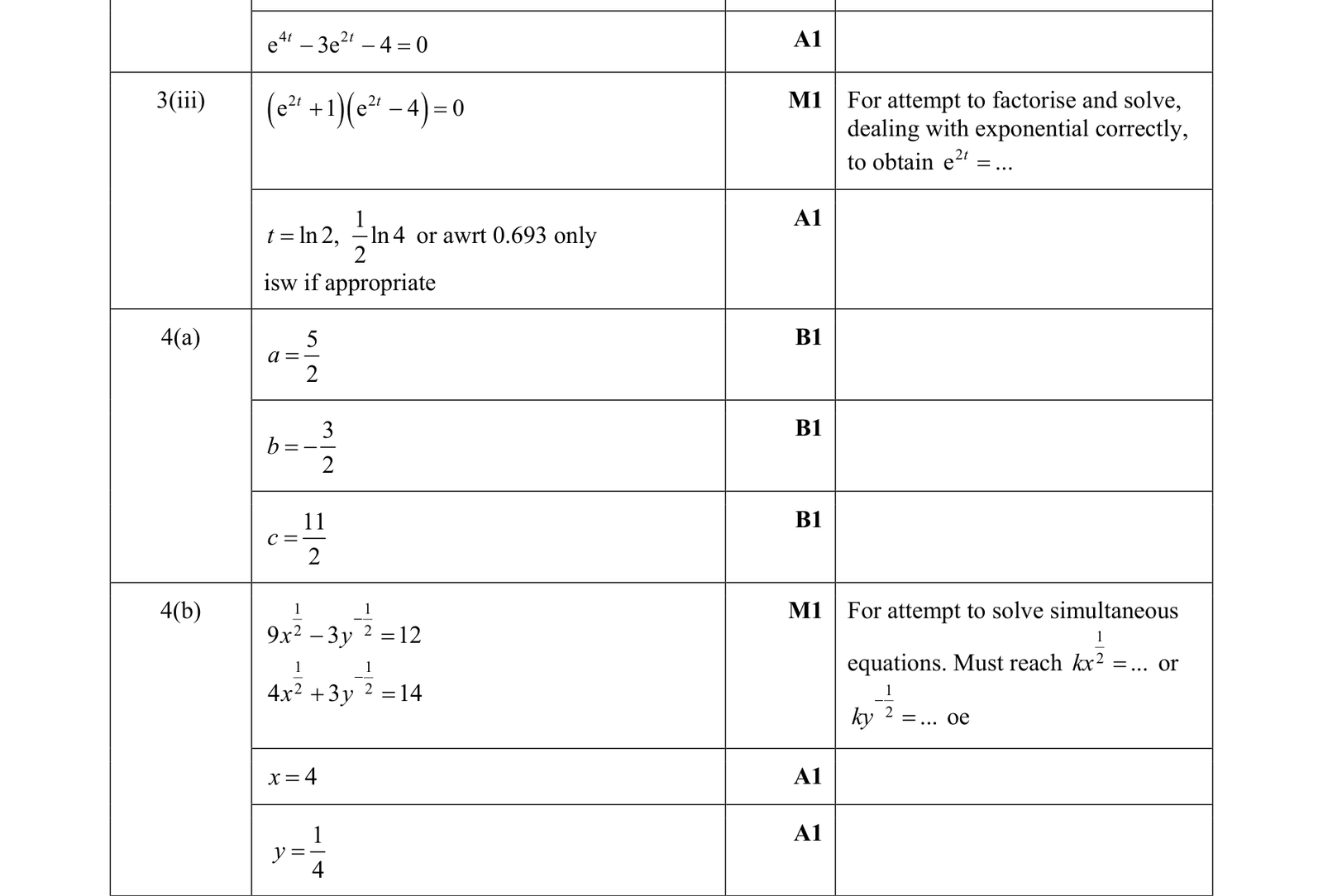
(a) Express \(\dfrac{(pr^2)^{3/2}\sqrt{qr}}{q^2(pr^2)^{-1}}\) in the form \(p^aq^br^c\), giving the values of \(a\), \(b\) and \(c\).
(b) Solve the simultaneous equations \(3x^{1/2}-y^{-1/2}=4\) and \(4x^{1/2}+3y^{-1/2}=14\).
0606 P22 - Nov 2019 - Q11 - 6 marks
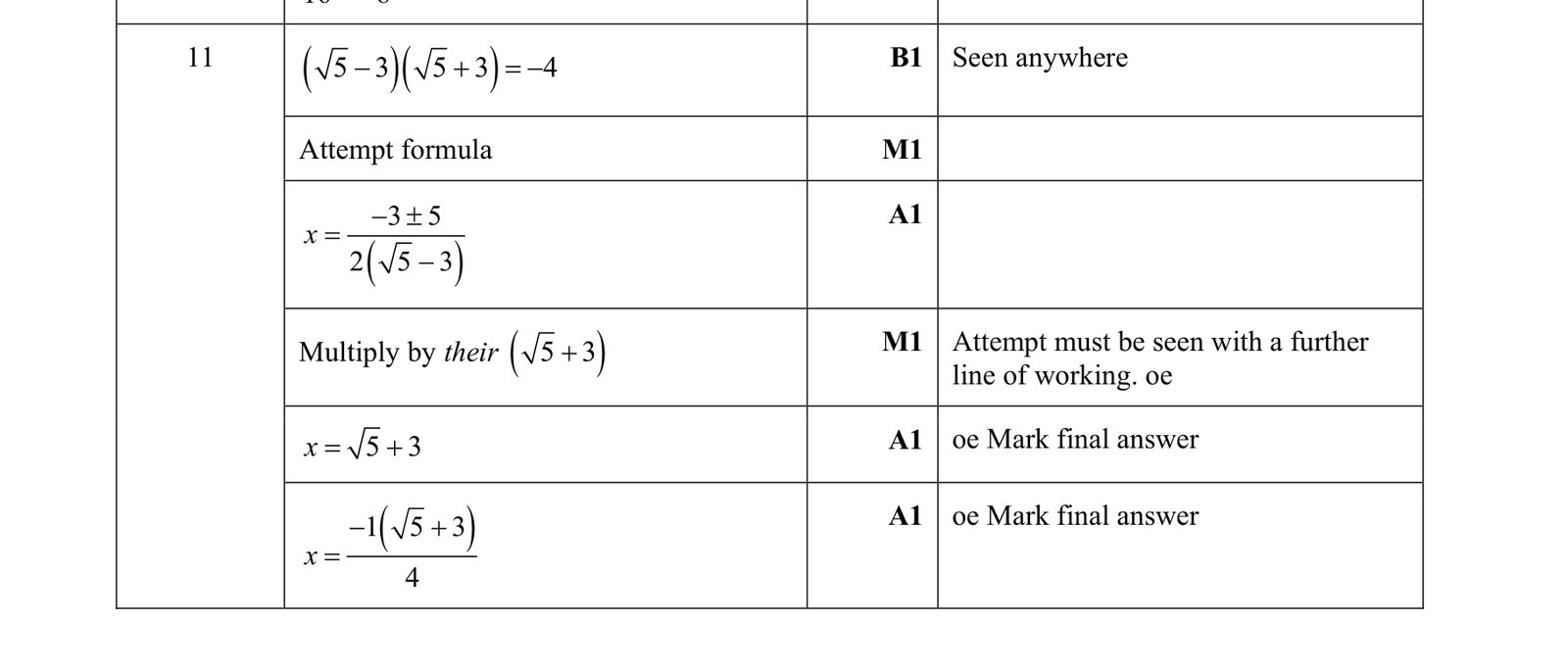
Do not use a calculator in this question.
Solve the quadratic equation
\((\sqrt5-3)x^2+3x+(\sqrt5+3)=0,\)
giving your answers in the form \(a+b\sqrt5\), where \(a\) and \(b\) are constants.
0606 P12 - Jun 2018 - Q12 - 7 marks
Do not use a calculator in this question.
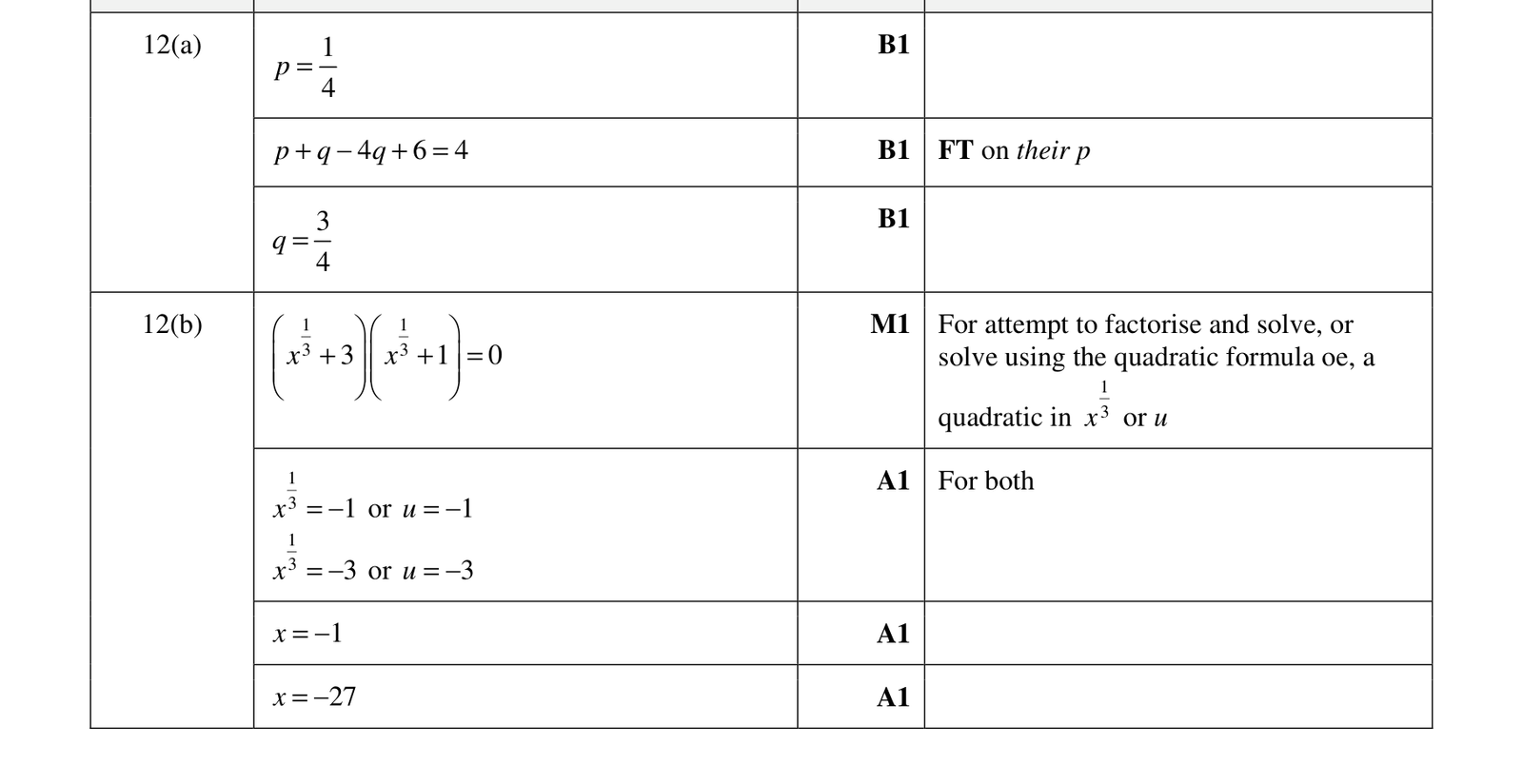
(a) Given that
\(\frac{6^p\times8^{p+2}\times3^q}{9^{2q-3}}\)
is equal to \(2^7\times3^4\), find the value of each of the constants \(p\) and \(q\).
(b) Using the substitution \(u=x^{1/3}\), or otherwise, solve
\(4x^{1/3}+x^{2/3}+3=0.\)
0606 P22 - Nov 2018 - Q7 - 6 marks
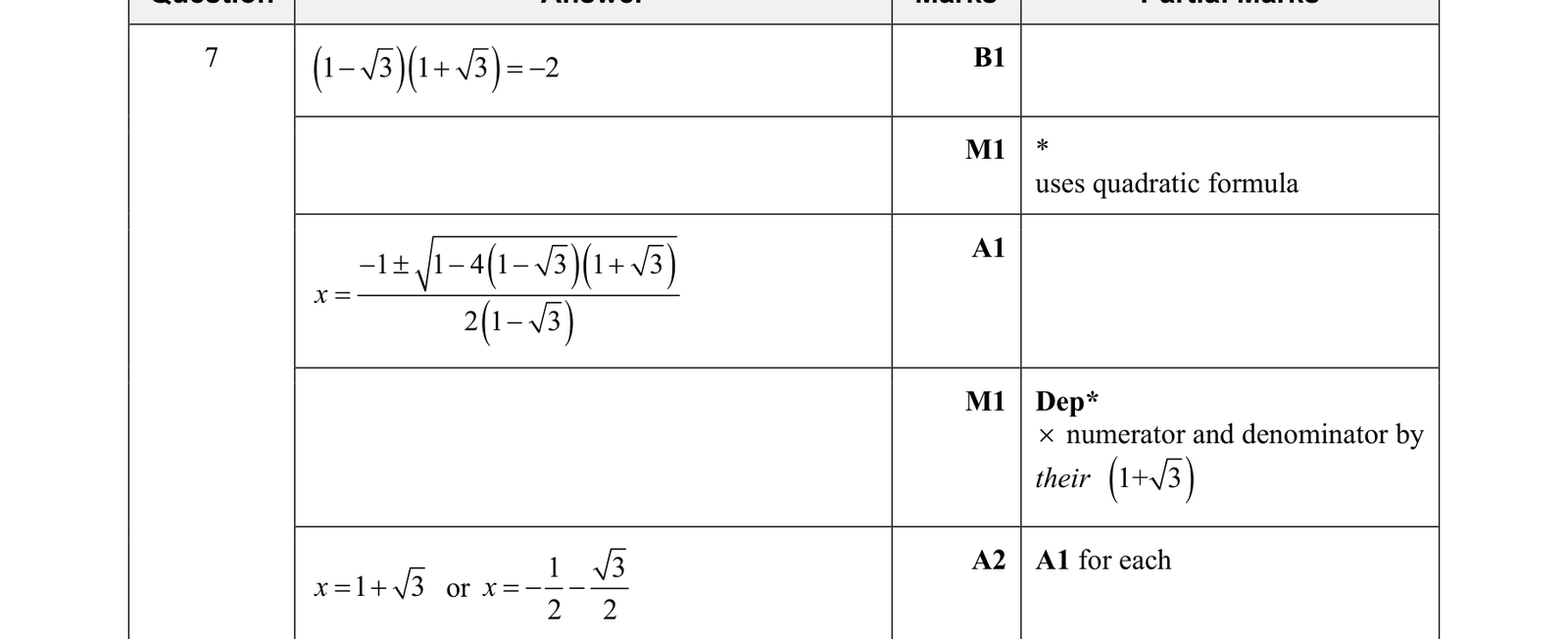
Solve the quadratic equation
\((1-\sqrt3)x^2+x+(1+\sqrt3)=0,\)
giving your answer in the form \(a+b\sqrt3\), where \(a\) and \(b\) are constants.
0606 P11 - Jun 2017 - Q3 - 6 marks
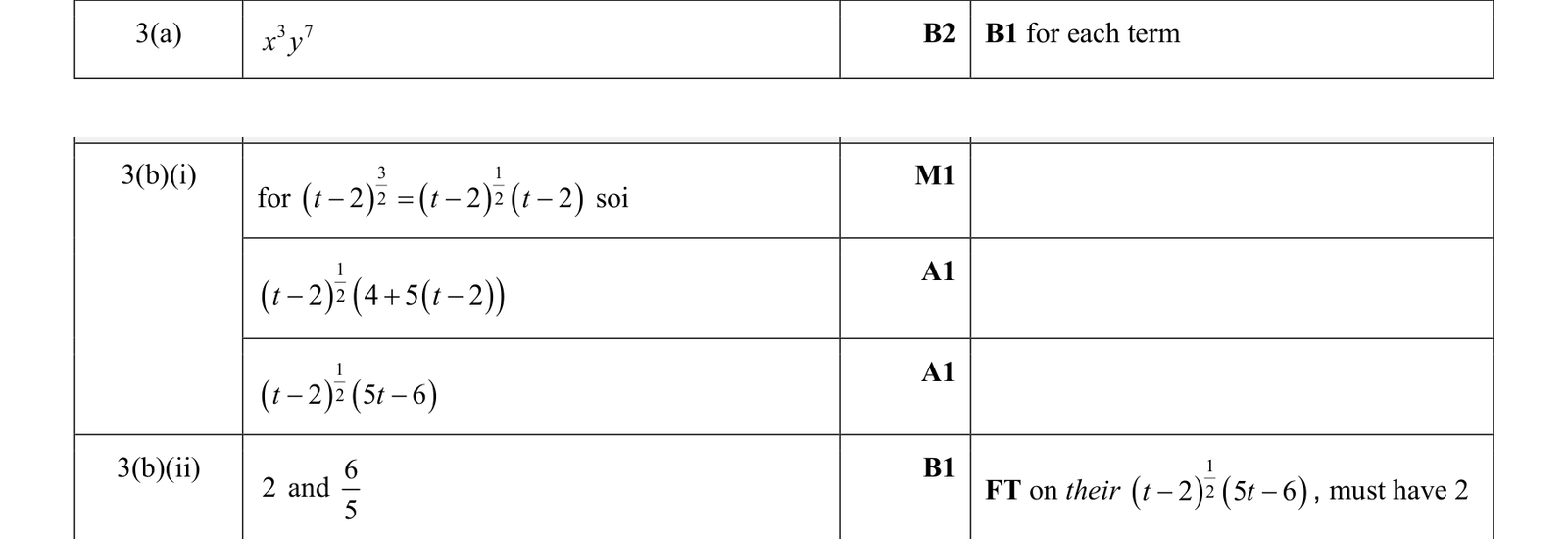
(a) Simplify \(\sqrt{x^8y^{10}}\div\sqrt[3]{x^3y^{-6}}\), giving your answer in the form \(x^ay^b\), where \(a\) and \(b\) are integers.
(b)(i) Show that \(4(t-2)^{1/2}+5(t-2)^{3/2}\) can be written in the form \((t-2)^p(qt+r)\), where \(p\), \(q\), and \(r\) are constants to be found.
(b)(ii) Hence solve \(4(t-2)^{1/2}+5(t-2)^{3/2}=0\).
0606 P11 - Nov 2017 - Q3 - 6 marks
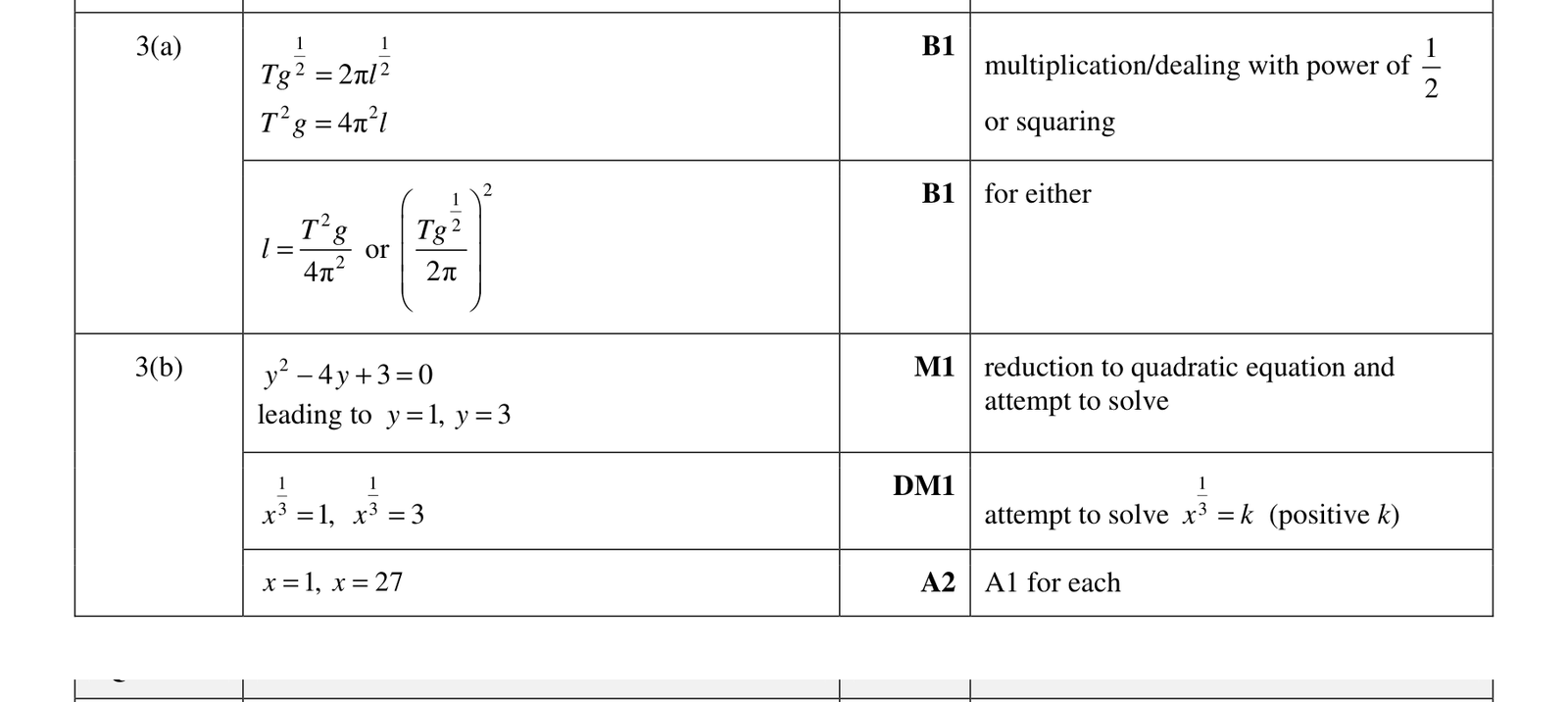
(a) Given that \(T=2\pi l^{1/2}g^{-1/2}\), express \(l\) in terms of \(T\), \(g\), and \(\pi\).
(b) By using the substitution \(y=x^{1/3}\), or otherwise, solve \(x^{2/3}-4x^{1/3}+3=0\).
0606 P22 - Nov 2017 - Q2 - 5 marks
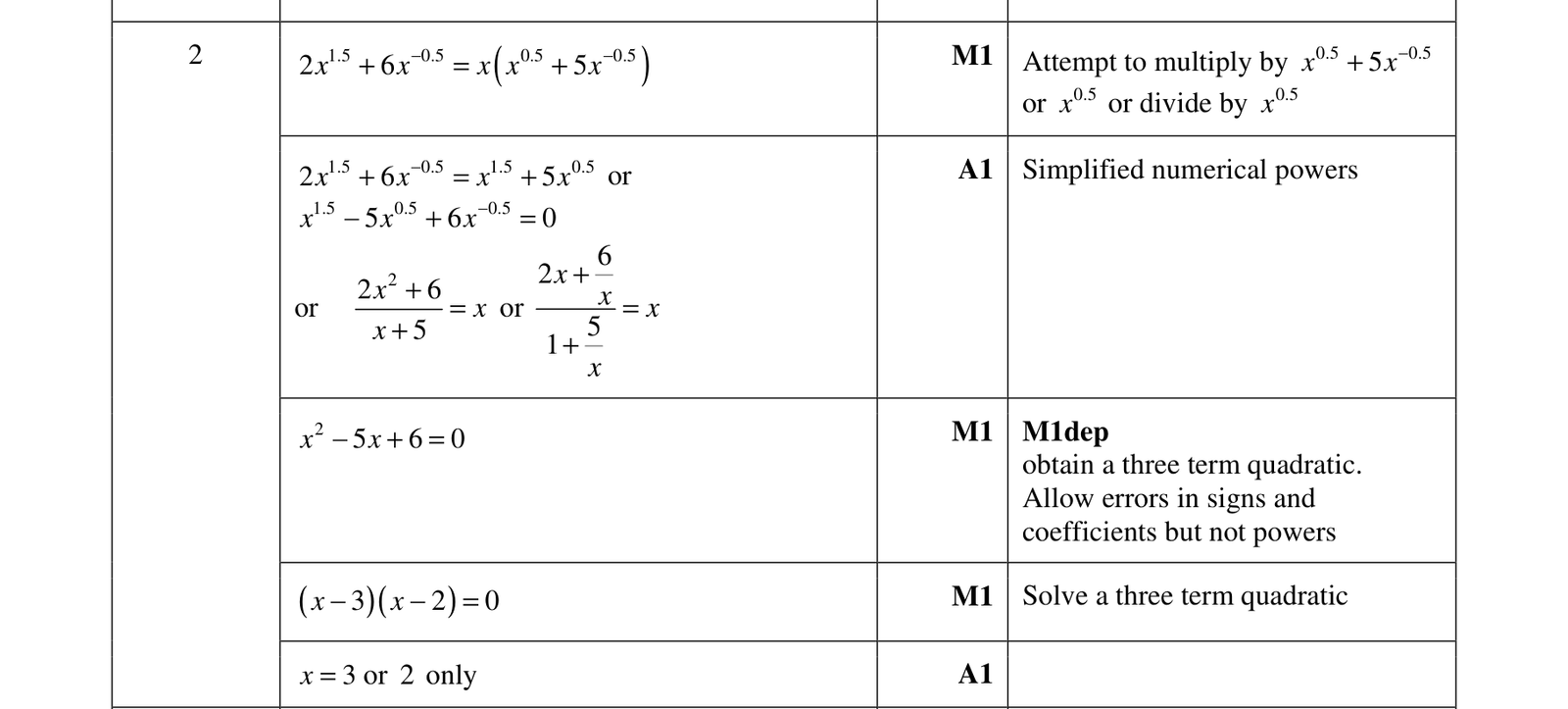
Solve the equation \(\dfrac{2x^{1.5}+6x^{-0.5}}{x^{0.5}+5x^{-0.5}}=x\).
9709 P12 - Nov 2018 - Q6
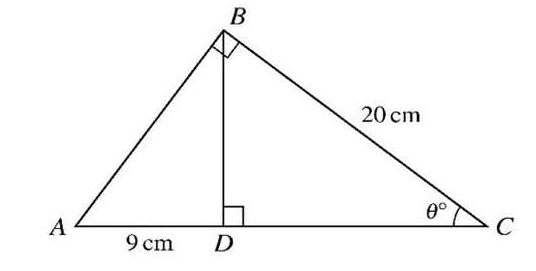
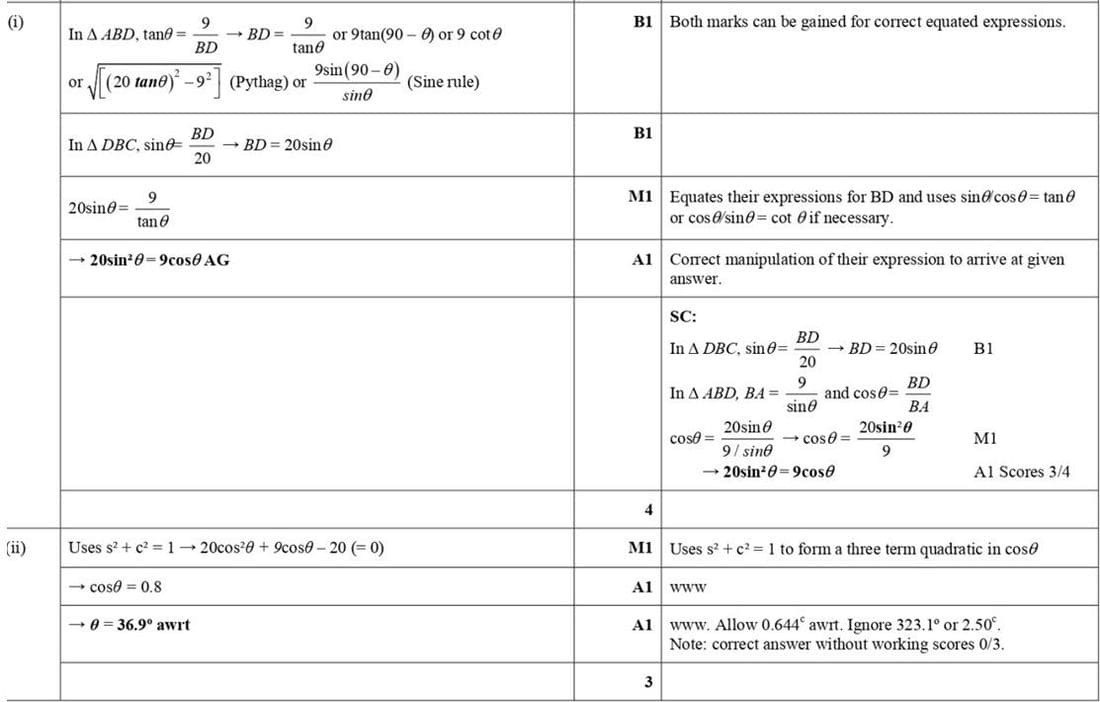
The diagram shows a triangle ABC in which BC = 20 cm and angle ABC is \(90^\circ\). The perpendicular from B to AC meets AC at D and AD = 9 cm. Angle BCA is \(\theta^\circ\).
- By expressing the length of BD in terms of \(\theta\) in each of the triangles ABD and DBC, show that \(20\sin^2\theta = 9\cos\theta.\)
- Hence, showing all necessary working, calculate \(\theta\).
9709 P12 - Jun 2016 - Q5
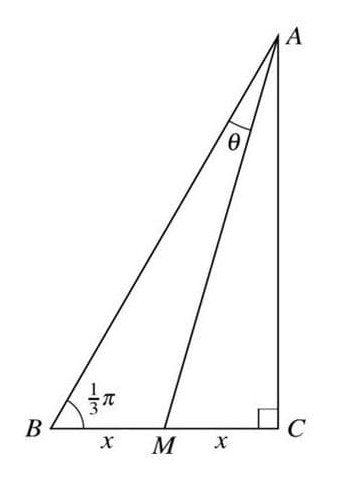
In the diagram, triangle ABC is right-angled at C and M is the mid-point of BC. It is given that angle ABC = \(\frac{1}{3} \pi\) radians and angle BAM = \(\theta\) radians. Denoting the lengths of BM and MC by x,
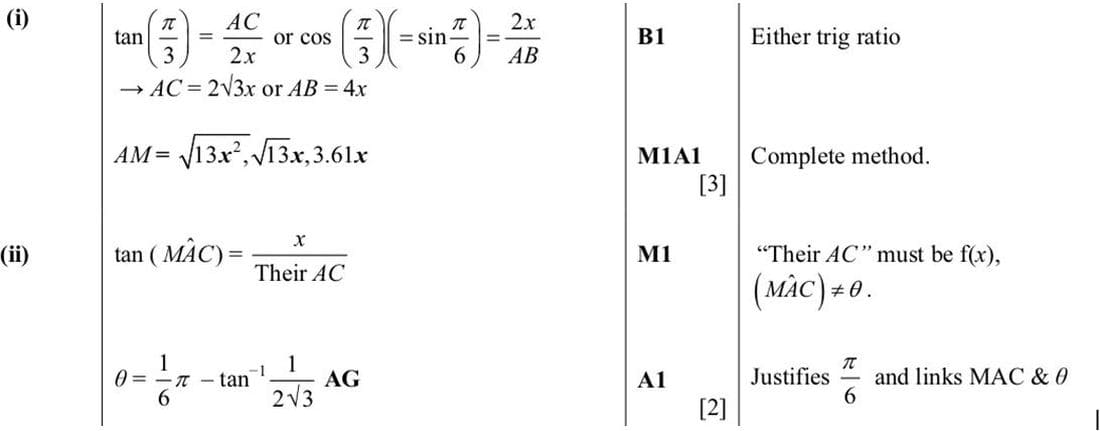
- find AM in terms of x,
- show that \(\theta = \frac{1}{6} \pi - \tan^{-1} \left( \frac{1}{2 \sqrt{3}} \right)\).