Past Exam Questions
← Back0606 P23 - Jun 2024 - Q3 - 6 marks
(a)
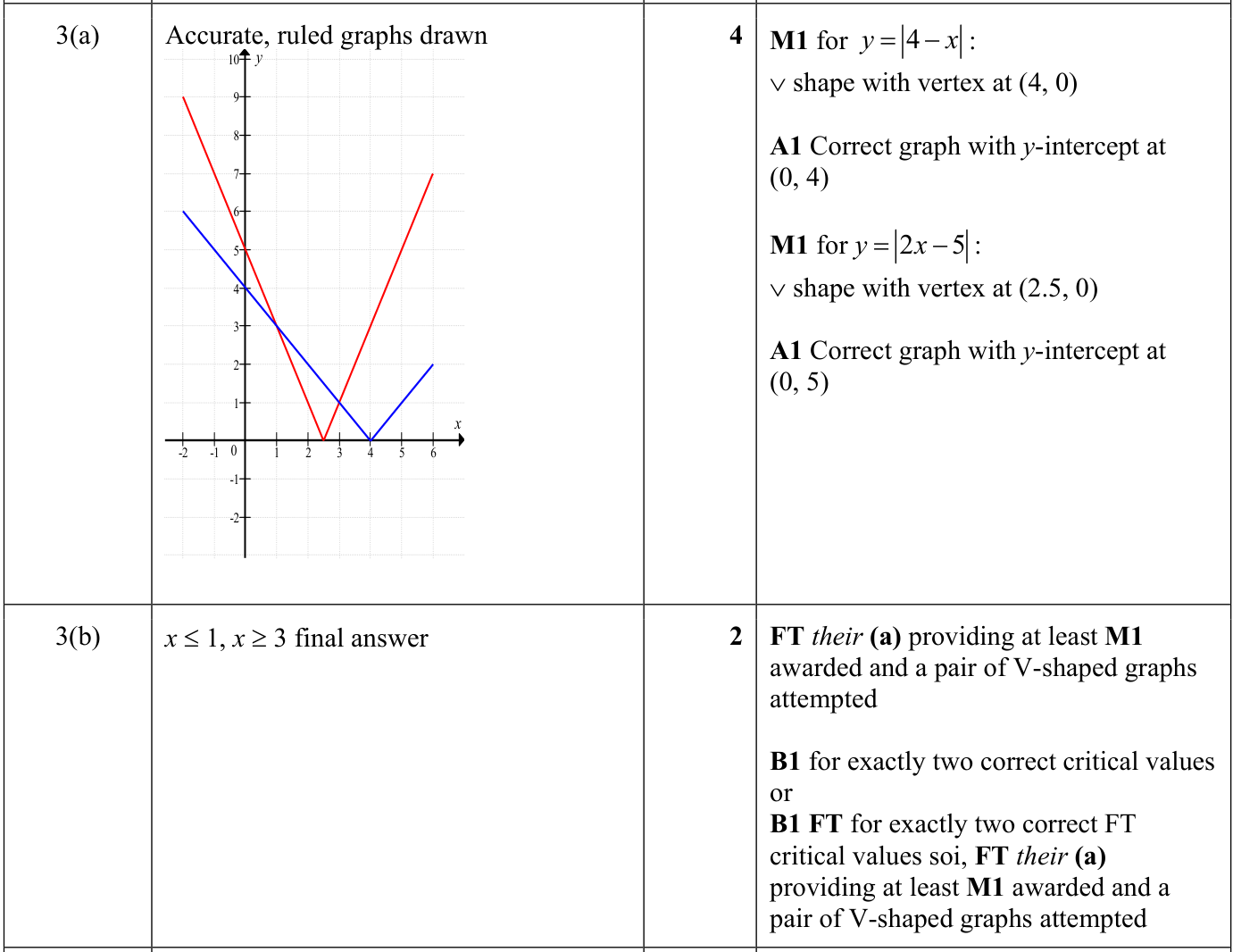
Draw the graphs of \(y=|2 x-5|\) and \(y=|4-x|\) for \(-2 \leqslant x \leqslant 6\).
(b) Use your graphs to solve the inequality \(|4-x| \leqslant|2 x-5|\).
0606 P23 - Jun 2023 - Q1 - 5 marks
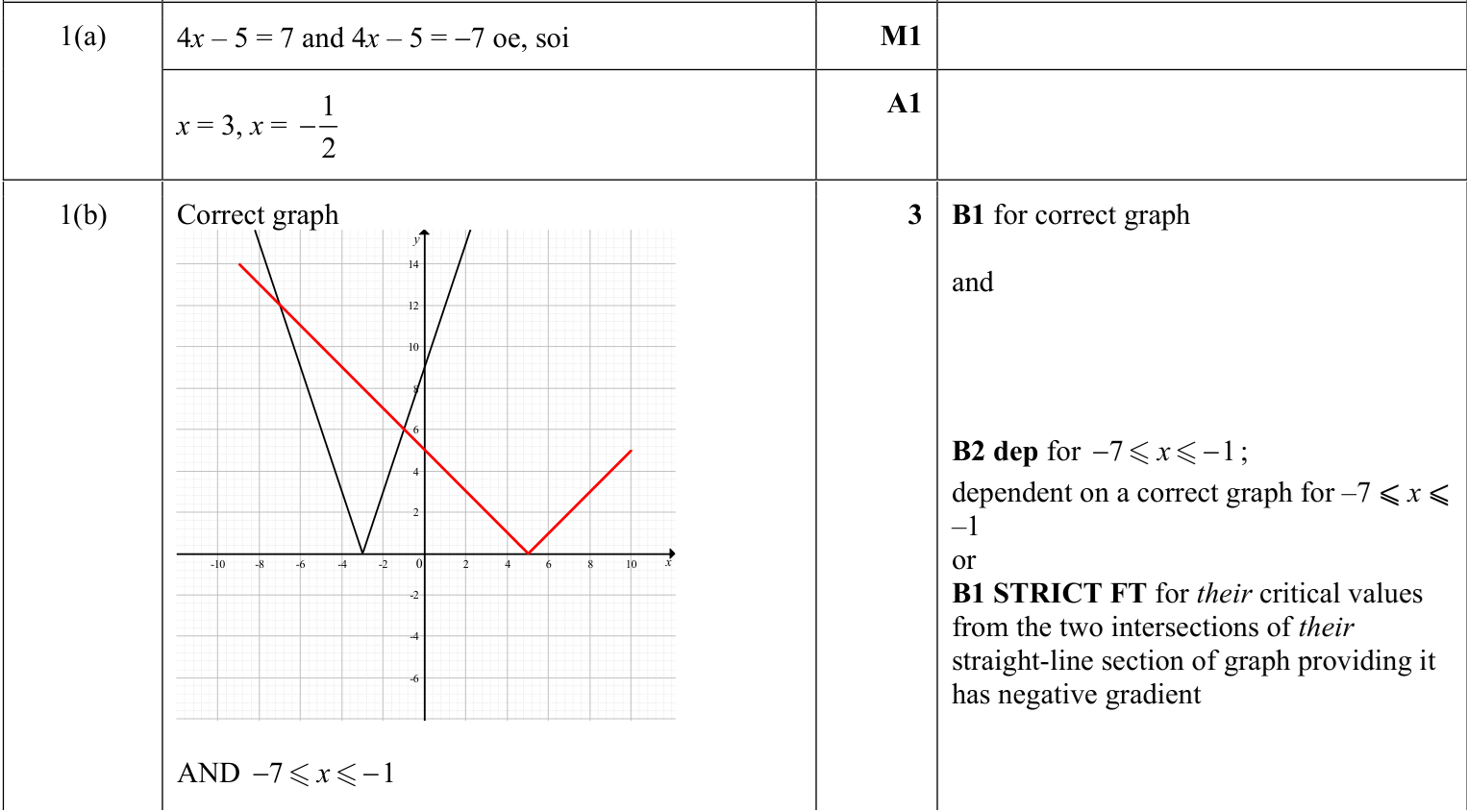
(a) Solve
\(\frac{|4x-5|}{7}=1.\)
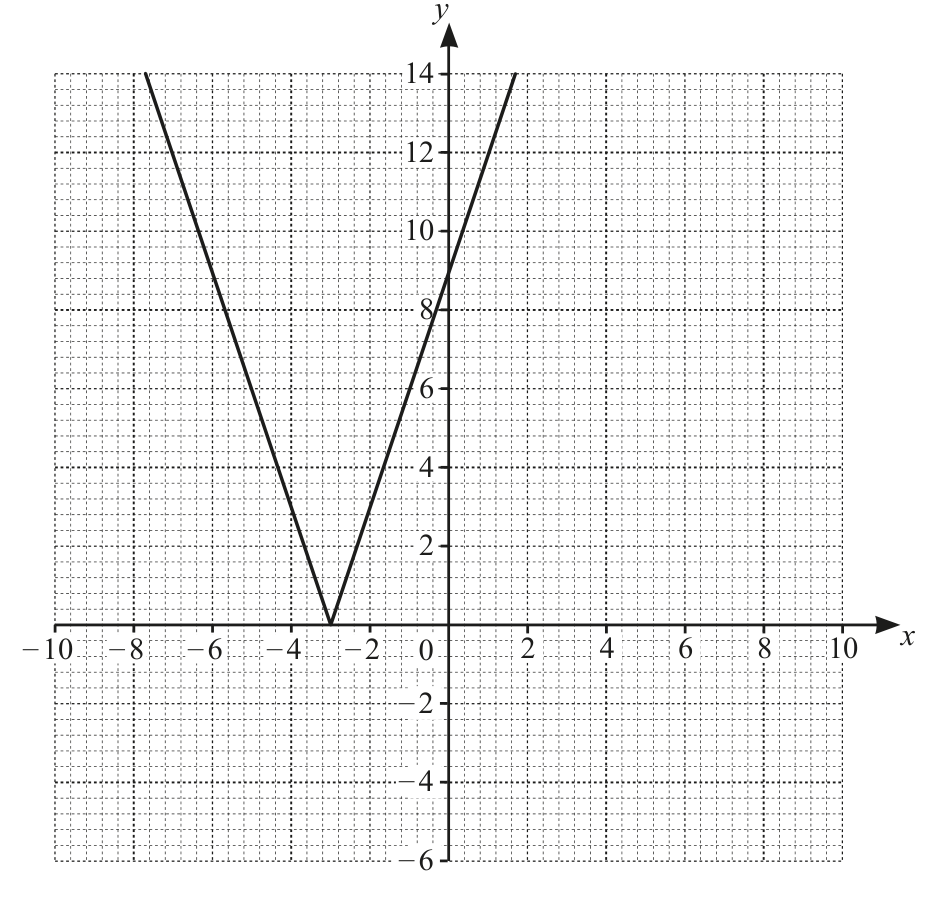
(b) The diagram shows the graph of \(y=|3x+9|\). By drawing a suitable graph on the same diagram, solve
\(|3x+9|\leq |x-5|.\)
0606 P13 - Nov 2023 - Q1 - 6 marks
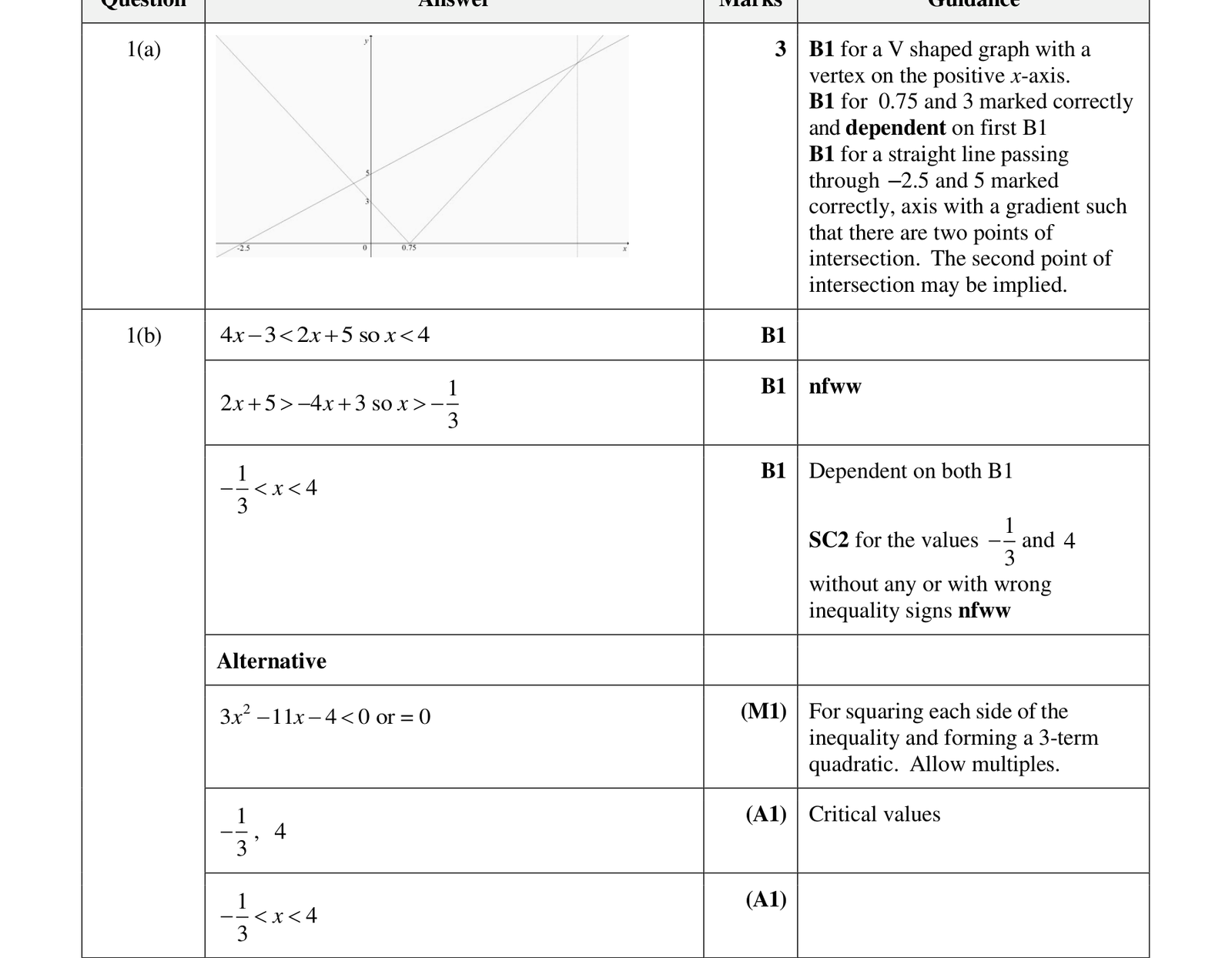
(a) On the axes, sketch the graphs of \(y=2x+5\) and \(y=|4x-3|\), stating the intercepts with the coordinate axes.
(b) Solve the inequality \(|4x-3| \lt 2x+5\).
0606 P22 - Mar 2023 - Q3 - 4 marks
Solve the inequality
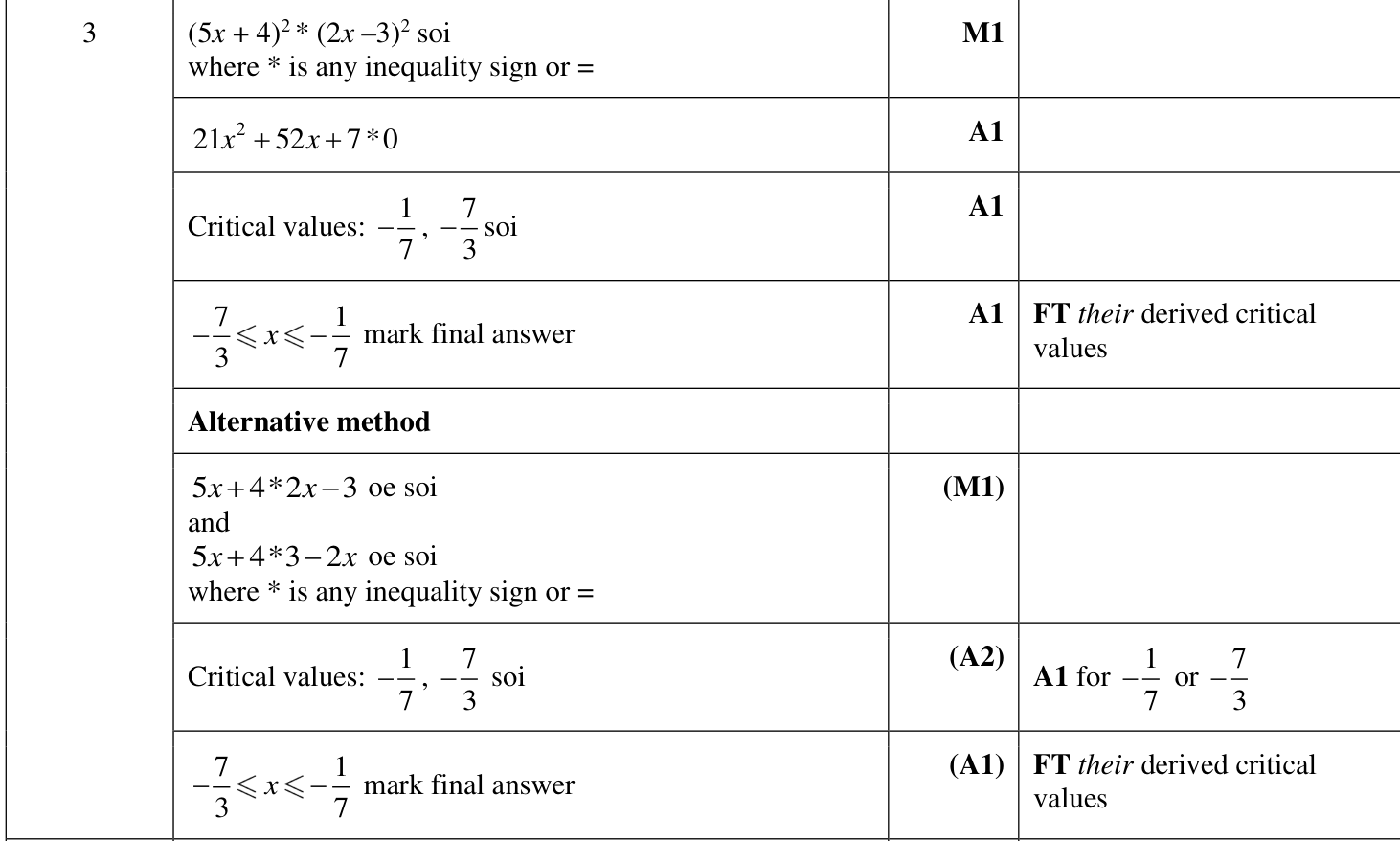
\(\left|5x+4\right|\lt \left|2x-3\right|.\)
0606 P12 - Jun 2021 - Q2 - 5 marks
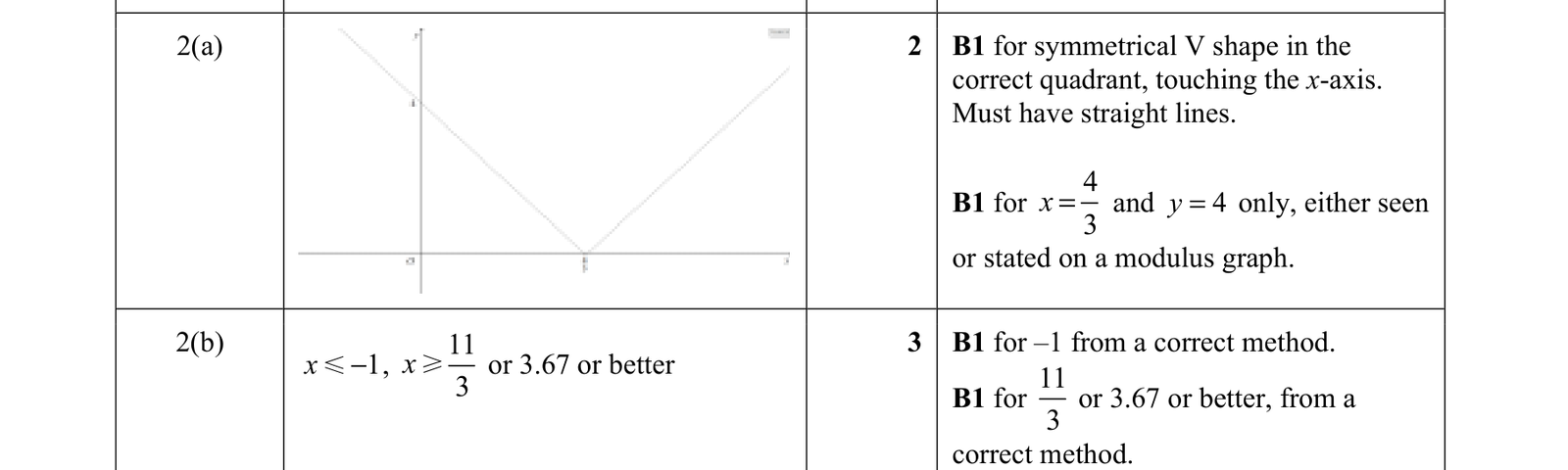
The graph of \(y=|4-3x|\) is sketched on the axes.
(a) State the coordinates of the points where the graph cuts the coordinate axes.
(b) Solve the inequality
\(|4-3x|\geq 7.\)
0606 P21 - Jun 2021 - Q3 - 6 marks
(a) Solve the inequality
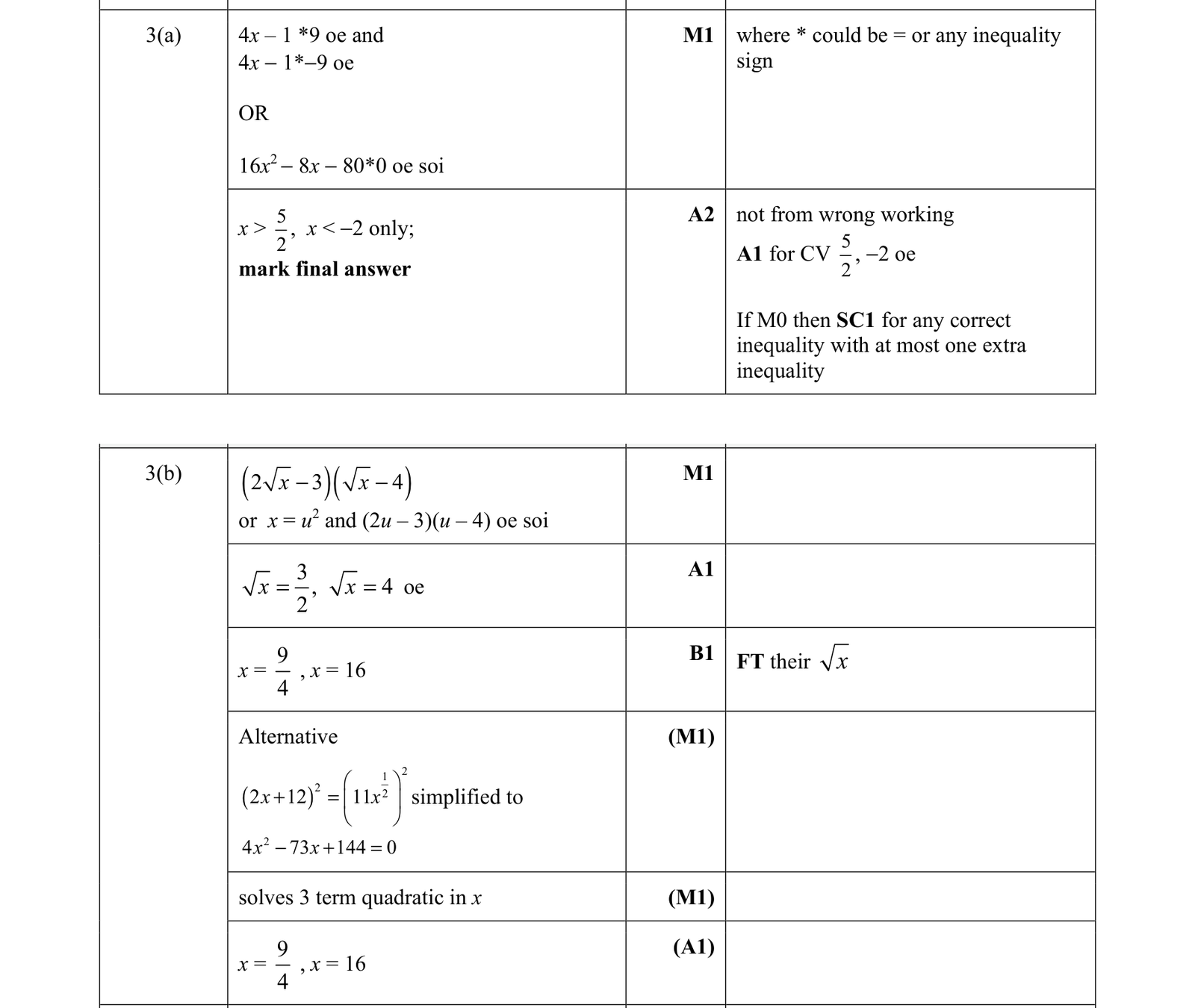
\(|4x-1|\gt 9.\)
(b) Solve the equation
\(2x-11\sqrt{x}+12=0.\)
0606 P22 - Nov 2017 - Q3 - 3 marks
Solve the inequality \(|3x-1|\gt 3+x\).
0606 P12 - Jun 2025 - Q1 - 3 marks
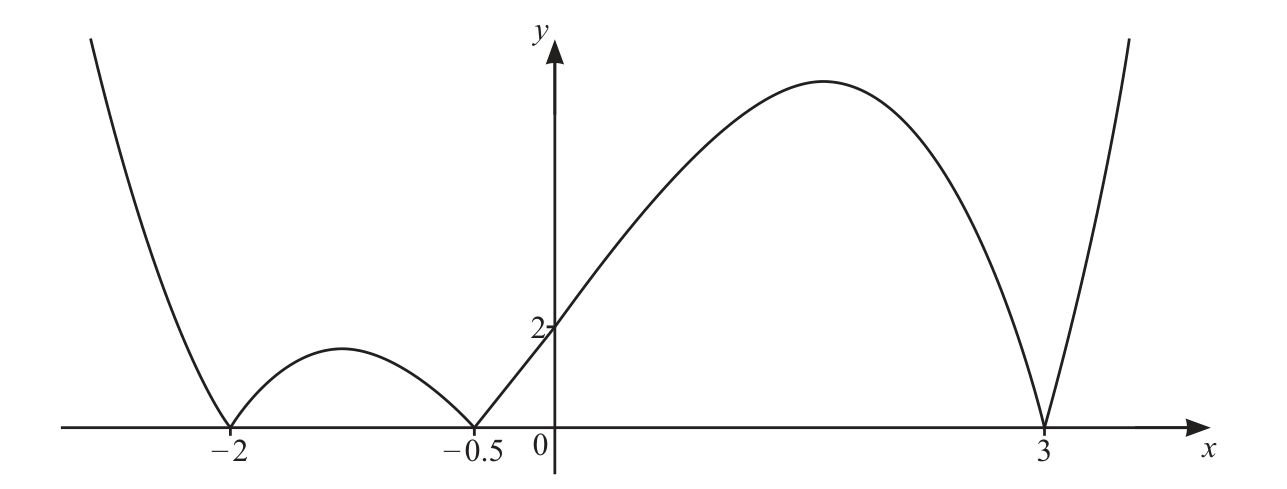
The diagram shows the graph of \(y=|\mathrm{f}(x)|\), where \(\mathrm{f}\) is a cubic polynomial.
Find expressions for the two possible functions \(\mathrm{f}(x)\). Write each expression in fully factorised form.
0606 P13 - Jun 2025 - Q1 - 5 marks
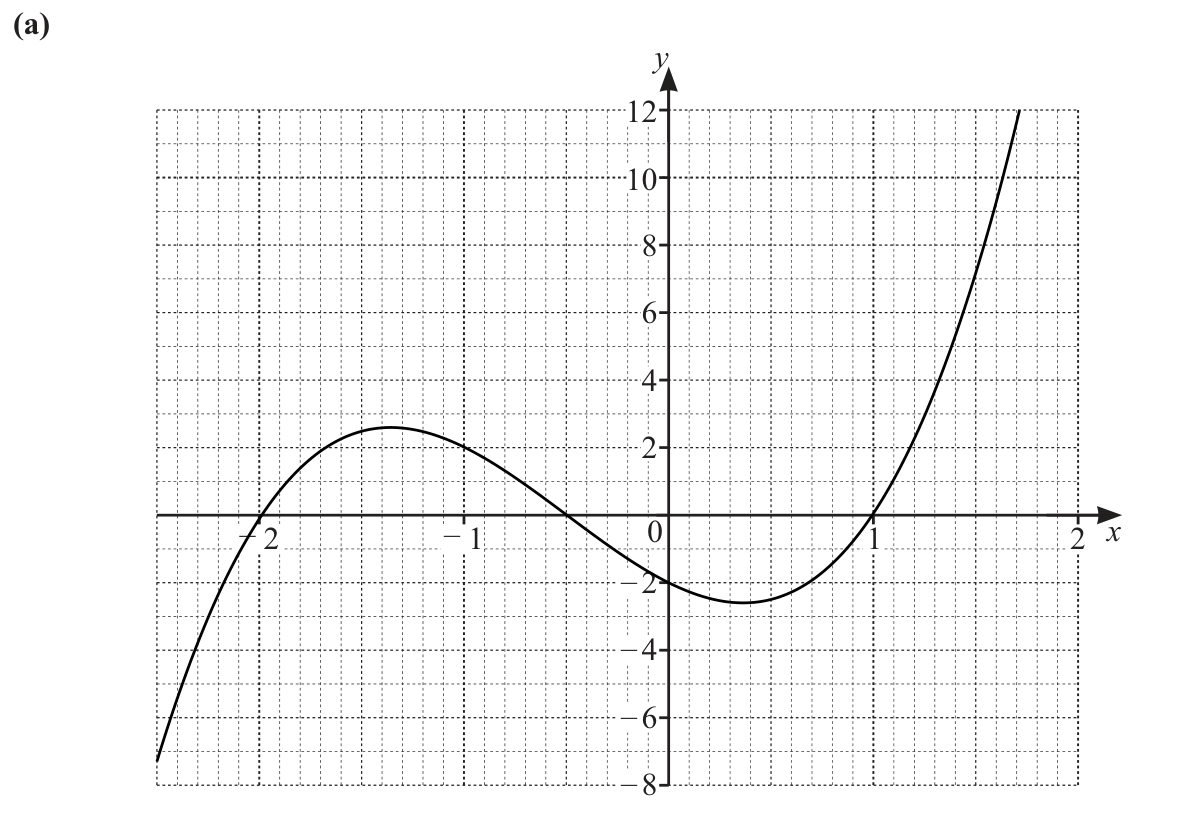
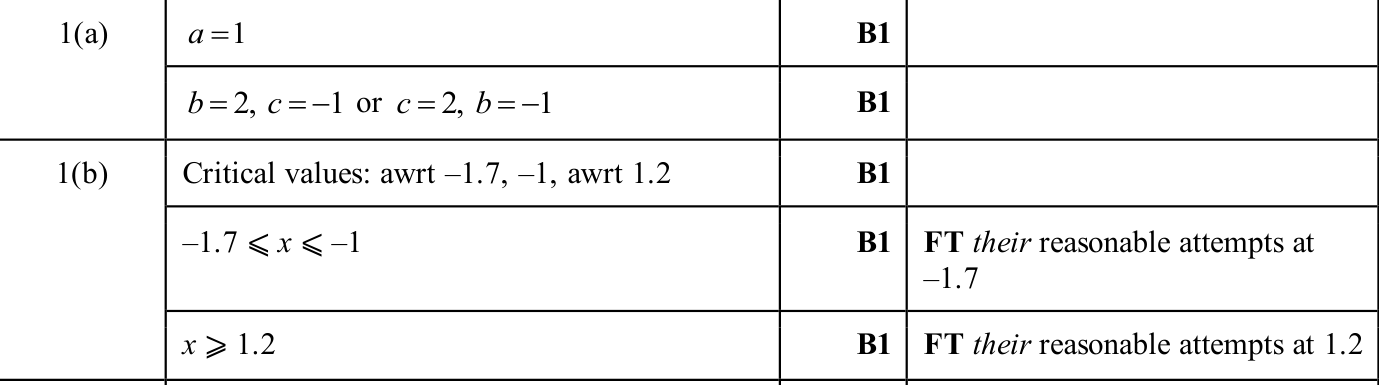
(a)
The diagram shows the graph of \(y=(2 x+a)(x+b)(x+c)\) where \(a, b\) and \(c\) are integers. Find values for \(a, b\) and \(c\).
(b) Use the graph to find the values of \(x\) for which \(y \geqslant 2\).
0606 P22 - Mar 2025 - Q2 - 9 marks
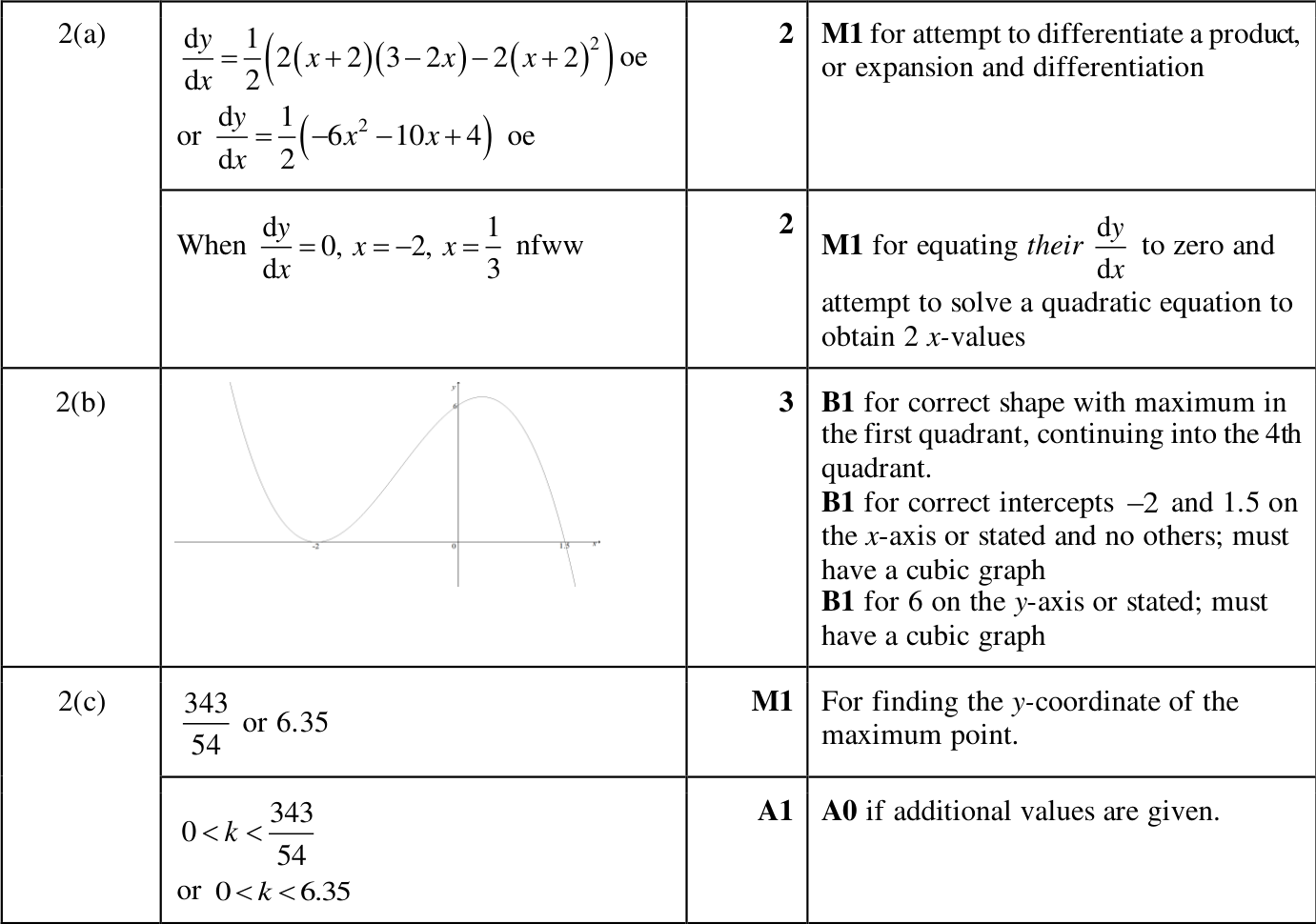
(a) Find the \(x\)-coordinates of the stationary points on the curve \(y=\frac12(3-2x)(x+2)^2\).
(b) On the axes, sketch the graph of \(y=\frac12(3-2x)(x+2)^2\), stating the intercepts with the coordinate axes.
(c) Find the values of \(k\) for which the equation \(\frac12(3-2x)(x+2)^2=k\) has three real and distinct roots.
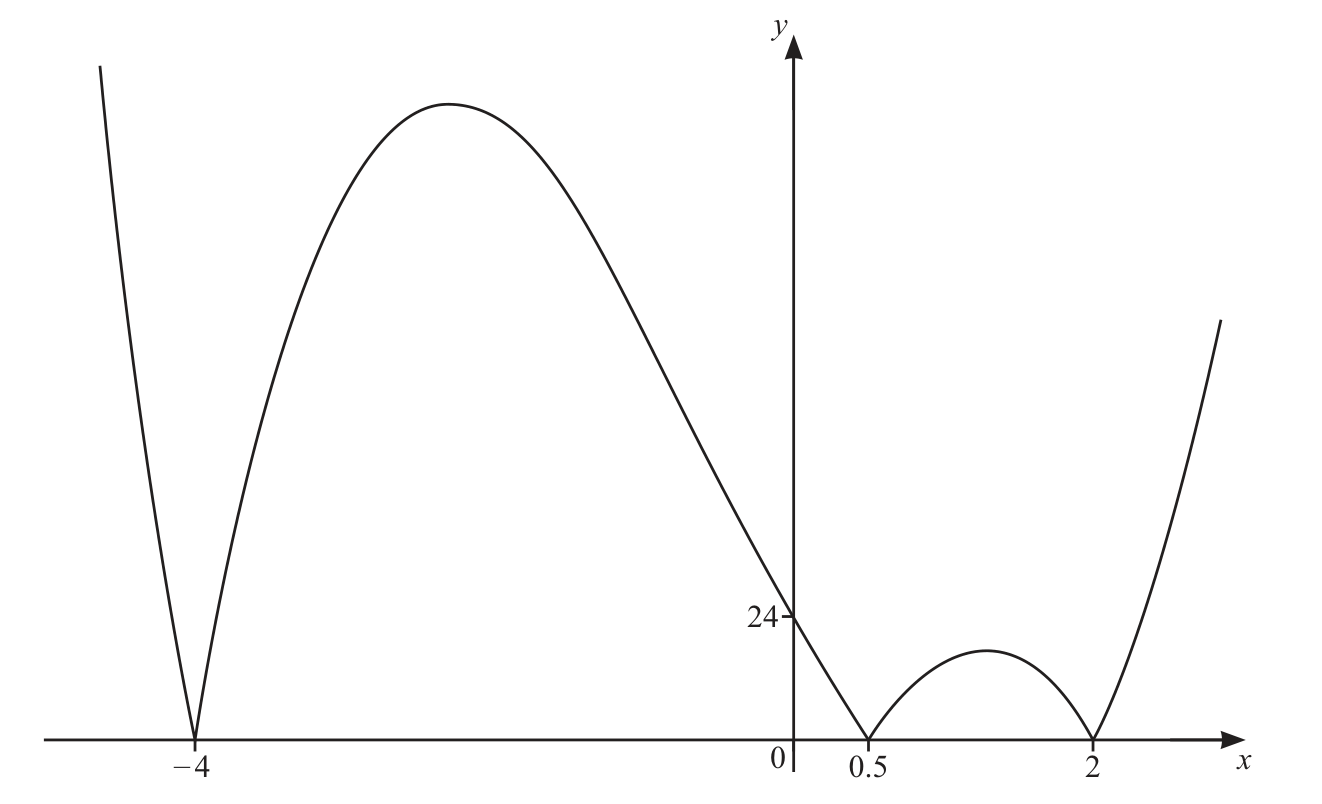
0606 P11 - Nov 2024 - Q1 - 3 marks
The diagram shows the graph of \(y=|\mathrm{f}(x)|\), where \(\mathrm{f}(x)\) is a cubic polynomial. Find the two possible expressions for \(\mathrm{f}(x)\) in terms of linear factors with integer coefficients.

0606 P12 - Nov 2024 - Q2 - 9 marks
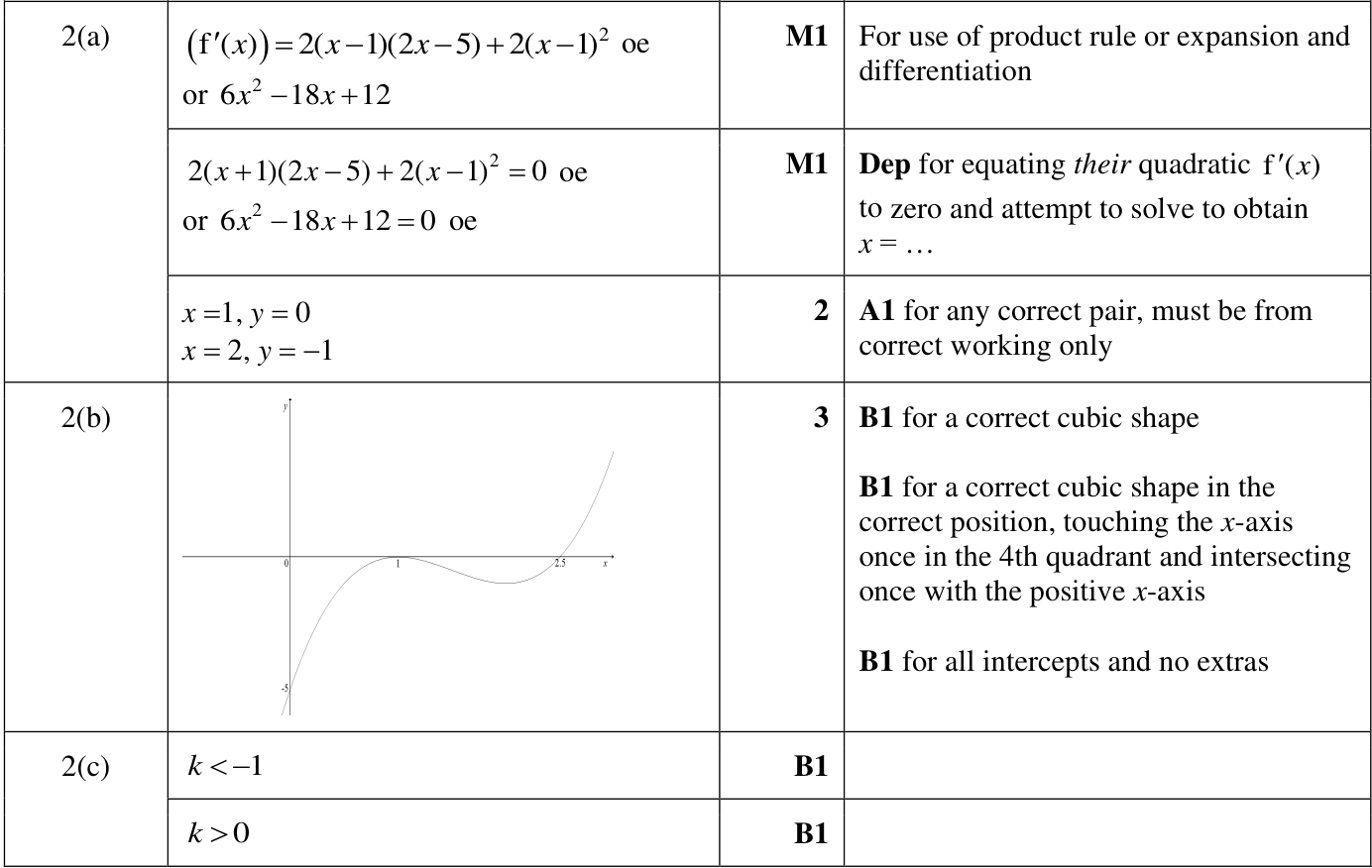
It is given that \(y=\mathrm{f}(x)\), where \(\mathrm{f}(x)=(2 x-5)(x-1)^{2}\). (a) Find the coordinates of the stationary points on the curve \(y=\mathrm{f}(x)\).
(b) On the axes, sketch the graph of \(y=\mathrm{f}(x)\), stating the intercepts with the axes.
(c) Hence find the values of \(k\) for which \(\mathrm{f}(x)=k\) has exactly one solution.
0606 P13 - Jun 2024 - Q3 - 9 marks
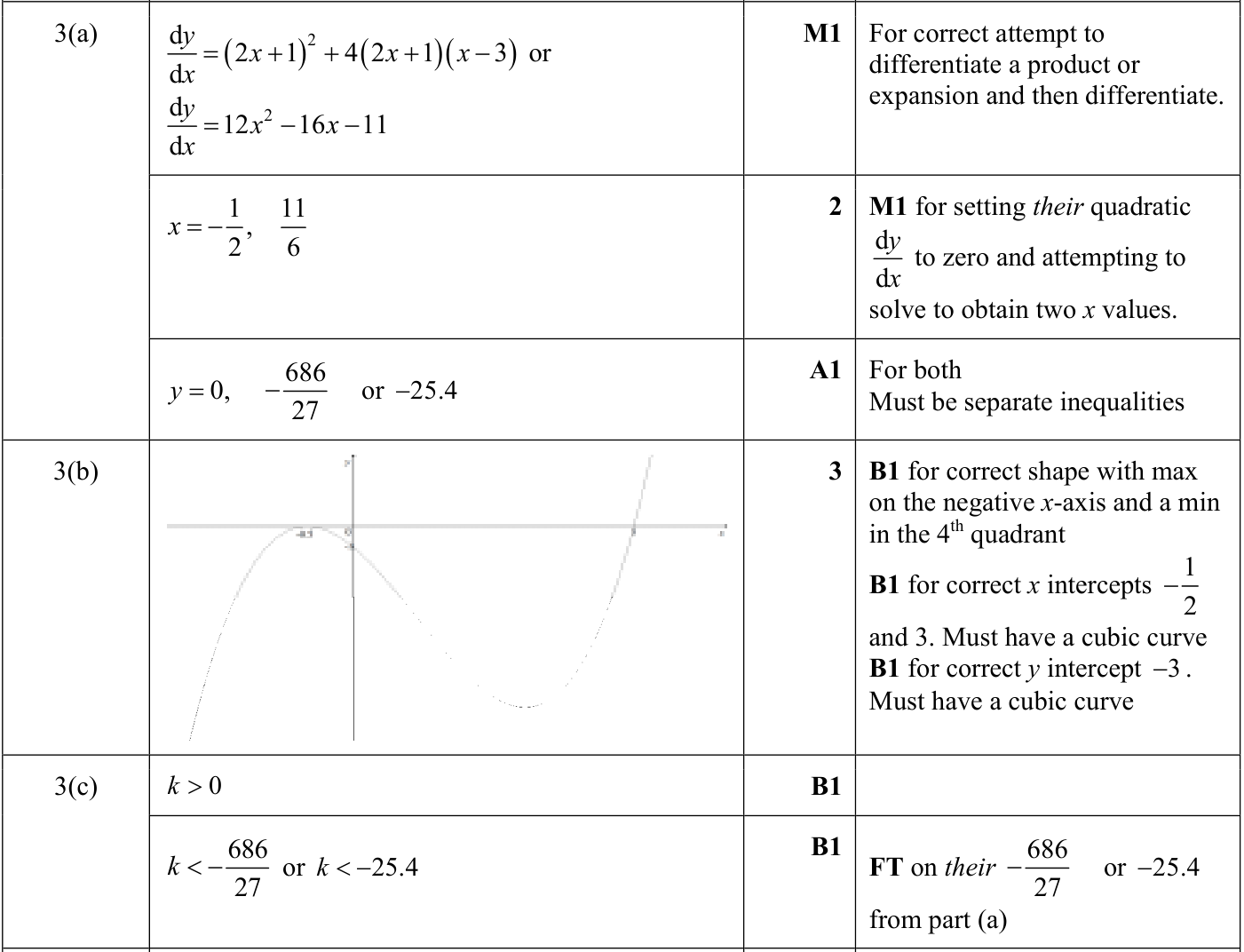
(a) Find the coordinates of the stationary points on the curve \(y=(2 x+1)^{2}(x-3)\). (b) On the axes, sketch the graph of \(y=(2 x+1)^{2}(x-3)\), stating the intercepts with the axes. (c) Write down the values of \(k\) for which the equation \((2 x+1)^{2}(x-3)=k\) has exactly one solution.
0606 P22 - Jun 2024 - Q1 - 6 marks
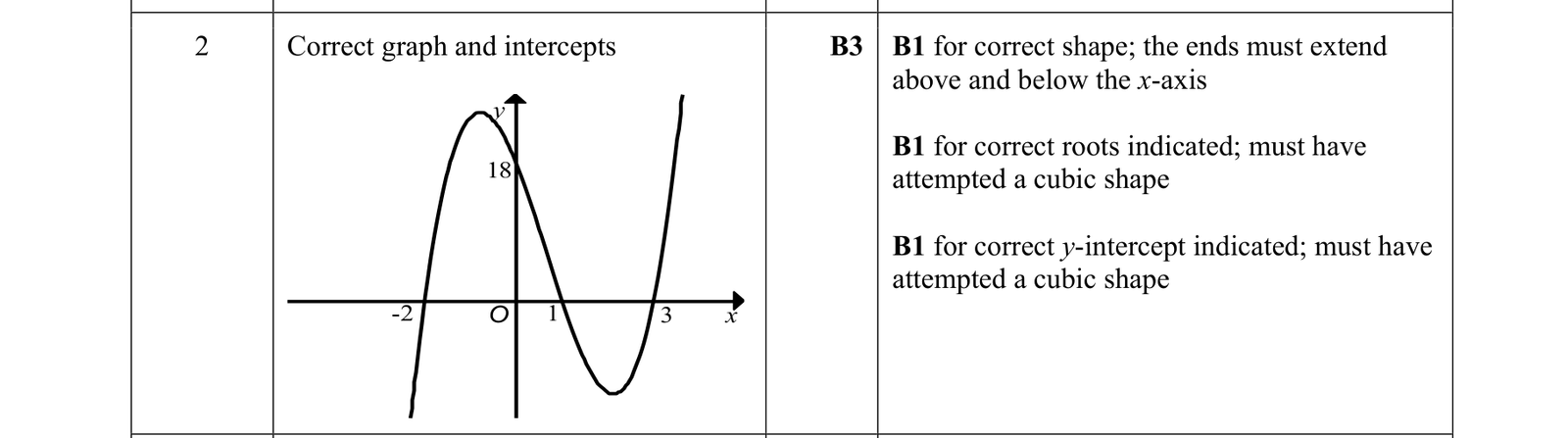
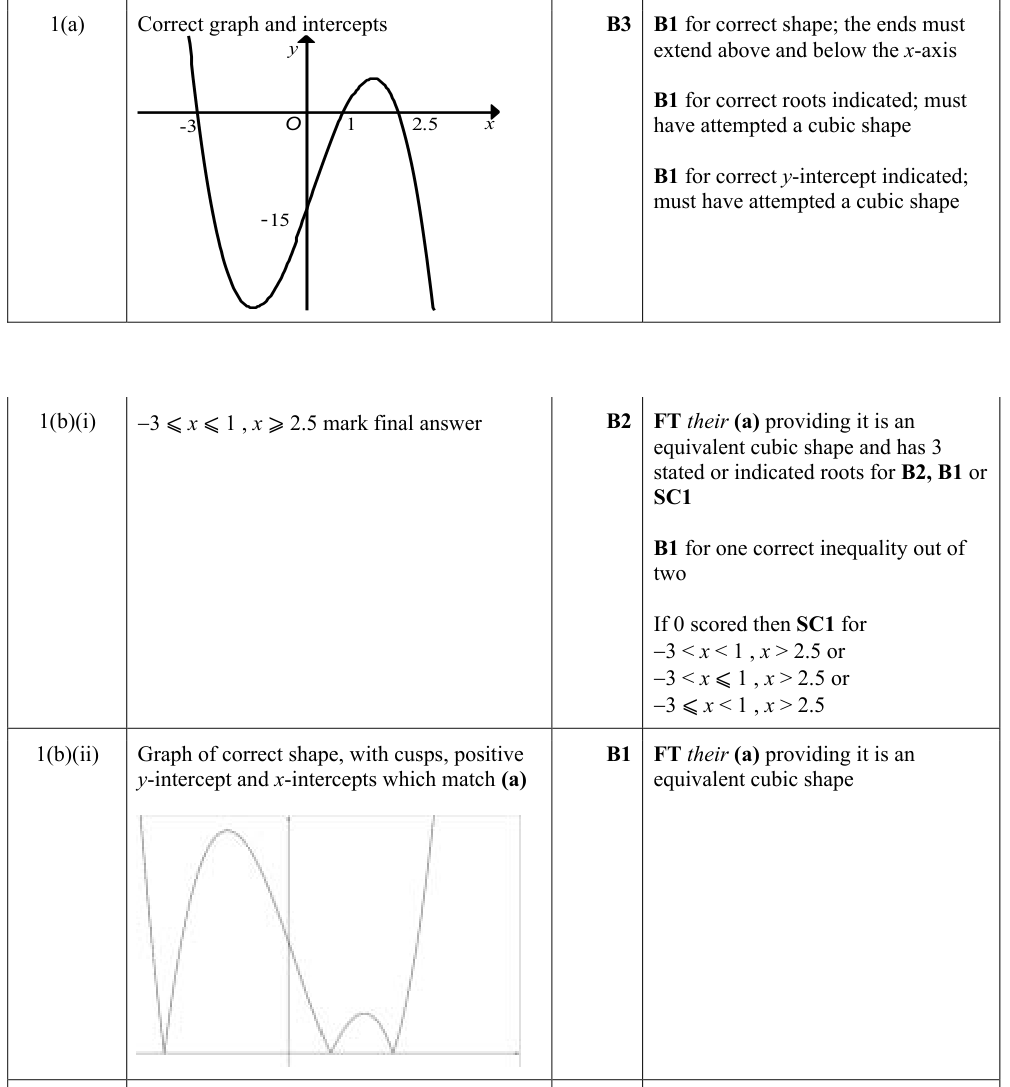
(a) On the axes, sketch the graph of \(y=(2 x-5)(x+3)(1-x)\), stating the intercepts with the coordinate axes.
(b) Hence (i) solve the inequality \((2 x-5)(x+3)(1-x) \leqslant 0\)
(ii) on the axes below, sketch the graph of \(y=|(2 x-5)(x+3)(1-x)|\).
0606 P12 - Mar 2023 - Q2 - 10 marks
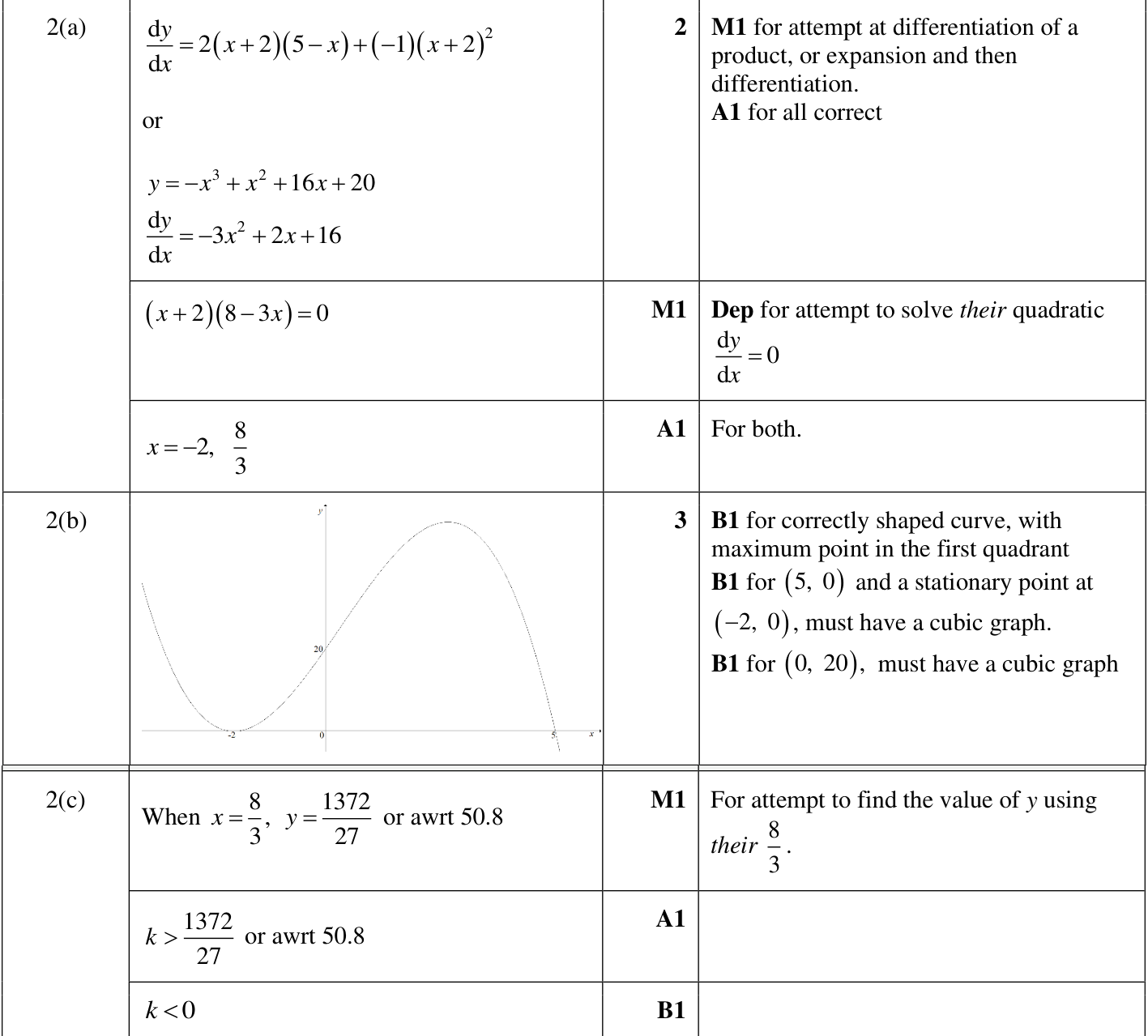
A curve has equation
\(y=(5-x)(x+2)^2.\)
(a) Find the \(x\)-coordinates of the stationary points on the curve.
(b) Sketch the graph of \(y=(5-x)(x+2)^2\), stating the coordinates of the points where the curve meets the axes.
(c) Find the values of \(k\) for which the equation
\(k=(5-x)(x+2)^2\)
has one distinct root only.
0606 P12 - Jun 2023 - Q3 - 7 marks
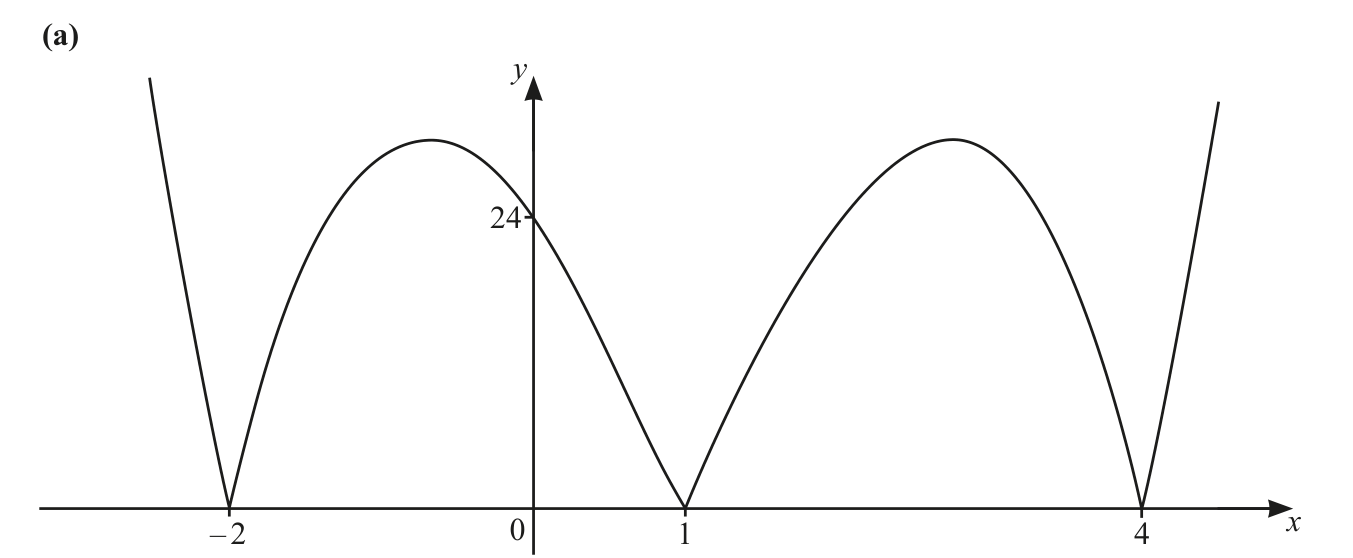
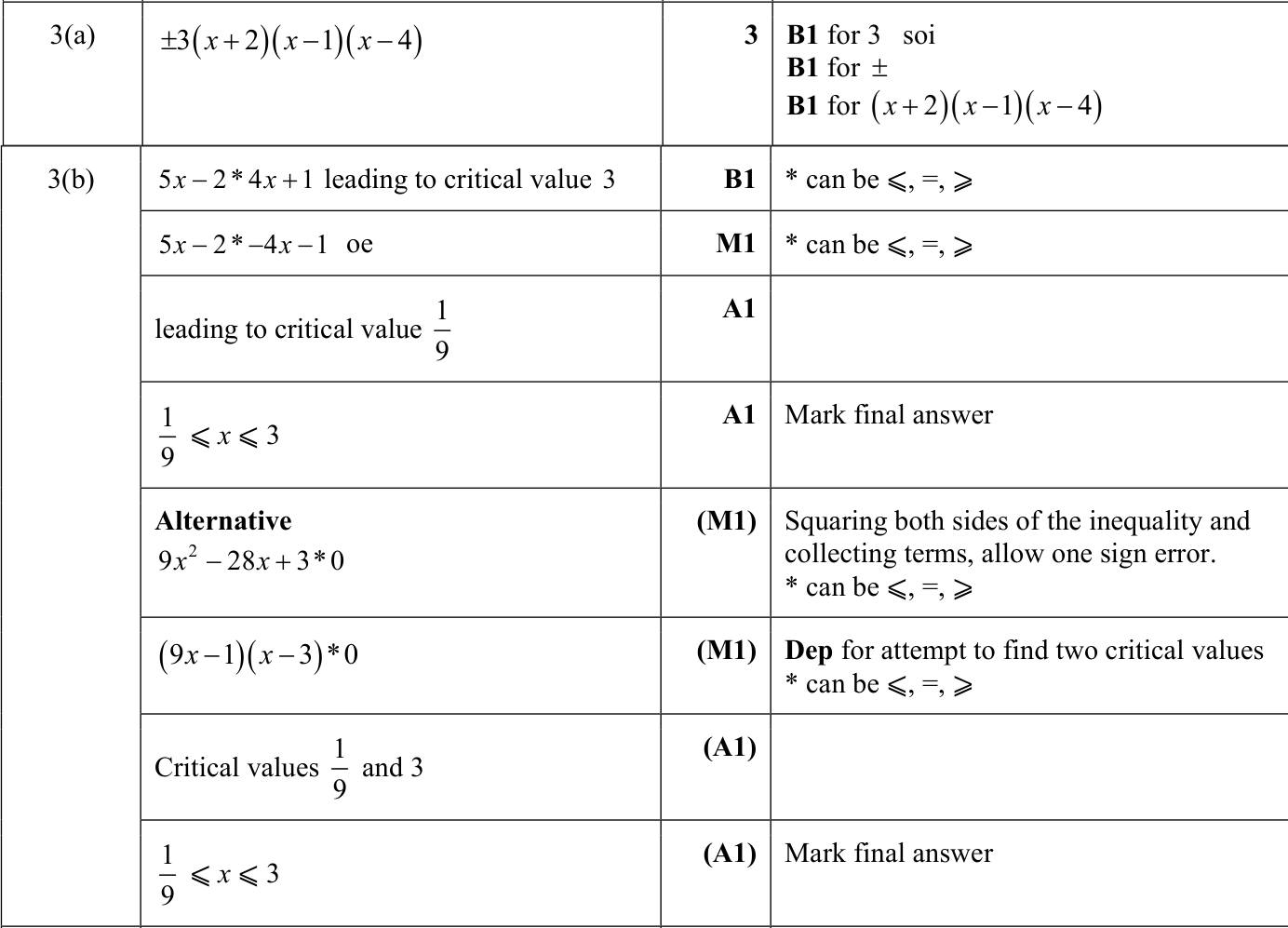
(a) The diagram shows the graph of \(y=\lvert f(x)\rvert\), where \(f(x)\) is a cubic polynomial. Find, in factorised form, the possible expressions for \(f(x)\).
(b) Solve the inequality
\(\lvert5x-2\rvert\leq\lvert4x+1\rvert.\)
0606 P21 - Jun 2023 - Q3 - 5 marks
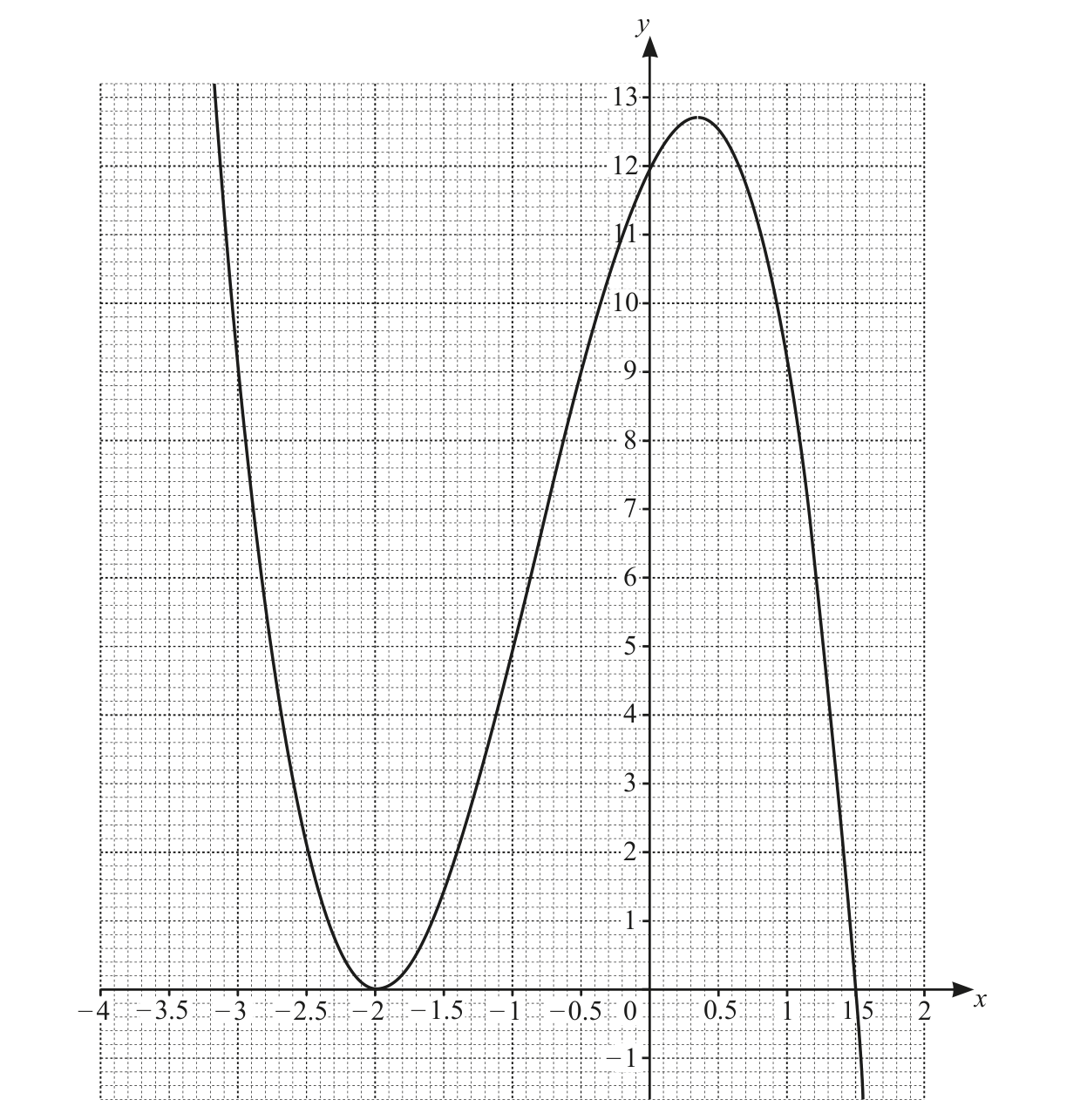
The diagram shows the graph of \(y=h(x)\), where
\(h(x)=(x+a)^2(b+cx)\)
and \(a\), \(b\) and \(c\) are integers. The curve meets the \(x\)-axis at the points \((-2,0)\) and \((1.5,0)\), and the \(y\)-axis at the point \((0,12)\).
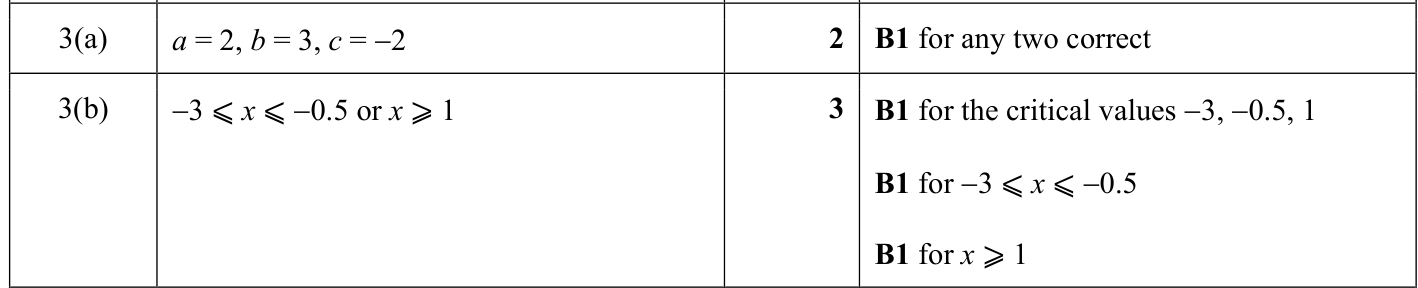
(a) Find the values of \(a\), \(b\) and \(c\).
(b) Use the graph to solve the inequality \(h(x)\leq9\).
0606 P11 - Jun 2022 - Q4 - 10 marks
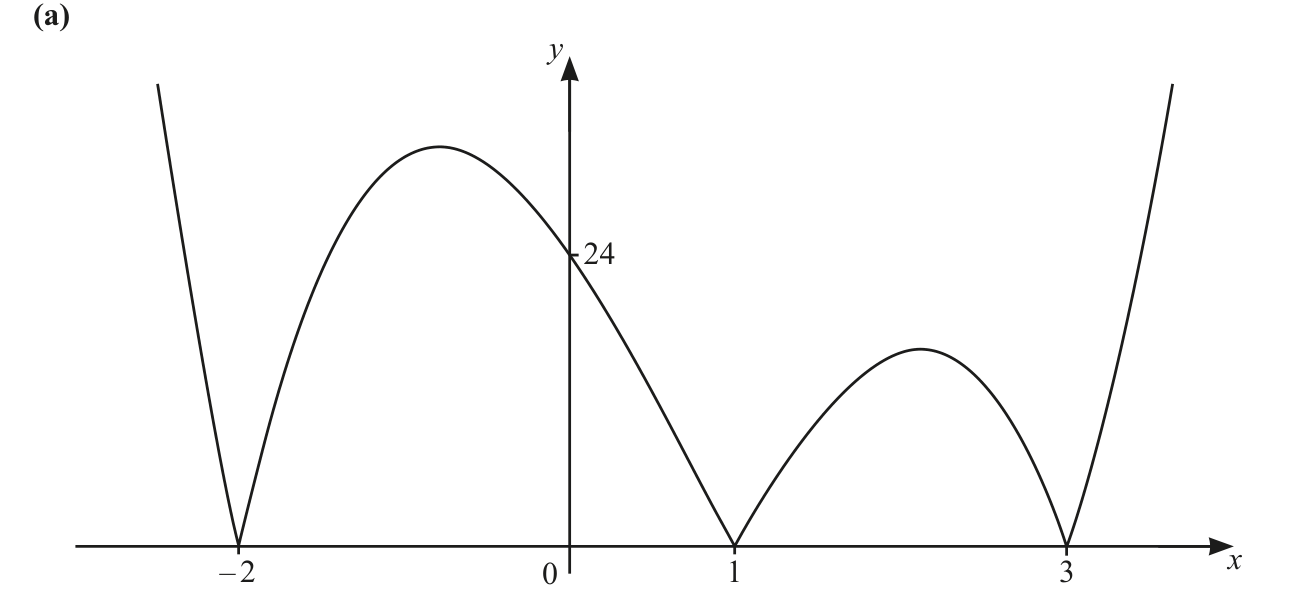
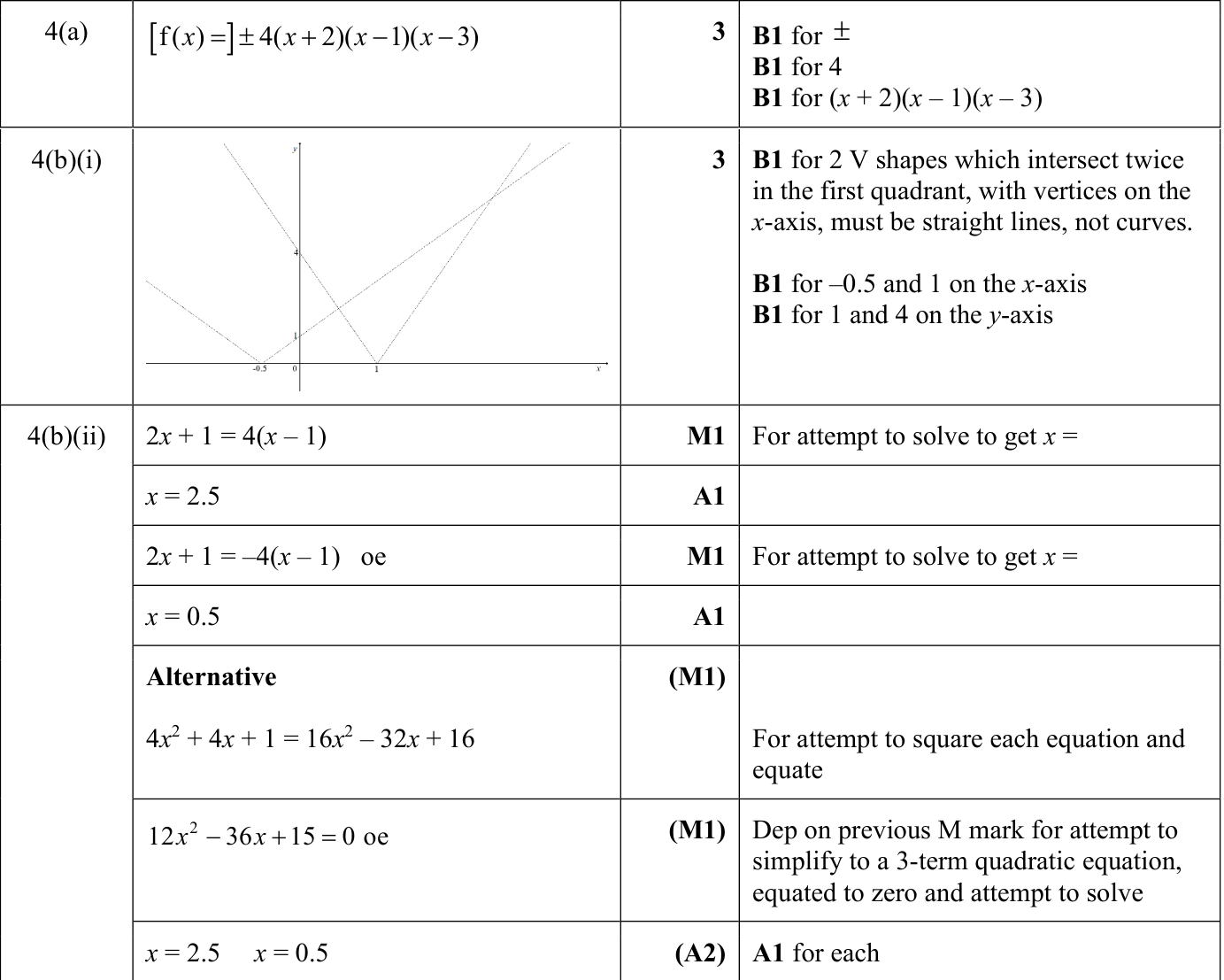
(a) The diagram shows the graph of \(y=|f(x)|\), where \(f(x)\) is a cubic. Find the possible expressions for \(f(x)\).
(b)(i) Sketch \(y=|2x+1|\) and \(y=|4(x-1)|\), stating the intercepts.
(b)(ii) Find the exact solutions of \(|2x+1|=|4(x-1)|\).
0606 P13 - Jun 2021 - Q9 - 10 marks
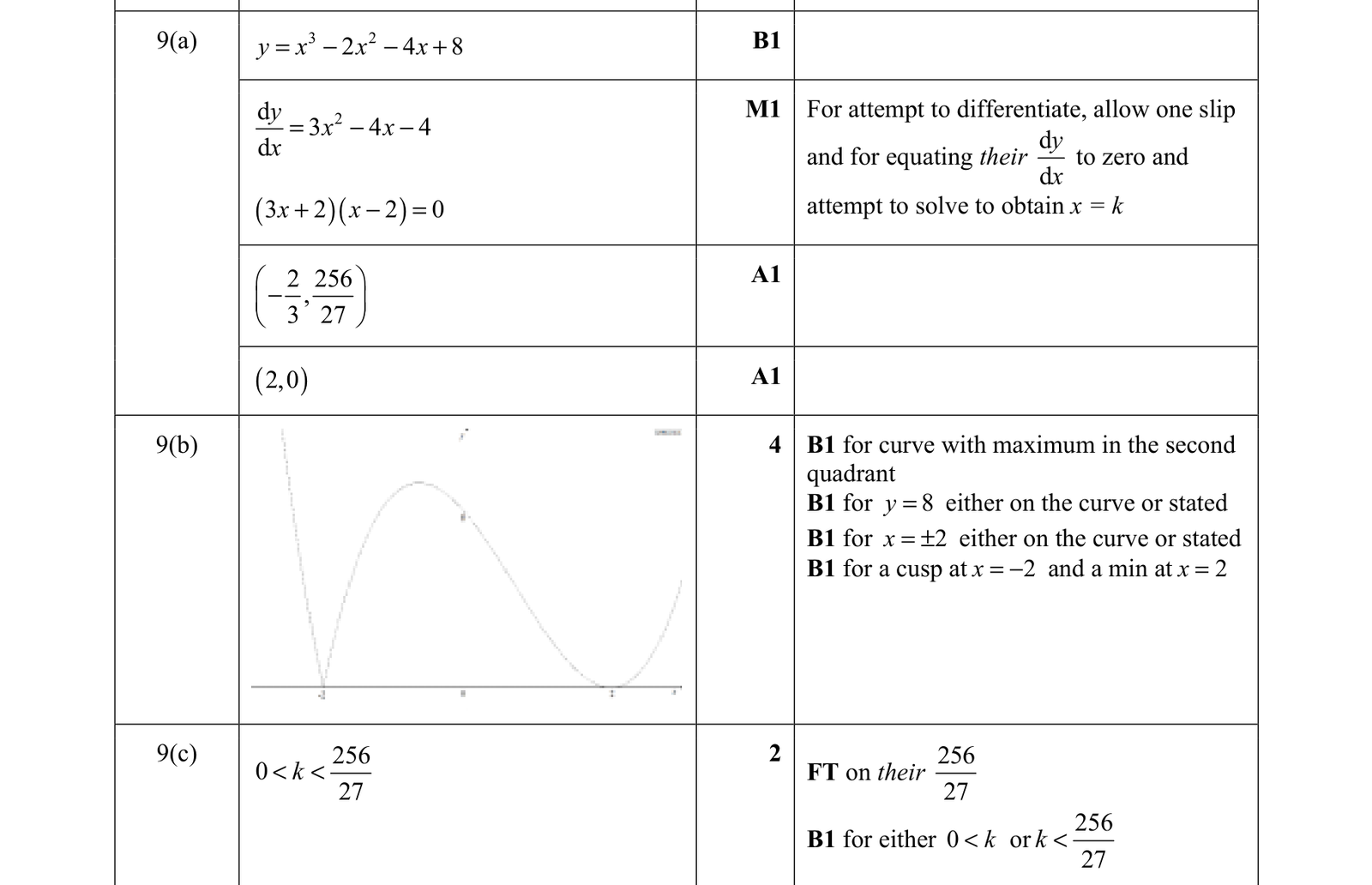
(a) Show that the equation of the curve
\(y=(x^2-4)(x-2)\)
can be written as
\(y=x^3+ax^2+bx+8,\)
where \(a\) and \(b\) are integers. Hence find the exact coordinates of the stationary points on the curve.
(b) On the axes, sketch the graph of
\(y=\left|(x^2-4)(x-2)\right|,\)
stating the intercepts with the coordinate axes.
(c) Find the possible values of the constant \(k\) for which
\(\left|(x^2-4)(x-2)\right|=k\)
has exactly \(4\) different solutions.
0606 P22 - Jun 2021 - Q2 - 3 marks
On the axes, sketch the graph of
\(y=3(x-3)(x-1)(x+2),\)
stating the intercepts with the coordinate axes.