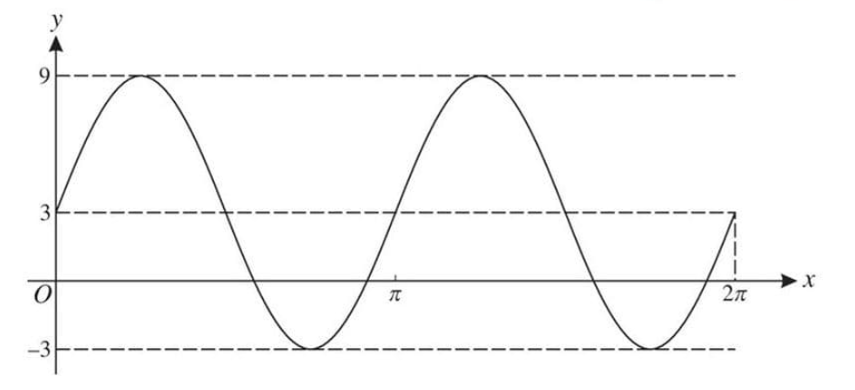
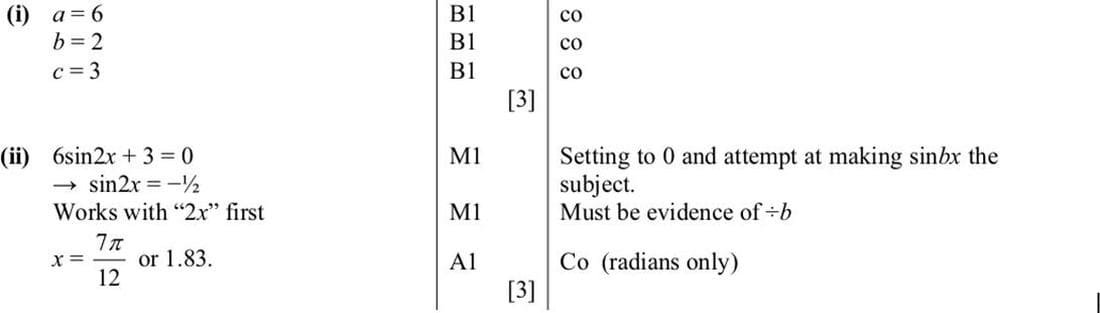
(i) The amplitude of the sine function is the distance from the midline to the maximum, which is \(9 - 3 = 6\). Therefore, \(a = 6\).
The period of the sine function is \(2\pi\) divided by the coefficient of \(x\), which is \(b\). The period is \(\pi\), so \(b = 2\).
The vertical shift \(c\) is the midline of the graph, which is at \(y = 3\). Therefore, \(c = 3\).
(ii) To find the smallest \(x\) for which \(y = 0\), set the equation to zero: \(6\sin(2x) + 3 = 0\).
Solving for \(\sin(2x)\):
\(6\sin(2x) = -3\)
\(\sin(2x) = -\frac{1}{2}\)
The general solution for \(\sin(\theta) = -\frac{1}{2}\) is \(\theta = \frac{7\pi}{6} + 2k\pi\) or \(\theta = \frac{11\pi}{6} + 2k\pi\).
For \(2x = \frac{7\pi}{6}\), solve for \(x\):
\(x = \frac{7\pi}{12}\)
Converting to decimal gives \(x \approx 1.83\).