Past Exam Questions
← Back9231 P12 - Nov 2013 - Q6 - 9 marks
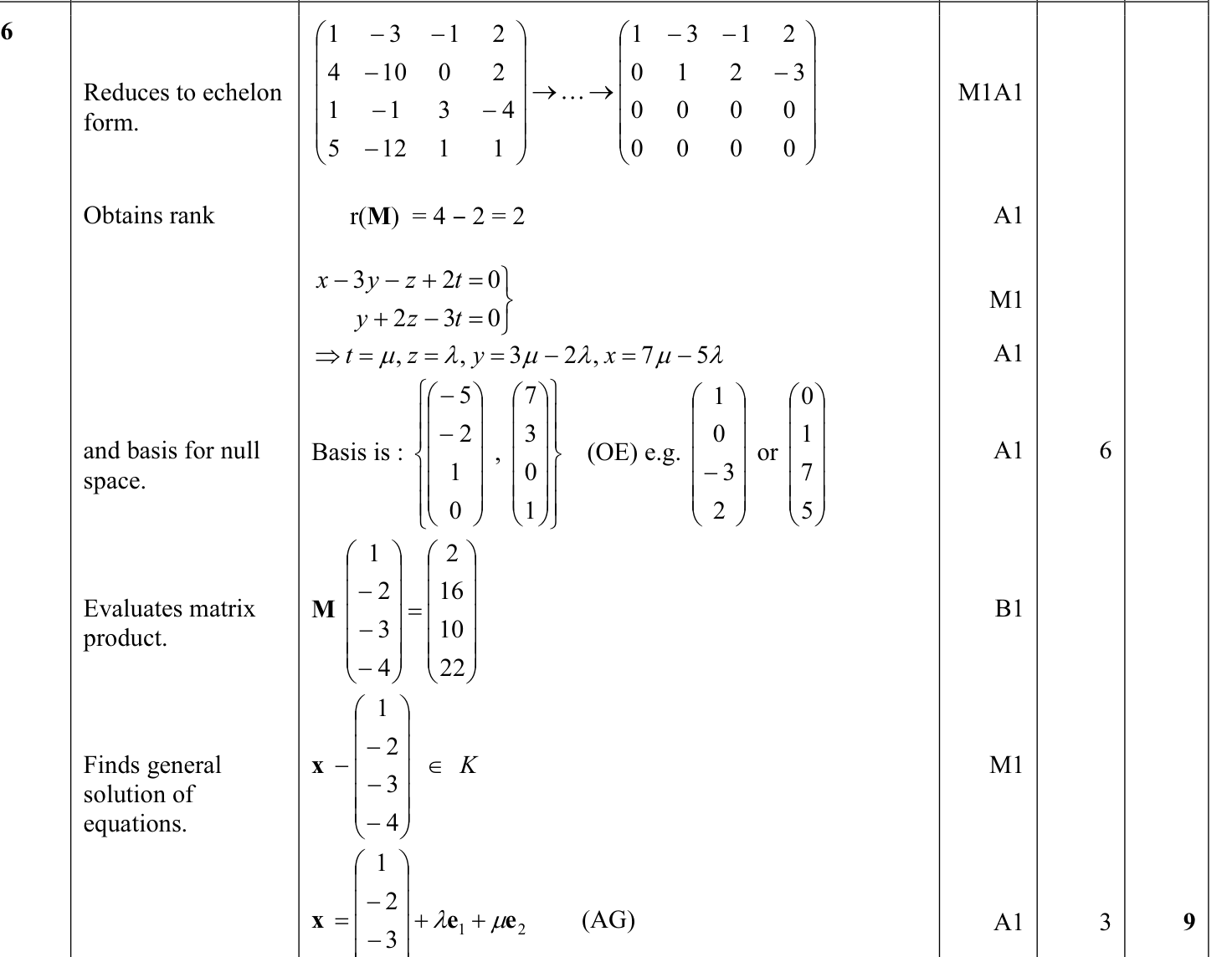
The linear transformation \(\mathrm{T}: \mathbb{R}^{4} \rightarrow \mathbb{R}^{4}\) is represented by the matrix \(\mathbf{M}\), where
\(\mathbf{M}=\left(\begin{array}{rrrr} 1 & -3 & -1 & 2 \\ 4 & -10 & 0 & 2 \\ 1 & -1 & 3 & -4 \\ 5 & -12 & 1 & 1 \end{array}\right) .\)
Find, in either order, the rank of \(\mathbf{M}\) and a basis for the null space \(K\) of T .
Evaluate
\(\mathbf{M}\left(\begin{array}{r} 1 \\ -2 \\ -3 \\ -4 \end{array}\right),\)
and hence show that every solution of
\(\mathbf{M} \mathbf{x}=\left(\begin{array}{r} 2 \\ 16 \\ 10 \\ \end{array}\right)\)
has the form
\(\mathbf{x}=\left(\begin{array}{r} 1 \\ -2 \\ -3 \\ -4 \end{array}\right)+\lambda \mathbf{e}_{1}+\mu \mathbf{e}_{2},\)
where \(\lambda\) and \(\mu\) are real numbers and \(\left\{\mathbf{e}_{1}, \mathbf{e}_{2}\right\}\) is a basis for \(K\).
9231 P11 - Jun 2011 - Q3 - 6 marks
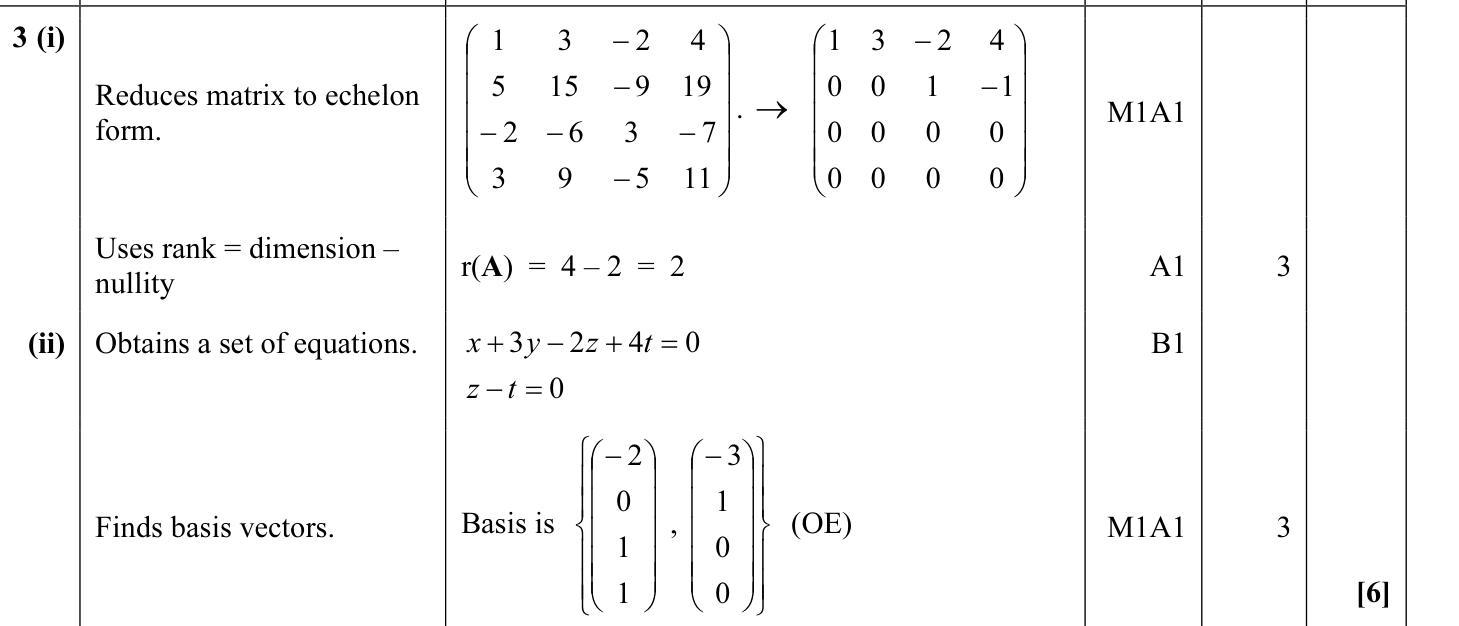
The linear transformation \(\mathrm{T}: \mathbb{R}^{4} \rightarrow \mathbb{R}^{4}\) is represented by the matrix \(\mathbf{M}=\left(\begin{array}{rrrr}1 & 3 & -2 & 4 \\ 5 & 15 & -9 & 19 \\ -2 & -6 & 3 & -7 \\ 3 & 9 & -5 & 11\end{array}\right)\).
(i) Find the rank of \(\mathbf{M}\).
(ii) Obtain a basis for the null space of T .
9231 P12 - Jun 2014 - Q6 - 8 marks
The linear transformation \(\mathrm{T}: \mathbb{R}^{4} \rightarrow \mathbb{R}^{4}\) is represented by the matrix \(\mathbf{M}\), where
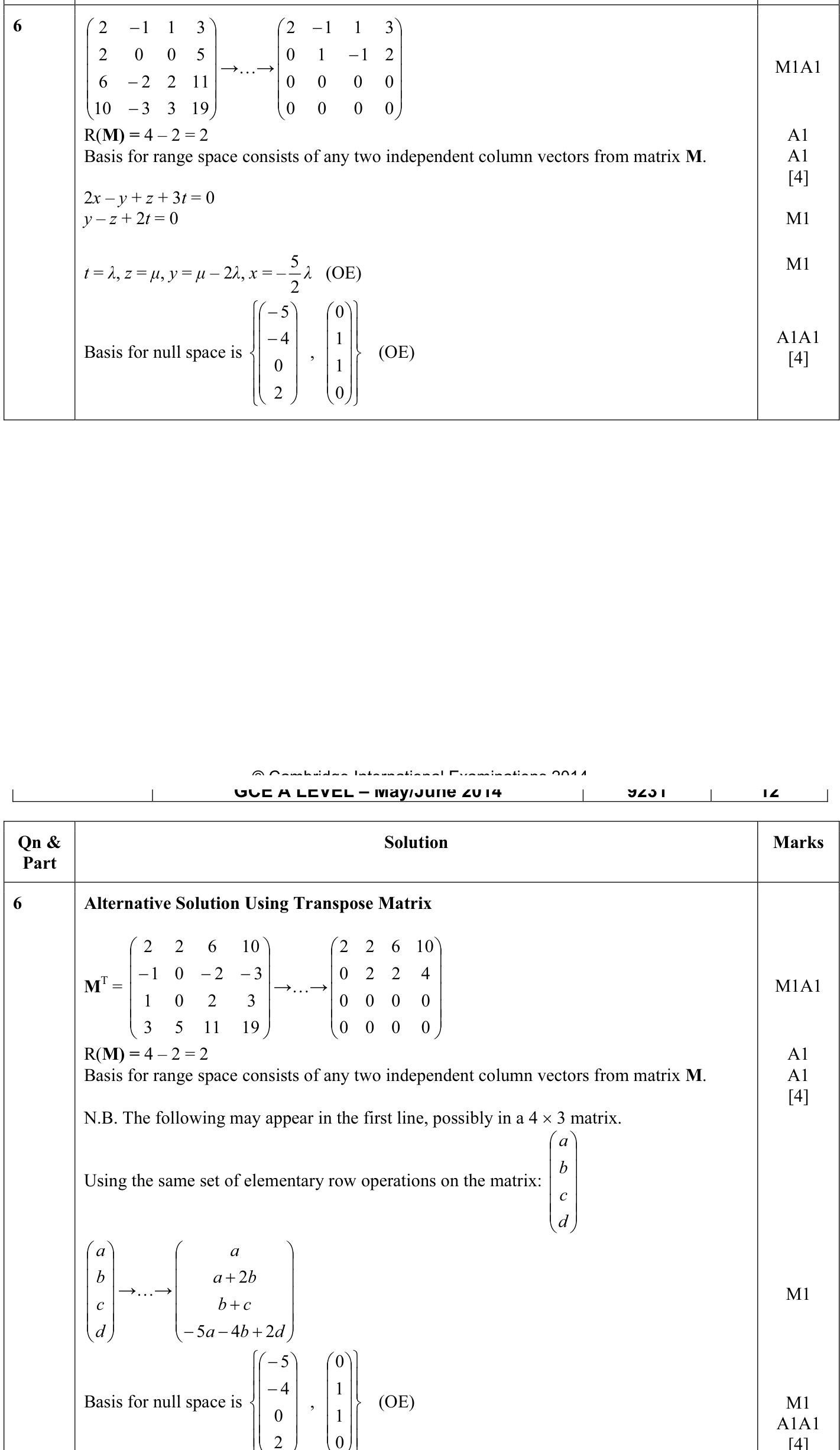
\(\mathbf{M}=\left(\begin{array}{rrrr} 2 & -1 & 1 & 3 \\ 2 & 0 & 0 & 5 \\ 6 & -2 & 2 & 11 \\ 10 & -3 & 3 & 19 \end{array}\right) .\)
(i) Find the rank of \(\mathbf{M}\) and state a basis for the range space of T .
(ii) Obtain a basis for the null space of T .
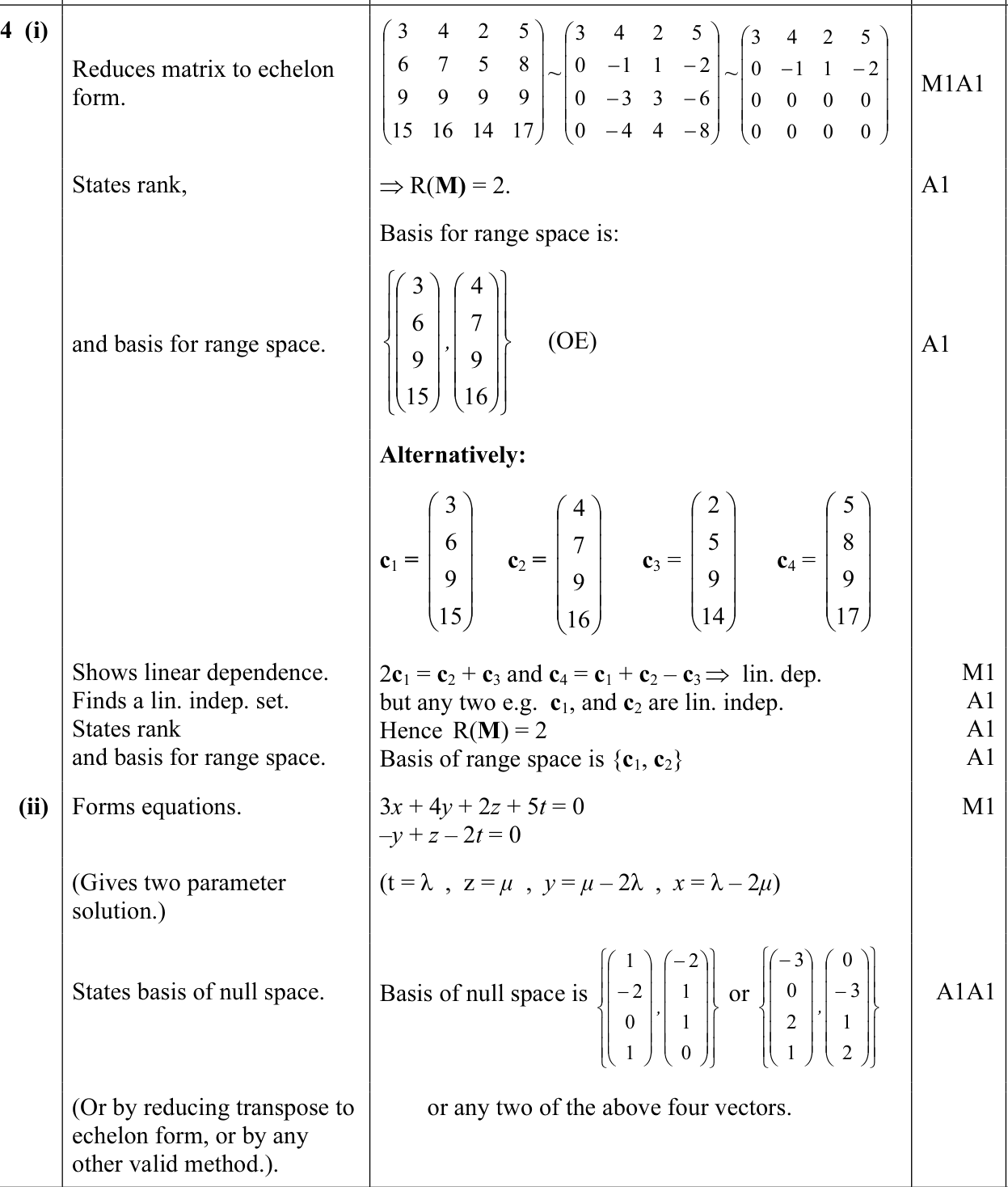
9231 P11 - Nov 2011 - Q4 - 7 marks
The linear transformation \(\mathrm{T}: \mathbb{R}^{4} \rightarrow \mathbb{R}^{4}\) is represented by the matrix \(\mathbf{M}\), where
\(\mathbf{M}=\left(\begin{array}{rrrr} 3 & 4 & 2 & 5 \\ 6 & 7 & 5 & 8 \\ 9 & 9 & 9 & 9 \\ 15 & 16 & 14 & 17 \end{array}\right) .\)
Find
(i) the rank of \(\mathbf{M}\) and a basis for the range space of T ,
(ii) a basis for the null space of T .
9231 P1 - Jun 2009 - Q12 - 26 marks
Answer only one of the following two alternatives.
EITHER
By considering \(\sum_{k=0}^{n-1}(1+\mathrm{i} \tan \theta)^{k}\), show that
\(\sum_{k=0}^{n-1} \cos k \theta \sec ^{k} \theta=\cot \theta \sin n \theta \sec ^{n} \theta,\)
provided \(\theta\) is not an integer multiple of \(\frac{1}{2} \pi\).
Hence or otherwise show that
\(\sum_{k=0}^{n-1} 2^{k} \cos \left(\frac{1}{3} k \pi\right)=\frac{2^{n}}{\sqrt{ } 3} \sin \left(\frac{1}{3} n \pi\right) .\)
Given that \(0\lt x\lt 1\), show that
\(\sum_{k=0}^{n-1} \frac{\cos \left(k \cos ^{-1} x\right)}{x^{k}}=\frac{\sin \left(n \cos ^{-1} x\right)}{x^{n-1} \sqrt{ }\left(1-x^{2}\right)} .\)
OR
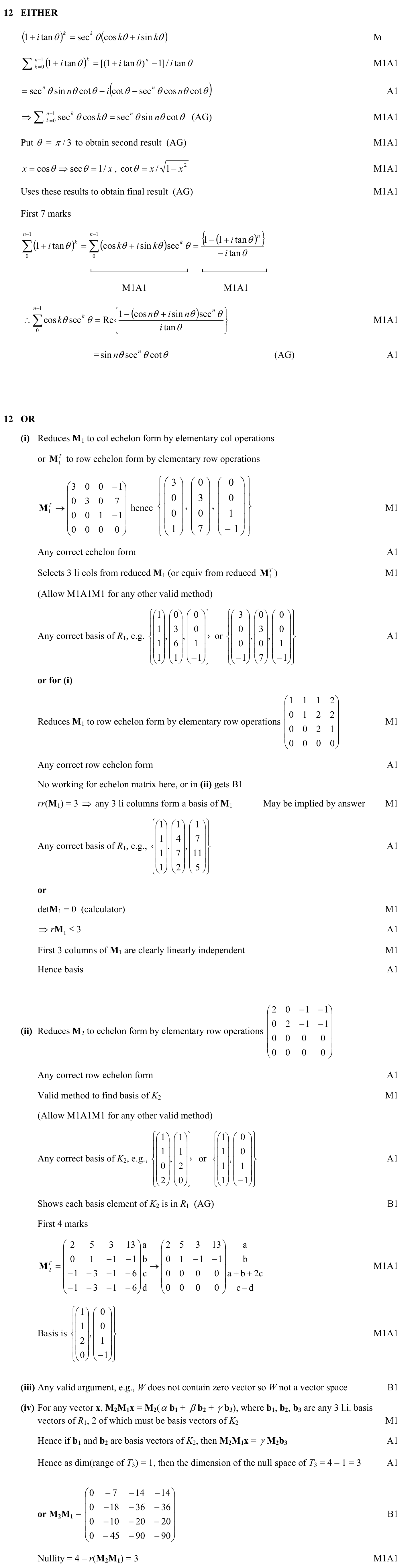
The linear transformations \(\mathrm{T}_{1}: \mathbb{R}^{4} \rightarrow \mathbb{R}^{4}\) and \(\mathrm{T}_{2}: \mathbb{R}^{4} \rightarrow \mathbb{R}^{4}\) are represented by the matrices \(\mathbf{M}_{1}\) and \(\mathbf{M}_{2}\), respectively, where
\(\mathbf{M}_{1}=\left(\begin{array}{rrrr} 1 & 1 & 1 & 2 \\ 1 & 4 & 7 & 8 \\ 1 & 7 & 11 & 13 \\ 1 & 2 & 5 & 5 \end{array}\right), \quad \mathbf{M}_{2}=\left(\begin{array}{rrrr} 2 & 0 & -1 & -1 \\ 5 & 1 & -3 & -3 \\ 3 & -1 & -1 & -1 \\ 13 & -1 & -6 & -6 \end{array}\right) .\)
(i) Find a basis for \(R_{1}\), the range space of \(\mathrm{T}_{1}\).
(ii) Find a basis for \(K_{2}\), the null space of \(\mathrm{T}_{2}\), and hence show that \(K_{2}\) is a subspace of \(R_{1}\).
The set of vectors which belong to \(R_{1}\) but do not belong to \(K_{2}\) is denoted by \(W\).
(iii) State whether \(W\) is a vector space, justifying your answer.
The linear transformation \(\mathrm{T}_{3}: \mathbb{R}^{4} \rightarrow \mathbb{R}^{4}\) is the result of applying \(\mathrm{T}_{1}\) and then \(\mathrm{T}_{2}\), in that order.
(iv) Find the dimension of the null space of \(\mathrm{T}_{3}\).
9231 P13 - Jun 2010 - Q12 - 28 marks
Answer only one of the following two alternatives.
EITHER
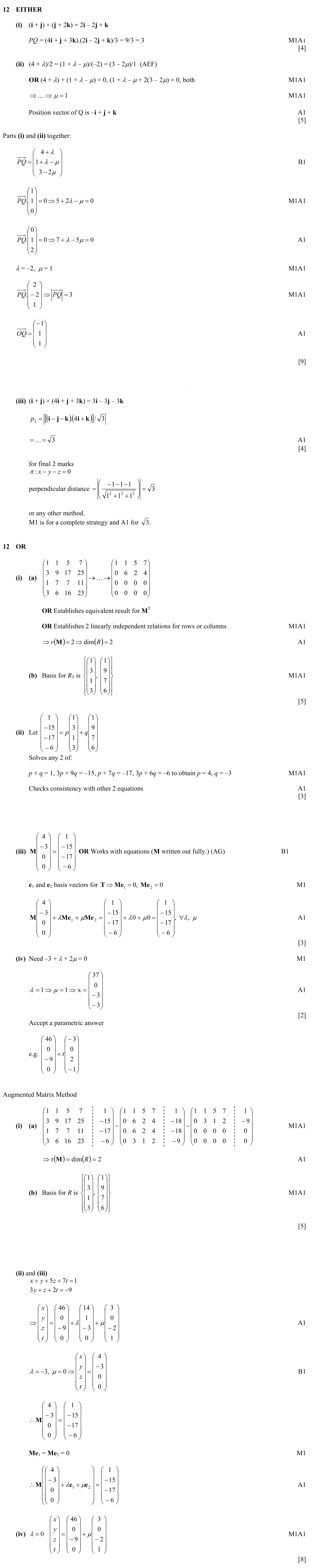
The line \(l_{1}\) passes through the point \(A\) whose position vector is \(3 \mathbf{i}+\mathbf{j}+2 \mathbf{k}\) and is parallel to the vector \(\mathbf{i}+\mathbf{j}\). The line \(l_{2}\) passes through the point \(B\) whose position vector is \(-\mathbf{i}-\mathbf{k}\) and is parallel to the vector \(\mathbf{j}+2 \mathbf{k}\). The point \(P\) is on \(l_{1}\) and the point \(Q\) is on \(l_{2}\) and \(P Q\) is perpendicular to both \(l_{1}\) and \(l_{2}\).
(i) Find the length of \(P Q\).
(ii) Find the position vector of \(Q\).
(iii) Show that the perpendicular distance from \(Q\) to the plane containing \(A B\) and the line \(l_{1}\) is \(\sqrt{ } 3\).
OR
The linear transformation \(\mathrm{T}: \mathbb{R}^{4} \rightarrow \mathbb{R}^{4}\) is represented by the matrix \(\mathbf{M}=\left(\begin{array}{rrrr}1 & 1 & 5 & 7 \\ 3 & 9 & 17 & 25 \\ 1 & 7 & 7 & 11 \\ 3 & 6 & 16 & 23\end{array}\right)\).
(i) In either order,
(a) show that the dimension of \(R\), the range space of T , is equal to 2 ,
(b) obtain a basis for \(R\).
(ii) Show that the vector \(\left(\begin{array}{r}1 \\ -15 \\ -17 \\ -6\end{array}\right)\) belongs to \(R\).
(iii) It is given that \(\left\{\mathbf{e}_{1}, \mathbf{e}_{2}\right\}\) is a basis for the null space of T , where \(\mathbf{e}_{1}=\left(\begin{array}{r}14 \\ 1 \\ -3 \\ 0\end{array}\right)\) and \(\mathbf{e}_{2}=\left(\begin{array}{r}19 \\ 2 \\ 0 \\ -3\end{array}\right)\). Show that, for all \(\lambda\) and \(\mu\),
\(\mathbf{x}=\left(\begin{array}{r} 4 \\ -3 \\ 0 \\ \end{array}\right)+\lambda \mathbf{e}_{1}+\mu \mathbf{e}_{2}\)
is a solution of
\(\mathbf{M x}=\left(\begin{array}{r} 1 \\ -15 \\ -17 \\ -6 \end{array}\right) .\)
(iv) Hence find a solution of \((*)\) of the form \(\left(\begin{array}{l}\alpha \\ 0 \\ \gamma \\ \delta\end{array}\right)\).
0606 P11 - Jun 2025 - Q5 - 5 marks
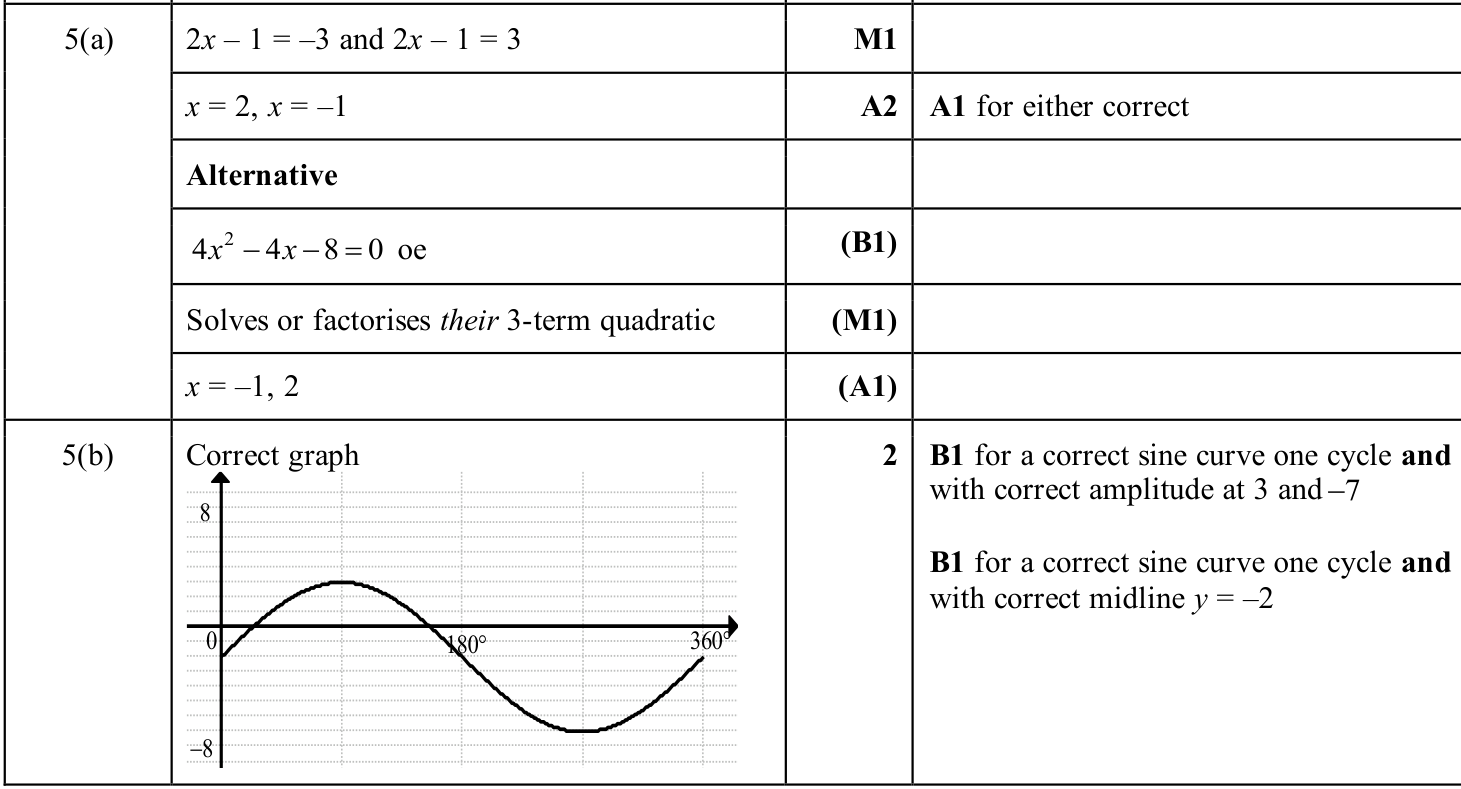
(a) Solve the equation \(5|2x-1|+8=23\).
(b) On the axes, sketch the graph of \(y=5\sin x-2\) for \(0^\circ\leqslant x\leqslant360^\circ\).
0606 P23 - Jun 2022 - Q1 - 3 marks
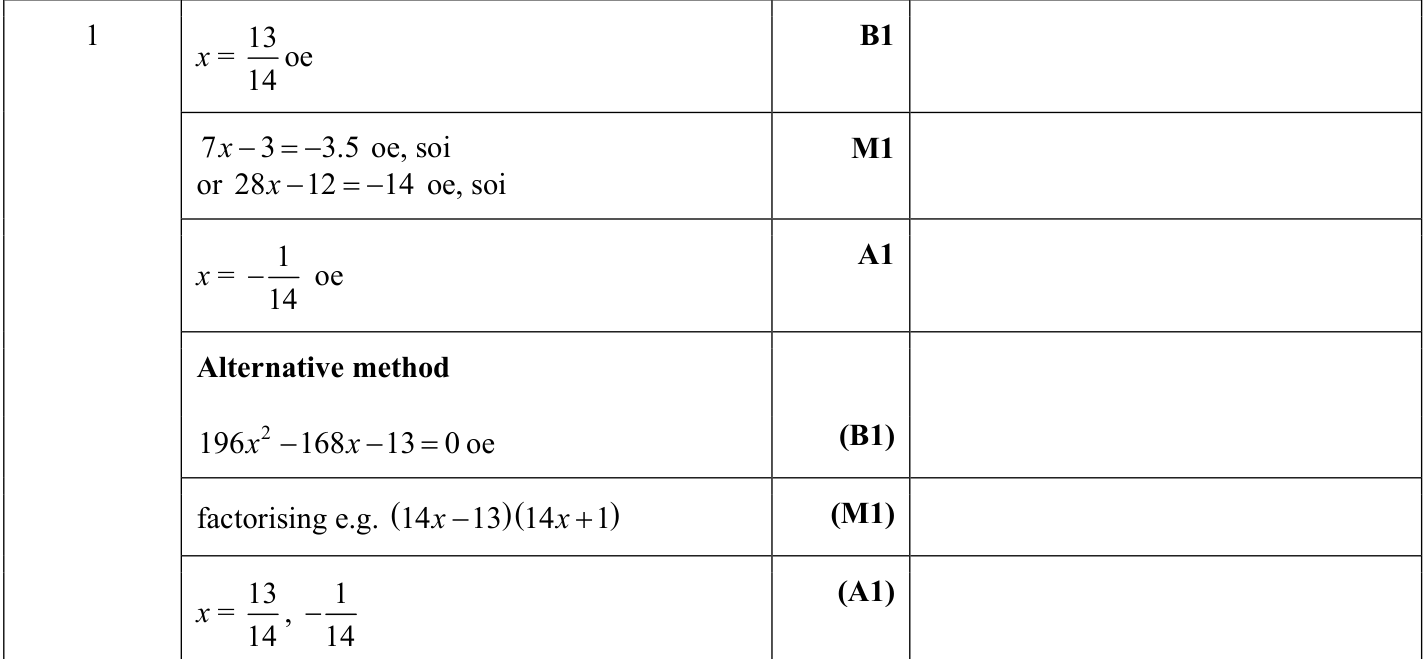
Solve the equation \(4|7x-3|-5=9\).
0606 P22 - Mar 2021 - Q1 - 3 marks
Solve the equation
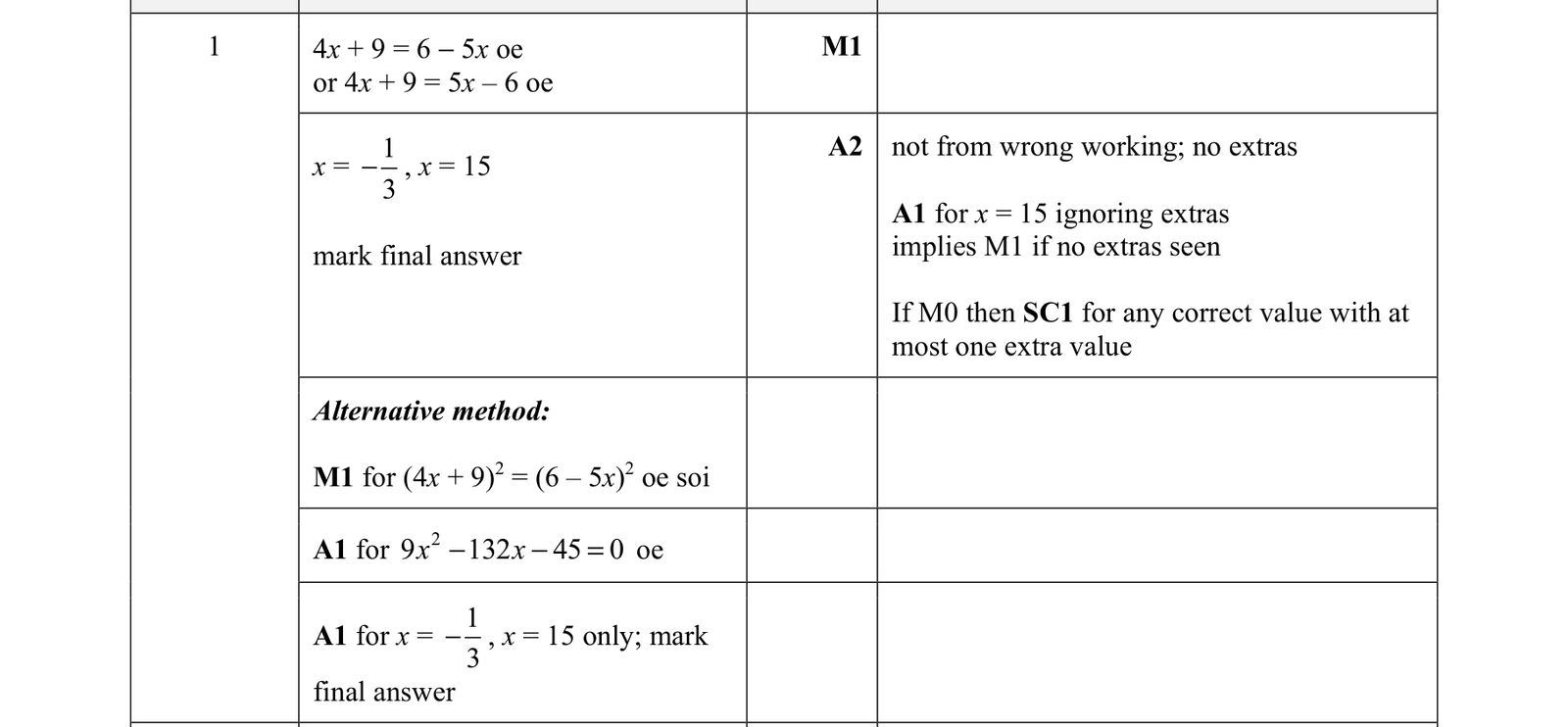
\(|4x+9|=|6-5x|.\)
0606 P23 - Nov 2020 - Q1 - 3 marks
Solve the equation
\(|3x-2|=4+x.\)

0606 P23 - Nov 2019 - Q1 - 3 marks
Solve
\(|3x+2|=x+4.\)

0606 P23 - Nov 2018 - Q1 - 3 marks
Solve the equation
\(|5x-3|=-3x+13.\)

0606 P22 - Jun 2017 - Q1 - 3 marks
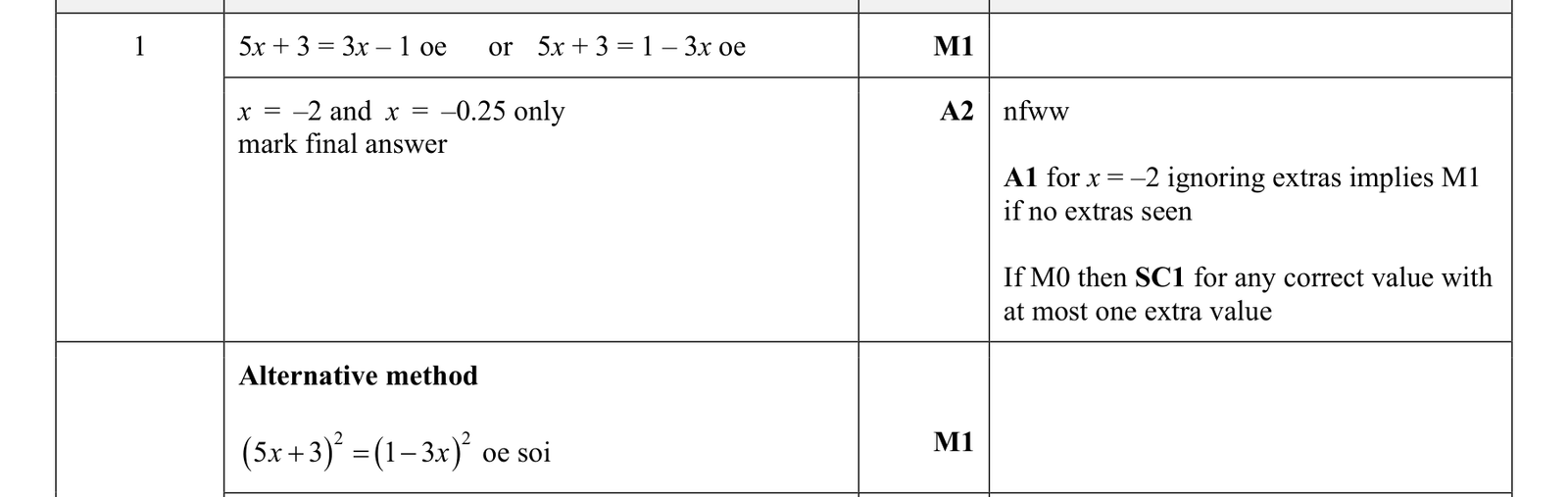
Solve \(\lvert 5x+3\rvert=\lvert 1-3x\rvert\).
0606 P23 - Nov 2017 - Q2 - 3 marks
Solve the equation \(|3x-1|=|5+x|\).

0606 P21 - Nov 2025 - Q2 - 3 marks
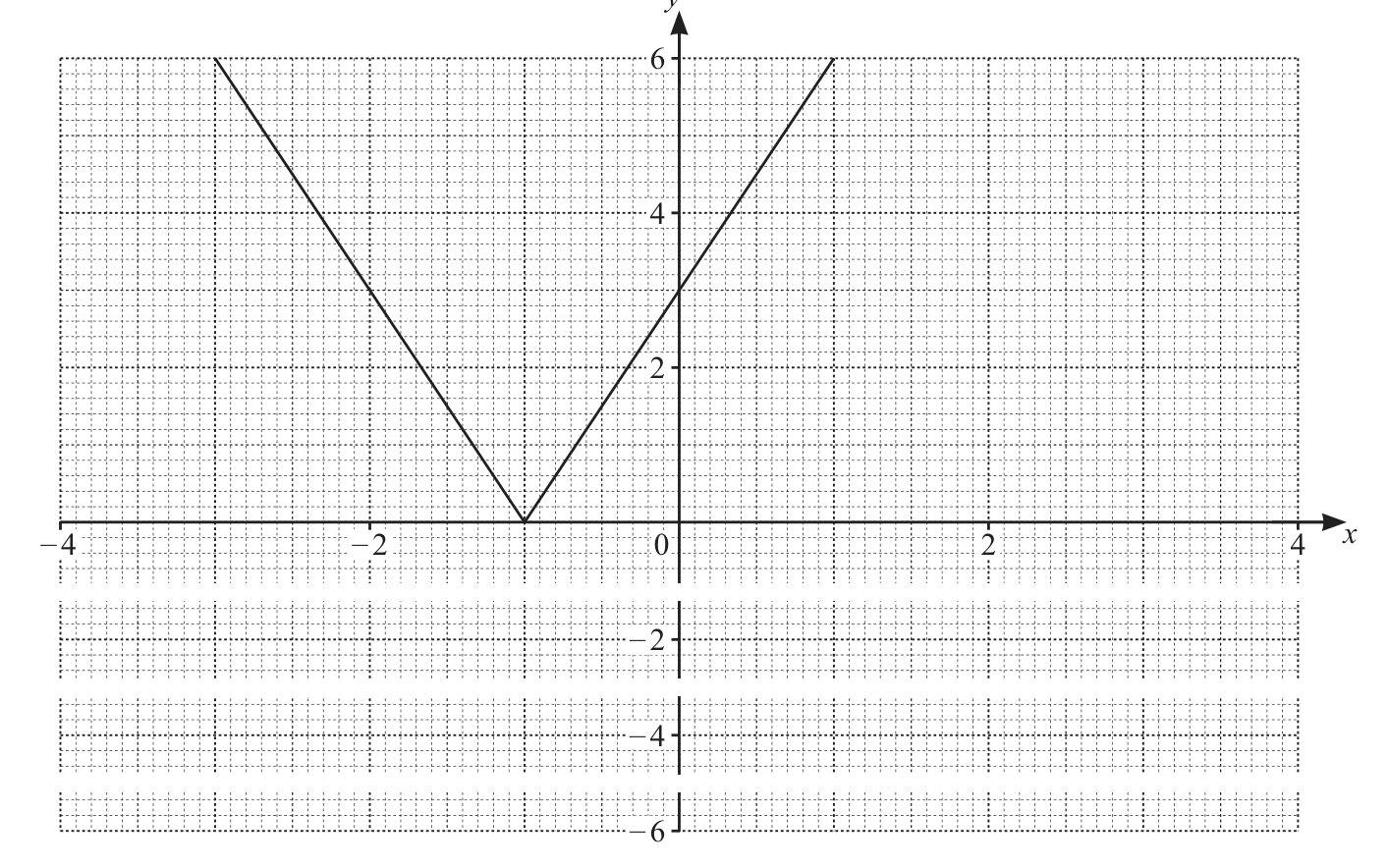
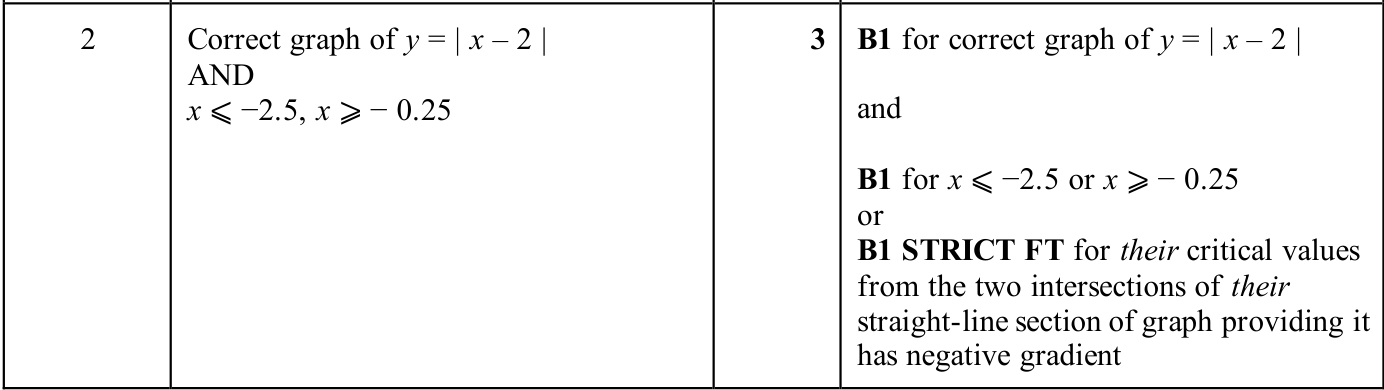
The diagram shows the graph of \(y=|3x+3|\).
Use a graphical method to solve the inequality \(|3x+3|\geqslant |x-2|\).
0606 P13 - Nov 2025 - Q1 - 7 marks
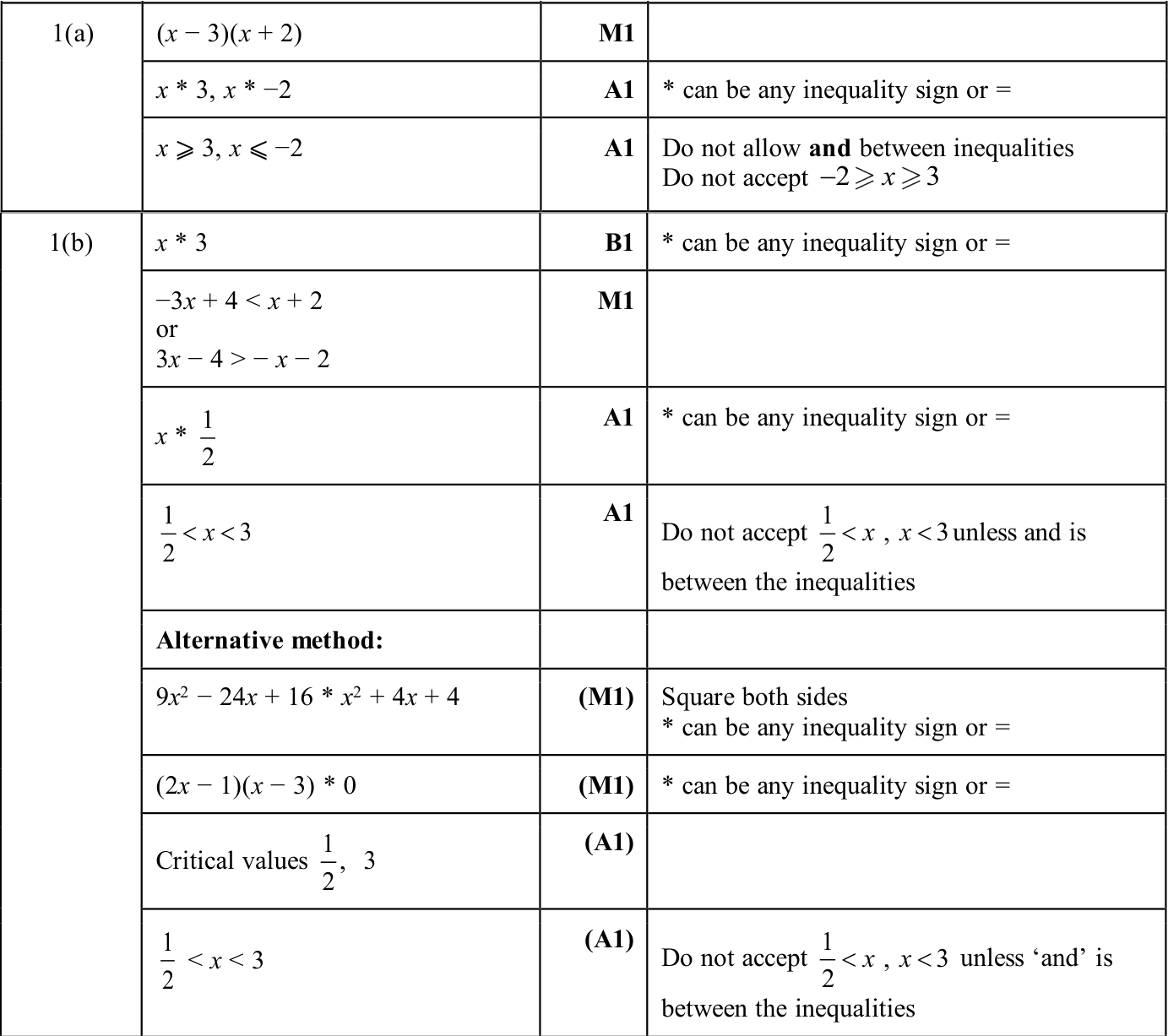
Solve the following inequalities.
(a) \(x^2-x-6\geqslant0\)
(b) \(|3x-4|\lt x+2\)
0606 P22 - Jun 2025 - Q1 - 4 marks
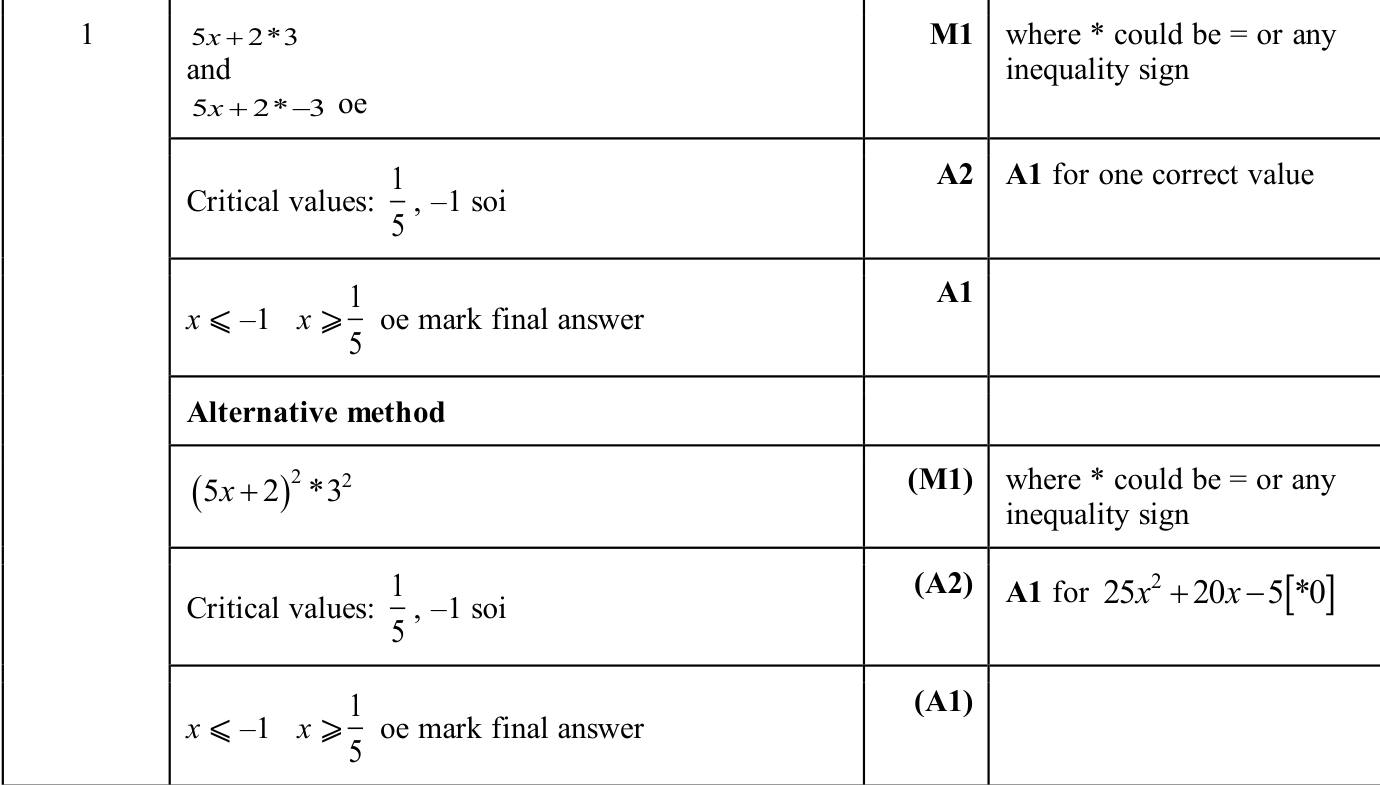
Solve the inequality \(|5 x+2| \geqslant 3\).
0606 P12 - Mar 2025 - Q1 - 7 marks
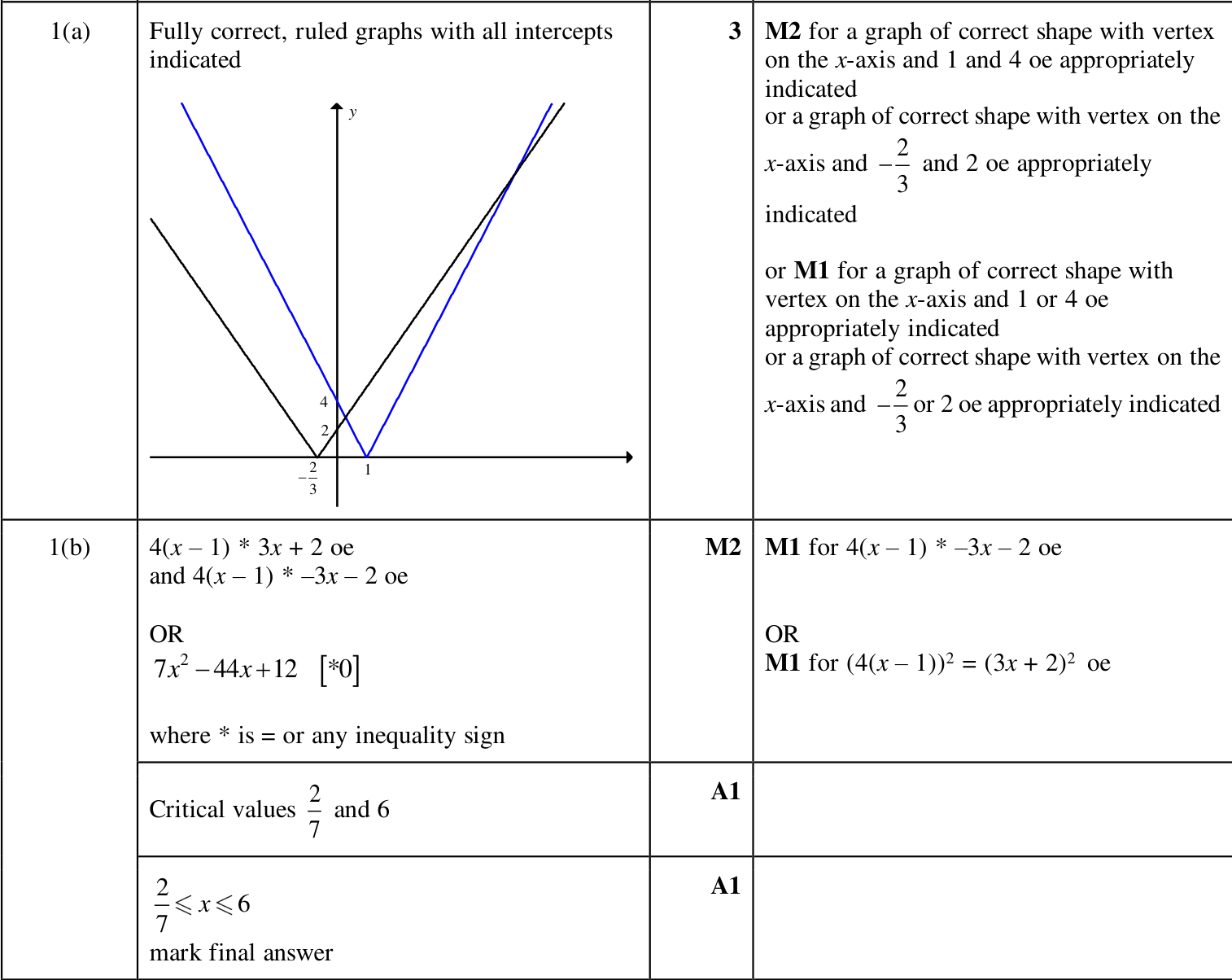
(a) On the axes, sketch the graphs of \(y=4|x-1|\) and \(y=|3x+2|\), stating the intercepts with the axes.
(b) Solve the inequality \(4|x-1|\leqslant |3x+2|\).
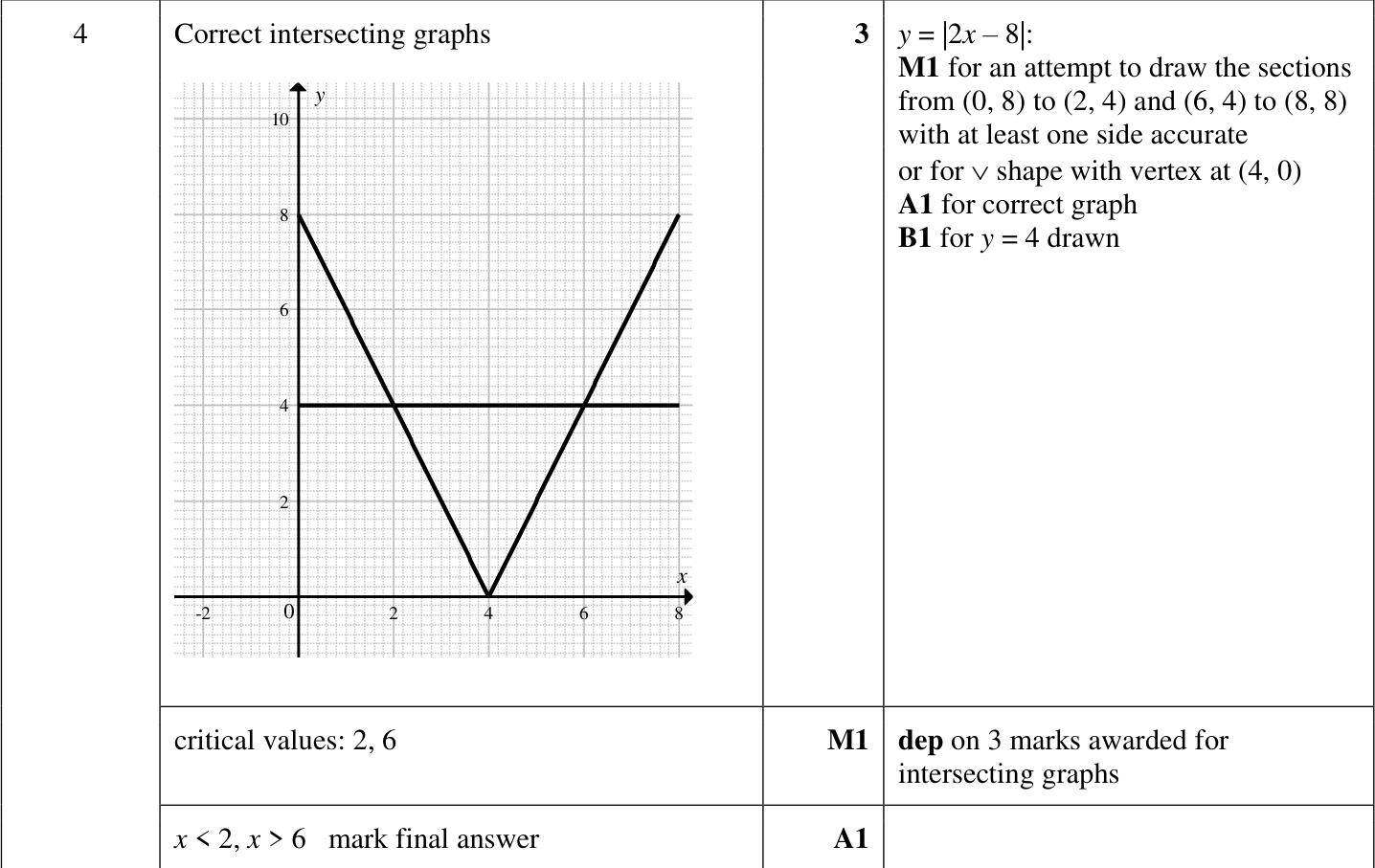
0606 P22 - Nov 2024 - Q4 - 5 marks
Use a graphical method to solve the inequality \(|2 x-8|\gt 4\).
0606 P22 - Mar 2024 - Q1 - 7 marks
(a) Solve the equation \(2|8-4 x|+5=25\).
(b) Solve the inequality \(16 x-5 x^{2}-3\lt \frac{57-9 x}{6}\).