Past Exam Questions
← Back9709 P43 - Nov 2015 - Q4
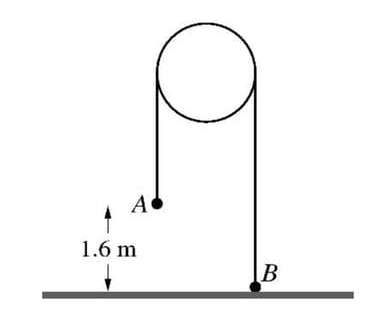
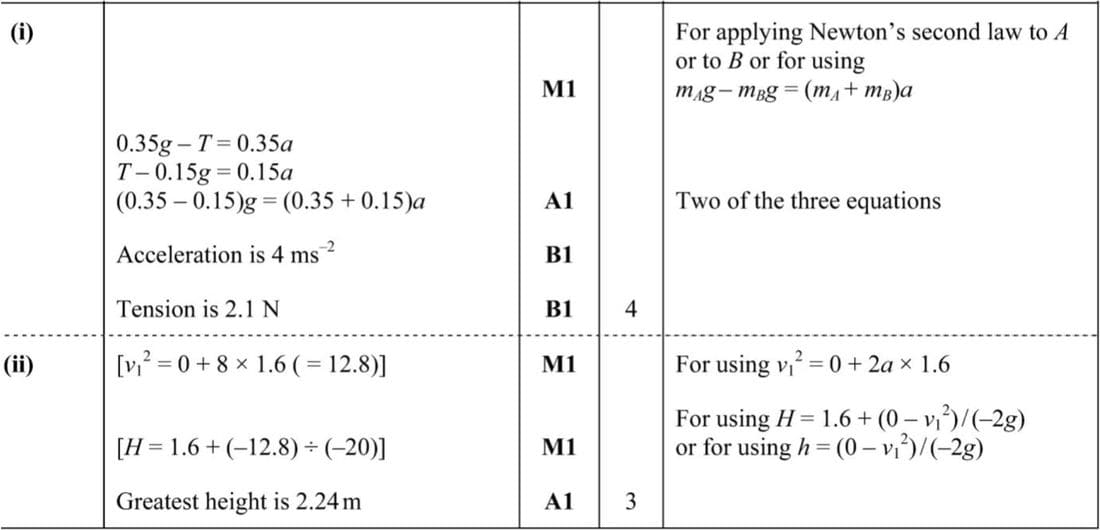
Particles A and B, of masses 0.35 kg and 0.15 kg respectively, are attached to the ends of a light inextensible string which passes over a fixed smooth pulley. The system is at rest with B held on the horizontal floor, the string taut and its straight parts vertical. A is at a height of 1.6 m above the floor (see diagram). B is released and the system begins to move; B does not reach the pulley. Find
- the acceleration of the particles and the tension in the string before A reaches the floor,
- the greatest height above the floor reached by B.
9709 P43 - Nov 2015 - Q1
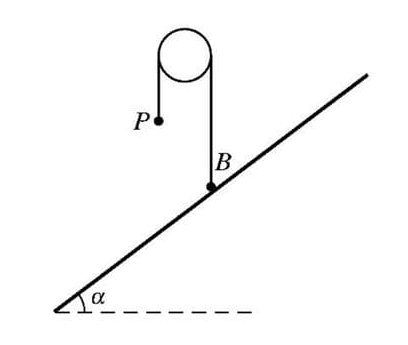
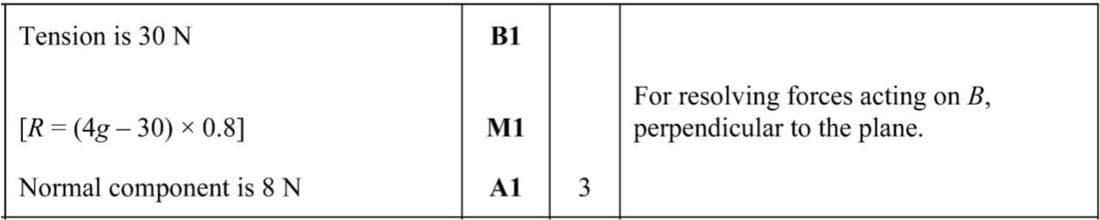
A small ball B of mass 4 kg is attached to one end of a light inextensible string. A particle P of mass 3 kg is attached to the other end of the string. The string passes over a fixed smooth pulley. The system is in equilibrium with the string taut and its straight parts vertical. B is at rest on a rough plane inclined to the horizontal at an angle of \(\alpha\), where \(\cos \alpha = 0.8\) (see diagram). State the tension in the string and find the normal component of the contact force exerted on B by the plane.
9709 P42 - Jun 2015 - Q6
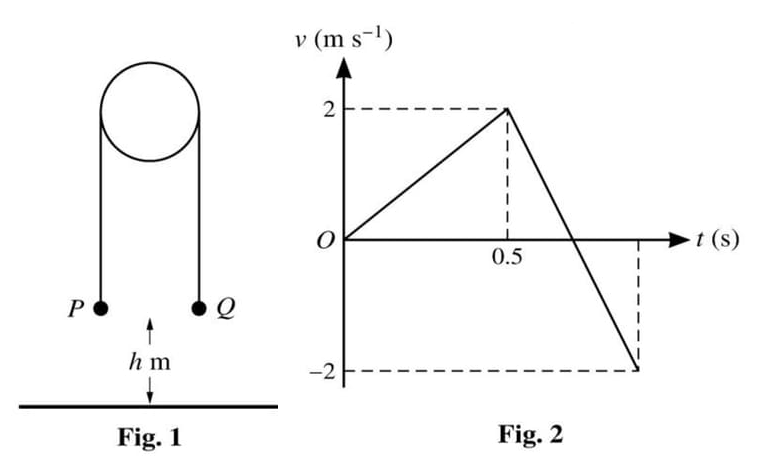
Two particles P and Q have masses m kg and (1 − m) kg respectively. The particles are attached to the ends of a light inextensible string which passes over a smooth fixed pulley. P is held at rest with the string taut and both straight parts of the string vertical. P and Q are each at a height of h m above horizontal ground (see Fig. 1). P is released and Q moves downwards. Subsequently Q hits the ground and comes to rest. Fig. 2 shows the velocity-time graph for P while Q is moving downwards or is at rest on the ground.
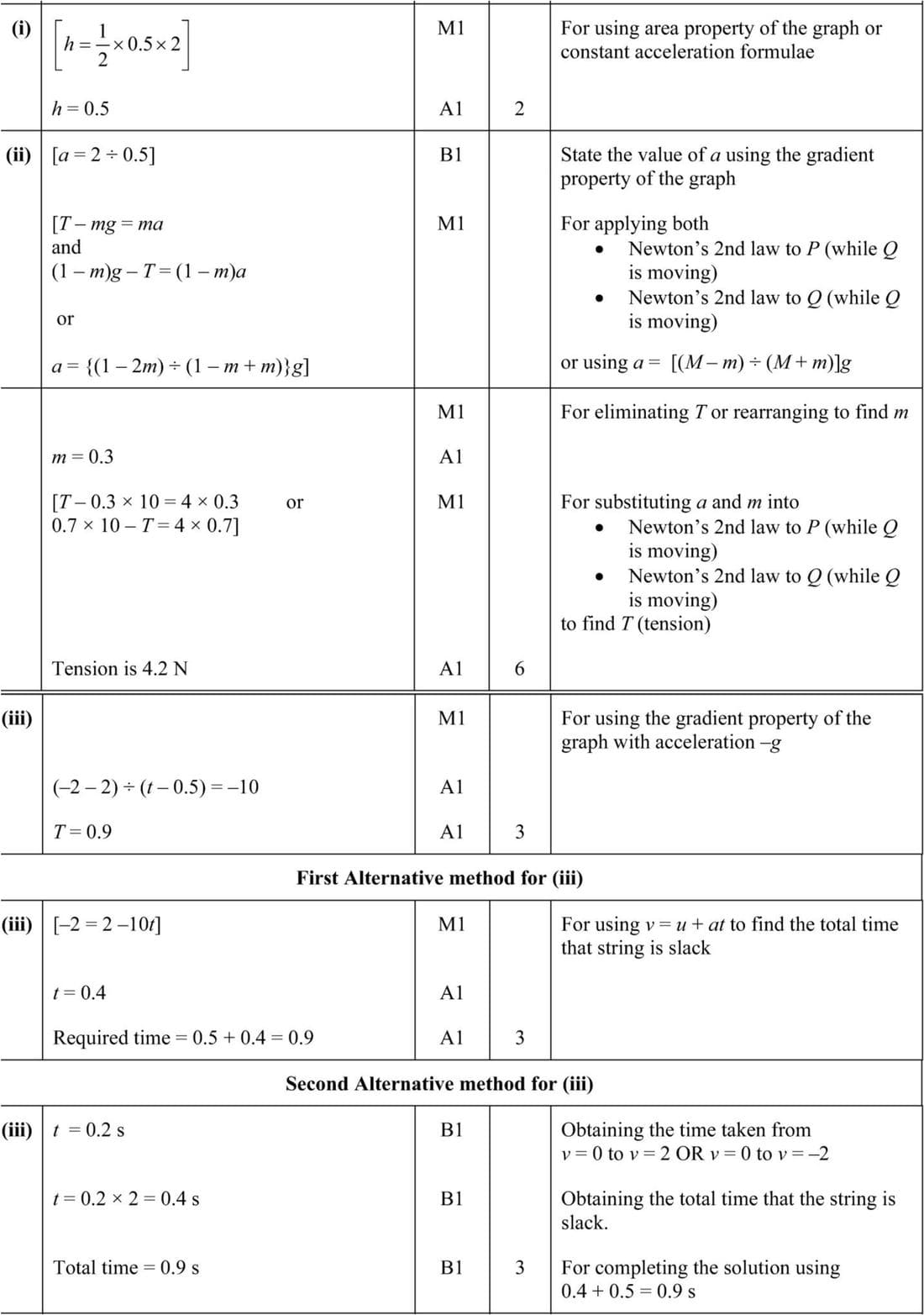
- Find the value of h. [2]
- Find the value of m, and find also the tension in the string while Q is moving. [6]
- The string is slack while Q is at rest on the ground. Find the total time from the instant that P is released until the string becomes taut again. [3]
9709 P43 - Nov 2014 - Q6
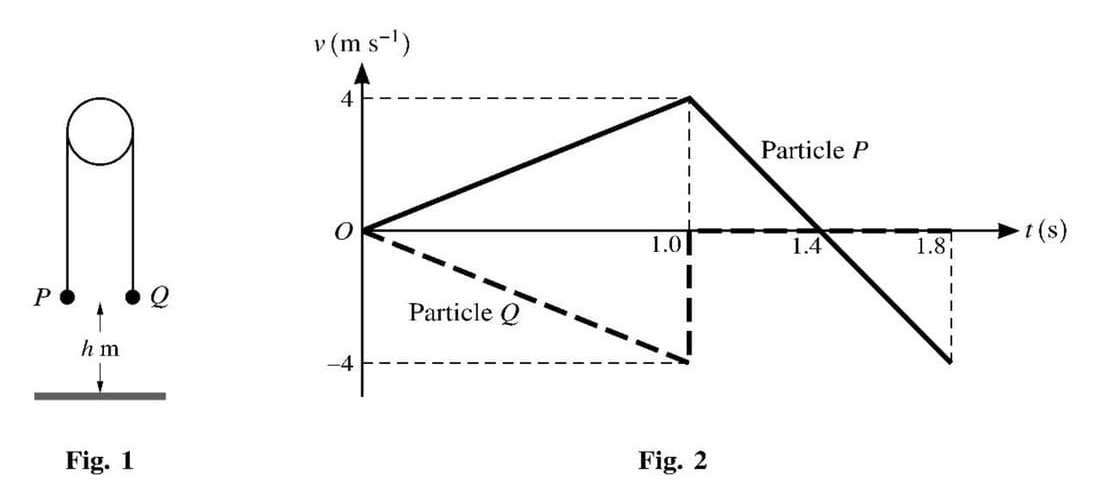
Particles P and Q have a total mass of 1 kg. The particles are attached to opposite ends of a light inextensible string which passes over a smooth fixed pulley. P is held at rest and Q hangs freely, with both straight parts of the string vertical. Both particles are at a height of h m above the floor (see Fig. 1). P is released from rest and the particles start to move with the string taut. Fig. 2 shows the velocity-time graphs for P's motion and for Q's motion, where the positive direction for velocity is vertically upwards. Find
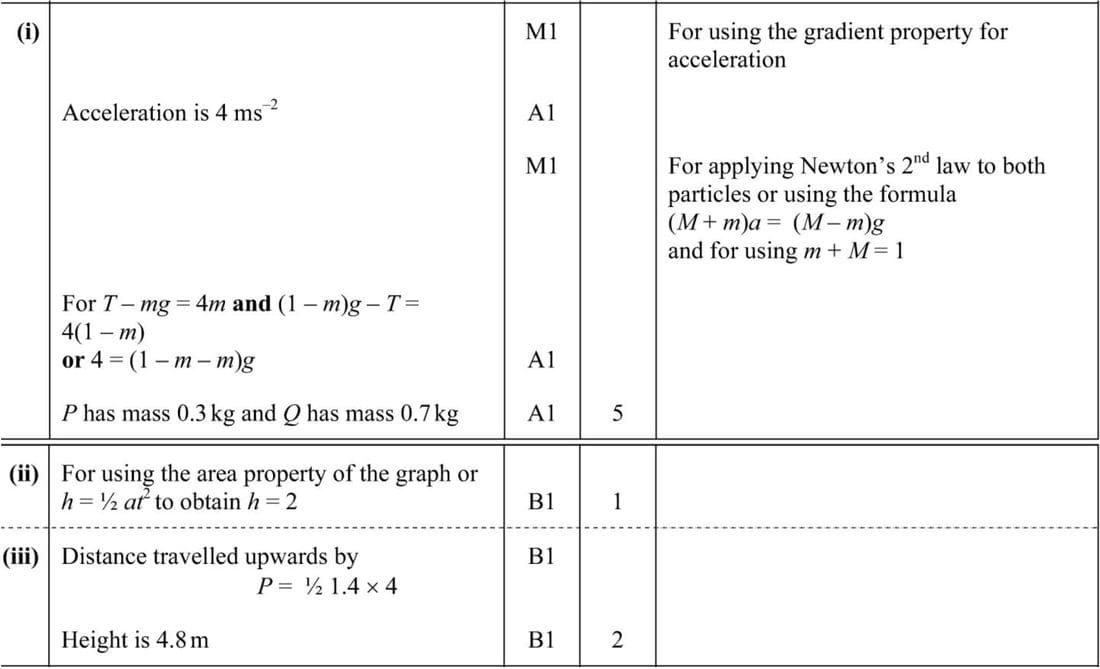
- the magnitude of the acceleration with which the particles start to move and the mass of each of the particles,
- the value of h,
- the greatest height above the floor reached by particle P.
9709 P41 - Jun 2014 - Q6
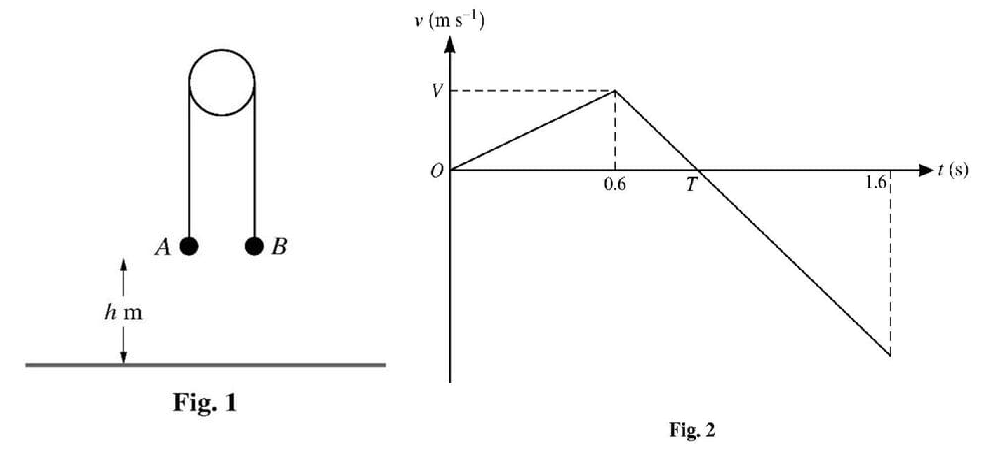
Particles A of mass 0.25 kg and B of mass 0.75 kg are attached to opposite ends of a light inextensible string which passes over a fixed smooth pulley. The system is held at rest with the string taut and its straight parts vertical. Both particles are at a height of h m above the floor (see Fig. 1). The system is released from rest, and 0.6 s later, when both particles are in motion, the string breaks. The particle A does not reach the pulley in the subsequent motion.
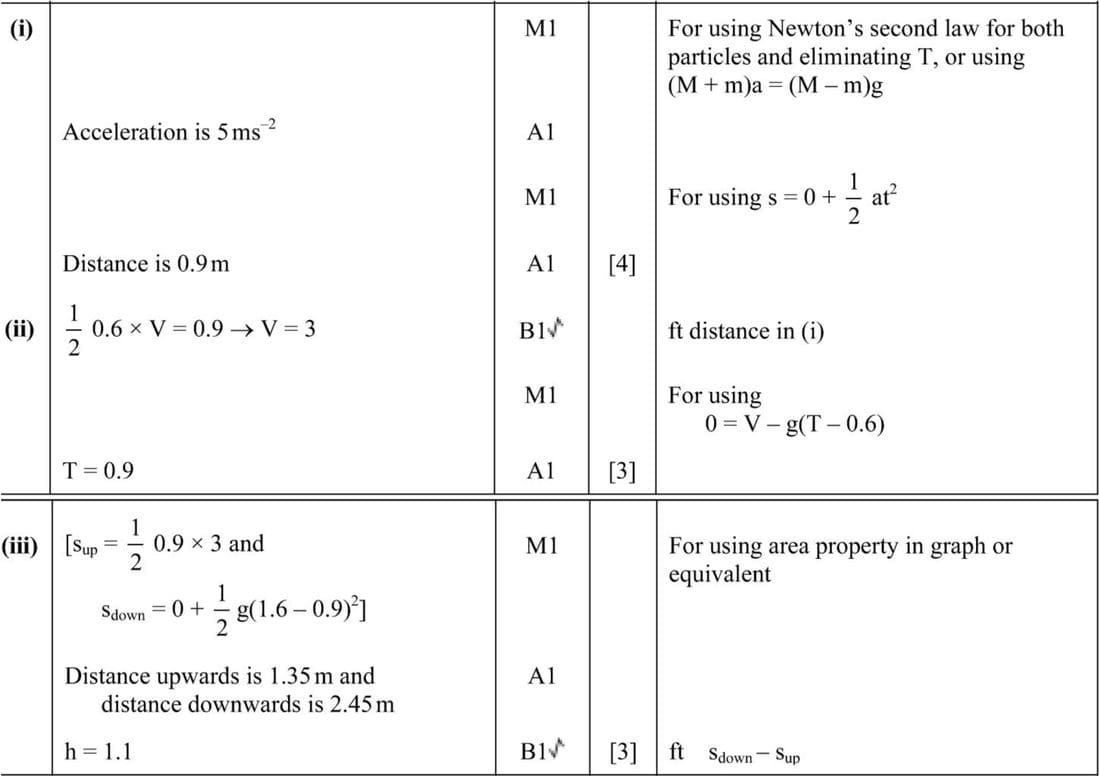
(i) Find the acceleration of A and the distance travelled by A before the string breaks.
The velocity-time graph shown in Fig. 2 is for the motion of particle A until it hits the floor. The velocity of A when the string breaks is V m s-1 and T s is the time taken for A to reach its greatest height.
(ii) Find the value of V and the value of T.
(iii) Find the distance travelled by A upwards and the distance travelled by A downwards and hence find h.
9709 P43 - Nov 2013 - Q2
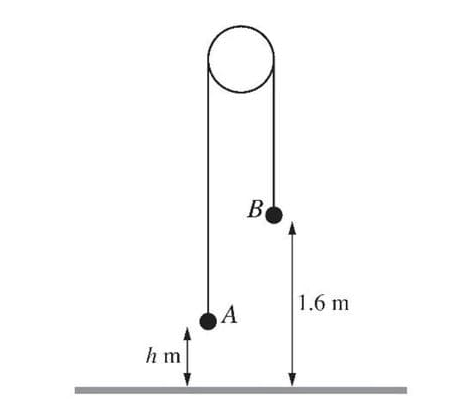
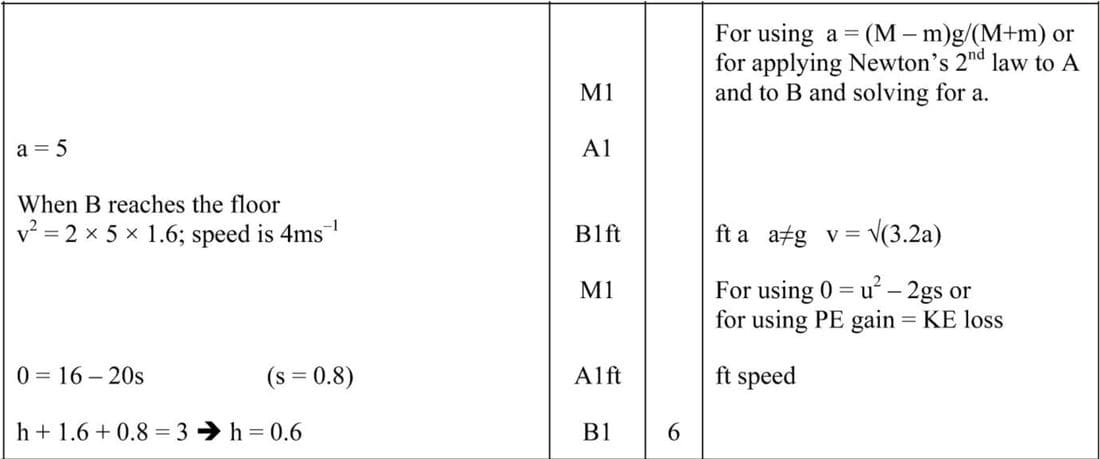
Particle A of mass 0.2 kg and particle B of mass 0.6 kg are attached to the ends of a light inextensible string. The string passes over a fixed smooth pulley. B is held at rest at a height of 1.6 m above the floor. A hangs freely at a height of h m above the floor. Both straight parts of the string are vertical (see diagram). B is released and both particles start to move. When B reaches the floor it remains at rest, but A continues to move vertically upwards until it reaches a height of 3 m above the floor. Find the speed of B immediately before it hits the floor, and hence find the value of h.
9709 P41 - Nov 2013 - Q6
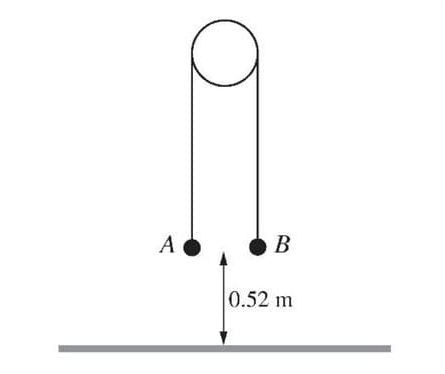
Particles A and B, of masses 0.3 kg and 0.7 kg respectively, are attached to the ends of a light inextensible string. The string passes over a fixed smooth pulley. A is held at rest and B hangs freely, with both straight parts of the string vertical and both particles at a height of 0.52 m above the floor (see diagram). A is released and both particles start to move.
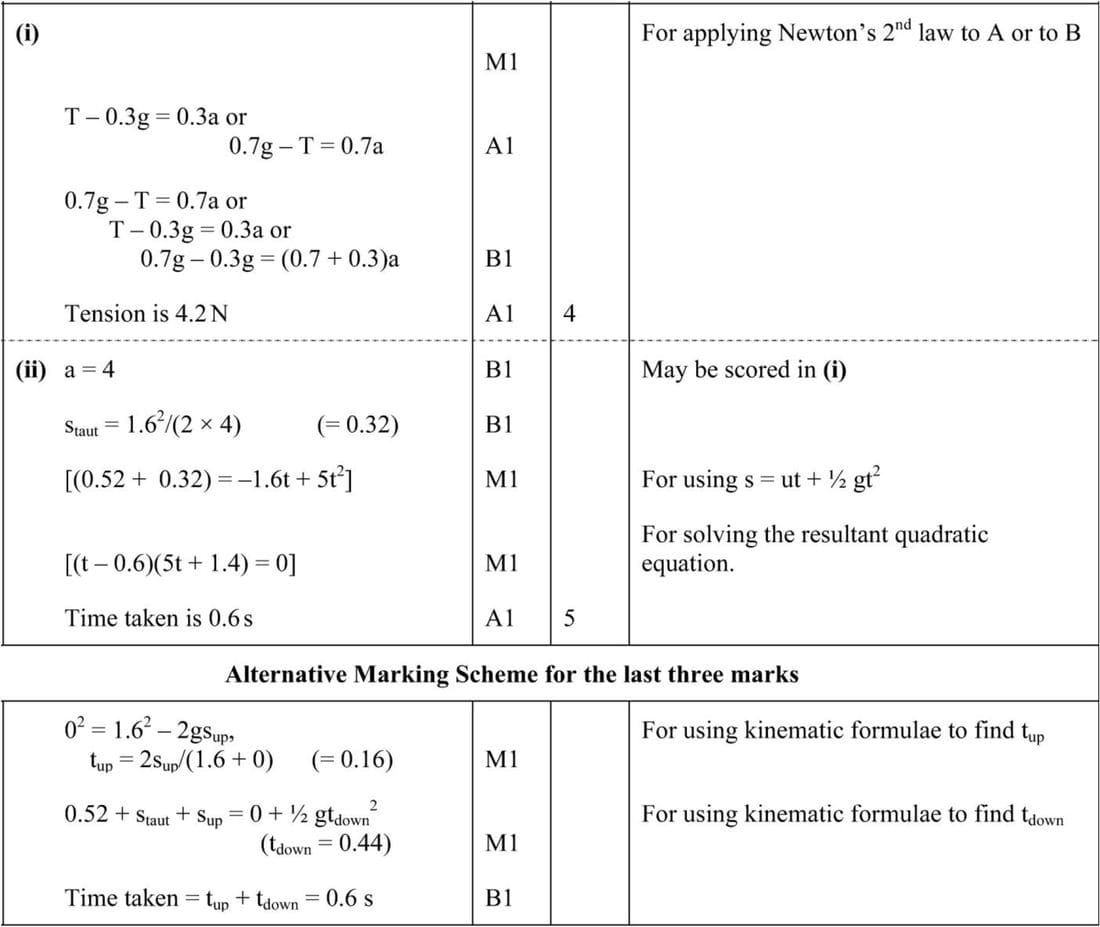
(i) Find the tension in the string.
When both particles are moving with speed 1.6 m s-1 the string breaks.
(ii) Find the time taken, from the instant that the string breaks, for A to reach the floor.
9709 P41 - Jun 2021 - Q2
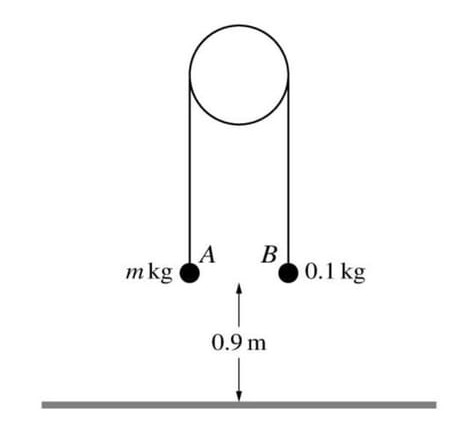
Two particles A and B have masses m kg and 0.1 kg respectively, where m > 0.1. The particles are attached to the ends of a light inextensible string. The string passes over a fixed smooth pulley and the particles hang vertically below it. Both particles are at a height of 0.9 m above horizontal ground (see diagram). The system is released from rest, and while both particles are in motion the tension in the string is 1.5 N. Particle B does not reach the pulley.
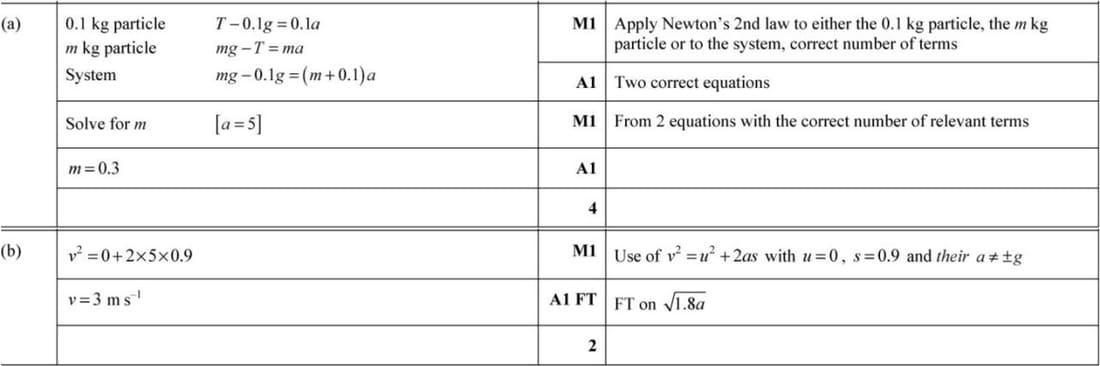
(a) Find m.
(b) Find the speed at which A reaches the ground.
9709 P42 - Nov 2012 - Q2
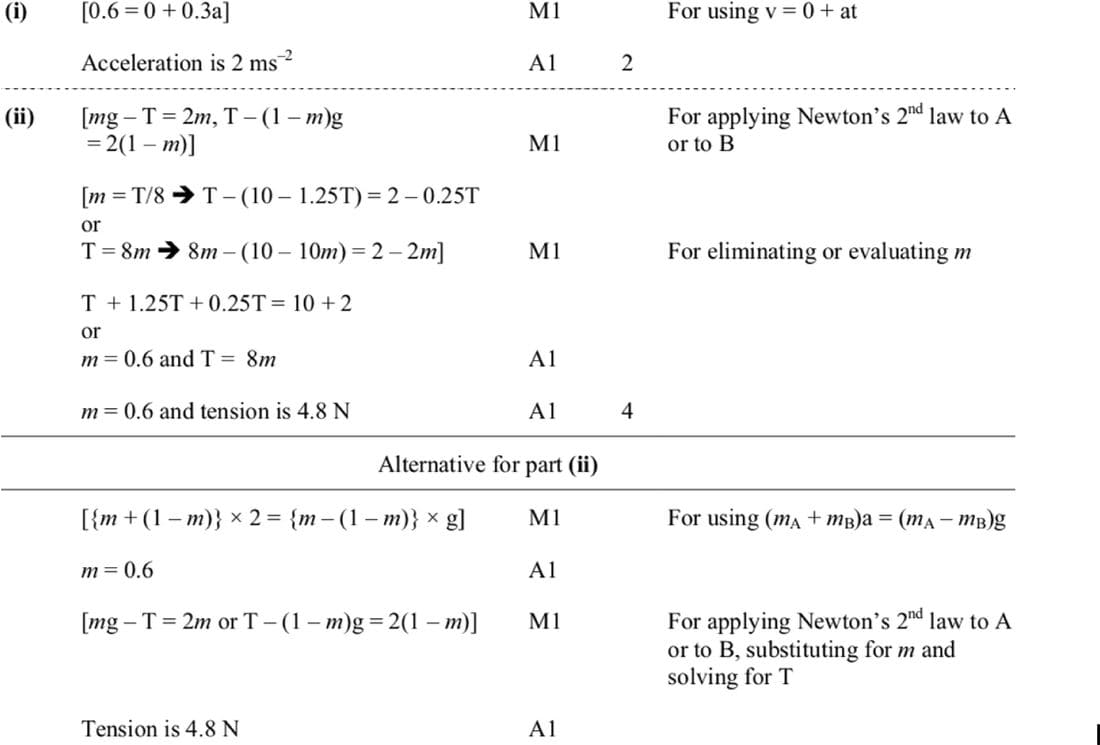
Particles A and B of masses m kg and (1 - m) kg respectively are attached to the ends of a light inextensible string which passes over a fixed smooth pulley. The system is released from rest with the straight parts of the string vertical. A moves vertically downwards and 0.3 seconds later it has speed 0.6 m s-1. Find
- the acceleration of A,
- the value of m and the tension in the string.
9709 P43 - Jun 2012 - Q7
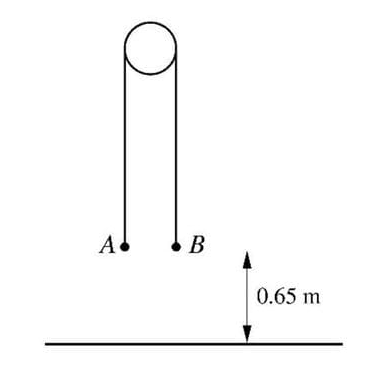
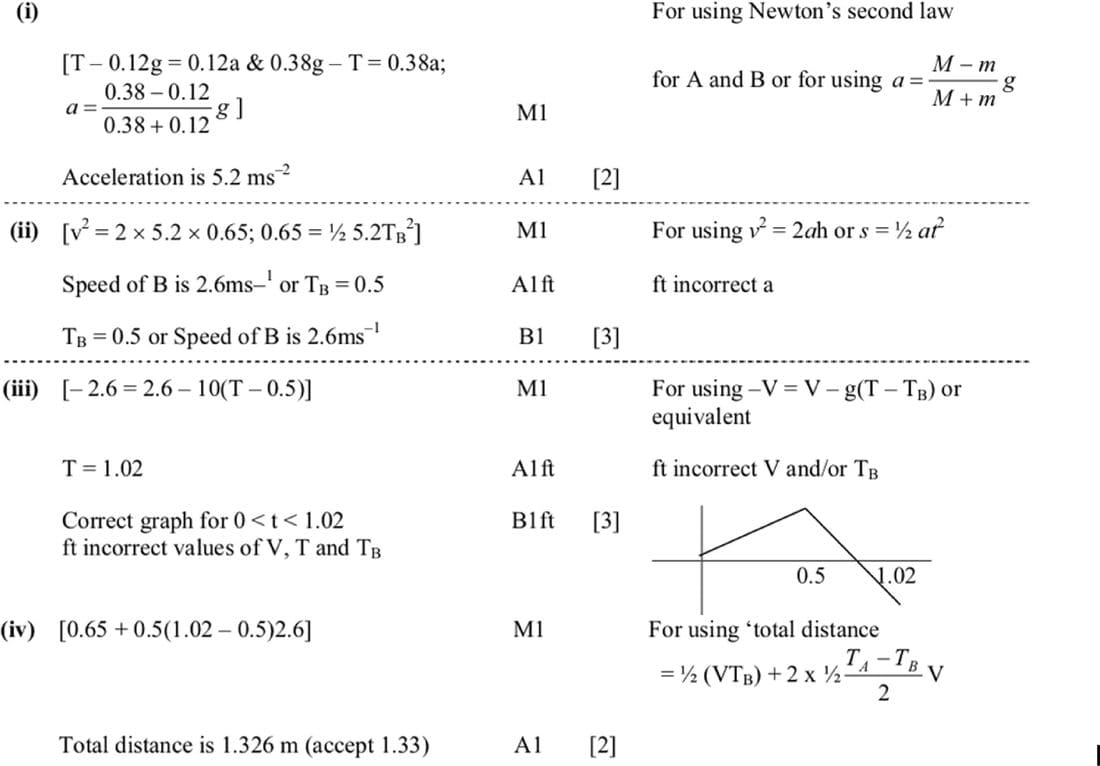
Two particles A and B have masses 0.12 kg and 0.38 kg respectively. The particles are attached to the ends of a light inextensible string which passes over a fixed smooth pulley. A is held at rest with the string taut and both straight parts of the string vertical. A and B are each at a height of 0.65 m above horizontal ground (see diagram). A is released and B moves downwards. Find
- the acceleration of B while it is moving downwards,
- the speed with which B reaches the ground and the time taken for it to reach the ground.
B remains on the ground while A continues to move with the string slack, without reaching the pulley. The string remains slack until A is at a height of 1.3 m above the ground for a second time. At this instant A has been in motion for a total time of T s.
- Find the value of T and sketch the velocity-time graph for A for the first T s of its motion.
- Find the total distance travelled by A in the first T s of its motion.
9709 P43 - Nov 2011 - Q3
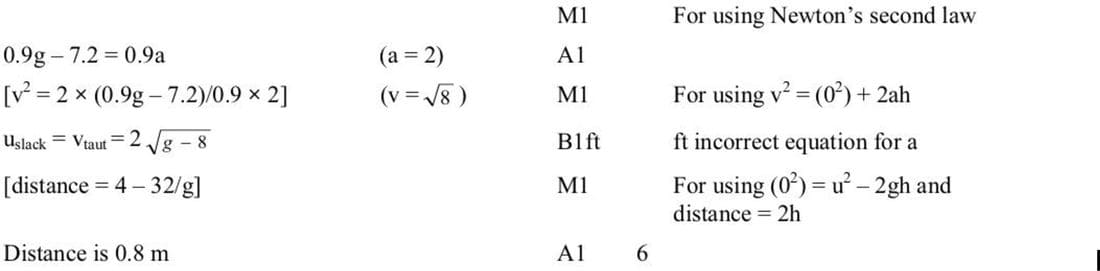
Particles P and Q are attached to opposite ends of a light inextensible string which passes over a fixed smooth pulley. The system is released from rest with the string taut, with its straight parts vertical, and with both particles at a height of 2 m above horizontal ground. P moves vertically downwards and does not rebound when it hits the ground. At the instant that P hits the ground, Q is at the point X, from where it continues to move vertically upwards without reaching the pulley. Given that P has mass 0.9 kg and that the tension in the string is 7.2 N while P is moving, find the total distance travelled by Q from the instant it first reaches X until it returns to X.
9709 P42 - Nov 2011 - Q5
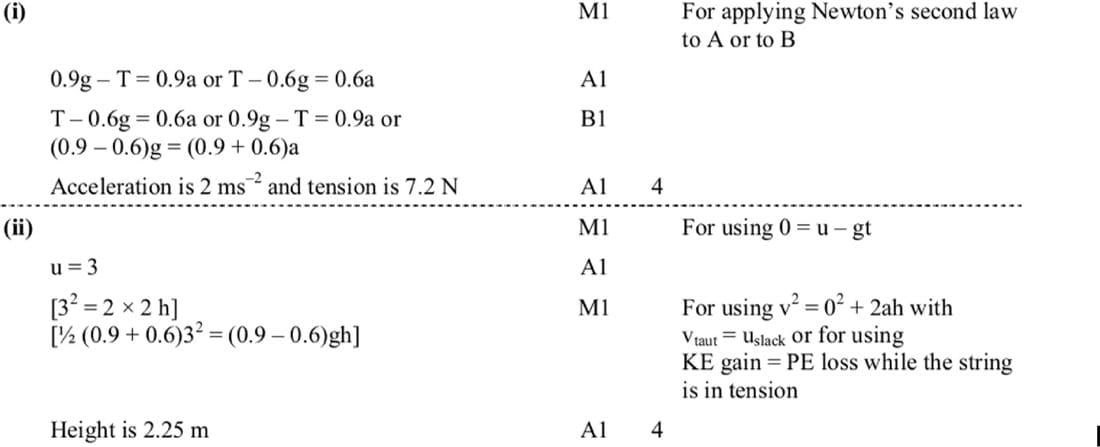
Particles A and B, of masses 0.9 kg and 0.6 kg respectively, are attached to the ends of a light inextensible string. The string passes over a fixed smooth pulley. The system is released from rest with the string taut, with its straight parts vertical and with the particles at the same height above the horizontal floor. In the subsequent motion, B does not reach the pulley.
(i) Find the acceleration of A and the tension in the string during the motion before A hits the floor.
After A hits the floor, B continues to move vertically upwards for a further 0.3 s.
(ii) Find the height of the particles above the floor at the instant that they started to move.
9709 P41 - Nov 2011 - Q2
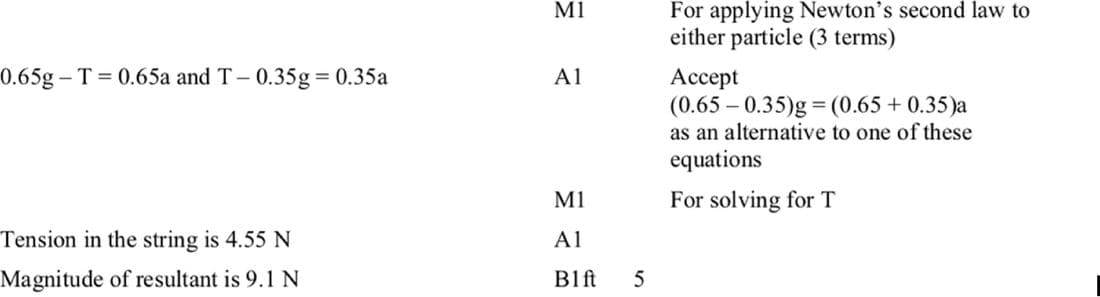
Particles A of mass 0.65 kg and B of mass 0.35 kg are attached to the ends of a light inextensible string which passes over a fixed smooth pulley. B is held at rest with the string taut and both of its straight parts vertical. The system is released from rest and the particles move vertically. Find the tension in the string and the magnitude of the resultant force exerted on the pulley by the string.
9709 P42 - Nov 2009 - Q6
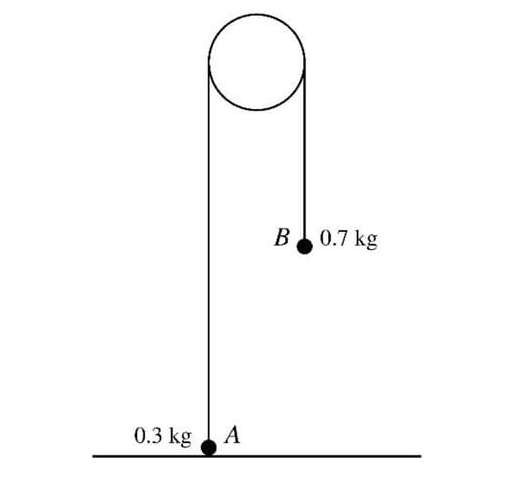
Particles A and B, of masses 0.3 kg and 0.7 kg respectively, are attached to the ends of a light inextensible string which passes over a smooth fixed pulley. Particle A is held on the horizontal floor and particle B hangs in equilibrium. Particle A is released and both particles start to move vertically.
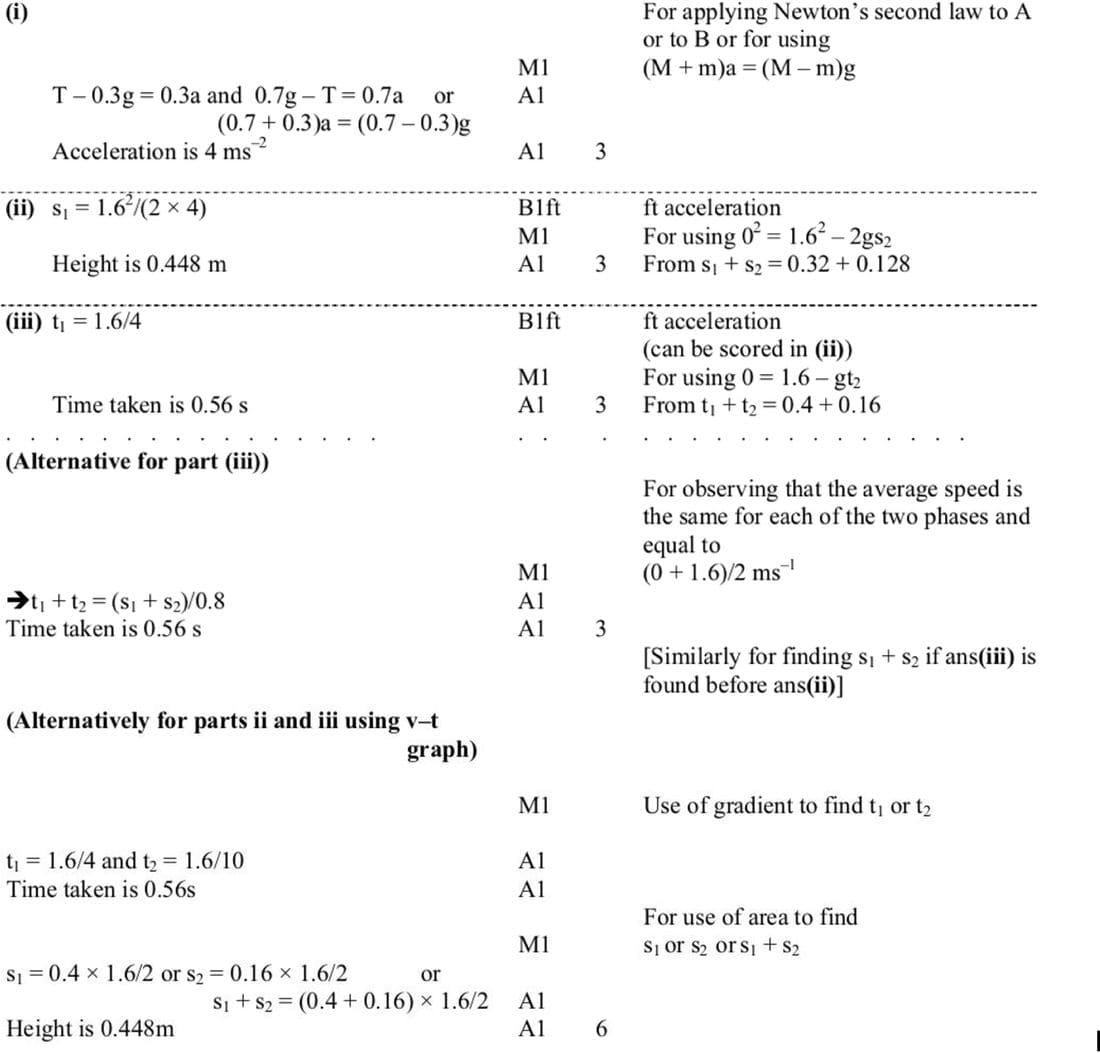
- Find the acceleration of the particles.
The speed of the particles immediately before B hits the floor is 1.6 m s-1. Given that B does not rebound upwards, find
- the maximum height above the floor reached by A,
- the time taken by A, from leaving the floor, to reach this maximum height.
9709 P41 - Nov 2009 - Q6
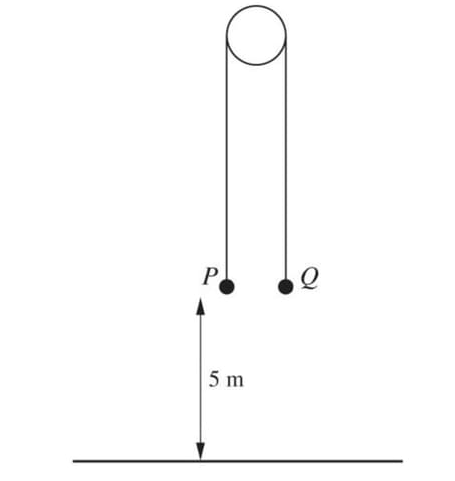
Particles P and Q, of masses 0.55 kg and 0.45 kg respectively, are attached to the ends of a light inextensible string which passes over a smooth fixed pulley. The particles are held at rest with the string taut and its straight parts vertical. Both particles are at a height of 5 m above the ground (see diagram). The system is released.
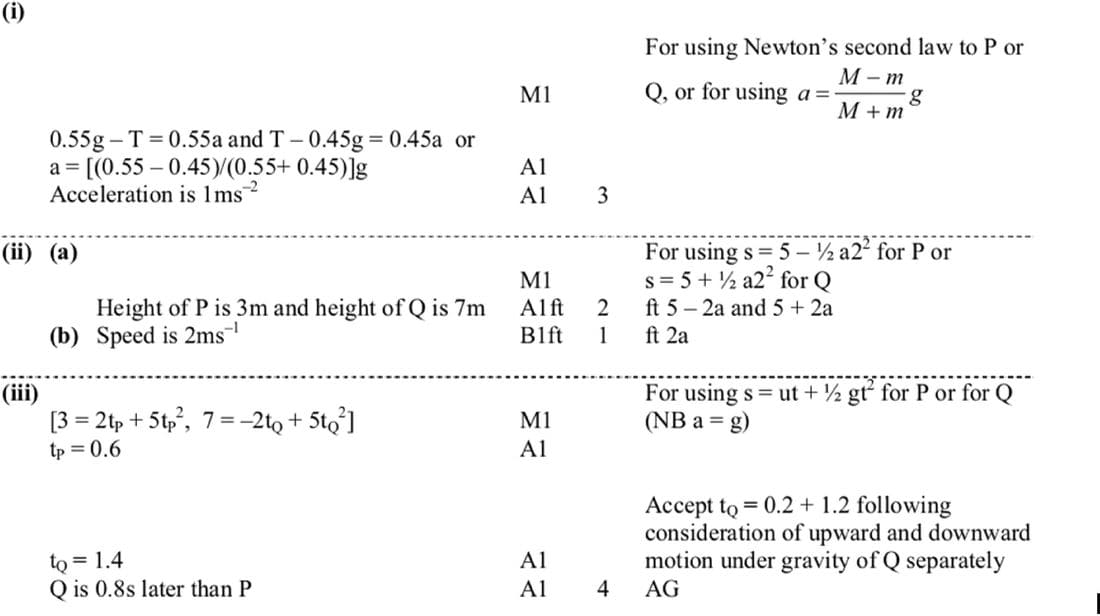
(i) Find the acceleration with which P starts to move. [3]
The string breaks after 2 s and in the subsequent motion P and Q move vertically under gravity.
(ii) At the instant that the string breaks, find
- the height above the ground of P and of Q,
- the speed of the particles.
(iii) Show that Q reaches the ground 0.8 s later than P. [4]
9709 P4 - Jun 2009 - Q6
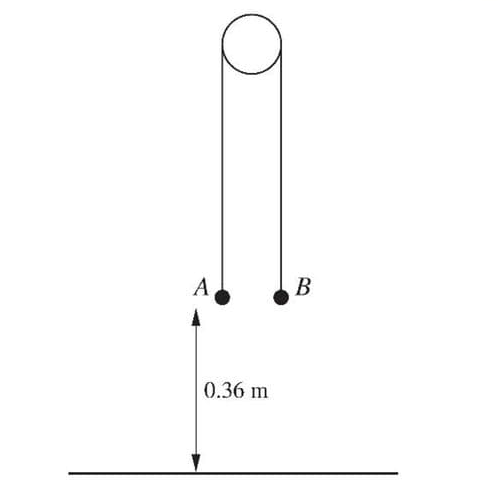
Particles A and B are attached to the ends of a light inextensible string which passes over a smooth pulley. The system is held at rest with the string taut and its straight parts vertical. Both particles are at a height of 0.36 m above the floor (see diagram). The system is released and A begins to fall, reaching the floor after 0.6 s.
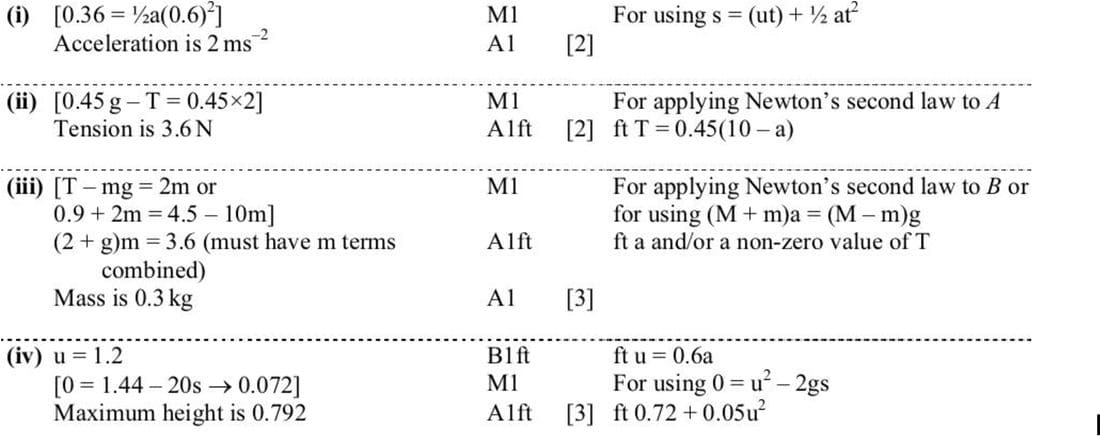
- Find the acceleration of A as it falls. [2]
The mass of A is 0.45 kg. Find
- the tension in the string while A is falling, [2]
- the mass of B, [3]
- the maximum height above the floor reached by B. [3]
9709 P4 - Jun 2009 - Q1
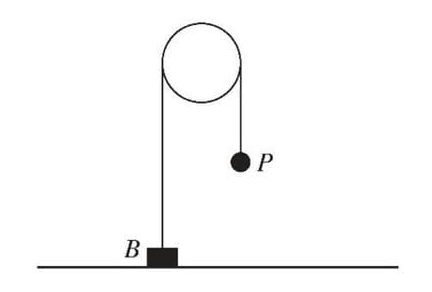
A block B of mass 5 kg is attached to one end of a light inextensible string. A particle P of mass 4 kg is attached to the other end of the string. The string passes over a smooth pulley. The system is in equilibrium with the string taut and its straight parts vertical. B is at rest on the ground (see diagram). State the tension in the string and find the force exerted on B by the ground.

9709 P4 - Nov 2008 - Q5
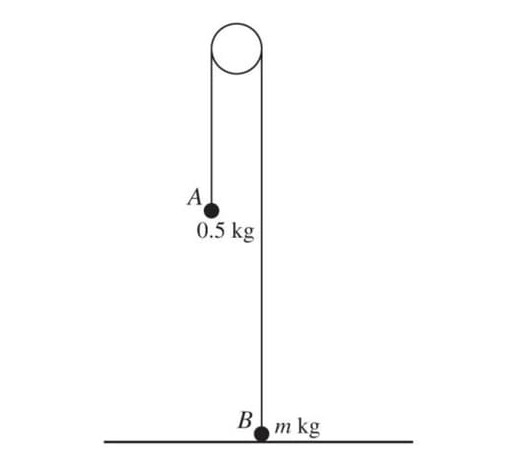
Particles A and B, of masses 0.5 kg and m kg respectively, are attached to the ends of a light inextensible string which passes over a smooth fixed pulley. Particle B is held at rest on the horizontal floor and particle A hangs in equilibrium (see diagram). B is released and each particle starts to move vertically. A hits the floor 2 s after B is released. The speed of each particle when A hits the floor is 5 m s-1.
- For the motion while A is moving downwards, find
- the acceleration of A,
- the tension in the string.
- Find the value of m.
9709 P41 - Nov 2020 - Q5
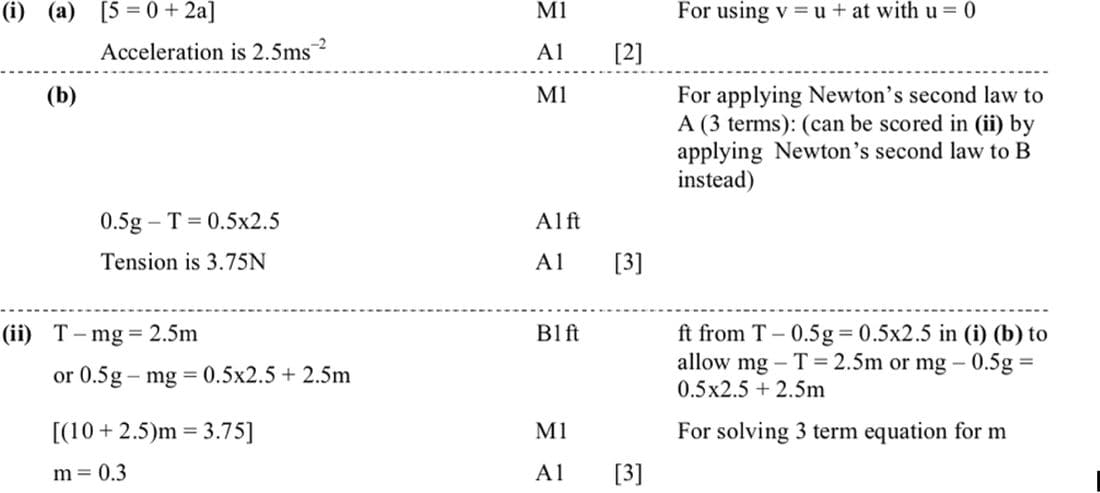
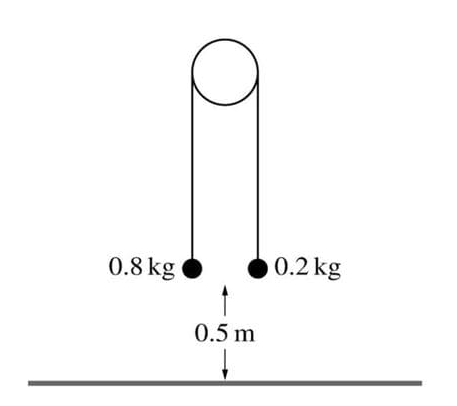
Two particles of masses 0.8 kg and 0.2 kg are connected by a light inextensible string that passes over a fixed smooth pulley. The system is released from rest with both particles 0.5 m above a horizontal floor (see diagram). In the subsequent motion the 0.2 kg particle does not reach the pulley.
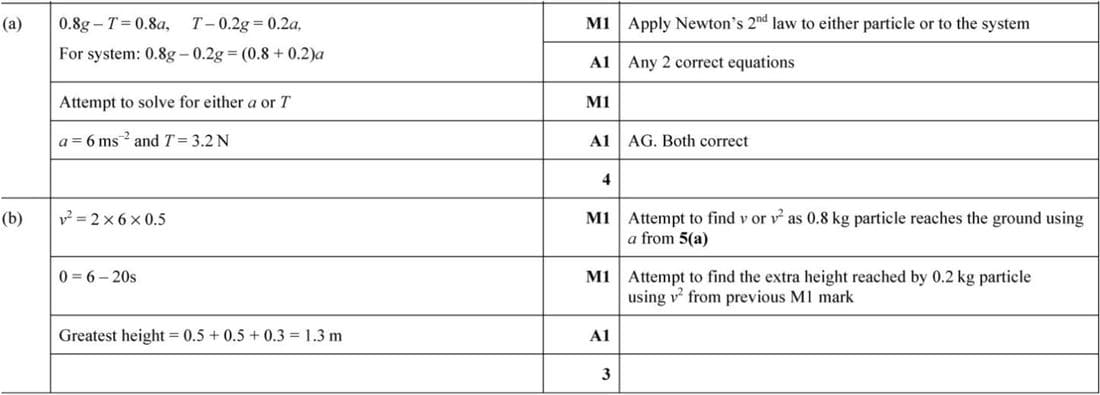
(a) Show that the magnitude of the acceleration of the particles is 6 m s-2 and find the tension in the string.
(b) When the 0.8 kg particle reaches the floor it comes to rest. Find the greatest height of the 0.2 kg particle above the floor.
9709 P4 - Jun 2007 - Q4
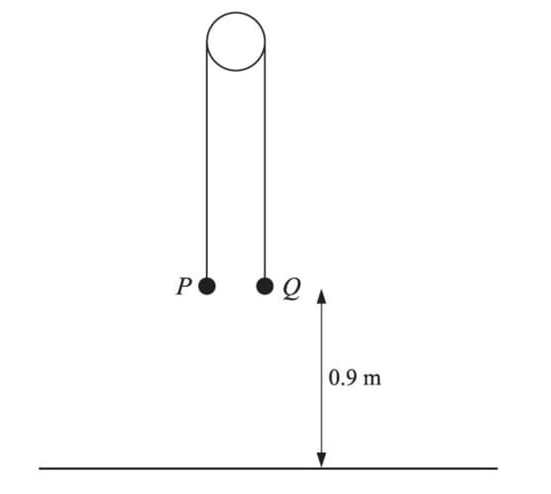
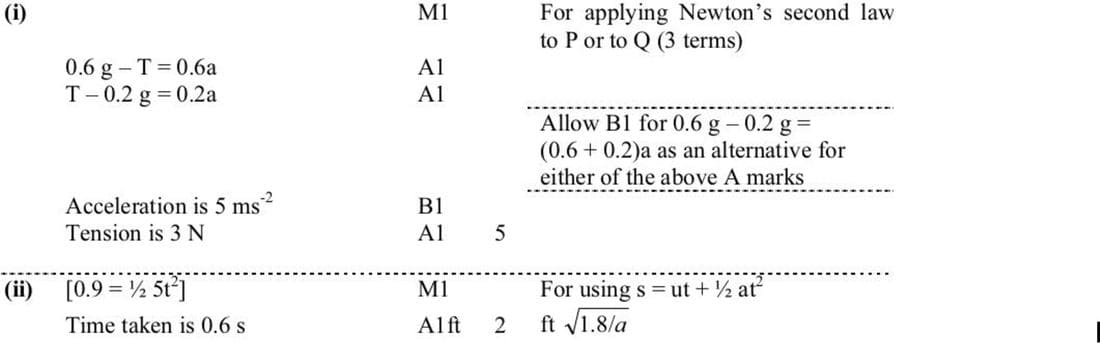
Particles P and Q, of masses 0.6 kg and 0.2 kg respectively, are attached to the ends of a light inextensible string which passes over a smooth fixed peg. The particles are held at rest with the string taut. Both particles are at a height of 0.9 m above the ground (see diagram). The system is released and each of the particles moves vertically. Find
- the acceleration of P and the tension in the string before P reaches the ground,
- the time taken for P to reach the ground.