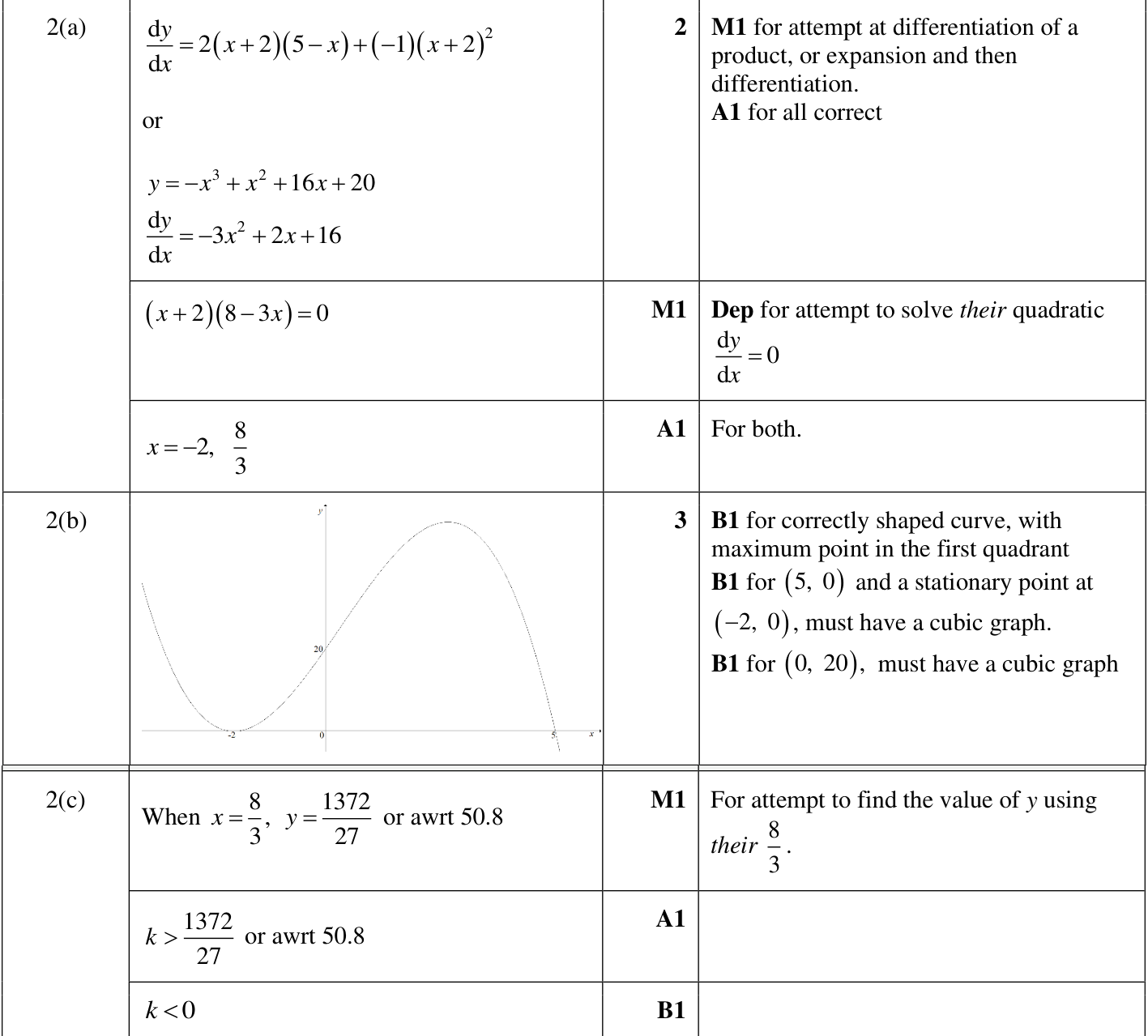
Answer: (a) \(x=-2\) and \(x=\frac83\); (c) \(\displaystyle k\lt 0\) or \(\displaystyle k\gt \frac{1372}{27}\).
Work through the problem step by step, using exact values where possible before giving any final numerical approximation.
(a) First expand the expression for \(y\):
\(y=(5-x)(x+2)^2.\)
Since \((x+2)^2=x^2+4x+4\),
\(y=(5-x)(x^2+4x+4).\)
Therefore
\(y=-x^3+x^2+16x+20.\)
Differentiate:
\(\frac{dy}{dx}=-3x^2+2x+16.\)
At a stationary point, \(\frac{dy}{dx}=0\), so
\(-3x^2+2x+16=0.\)
Equivalently,
\(3x^2-2x-16=0.\)
Factorising,
\((3x-8)(x+2)=0.\)
Hence
\(x=-2 \quad\text{or}\quad x=\frac83.\)
(b) The curve meets the \(x\)-axis when
\((5-x)(x+2)^2=0.\)
So the \(x\)-intercepts are
\((-2,0) \quad\text{and}\quad (5,0).\)
The root at \(x=-2\) is repeated, so the curve touches the \(x\)-axis there. The curve meets the \(y\)-axis when \(x=0\):
\(y=(5)(2)^2=20.\)
So the \(y\)-intercept is
\((0,20).\)
The other stationary point has
\(y=\left(5-\frac83\right)\left(\frac83+2\right)^2.\)
This is
\(y=\frac73\left(\frac{14}{3}\right)^2 =\frac73\cdot\frac{196}{9} =\frac{1372}{27}.\)
So the cubic touches the \(x\)-axis at \((-2,0)\), passes through \((0,20)\), reaches a maximum at \(\left(\frac83,\frac{1372}{27}\right)\), and crosses the \(x\)-axis at \((5,0)\).
(c) The equation
\(k=(5-x)(x+2)^2\)
represents intersections between the cubic and the horizontal line \(y=k\).
For the horizontal line to meet the cubic in one distinct root only, it must lie below the minimum value \(0\), or above the maximum value \(\frac{1372}{27}\). Hence
\(k\lt 0 \quad\text{or}\quad k\gt \frac{1372}{27}.\)